
01
Lift the lid on one square of pork
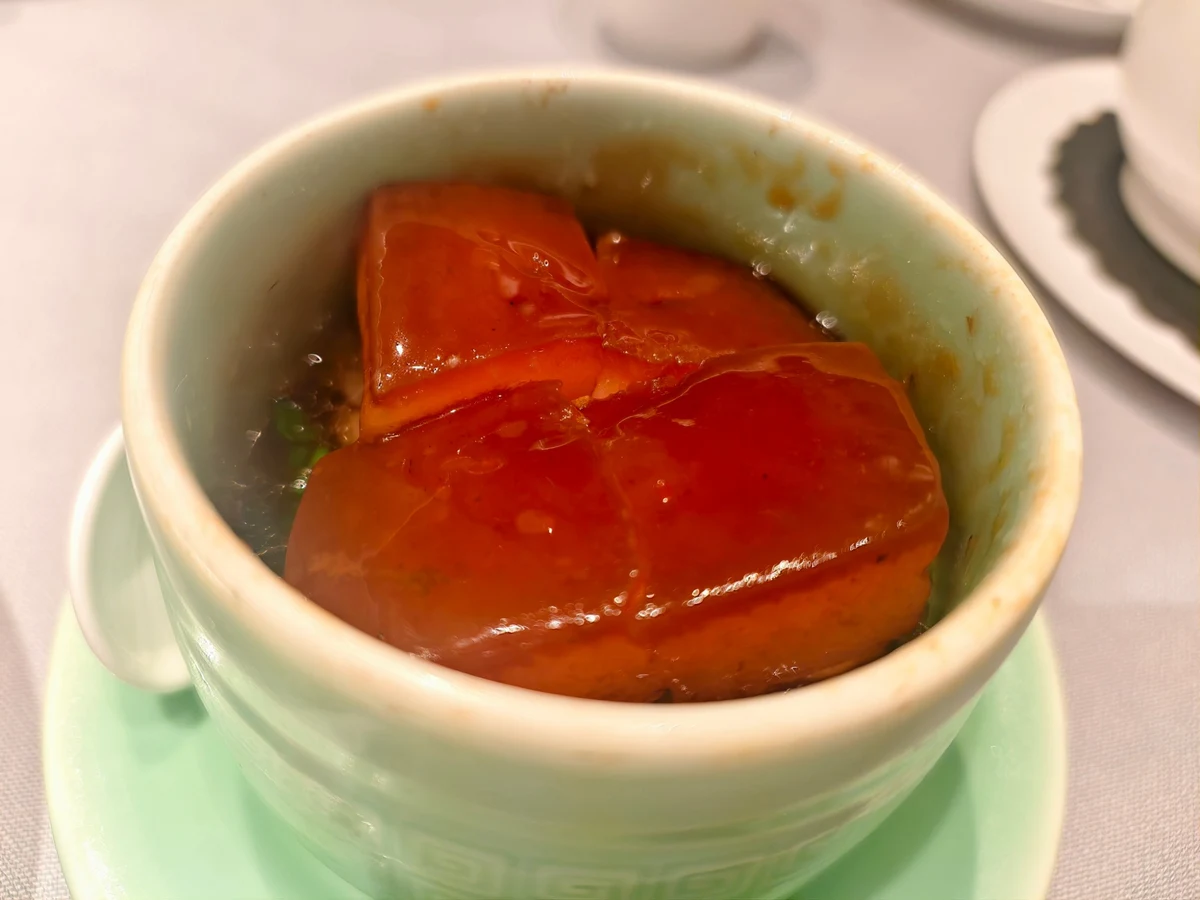
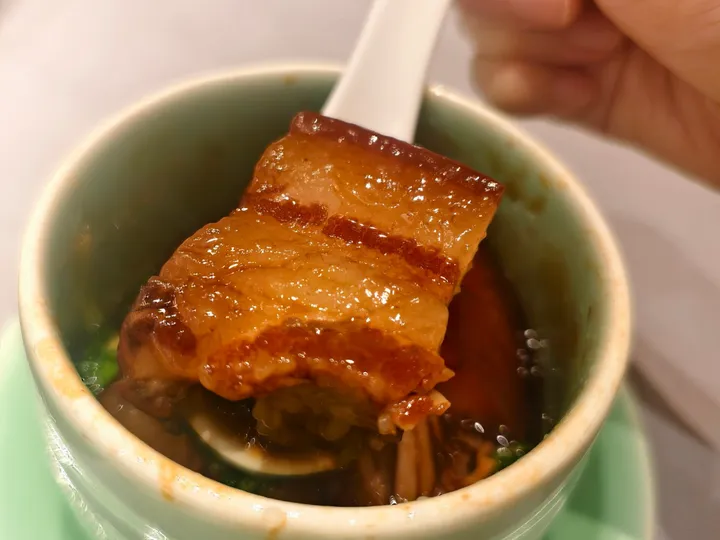
The lid is small enough to lift with two fingers. Inside is a piece of pork that nearly fills the cup, with a smooth reddish-brown skin across the top and just enough sauce to spoon over it. Lift an edge and you can see how the skin, pale fat and lean are stacked. The meat is soft enough to divide with a spoon and still firm enough to hold its layers when lifted.
Eat it from top to bottom. A slice from the top is mostly skin and one from the bottom can be all lean, so take a little of every layer and let the fat soften the lean as you chew. The sauce is sweet-salty, with a warm rice-wine smell, and a spoonful over plain rice goes a long way. The little lidded cup is kitchen equipment as much as tableware: the pork is steamed in it with its juices and goes straight to the table. Hangzhou’s 2024 cooking standard also allows a porcelain plate, though its illustration shows the clay pot.
The layers beneath the skin
The spoon lifts a piece from the same cup shown above.
02
First the braising pot, then the steamer
The meat is skin-on belly from the ribs. Look for a slab of fairly even thickness, with bands of lean running through the fat from end to end. Every square should have those layers. A short blanch firms the slab for cutting and makes it easier to scrape the skin. Hangzhou’s current standard cuts it into squares about four centimeters across and starts them skin-down on a bed of tied scallions and crushed ginger. At Lou Wai Lou, Chai Baorong puts another layer of scallion and ginger on top. The bed keeps the skin away from the hottest part of the pot and scents the liquid as it cooks.
In the 1960 recipe from Tianxianglou, the meat sits on a small bamboo support. Shaoxing wine, soy and rock sugar supply the braising liquid and seasoning, with scallion and ginger for fragrance. The kitchen seals the lid with dough and leaves the pot over very low heat for about two hours before finishing the meat in lidded vessels in the steamer. The Xinxin Hotel braises in wine with no water at all; Lou Wai Lou adds water and uses Hu Yang, a soy sauce brewed locally. Wine alone or wine and water, every Hangzhou kitchen braises under a lid and then steams.
The 2024 city standard spells out both stages. Its two-kilo batch uses about 550 mL of yellow rice wine and about 1.5 L of water. The squares braise skin-down on low heat for an hour to an hour and a half, then skin-up until tender. The fat is skimmed and the liquid reduced until it thickens; each square goes skin-up into a clay pot with a spoonful of that sauce, the mouth is sealed with peach-blossom paper and lidded, and the pots steam for thirty minutes. The lid keeps the skin moist all the way to the table.
03
The Eastern Slope and a poem about cheap pork
Dongpo means “eastern slope.” In his preface to Eight Poems on the Eastern Slope, Su Shi says that he was running short of food in Huangzhou and his friend Ma Zhengqing secured some abandoned military land for him to farm. This is the Huangzhou in what is now Huanggang, Hubei, where he was sent in 1080 after his prosecution over satirical verse. He remained there until 1084. The slope became his adopted name, and eventually that name appeared on food and household objects.
The short text often printed as “Ode to Pork” says Huangzhou had good pork at a price low enough to joke about. Its memorable cooking advice concerns the stove: clean the vessel, use little water, leave the fire low and let the meat take its time. The Southern Song poet Lu You already quoted what he called Dongpo’s pork-cooking verse, so the link between Su and slow-cooked pork goes back to the Song. The full text people recite today is another matter: it exists in several versions, and the Qing scholar Qiao Songnian doubted that Su wrote the one printed under his name in a Ming edition.
As a recipe the verse gives only the fire. Chen Peng, in Su Dongpo’s Afternoon Tea, reads it as an instruction to cook gently over a low flame, and points out that it says nothing about how much water, which seasonings or how long. The quantities in today’s cup come from much later cookbooks.
04
A Ming name and two Qing recipes
The name in print goes back to the late Ming writer Shen Defu. In a passage about things named after people, he lists a Dongpo chair, a Dongpo cap and Dongpo pork. What he means by the pork is one large piece, left whole, and he says nothing about how it was seasoned. Four centuries later it still comes to the table as a single square.
The Qing recipe collection Tiaoding Ji gives two different instructions under the name. One is a cousin of “chessboard pork”: a large square cooked with sugar, sweet bean paste, seasoned liquid and wine, with the skin left unscored for the Dongpo version. The other calls for a square cooked with mugua fruit wine, caramel color, then soy and rock sugar, with star anise and steamed yam underneath. The two recipes in one book disagree even on when the sugar goes in; both start from one big square.
Hangzhou restaurants made it their own. In 1930 a Shanghai newspaper announced a new Hangzhou restaurant opposite the Great World entertainment complex, selling West Lake scenery and Hangzhou dishes: Sister Song for the fish, Dongpo for the pork. In 1956 Dongpo pork was one of the thirty-six Hangzhou dishes recognized by the province, and in 1960 Famous Chinese Dishes wrote down Tianxianglou’s method.
05
Four places tell the story differently
| Place | The connection | What the record shows |
|---|---|---|
| Huangzhou, Hubei | Su’s exile and his verses about the Eastern Slope | Song sources link him with slow-cooked pork. The familiar pork text mentions Huangzhou |
| Hangzhou, Zhejiang | West Lake dredging, gifts of pork and wine, and a meal returned to the workers | The gifts are a local story. Restaurant records and modern cooking standards document the dish’s place in Hangzhou cuisine |
| Xuzhou, Jiangsu | A flood and a gift of meat returned to the residents, hence huizeng rou 回赠肉 | The legend is attached to Su’s 1077 flood relief and remains part of Xuzhou’s local food tradition |
| Meishan, Sichuan | Su’s home town, with its own Dongpo dishes | Sichuan cookery books record named versions by the late Qing. Meishan issued a separate Xueya Dongpo pork standard in 2023 |
The Hangzhou and Xuzhou stories have a similar shape: the official helps with water, people bring him food, and he sends it back as a cooked dish. In Hangzhou the work is dredging and rebuilding around West Lake, and some tellers say rice wine supplied by grateful residents went into the pot. In Xuzhou the waters come from a Yellow River breach and the name of the dish remembers the return gift. Tianxianglou’s 1960 entry gives still another version, in which Su cooked pork for guests and nearby restaurants copied it.
06
Order by the piece, and ask what comes with it
Look for 位, per person, or 块, per piece. When a menu lists 份, ask 这一份有几块?, “How many pieces are in this order?” One square can be a rich addition to a table of greens, soup and rice, especially if several people want only a taste. Lou Wai Lou served a wheat cake with its square in 2015. The soft bread gives you a way to pick up the sauce that stays behind in the cup. Hotel takeaway counters also sell the braised squares by the piece, to eat at home.
The kitchens plan around long batches. Staff at Lou Wai Lou told a reporter they sold more than 3,500 pieces on one day of the 2016 National Day holiday and spent roughly four hours on a batch, including steaming. A 2022 visit to the Xinxin Hotel found its kitchen limiting the dish to sixty squares a day. When a batch sells out, the next one is hours away.
| Where | What was sold | Reported price |
|---|---|---|
| Lou Wai Lou, 2015 | One square with a wheat cake at the restaurant | ¥25 per square |
| Grand Canal community canteen, Zhugan Lane, 2024 | One serving at the neighborhood canteen | ¥16 |
| Zhejiang Grand Hotel takeaway counter, April 2026 | Cooked pork sold by the piece | ¥8 per piece |
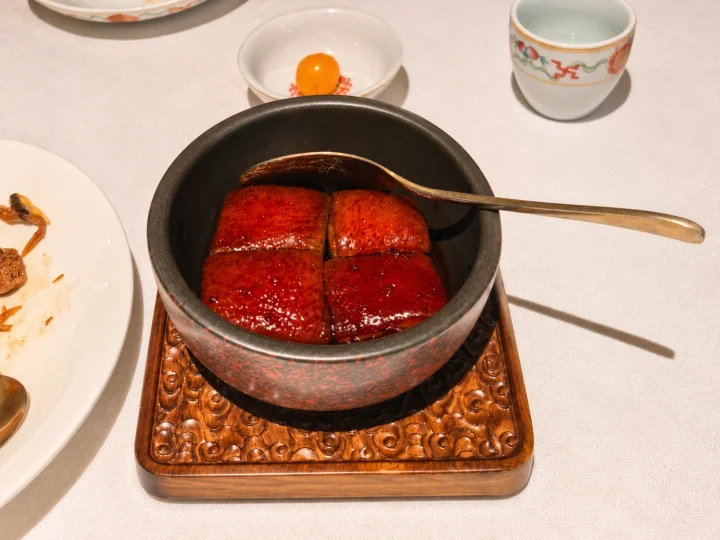
Four squares in one pot
Our own photograph of an order for sharing.
08
Bring the square to the steamer intact
Choose a heavy pot sized so that the pieces fit in one layer. A tight lid will do the job of the restaurant seal at home. For the Hangzhou standard’s proportions, one quarter of its published batch would start with 500 g of skin-on belly, roughly 140 mL of Shaoxing wine, 38 mL of brewed soy sauce, 50 g of sugar and enough water to just cover the meat in your pot. The standard’s scaled water is about 375 mL. The amount needed to cover depends on the vessel.
Blanch the belly and cut it into squares, then set them skin-down on scallion and ginger. Bring the liquid to a boil, skim and cover. Lower the heat until the liquid barely moves. Turn the pieces skin-up after about an hour to an hour and a half and cook gently until a chopstick slides through. Move each piece with a spoon or spatula under the lean. Lift off the fat, reduce the liquid separately and spoon some over the pork in a heatproof bowl. Cover the bowl loosely and steam for about half an hour.
Let the sauce reduce on its own once the meat is tender. That way you can stop when it coats the spoon, and the pork can go into the steamer with its corners still in place.
FAQ
Questions about Dongpo Pork
What is Dongpo pork?
A Hangzhou specialty of skin-on pork belly cut into squares and cooked slowly with rice wine, soy and sugar. The documented restaurant method braises the pork and then finishes it in a steamer.
Did Su Dongpo invent Dongpo pork?
Not as it is cooked today. Song writers already linked Su Shi with slow-cooked pork, the name Dongpo pork appears in late-Ming writing, and the first recipes under that name are Qing. The Hangzhou square braised in wine and soy and then steamed is a restaurant dish of the twentieth century.
Where is Dongpo pork from?
The lidded-cup version is closely associated with Hangzhou. Huangzhou has the earliest literary connection with Su’s pork cooking, Xuzhou has the return-gift legend and Meishan has its own preparation.
Why is Dongpo pork braised and then steamed?
The first stage cooks the belly slowly in wine and soy liquid. The second finishes the skin in steam, with some of the reduced sauce kept in the serving vessel.
Do you have to cook Dongpo pork without water?
No. The Xinxin Hotel braises in wine, soy and sugar with no water, but Lou Wai Lou and Hangzhou’s 2024 city standard both add water to the wine.
How is Dongpo pork different from Shanghai red-braised pork?
Both can be sweet and soy-rich. The old Shanghai cookbook method browns the skin in lard before braising. Hangzhou Dongpo pork is known for its large square and a separate steaming stage after the braise.
Does a serving of Dongpo pork mean one piece?
Many restaurants serve a single square in an individual cup. Check whether the menu says per piece, per person or per serving, and ask how many pieces are in the order.
Sources
Sources and further reading
- 1 Su Shi, Eight Poems on the Eastern Slope: preface (in Chinese)Su Shi Shiji, Shidian Guji edition ↗
- 2 Chinese Cookbook: Shanghai, p. 15, Shanghai-style kao rou (in Chinese)Chinese Cookbook editorial group; China Financial and Economic Publishing House
- 3 Fuchsia Dunlop, Revolutionary Chinese Cookbook, p. 78, Mao Anping’s red-braised porkEbury Press (2006)
- 4 Wu Renshu, “A Preliminary Study of the Formation and Dissemination of Dongpo Pork,” pp. 13–56 (in Chinese)Journal of Chinese Dietary Culture 14.1 (2018) ↗
- 5 Meishan’s Xueya Dongpo Pork Cooking Standard, DB5114/T 49–2023 (in Chinese)National Public Service Platform for Standards (2023) ↗
- 6 The Zhejiang Grand Hotel’s takeaway counter and its ¥8 Dongpo pork (in Chinese)Wang Haifeng, Metro Express, via the Hangzhou CPPCC (April 2026) ↗
- 7 Regional foods of Nagasaki: shippoku meals, tōba-ni and pork kakuni (in Chinese)Japan Ministry of Agriculture, Forestry and Fisheries ↗
- 8 Catalogue of traditional Hangzhou dishes: the 1956 selection (in Chinese)Hangzhou municipal government, Appendix 7 ↗
- 9 Quanshan’s food heritage: the Xuzhou flood story and local Dongpo pork making (in Chinese)Quanshan district account, via The Paper (2026) ↗
- 10 Dongpo pork at the Xinxin Hotel: chef Chen Jianjun’s method and daily batch (in Chinese)China News Service (August 2022) ↗
- 11 Lou Wai Lou chef Chai Baorong recalls Dongpo pork at a 1988 Singapore food festival and explains its preparation (in Chinese)Qianjiang Evening News, via China News Service (November 2015) ↗
- 12 A journey down the Grand Canal: Xuzhou, the 1077 flood and the return-gift pork story (in Chinese)China National Radio (2021) ↗
- 13 Hangzhou Cuisine, Part 2: Dongpo Pork, DB3301/T 0477.2–2024, §§4–8 and appendices (in Chinese)Hangzhou Municipal Administration for Market Regulation (2024) ↗
- 14 Famous Chinese Dishes, vol. 8: Jiangsu and Zhejiang, pp. 104–105, Tianxianglou’s Dongpo pork (in Chinese)Catering Services Administration, Ministry of Commerce; Light Industry Press (1960) ↗
- 15 Shen Defu, Wanli Yehuo Bian, vol. 26, “Objects that carry a person’s name” (in Chinese)Late Ming text, Zhonghua Wenku ↗
- 16 Hangzhou’s local food customs: the West Lake embankment story (in Chinese)Hangzhou Municipal Archives ↗
- 17 Lou Wai Lou’s Dongpo pork: a four-hour kitchen process (in Chinese)Metro Express, via Zhejiang Online (January 2017) ↗
- 18 The Grand Canal community canteen’s ¥16 Dongpo pork (in Chinese)Pu Xiaoyan and Wang Qing, Metro Express, via Zhejiang Online (October 2024) ↗
- 19 Chen Peng, Su Dongpo’s Afternoon Tea, “The gourmand: the pleasures of simple things” (in Chinese)Sichuan People’s Publishing House (2020), WeRead ↗
- 20 Two bites, one square: ordering Dongpo pork at Hangzhou Restaurant (video, in Chinese)Zuizuir (-嘴嘴儿), Bilibili (2022) ↗
Last updated November 2026