
01
One chicken, one platter, one plate of noodles
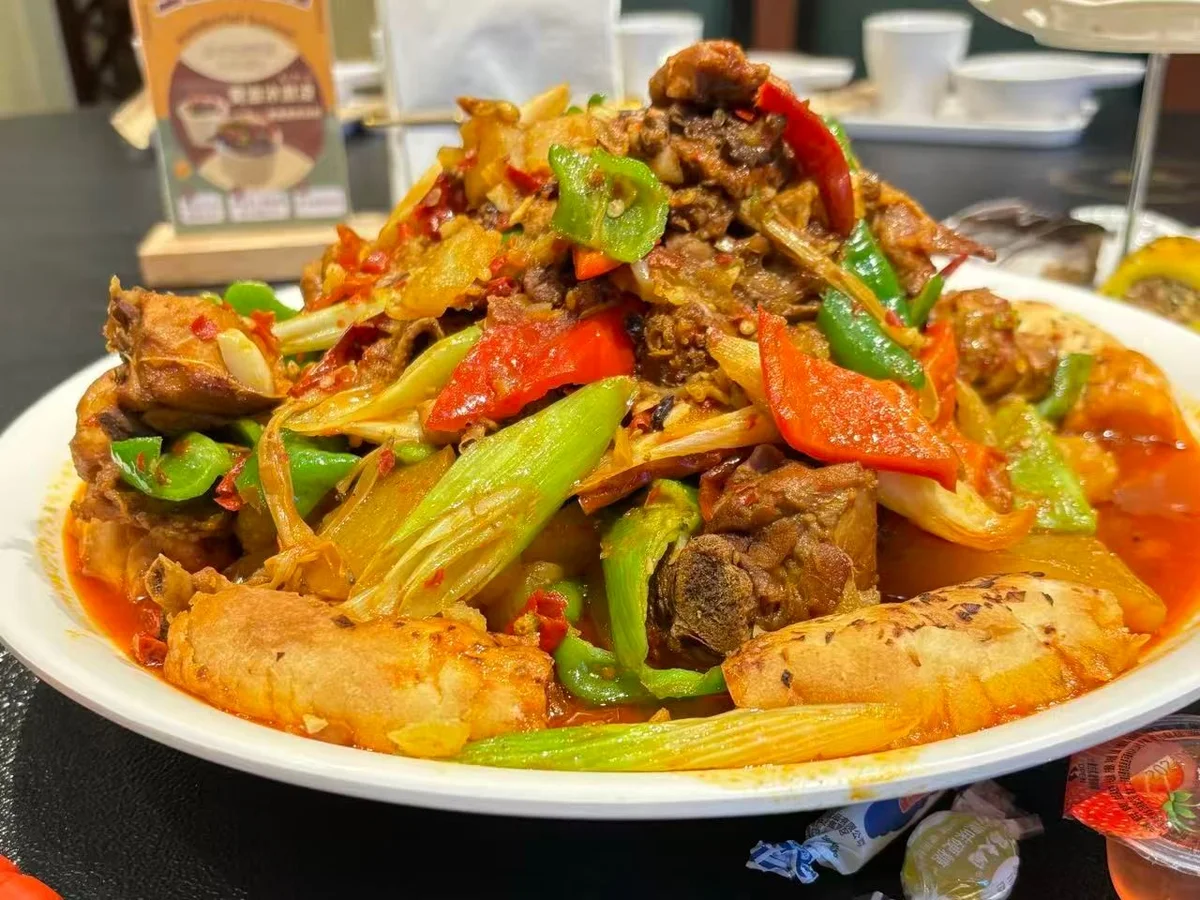
Big plate chicken is a whole chicken braised with potatoes and chilies, served on one platter for the table and finished with wide noodles in the sauce.
The chicken is chopped through the bone into chunks and stir-fried until it takes color, then braised with dried chilies, Sichuan pepper, star anise and other spices until the sauce turns a glossy red-brown. Chunks of potato go in halfway, so they finish soft and half-dissolved into the sauce, and green peppers are added at the end to stay bright. It arrives on a platter of the kind that was once an enamel tray about a foot across, piled high, and it is not a dish for one: one portion feeds two or three people, three or four with noodles.
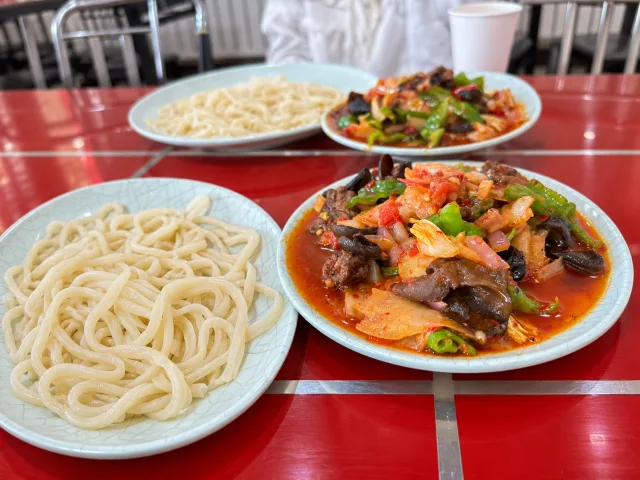
The noodles are the second course on the same plate. When most of the chicken is gone, the waiter brings a plate of 皮带面, “belt noodles,” wide flat ribbons of hand-pulled dough, which are tipped into the remaining sauce and tossed until they are coated. The Xinjiang writer Wang Zu, who lived in the region for twenty years, describes the sound of a table ordering it: diners walking in and shouting “Big plate chicken!” in a voice, he says, you do not hear elsewhere. The flavor is spicy, numbing and a little sweet, with tender chicken and potatoes that have soaked up the sauce.
02
Shawan, Route 312 and the long-distance drivers
The dish was named by its customers: drivers who asked for a big plate of chicken.
Shawan is a county, now a county-level city, about 185 kilometers west of Urumqi in Tacheng prefecture. Forty years ago Route 312, the main road from Urumqi to Ili, Tacheng and Altay, ran straight through the town, and trucks that left Urumqi in the morning reached Shawan at lunchtime. The version told most often in the Chinese press comes from the cook Li Shilin: in 1987 he opened a small restaurant in Shawan selling spicy chicken and stewed fish. Workers from a construction company who ate there ordered so much chicken that he served it on the big tray normally used to rest noodle dough, and they began asking for “a big plate of chicken.” The name stuck, and Li later opened a restaurant called Manpengge on Route 312, where other cooks were soon selling the same dish.
Wang Zu tells a looser version of the same story: drivers tired of noodles every day asked a roadside cook to fry them a chicken with plenty of green peppers and potatoes and a strong taste, and the cook, mixing Sichuan and Hunan habits, used sugar, soy sauce, Pixian chili bean paste and a bottle of beer. What all the accounts share is the place and the customers: a road through Shawan in the late 1980s, and drivers who wanted a lot of food fast. The dish became widely known in Xinjiang in the early 1990s. Stories that trace it to an imperial chef of the Qianlong emperor have no basis. The Xinjiang food writer Lou Wanghao adds that the Hui Muslim cooks of Shawan, Changji and Miquan are known for it.
03
The whole-chicken rule
In Xinjiang a portion of big plate chicken means one whole bird, and diners check.
Owners and diners have held the same view for decades, Wang Zu writes: a portion must be made from one whole chicken, or the cook is cheating and the table will be unhappy. Some restaurants buy birds of the same size so that every portion looks the same. Twenty years ago a whole chicken was served on two large plates, and careful diners counted two feet, two legs and two wings; if a piece was missing there would be an argument. Wang remembers taking visitors from Beijing to lunch in Turpan, where the chicken came on two plates and the guests at first thought a mistake had been made. At another restaurant the next day it came on one.
The rule also explains the price. A big plate chicken is priced by the bird, not by weight or by the person. The shortcut that worries Xinjiang diners is the pressure cooker: Wang describes a “Shawan big plate chicken” restaurant in Urumqi that cooked several chickens together under pressure and ladled out a portion as soon as it was ordered. A chicken cooked to order takes about twenty minutes or more, and good restaurants make you wait.
04
Sugar, chili, beer and potatoes
The color comes from sugar, the depth from chili and beer, and the body from the potatoes.
Most cooks start by frying sugar. Oil is heated, a spoon of sugar is stirred in over low heat until it turns reddish, and the chicken goes in on top; Wang Zu says this small step decides the color of the whole dish. Then come scallion, ginger, garlic and Sichuan pepper, dried chilies, star anise, bay leaf, cassia or cao guo, often a spoon of chili bean paste, and the liquid. Xinjiang cooks are unusual in using beer, a whole bottle, instead of water, which makes the sauce richer. Li Shilin’s own description is short: fry, then stew; add the potatoes when the chicken is half soft; finish with green and red peppers fried hard for two minutes.
There are two schools, and they suit different kitchens.
| Stir-fry and braise (爆炒) | Dry-fry first (干煸) | |
|---|---|---|
| How | Chicken fried in caramelized sugar, then braised with spices, beer and potatoes | Chicken first fried in hot oil until golden and lifted out, then fried again with the seasonings |
| Liquid | A bottle of beer, no water | No beer, no sugar |
| Texture | Tender chicken in plenty of sauce | Firmer, chewier chicken, a drier plate |
| Who uses it | Most home cooks | Many restaurants: the frying oil is reused and the dish looks better |
05
Belt noodles, the second course
For many diners the noodles at the end are the best part of the dish, and Xinjiang’s official standard says they are compulsory.
皮带面, belt noodles, also called 裤带面, “trouser-belt noodles,” are flat ribbons of hand-pulled wheat dough about two to three centimeters wide. They are boiled, drained and either laid under the chicken or brought on a separate plate when the meat is half eaten, then mixed into the sauce until every strand is coated with chili oil and potato. On 26 October 2014, at a Silk Road food fair, Xinjiang published standards for seven of its specialties, and the one for big plate chicken says it must come with belt noodles.
The dough is simple: strong flour, about three parts water to five of flour, and salt. It is kneaded, rested, oiled and cut into strips, which rest again and are pulled out thin just before boiling. Restaurants in northern Xinjiang usually include a portion free with the chicken, and you can ask for it pulled thinner. Some diners say the noodles and the potatoes, soaked in the sauce, end up tasting better than the chicken.
06
Potatoes, pickles and the 2026 argument
Potatoes are the classic, but Xinjiang has never treated them as the only option.
In summer 2026 a diner in Shanghai argued with a restaurant over whether big plate chicken should contain potatoes at all, insisting that a real one has none, and the quarrel briefly reached China’s trending lists. In Xinjiang the reaction was amusement. Potatoes have been the standard since the beginning, when they were the cheapest vegetable a roadside cook could buy, and Wang Zu calls the potato version the classic. But Shawan alone cooks dozens of versions, and the side ingredient has moved on to green beans, shiitake, wide potato-starch noodles, pickled vegetables and even morels.
Wang Zu lists versions with cowpeas, kelp, frozen tofu, chicken-blood cake, steamed huajuan rolls and fried naan, and singles out a naan pressed under the chicken so that it soaks up the sauce. His favorite was a Shawan restaurant with four or five tables that replaced the potatoes with shreds of home-pickled napa cabbage, which cut the richness. When the owner first offered it, nobody ordered it, so fifty portions were given away free in one day; the next day more than a hundred sold. Some restaurants now serve one chicken two ways, half with potatoes and half with pickles.
07
Shawan today: a thousand restaurants and a museum
The town that named the dish has turned it into an industry.
Shawan counts more than 1,000 big plate chicken restaurants, up from a few dozen, employing about 16,000 people, and the cooking technique is on the Xinjiang Uygur Autonomous Region’s list of intangible cultural heritage. Since 2023 the city has published two group standards, one for how it is cooked and one for how it is served; in February 2024 the first restaurant using the official “Shawan big plate chicken” collective trademark opened, and in November 2024 the city museum opened a hall devoted to the dish. Many restaurants cluster on a food street the locals call Shanghaitan, where a row of chicken restaurants opened in 2002.
The ingredients are local too. Cooperatives supply free-range chickens raised outdoors for about six months, and Anjihai, a township of Shawan, grows more than 20,000 mu of chilies; in September and October its drying grounds turn red. The Shawan writer Fang Ruguo, who wrote a book about the dish, summed it up as potatoes from the northwest, scallions from the northeast and chilies from the southwest, “commanded by one chicken.”
08
How to order, and what it costs
Order by the chicken, bring friends, and save room for the noodles.
One chicken for three or four
A whole chicken is one portion. Some restaurants also sell half or medium portions; a whole bird with noodles comfortably feeds three or four people.
Expect to pay by the bird
In a Shawan-style restaurant in Jingouhe, Tacheng, a large free-range chicken served two ways cost 300 yuan in 2026, with noodles included; three people paid 400 yuan with a goose and still took food home. City restaurants elsewhere usually sell smaller birds for less.
Ask for the noodles
Belt noodles usually come with it. Ask for them when you are halfway through the chicken, and say if you want them thinner.
Choose the side
Potato is the classic; ask whether the kitchen does pickled vegetable, green bean or naan versions, or a chicken served two ways.
Heat is moderate
The red color comes from dried chilies and sugar. Xinjiang chili skin is fragrant and only mildly hot, so a standard plate is spicy but not punishing.
Allow twenty minutes
A chicken cooked to order takes time. A plate that arrives instantly has probably been cooked in advance.
09
Big plate chicken across China
Once it left Xinjiang, the dish was adapted to every region’s noodles.
Restaurants called “Xinjiang big plate chicken” opened across inland China in the 1990s and 2000s, and each region put its own noodle under the sauce. Henan versions are served with the province’s thick braised noodles, or cooked in a milder five-spice style; Yuncheng in Shanxi pairs it with pressed helao noodles; Sichuan cooks add more chili bean paste and Sichuan pepper. A Xinjiang cook who has run a restaurant in Kyrgyzstan for over ten years uses less chili and salt for local customers. Shawan, meanwhile, sells vacuum-packed portions online to Beijing, Shanghai and Hainan.
10
Making it at home
A home version takes about an hour and one large wok.
No hand-pulled belt noodles? Wide dried noodles or pappardelle work; boil them just done and toss them in the sauce at the table.
For four people: a whole chicken of about 1.5 kg, three potatoes, two green peppers, a handful of dried chilies, a bottle of beer and a plate of wide noodles.
- 1. Chop and rinse the chicken
Chop a whole chicken, about 1.5 kg, through the bone into large chunks. Soak or rinse until no more blood comes out, then drain well. A free-range bird is firmer and tastier but needs longer.
- 2. Prepare the vegetables
Soak a handful of dried chilies for five minutes. Cut three potatoes into large rolling-cut chunks, two green peppers into pieces, and slice ginger, garlic and scallion.
- 3. Fry the sugar and chicken
Heat 3 tablespoons of oil, add a tablespoon of sugar or rock sugar and stir over low heat until it melts and turns reddish-brown. Add the chicken and fry over high heat until it is colored all over.
- 4. Add the aromatics
Add ginger, garlic, scallion, a teaspoon of Sichuan pepper, two star anise, a piece of cassia and two bay leaves, the drained chilies and a spoon of chili bean paste. Fry for a minute.
- 5. Braise
Pour in a bottle of beer (or water), 2 tablespoons of light soy sauce and a little dark soy sauce, bring to the boil and simmer covered for 15 minutes.
- 6. Add the potatoes
Add the potatoes and simmer 15 to 20 minutes more, until they are soft and the sauce is thick. Season with salt.
- 7. Finish with peppers
Add the green peppers and toss over high heat for two minutes. Serve on the largest plate you have, over or beside a plate of boiled wide noodles.
11
More from Xinjiang
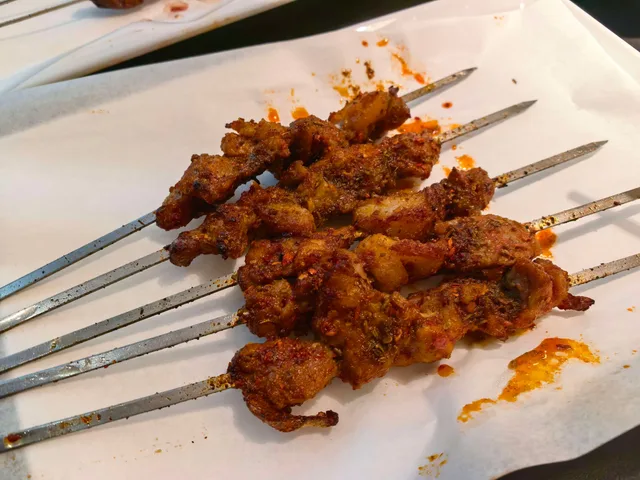
Xinjiang lamb skewers
Lamb and fat over charcoal with cumin and chili, the region’s favorite snack.
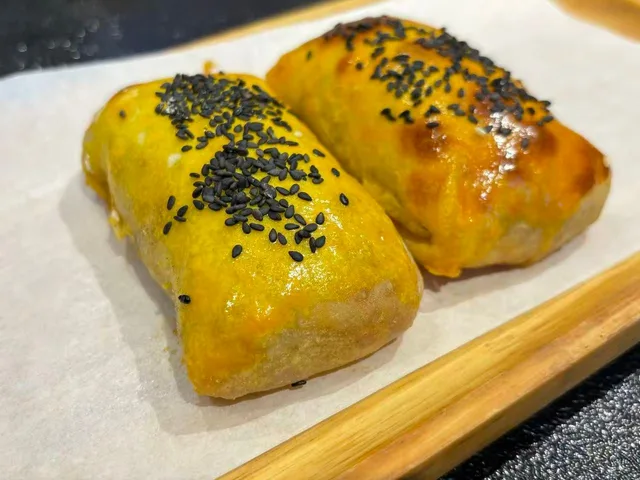
Read about lamb skewers →Samsa
Square lamb and onion pastries baked on the wall of a naan oven.
Read about samsa →Xinjiang
Naan, polo, laghman and the other foods of the region.
Explore Xinjiang food →Xinjiang classics
- Xinjiang Lamb Skewers
Charcoal-grilled skewers · Snack, street food, before a meal
- Xinjiang Samsa
Oven-baked lamb pastry · Breakfast, snack, with tea
- Guoyourou Laghman
Hand-pulled noodles with a stir-fried topping · Lunch at a noodle shop
FAQ
Questions about Big Plate Chicken
What is big plate chicken?
A Xinjiang dish of a whole chicken chopped and braised with potatoes, dried chilies, green peppers and spices, served on one large platter and finished with wide hand-pulled noodles.
Where does big plate chicken come from?
Shawan in northern Xinjiang, where roadside restaurants on Route 312 began serving it to long-distance drivers in the late 1980s. The cook Li Shilin dates his version to 1987.
Why is it called big plate chicken?
Because a whole chicken was served on one very large plate or tray, and customers asked for “a big plate of chicken.”
Does big plate chicken have potatoes?
Yes, potatoes are the classic version. Shawan also cooks it with pickled vegetables, green beans, shiitake, wide noodles or naan.
What are the noodles in big plate chicken?
Belt noodles: flat hand-pulled ribbons about two to three centimeters wide, tossed in the sauce at the end. Xinjiang’s 2014 standard says the dish must include them.
Is big plate chicken spicy?
Moderately. The sauce is red with dried chilies and Sichuan pepper, but Xinjiang chilies are fragrant rather than fierce, and sugar rounds the flavor.
How many people does big plate chicken feed?
One whole chicken with noodles feeds three or four people.
How much does big plate chicken cost?
It is priced by the chicken. A large free-range bird served two ways cost 300 yuan at a Shawan-style restaurant in Tacheng in 2026; smaller city portions cost less.
Is big plate chicken halal?
Hui cooks in Shawan, Changji and Miquan are known for it, and in Xinjiang it is widely served in halal restaurants; elsewhere, ask the restaurant.
What is the difference between big plate chicken and jiaoma chicken?
Big plate chicken is a hot braise with potatoes and noodles; jiaoma chicken is a cold dish of poached chicken in a numbing green-pepper dressing, also often served as a whole bird on a big plate.
Sources
Sources and further reading
- 1 Wang Zu, Shi Wei Tian (食为天), chapters “Big plate chicken” and “Jiaoma chicken” (in Chinese)People’s Literature Publishing House (2020; WeChat Read edition)
- 2 Lou Wanghao, Xinjiang Musilin Yinshi Wenhua (新疆穆斯林饮食文化), chapter on Hui food: big plate chicken in Shawan, Changji and Miquan (in Chinese)Xinjiang Juvenile Publishing House (WeChat Read edition)
- 3 The story of Xinjiang big plate chicken starts more than forty years ago: Li Shilin in 1987, Route 312 and Shawan’s thousand shops (in Chinese)Geng Dandan, Economic Daily, via Xinhua (2025) ↗
- 4 Go to the home of big plate chicken once in your life: Shawan, the potato row and the regional heritage listing (in Chinese)Hu Hanxiao, China News Service (2026) ↗
- 5 Big plate chicken at the Xinjiang New Year table: the 2014 snack standard, Li Shilin’s method and versions elsewhere (in Chinese)Fu Zihao, China News Service (2025) ↗
- 6 Should big plate chicken have potatoes? The argument that reached the trending lists (in Chinese)Ji Shuang, Xinjiang Daily, via Guangming Online (2026) ↗
- 7 Bust out for Xinjiang-style grub: big plate chicken, its enamel platter and a recipeGinger Huang, China Daily, from The World of Chinese (2015) ↗
- 8 A 300-yuan Shawan big plate chicken in Jingouhe, Tacheng: one chicken two ways, free belt noodles (video, in Chinese)Da Ge Zai Shanghai (达哥在上海), Bilibili (2026) ↗
- 9 A chef’s big plate chicken at home and in a restaurant: a five-month rooster, rock sugar, spice water and hand-pulled noodle sheets (video, in Chinese)Wang Gang (美食作家王刚R), Bilibili (2020) ↗
Last updated November 2026