
01
A lamb parcel from the naan oven
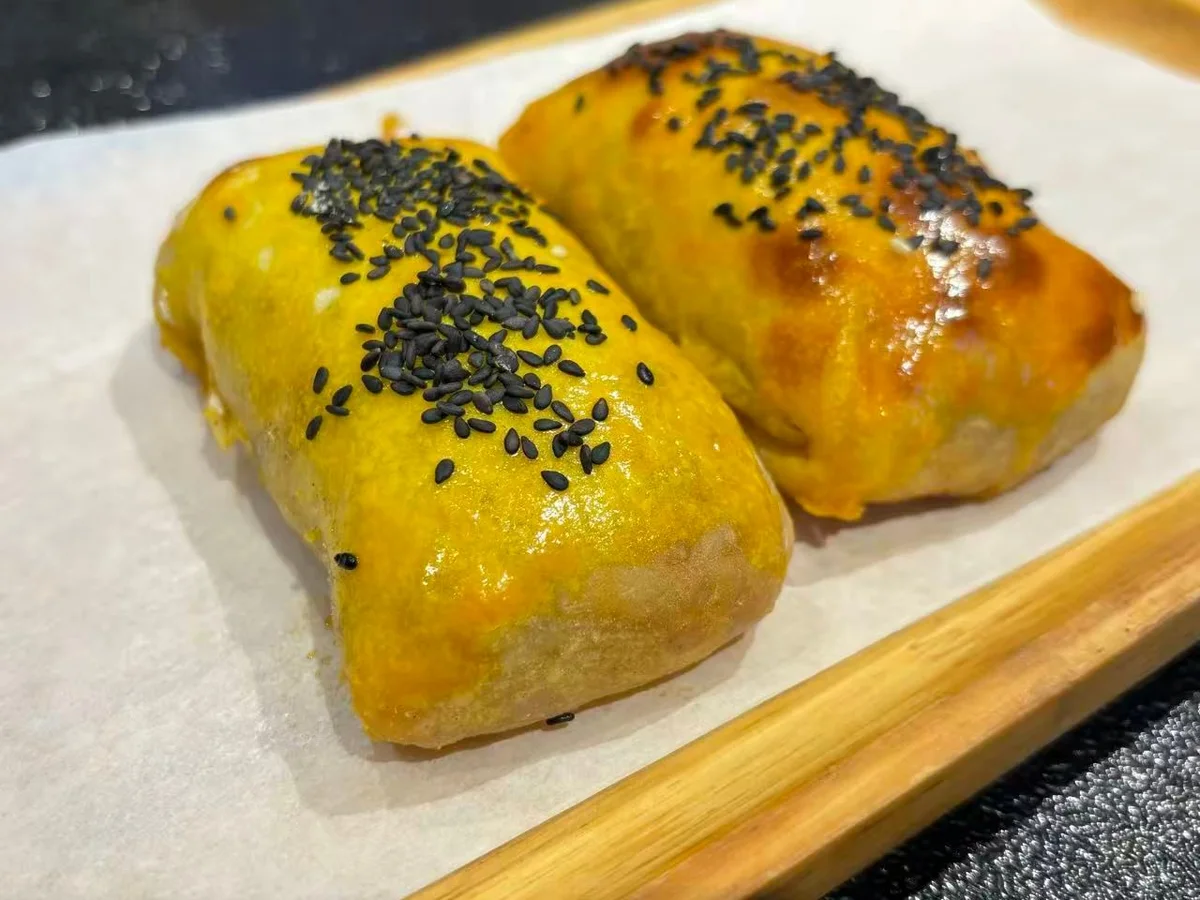
A samsa is diced lamb, sheep fat and onion sealed in thin dough and baked on the inside wall of a clay oven until the fat soaks into the crust.
The dough is 死面, “dead dough,” flour and water with no yeast, rolled very thin. The filling is lamb cut into small dice with diced sheep tail fat, plenty of onion, cumin, salt and black pepper, and a splash of water. The dough is folded around it into a square and the edges pinched shut, and the baker reaches into the oven and slaps it onto the hot wall. Seven to ten minutes later it is scooped out with a long ladle, blistered and golden, the crust streaked with fat from inside.
The Xinjiang writer Wang Zu describes what happens in the oven: the fat and juices of the lamb soak into the thin crust, so that although everyone knows there is onion inside, the whole thing tastes of lamb, crisp outside and almost liquid within. In Uyghur the pastry is samsa; Xinjiang Mandarin calls it 烤包子, “baked baozi,” though it has little in common with a steamed bun.
02
The oven: a smaller tonur, sprinkled with salt water
Samsa are baked in the same clay ovens as naan, but never at the same time.
The tonur is a beehive-shaped clay oven, open at the top, with a fire at the bottom; bakers lean in to stick dough to its curved inner wall. A samsa oven, which Uyghur calls samsa tonur, is smaller than an ordinary naan oven, Lou Wanghao writes: the size of a small water vat with the bottom knocked out, turned upside down and built in with mud bricks. Before baking the baker sprinkles salt water inside so the pastries stick and do not drop into the fire, which is why the underside of a samsa often carries a crust of salt that locals scrape off. Wood gives the most even heat and the best smell; in towns, iron ovens burning coal have taken over.
Wang Zu notes a rule any Kashgar customer knows: an oven that is baking naan is not baking samsa, and the other way around. The two need different heat and timing. Standing at the mouth of a working oven is enough to make it hard to breathe, and bakers who spend years there, he writes, barely break a sweat.
03
Lamb, tail fat and a lot of onion
The filling is diced, never minced, and the fat is what makes the juice.
Lamb for samsa is cut by knife into small dice rather than ground, so the pieces keep their texture, and it is mixed with dice of sheep tail fat, which melt in the oven and become the hot juice inside. Onion goes in by the handful: it sweetens and stretches the filling. Seasoning is simple, salt, black pepper and cumin, ground and sometimes whole, with a little water stirred in to keep the meat tender. Many shops in southern Xinjiang also make beef samsa.
Wang Zu watched a family make them at a canal-side samsa stall on the edge of Kashgar. The daughter rolled the wrappers thin, folded four sides in to make a square around a spoon of filling and pinched the corners; her brother, crouching at the oven, bent over and slapped each one onto the wall. He could smell the cumin before he saw it, and five young soldiers between them managed fewer than thirty samsa, to the grandmother’s mock indignation.
04
Look, touch, eat slowly
The inside of a fresh samsa is molten fat, so locals have a rule for eating one.
The Kashgar grandmother who fed Wang Zu taught him the method in three words: look, touch, eat slowly. Look, and choose one baked pale gold rather than dark, which will be crisp but not hard. Touch it, to judge how long it has been out of the oven, so that it is neither scalding nor cold. Then bite a small hole and wait, letting the steam and hot fat escape before you eat. People who bite straight in and swallow, she said, get burned, and it happens to visitors every day.
In Kashgar a samsa is eaten with a bowl of hot tea. Scrape off the salt on the base, eat the filled middle, and dip the plain folded edges in the tea to soften them; an old man without teeth was eating his that way. Three or four are a meal for most people.
05
Square, round, sweet and dough-less
The square lamb samsa is only the most common of a large family.
| Name | What it is | Where |
|---|---|---|
| Samsa 沙木萨, 烤包子 | Square, thin unleavened dough, diced lamb, fat and onion, baked in a tonur | Everywhere; Kashgar is famous for them |
| Round vegetable samsa 菜包子 | Round, filled with tomato, green pepper and chili, baked the same way | Kashgar bazaars |
| Goshgirde 果西格尔德 | Large and round, thin dough and a lot of juicy filling; cut open with a knife | Hotan |
| Pamurdin 帕木尔丁 | A cylinder 7–8 cm long, pressed with five fingers; egg and oil in the dough | Southern Xinjiang |
| Kak 喀克 | Sweet, folded like a jiaozi around apricot jam, with a crimped edge | Given as gifts at weddings and funerals |
| Yahbaher 亚合拜合尔 | Liver, heart and tail fat wrapped in caul fat instead of dough | Xinhe county, Aksu |
| Pitir manta 皮特尔曼塔 | The steamed thin-skinned baozi, the same filling cooked in a steamer | Everywhere |
06
Samsa from Xinjiang to Uzbekistan
The samsa is not only Xinjiang’s: the same pastry is baked in clay ovens across Central Asia.
Samsa is eaten all over Central Asia, often baked in the same kind of large clay tandoor, and Uzbekistan claims it as its own. Its exact origin cannot be pinned down. Food reference books trace the name to the Persian sanbosag, “triangular pastry,” and Arabic cookery manuals of the eleventh century already describe sanbusaq, little pies of minced meat, nuts and spices, a word still used for meat pastries in Syria, Egypt and Lebanon; the Indian samosa is a close relative. The pastry reached Russia when Central Asia became part of the Russian empire in the nineteenth century, and Uzbek kiosks still sell it in Moscow.
In Xinjiang the shape tends to be square, and the word survives twice over: samsa for the oven-baked pastry and sanbusa for the fried, crimped one given as a gift at weddings. Xinjiang’s Uzbek families, Lou Wanghao notes, keep their own tonur at home, bake naan once a week and use the small ovens for samsa; in towns, iron ovens fired with coal have replaced the clay ones.
07
Kumach: the grandfather, baked in hot ashes
Hotan bakes its meat pie not in an oven but in hot ashes.
In Hotan, people say, “kumach is the grandfather of samsa, and samsa is its grandson.” Kumach is a round pie about ten times the size of a samsa: two sheets of dough with lamb, onion, salt, pepper and cumin between them, the edges pinched into a rope. It is not baked in a tonur but buried in the hot ashes of a fire of desert poplar or red willow and left to cook slowly. It is too big to hold, so it is cut into wedges with a knife.
Wang Zu writes that kumach has barely traveled beyond Hotan, and that locals send you further into the desert, to Gulakhma township in Qira county, for the best; at festivals there people sing kumach songs and dance a kumach dance. Working on a desert site with his unit, he watched women shape the dough entirely by hand, without a rolling pin.
Sources [1]
08
Kashgar’s samsa shops
In Kashgar a good samsa shop is judged by how fast it sells out.
The best-known shops are small and specialized. One Kashgar shop, open for more than forty years, uses over 200 kilograms of meat and sells more than 8,000 samsa a day; a batch is out of the oven in about five minutes, and customers queue for each one. At a bazaar stall in 2023, one man cut the meat, three wrapped, and four ovens baked at once; the samsa sold at 2 yuan each as fast as they came out, about 8,000 a day, against 3 yuan or more in most places.
Bakers also keep a legend. Lou Wanghao records that a holy man said to have looked after food more than a thousand years ago, whose name he transcribes as Yibulayin Ailikesilamu, made the best samsa, and that Uyghur cooks still call out his name in a long cry when they lift samsa from the oven or a steamer, to tell customers these are made his way. The Kashgar grandmother told Wang Zu the same story, comparing her samsa to those of a famous cook of centuries past.
09
Buying samsa
Buy them hot, by the piece, from a busy oven.
Go where the oven is working
Samsa are best within minutes of baking. A shop with a queue and a fire going is a better bet than a tray of cold ones.
Expect 2 to 3 yuan
At a Xinjiang bazaar in 2023 a samsa cost 2 yuan; most shops charged 3, and some 4 or 5.
Square or round
Square ones are lamb; at some stalls round ones are filled with vegetables. Ask if there is beef.
Order tea
A bowl of hot tea is the standard companion, and is good for softening the edges.
Count on three
Three or four make a meal.
Take some away
In Urumqi roadside shops stack them at the door; feel one to check it is still warm.
10
Samsa in a home oven
Without a tonur, a very hot oven and thin dough get close.
For about 12 samsa: 250 g lamb with some fat, 50 g lamb fat, two onions, 500 g flour, an egg, salt, black pepper and cumin.
- 1. Make the filling
Dice the lamb and fat into pieces about 1 cm, not mince. Dice the onions and mix in with 8 g salt, 3 g black pepper, 5 g ground cumin, a pinch of whole cumin and two tablespoons of water. Rest 30 minutes.
- 2. Make a firm dough
Mix 500 g flour with 5 g salt, the egg, 20 g oil and about 180 g water into a firm dough. Cover and rest 20 minutes.
- 3. Roll and fold
Divide into balls and roll each into a thin round. Put a heaped spoon of filling in the middle, moisten the edges and fold in four sides to make a square, pinching the corners so no juice can escape.
- 4. Bake hot
Set seam side down on a tray, brush with beaten egg and scatter black sesame. Bake at 230°C, as hot as your oven goes, for about 25 minutes, until blistered and deep gold.
- 5. Rest, then eat slowly
Let them stand two minutes, and bite a small hole first to let the steam out.
11
More from Xinjiang
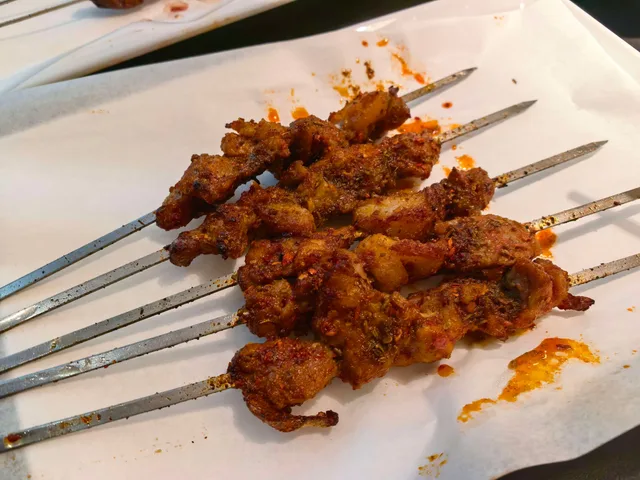
Xinjiang lamb skewers
Lamb and fat over charcoal, the other thing grilled in a naan oven.
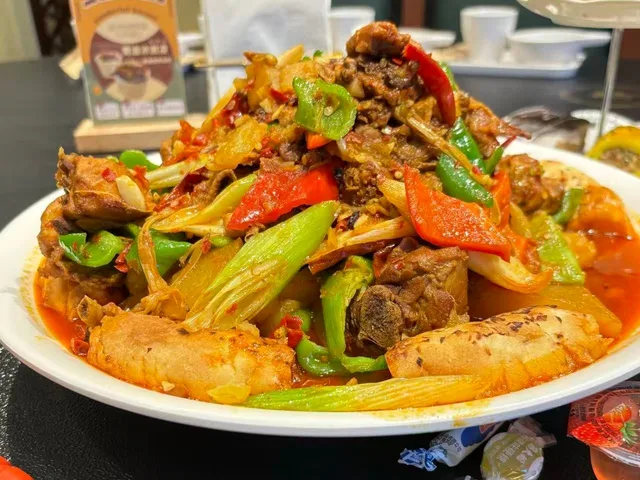
Read about lamb skewers →Big plate chicken
Chicken, potatoes and belt noodles for the whole table.
Read about big plate chicken →Xinjiang
Naan, polo, laghman and the rest of the region’s table.
Explore Xinjiang food →Xinjiang classics
- Xinjiang Lamb Skewers
Charcoal-grilled skewers · Snack, street food, before a meal
- Big Plate Chicken
Shared chicken braise with noodles · Lunch and dinner for three or four
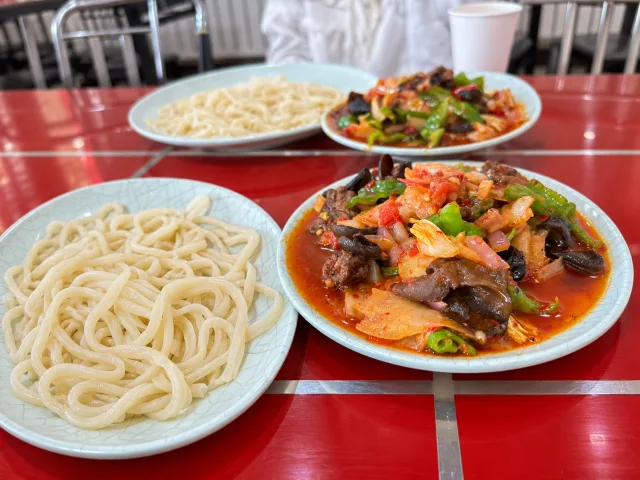
- Guoyourou Laghman
Hand-pulled noodles with a stir-fried topping · Lunch at a noodle shop
FAQ
Questions about Xinjiang Samsa
What is samsa?
A Xinjiang pastry of thin unleavened dough folded around diced lamb, sheep fat and onion, baked on the wall of a clay naan oven.
What is kaobaozi?
The Mandarin name for samsa, 烤包子, “baked buns.”
What is the filling of samsa?
Diced lamb, diced sheep tail fat, plenty of onion, cumin, black pepper, salt and a little water. Some shops use beef; some round ones are filled with vegetables.
How is samsa baked?
It is slapped onto the hot inside wall of a tonur, the clay naan oven, which is first sprinkled with salt water, and baked for about seven to fifteen minutes.
How do you eat samsa?
Choose a pale gold one, check it is not too hot, bite a small hole and let the steam and fat out before eating. Drink hot tea with it.
How much does samsa cost in Xinjiang?
About 2 to 3 yuan each in 2023; 2 yuan at a bazaar, 4 or 5 at some shops.
What is the difference between samsa and baozi?
Baozi are usually soft steamed buns of leavened dough; samsa use thin unleavened dough and are baked in an oven until crisp. Xinjiang’s steamed thin-skinned baozi share the samsa filling.
What is kumach?
A large round lamb pie from Hotan, about ten times the size of a samsa, cooked buried in hot ashes and cut into wedges.
Can I make samsa without a naan oven?
Yes: roll the dough thin and bake at about 230°C for 25 minutes, brushed with egg.
When do people eat samsa?
Any time, often for breakfast or as a snack, and at festivals and for guests.
Sources
Sources and further reading
- 1 Wang Zu, Shi Wei Tian (食为天), chapters “Samsa” (烤包子) and “Kumach” (库麦其) (in Chinese)People’s Literature Publishing House (2020; WeChat Read edition)
- 2 Lou Wanghao, Xinjiang Musilin Yinshi Wenhua (新疆穆斯林饮食文化), chapters on Uyghur and Uzbek food: samsa, the samsa oven, Hotan goshgirde, pamurdin, kak and yahbaher (in Chinese)Xinjiang Juvenile Publishing House (WeChat Read edition)
- 3 Samsa: the Silk Road snackJennifer Eremeeva, The Moscow Times (2021) ↗
- 4 A forty-year-old samsa shop in Kashgar: more than 8,000 a day and over 200 kg of meat (video, in Chinese)Kashi Nong Mei Ge (喀什浓眉哥), Bilibili (2023) ↗
- 5 Samsa at 2 yuan from four naan ovens at a Xinjiang bazaar, 8,000 a day (video, in Chinese)Pin Wei Xinjiang (品味新疆), Bilibili (2023) ↗
- 6 Samsa at home: diced lamb, sheep fat and onion in a thin egg dough, baked at 230°C (video, in Chinese)Pin Nuo Mei Shi (品诺美食开课啦), Bilibili (2021) ↗
Last updated November 2026