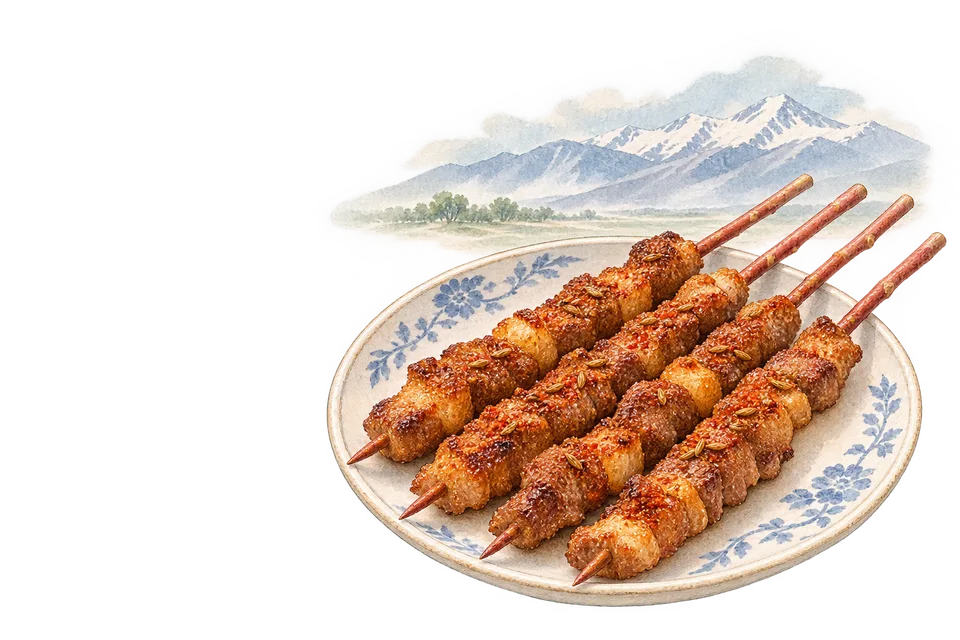
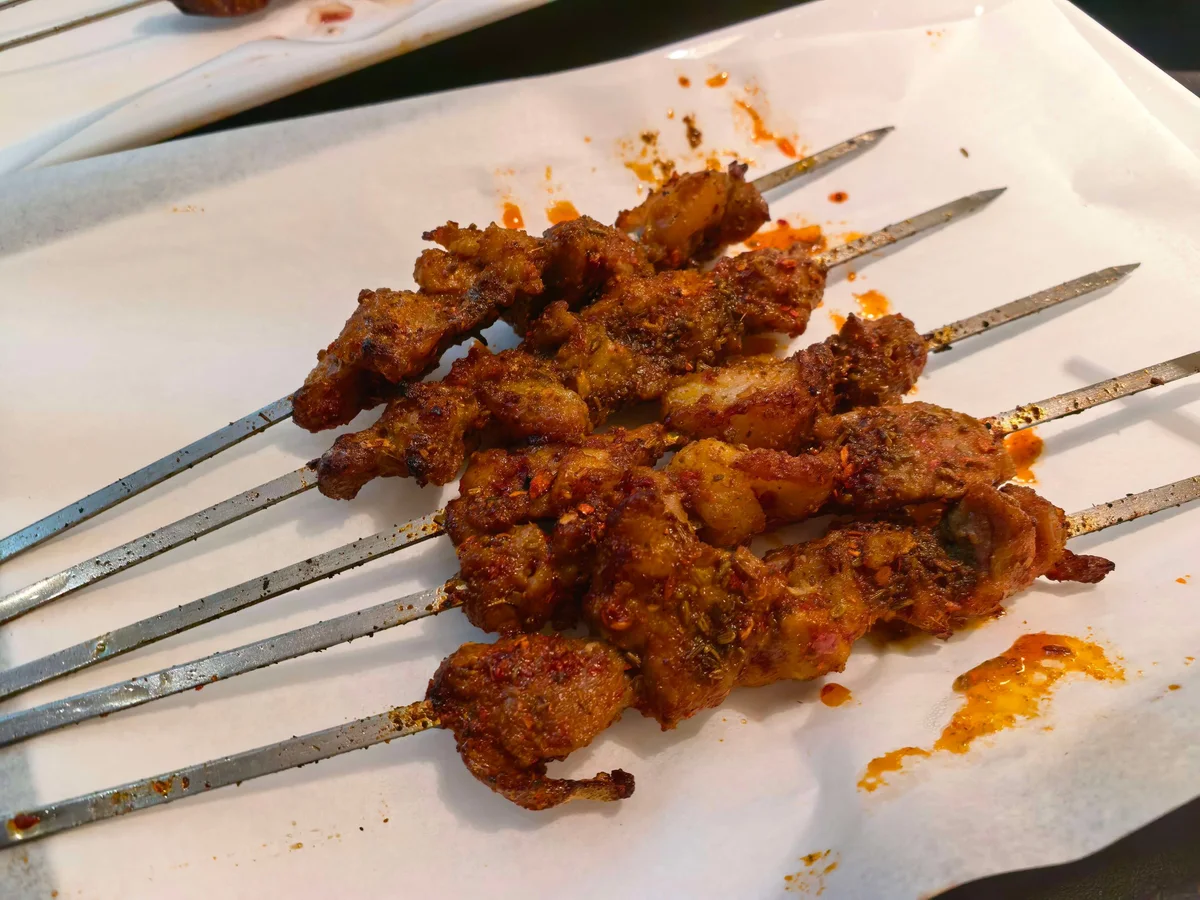
Xinjiang Lamb Skewers羊肉串
Lamb with one piece of fat on each iron or red-willow skewer, grilled over charcoal and seasoned halfway with salt, chili and cumin; a snack in Xinjiang, not a meal.
Regional food guide
Naan at every meal, lamb over charcoal, and noodles and rice on both sides of the Tian Shan
Xinjiang is China’s largest region, a land of deserts, oases and mountain pastures in the far northwest, and its food is built on wheat, lamb and the clay oven. Naan is eaten at every meal; lamb is grilled on skewers, baked in the naan oven and boiled on the bone; rice is cooked as polo with carrots and onion; hand-pulled laghman noodles come with a stir-fried topping; and the roadside restaurants of the north invented big plate chicken. Uyghur, Kazakh, Hui, Kyrgyz, Uzbek, Tajik, Xibe and Han cooks share one table and keep their own dishes. Start with naan and tea, a few skewers and a plate of laghman.
Start with the classics
Lamb with one piece of fat on each iron or red-willow skewer, grilled over charcoal and seasoned halfway with salt, chili and cumin; a snack in Xinjiang, not a meal.
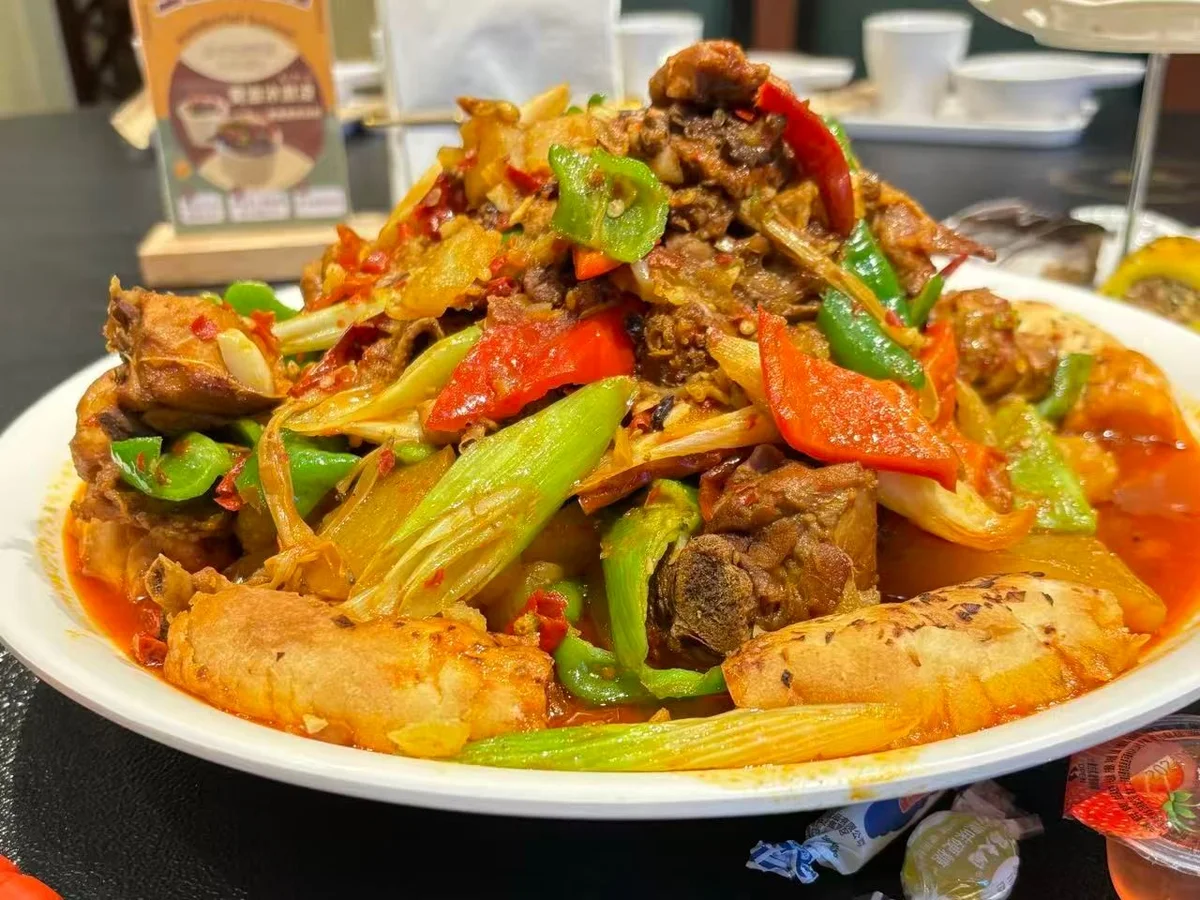
A whole chicken braised with potatoes, chili and green peppers on one huge platter, finished with wide belt noodles in the sauce; born on a Shawan highway in the late 1980s.
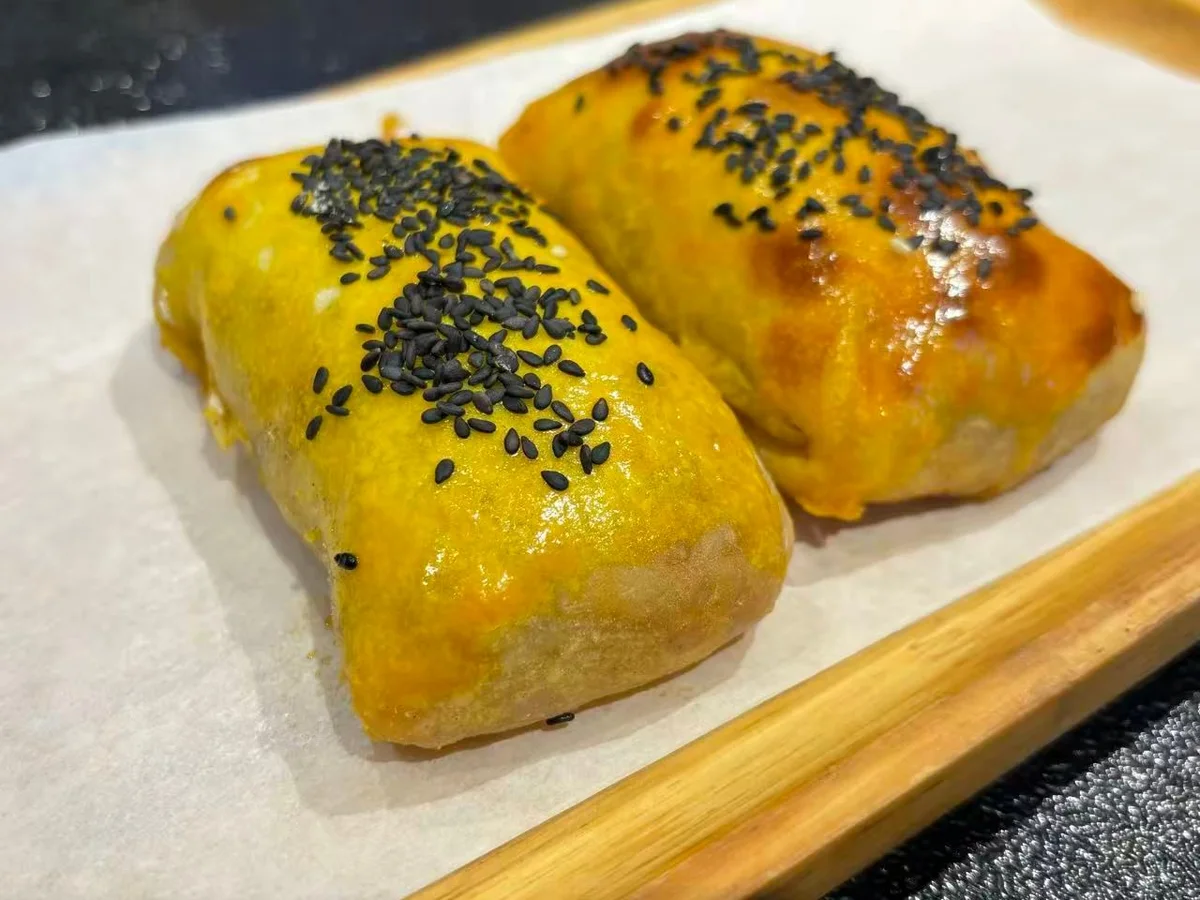
Square pastries of thin unleavened dough around diced lamb, tail fat and onion, baked on the wall of a naan oven; 2 to 3 yuan in Kashgar, eaten slowly.
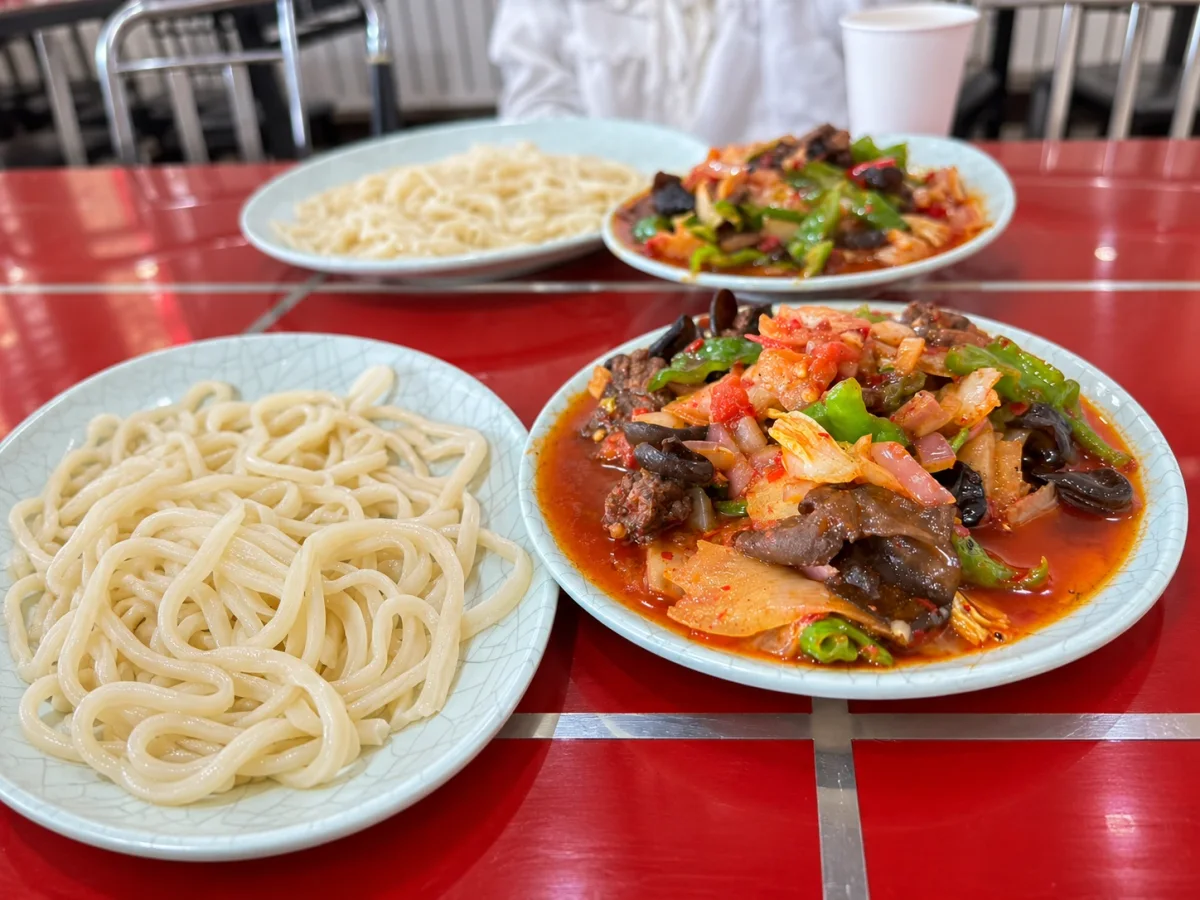
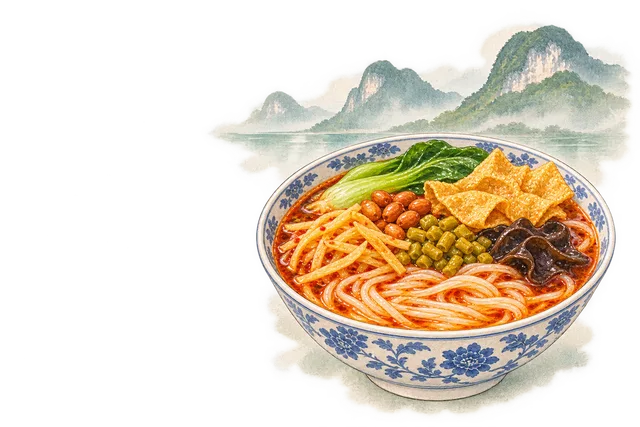
A plate of hand-pulled lazizi noodles and a plate of meat flashed through oil with peppers, onion, tomato and wood ear. Mix them at the table and ask for extra noodles.
01
Xinjiang’s cooking stands on three things: wheat, lamb and the clay oven, and almost every famous dish combines them.
Xinjiang covers a sixth of China. The Tian Shan mountains split it in two: to the south the Tarim basin, a ring of oasis towns around the Taklamakan desert, from Kashgar and Hotan to Kuqa and Turpan; to the north the Junggar basin and the grasslands of Ili, Tacheng and Altay. The oases grow wheat, rice, fruit and cotton under irrigation from snowmelt; the pastures raise sheep, cattle and horses. Urumqi, the capital, sits on the line between them.
The food follows the land. Wheat becomes naan, hand-pulled noodles and pastries; sheep become skewers, whole roast lamb and boiled meat; rice is cooked with lamb and carrots as polo. On the grassland, the writer Wang Zu notes, “having tea” always means milk tea and “eating meat” always means mutton. He once went out with a herder in Baihaba, near the Kazakh border, who said he needed only three things in his pocket to make lunch anywhere: a knife, a handful of salt and a box of matches. Many peoples share this kitchen. Uyghur oasis cooking, Kazakh and Kyrgyz pastoral food, Hui wheat and stir-fries, Uzbek, Tatar and Xibe dishes and the Han restaurant food of the towns borrow from one another, and many restaurants in Xinjiang are halal.
02
Naan is eaten at breakfast, lunch and dinner, and the proverbs about it are as many as its kinds.
Xinjiang proverbs give naan the place bread once had in Europe: “your parents give you life, wheat gives you naan,” and “better a day without vegetables than a day without naan.” Making it is called 打馕, “striking naan,” though there is nothing violent about it. Dough of flour, salted water and, for richer kinds, egg, milk, oil and honey is shaped into rounds, the edge pinched thick, the center pricked with a naan stamp into a pattern of dots so it stays flat, brushed with oil, scattered with sesame or onion, and slapped onto the wall of a tonur, the beehive-shaped clay oven. Most households in southern Xinjiang have their own oven and bake every few days, and every bazaar has naan stalls.
Wang Zu counts about fifty kinds: oil naan, meat naan, sesame naan, thin naan, xierman naan, wowo naan, one nearly ten centimeters thick with a hole in the middle to break it by, and newer ones made with rose jam, chili, apple, blackcurrant or jujube. The biggest are 40 to 50 centimeters across and take about two kilos of flour; the smallest are the size of a teacup. Naan travels well in a dry climate, so it is also the food of journeys and of ceremony: a suitor’s family brings five naan of the same size, and at a wedding the couple race to snatch two pieces of naan from a bowl of salt water. People break naan by pressing one palm on it like a knife and pulling up the side with the other hand, dip it in tea, and tap their lamb skewers on it so the cumin and chili fall on the bread. Crumbs are swept up for the birds.
Naan is also now an industry. In 2022 a naan park in Artux, near Kashgar, employed 228 workers who baked 268,000 naan a day in gas and electric ovens: 158,000 for sale locally, 40,000 for the rest of China, where fig and rose naan sold best, and 70,000 for export to Kyrgyzstan and Uzbekistan. Naan-making is on China’s national intangible heritage list, and the old way carries on beside the factories. At a century-old shop of a few square meters in Kashgar’s old town in 2023, one worker rolled each round and pinched its edge, an apprentice pricked it and scattered onion and cumin, and the baker wet a hand in salt water and flicked it over the back of the naan and the oven wall before putting the bread in. In 2026 a 30-year-old baker from Kashgar drew queues of up to four hours on the streets of Xi’an, selling three naan as big as washbasins for 10 yuan.
03
In Xinjiang “meat” means lamb, cooked in four or five ways.
The best-known is the lamb skewer, small pieces of lamb with one piece of fat, grilled over charcoal and seasoned with salt, chili and cumin; Xinjiang treats it as a snack, and eats it with cold yellow noodles. Real “eating meat,” Wang Zu explains, means the bigger dishes. 馕坑肉, naan-oven meat, is lamb or lamb ribs cut into hand-sized pieces, hung on an iron rack and lowered into a naan oven once the naan are done and the heat has dropped a little, hence its other name, 架子肉, “rack meat.” 手抓羊肉, hand-held mutton, is lamb boiled on the bone with salt and eaten with the fingers with onion; in a Kazakh household the boiled sheep’s head is offered to the eldest guest. Whole roast lamb, roasted in a big naan oven, is the banquet dish.
04
Polo, which Chinese calls 抓饭, “hand-grabbed rice,” is the dish for guests, festivals and weddings.
Polo is rice cooked with lamb, carrots, onion and plenty of oil in a heavy pot until the grains are glossy, separate and sweet with carrot. It is what Uyghur families cook for festivals, weddings, funerals and guests. The traditional way to eat it is by hand from a shared platter, each person taking only from the part in front of them, and the Chinese name 抓饭, “grabbed rice,” remembers that, though restaurants give you a spoon.
Polo changes with the season. Lou Wanghao, who surveyed the foods of Xinjiang’s Muslim peoples, describes winter versions with lamb, eggs or sugar, eaten with strong brick tea for warmth, and summer ones topped with stir-fried vegetables, yogurt or quince. One restaurant dish, ashmanta, puts five steamed thin-skinned dumplings on a plate of plain polo. In Hotan a farm family might cook polo with a big piece of lamb and a couple of jujubes, and raisins when the year’s grapes are dried; it comes with sharp salads of onion, cabbage and chili, a bowl of yogurt, or in summer a glass of kvass with honey.
05
The everyday lunch of Xinjiang is a plate of pulled noodles and a bowl of stir-fried topping.
拉条子 (latiaozi), known outside China as laghman, are noodles pulled by hand from oiled coils of dough to about the thickness of a chopstick, thicker and rounder than Lanzhou’s and chewier than Shaanxi’s. They are boiled, drained and served on a plate, with a bowl of 拌菜, the topping, that the diner tips over and mixes in; the dish as a whole is called 拌面, “mixed noodles.” Good cooks use flour from winter wheat, knead long, add more salt for a firmer noodle and oil the coils as they rest. Kashgar, Toksun and Urumqi all have streets of laghman restaurants, and a refill of noodles is usually free.
The topping makes the plate. Common ones are stir-fried lamb with green peppers and tomatoes, cabbage and meat, potato, celery, chili skins, chamgur turnip and the popular 过油肉, guoyou rou, a stir-fry of meat, peppers, onion and wood-ear mushrooms; Wang Zu counted more than thirty toppings at one Kashgar restaurant. Guoyou rou is a Shanxi dish in origin, but in Xinjiang it is made with beef, and Qitai county is famous for it. When the plate is finished, many diners drink a bowl of the noodle water: a Xinjiang saying holds that “the original soup digests the original food,” and a story tells of a driver who ate laghman in Dabancheng, forgot the soup, and drove back a hundred kilometers to drink it.
06
Northern Xinjiang’s Hui and Han restaurants gave the region its newest classics.
Big plate chicken was born in the late 1980s at roadside restaurants in Shawan, on the old Route 312 west of Urumqi: a whole chicken braised with potatoes and chili and finished with wide belt noodles, served to long-distance drivers. Shawan now has more than a thousand big plate chicken restaurants. Its cold cousin is 椒麻鸡, jiaoma chicken, a whole poached chicken in a numbing dressing of green Sichuan pepper, also served on a big plate and eaten with steamed rolls or noodles. 黄面, yellow noodles, finer than laghman and tinted by alkali, are a Hui specialty dressed with a thickened sauce of courgette, egg and spinach, fried celery, chili oil, garlic and sesame paste, and in summer grill restaurants serve them cold with skewers, alongside liangpi and liangfen as the “three cold dishes.”
07
The naan oven also bakes Xinjiang’s favorite snack.
Samsa, 烤包子, are square parcels of thin unleavened dough filled with diced lamb, sheep fat and onion, slapped onto the oven wall and baked until blistered. They cost 2 or 3 yuan at a Xinjiang bazaar in 2023, where a single stall with four ovens sold about 8,000 a day. Their relatives include the steamed thin-skinned dumplings 皮特尔曼塔 (pitir manta), Hotan’s large round goshgirde, the sweet apricot-jam kak given at weddings, and Hotan’s kumach, a pie ten times the size of a samsa buried in hot ashes to cook.
09
North and south of the Tian Shan eat differently.
| Area | Places | Character | Eat |
|---|---|---|---|
| Urumqi | Urumqi, the Erdaoqiao bazaar | The capital, every cuisine in one city | Skewers, laghman, big plate chicken, samsa, Xibe flatbread |
| Kashgar and the southwest | Kashgar, Yecheng, Artux | Uyghur oasis cooking, bazaars, naan ovens in every yard | Samsa, naan, polo, naan-oven meat, brick tea |
| Hotan | Hotan, Qira, Moyu | Desert oases | Kumach, goshgirde, long naan-oven skewers |
| Kuqa and Aksu | Kuqa, Xinhe | Oasis farming | Meter-long kawap, yahbaher, apricots |
| North-central | Shawan, Changji, Qitai | Hui and Han roadside restaurants | Big plate chicken, guoyou rou laghman, yellow noodles |
| Ili and the northwest | Yining, Tacheng, Altay | Kazakh grassland, Xibe, Tatar and Russian quarters | Milk tea, baursak, smoked horse meat, Xibe fish with tarragon, kvass |
10
Plan your days around the naan oven and the noodle counter.
Buy a hot naan from a bazaar oven, break it with your palm and eat it with tea or yogurt.
Skewers are a snack: order five or ten, eat them hot and wipe the tip of an iron skewer first.
Choose a topping, tip it over, ask for more noodles if you want them, and drink the noodle water after.
Go with three or four people, order a whole chicken and ask for the belt noodles halfway through.
Bite a hole and let the steam out first.
If invited home, expect tea, then polo, and take only from your side of the platter.
11
Chicken, potatoes and belt noodles from Shawan.
Read about big plate chicken →Xinjiang’s ganbian chaomian: thick, chewy noodles dry-fried with beef or lamb, about 15 yuan a plate in 2024.
Read about chow mein →Xinjiang’s neighbor on the Silk Road, with beef noodles and mutton.
Explore Gansu food →FAQ
Wheat, lamb and the clay oven: naan, lamb skewers and naan-oven meat, polo rice with carrots, hand-pulled laghman, samsa, and newer dishes like big plate chicken.
Naan with tea, lamb skewers, a plate of laghman, samsa, polo and, with friends, a big plate chicken.
Moderately. Chili and cumin are common, but Xinjiang chilies are more fragrant than fierce, and much of the food is simply salted.
Many restaurants in Xinjiang are halal, run by Uyghur, Hui, Kazakh and other Muslim cooks; elsewhere in China ask.
A family of about fifty flatbreads baked on the wall of a clay tonur oven, eaten at every meal.
Rice cooked with lamb, carrots and onion in one pot; in Chinese it is 抓饭, “hand-grabbed rice.”
Hand-pulled noodles about as thick as a chopstick, served with a stir-fried topping that you mix in; in Chinese 拉条子 or 拌面.
Brick tea or milk tea with meals, dogh (iced yogurt) in summer, kvass at night markets, and fermented mare’s milk on the grassland.
Naan with tea or milk tea, hot samsa, yogurt, and in Kazakh homes baursak with milk tea.
Shawan, in northern Xinjiang, where roadside restaurants on Route 312 began serving it to drivers in the late 1980s.
Sources
Last updated November 2026
Keep exploring