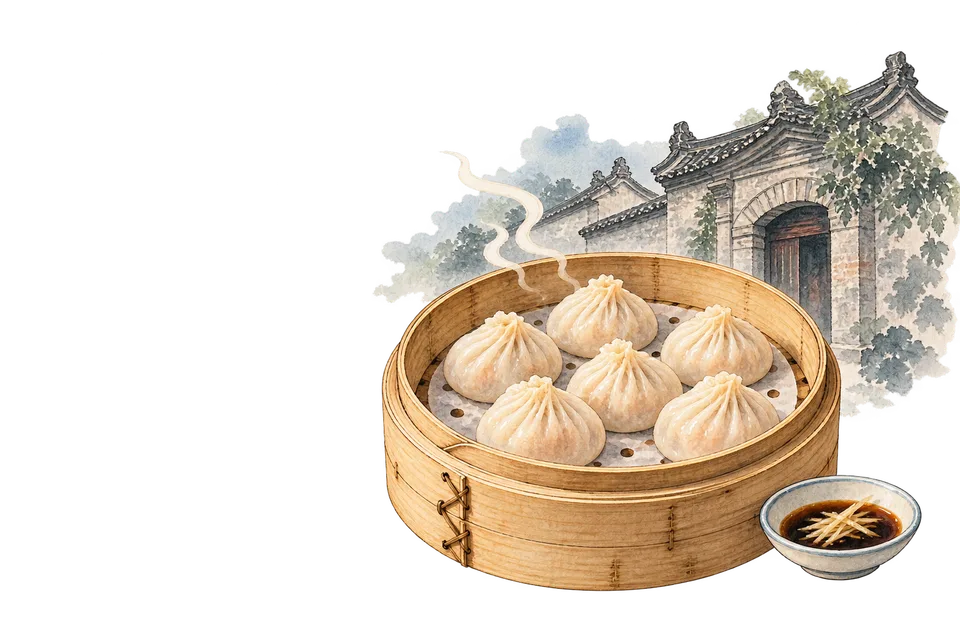
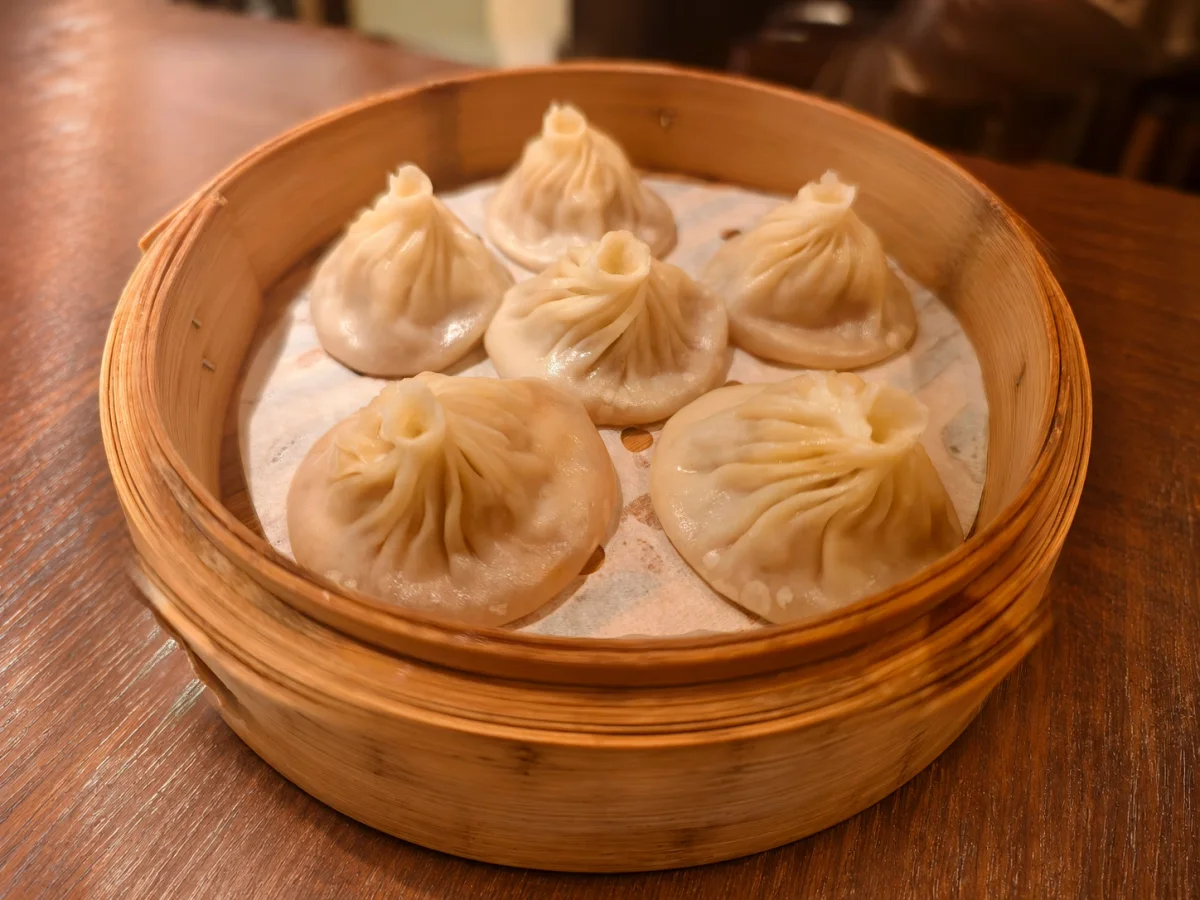
Xiaolongbao小笼包
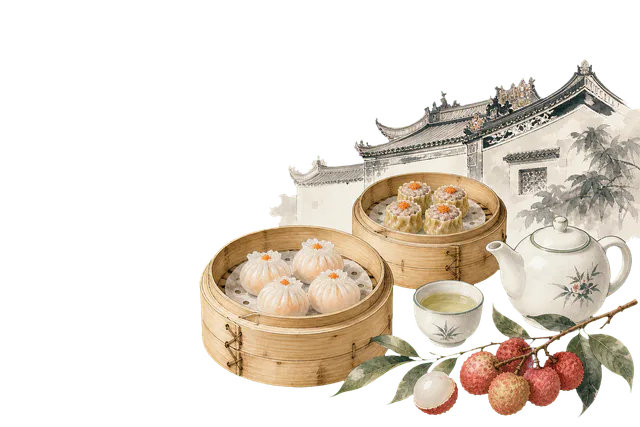
Small pleated dumplings of thin unleavened dough around pork and chopped pork-skin jelly, which melts into soup in the steamer; eaten from a spoon with vinegar and ginger.
Regional food guide
Benbang cooking in soy and sugar, soup dumplings, and a breakfast of four kings
Shanghai food has two faces. Benbang (本帮), the city’s own cooking, is soy-dark, sweet and glossy: red-braised pork, eight-treasure duck, river shrimp, wine-lees dishes and spring yanduxian soup. Around it sits everything a port city of migrants absorbed: soup dumplings and pan-fried buns, a four-part street breakfast, noodle shops, Russian borscht and fried pork chops with “spicy soy.” Start with xiaolongbao, shengjian, a bowl of scallion noodles and a red-braised dish, then eat by season.
Start with the classics
Small pleated dumplings of thin unleavened dough around pork and chopped pork-skin jelly, which melts into soup in the steamer; eaten from a spoon with vinegar and ginger.
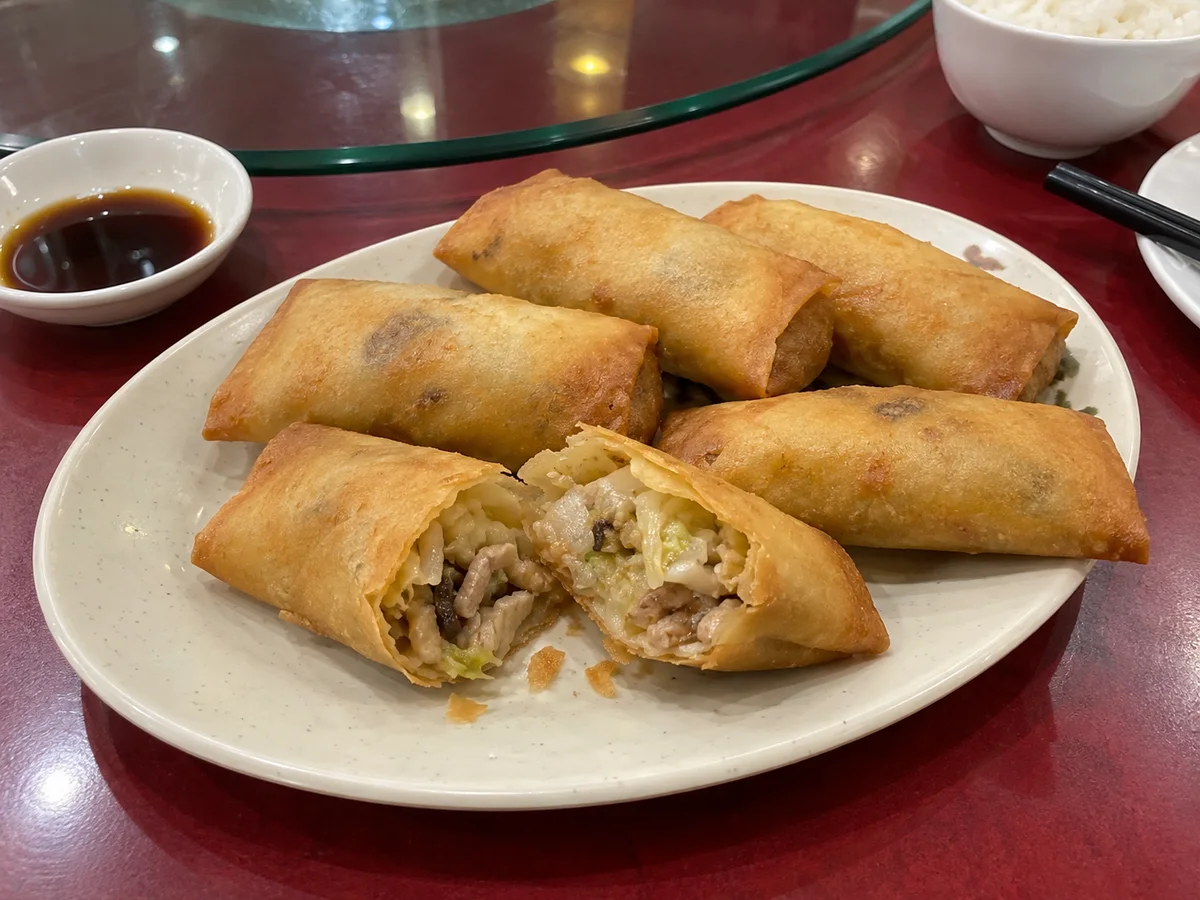
Paper-thin wheat wrappers rolled around cooked shredded pork and cabbage, sealed and fried golden; Shanghai’s New Year “gold bars.”
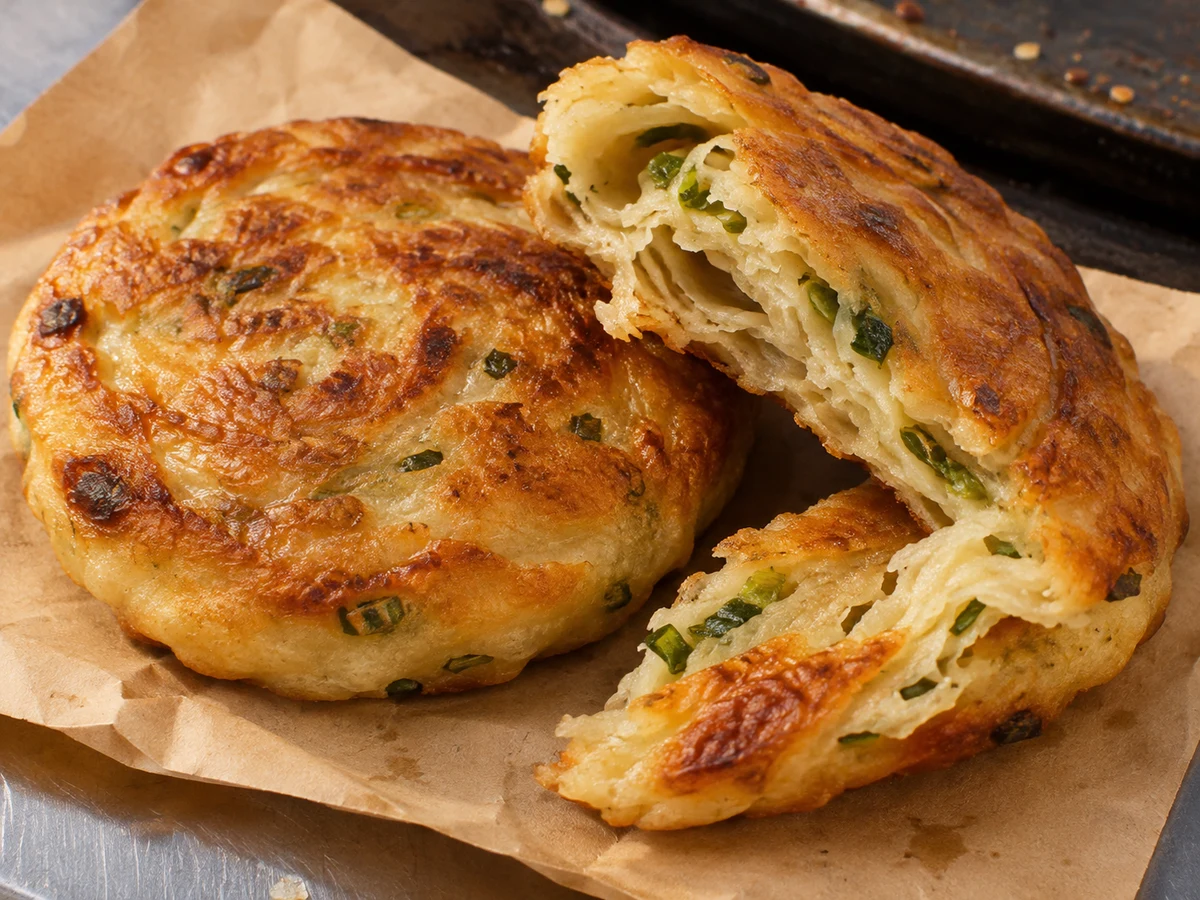
A round of wheat dough folded with chopped scallion and fat. At a Shanghai stall it can go from griddle to oven, turning crisp outside while the scallion layers stay soft.
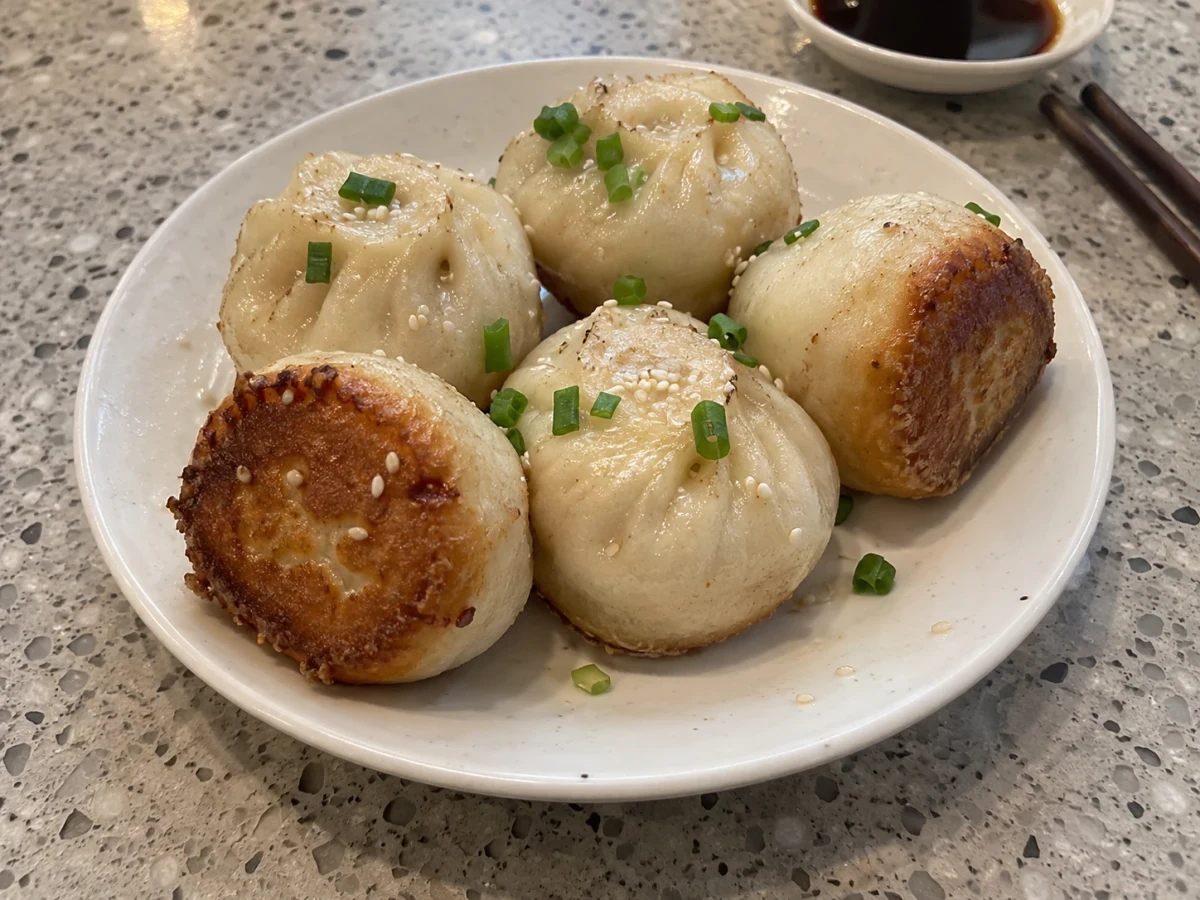
Raised-dough pork buns fried and steamed in one iron pan, crisp underneath and often full of soup; four to a liang, with curry beef soup.
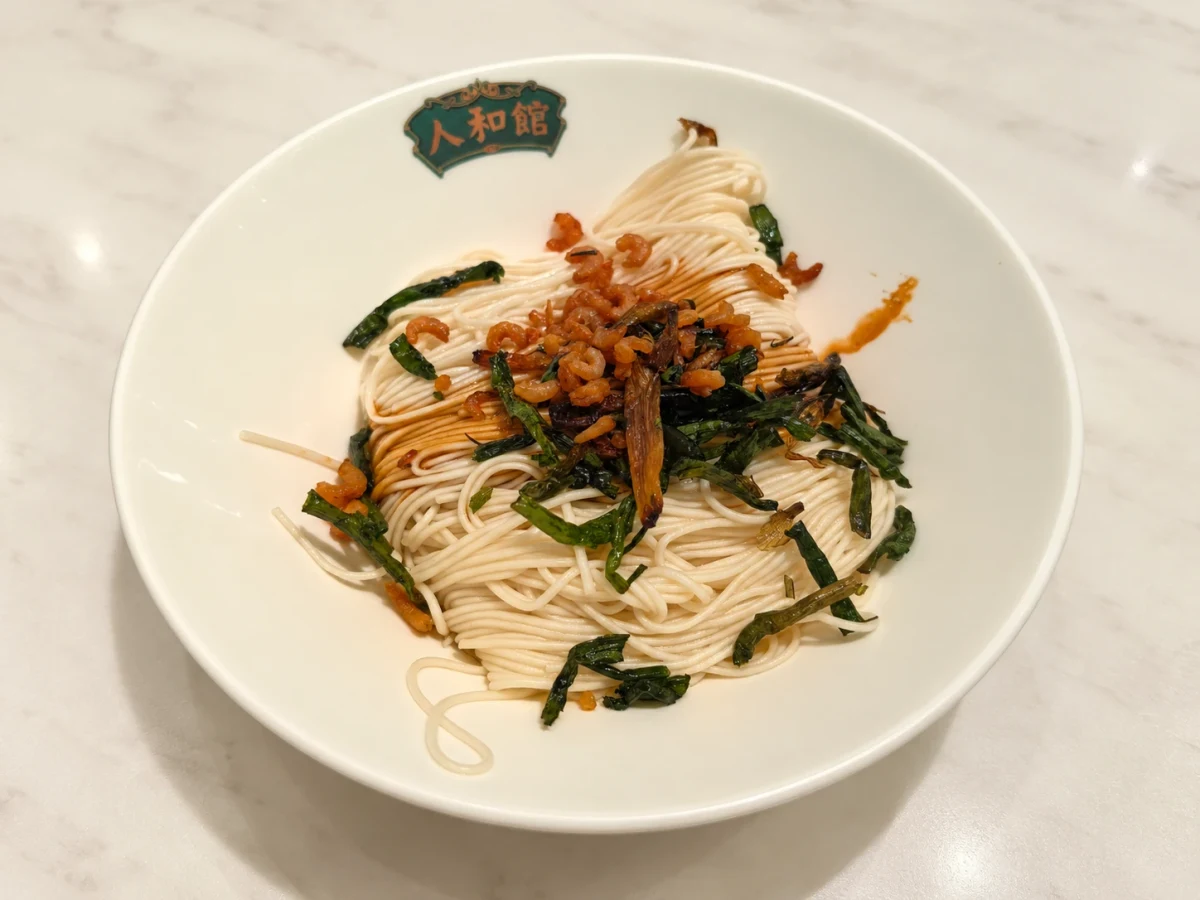
Plain noodles tossed with slow-fried scallion oil, soy and sugar, often with dried shrimp; Shanghainese call the shrimp version conggai.
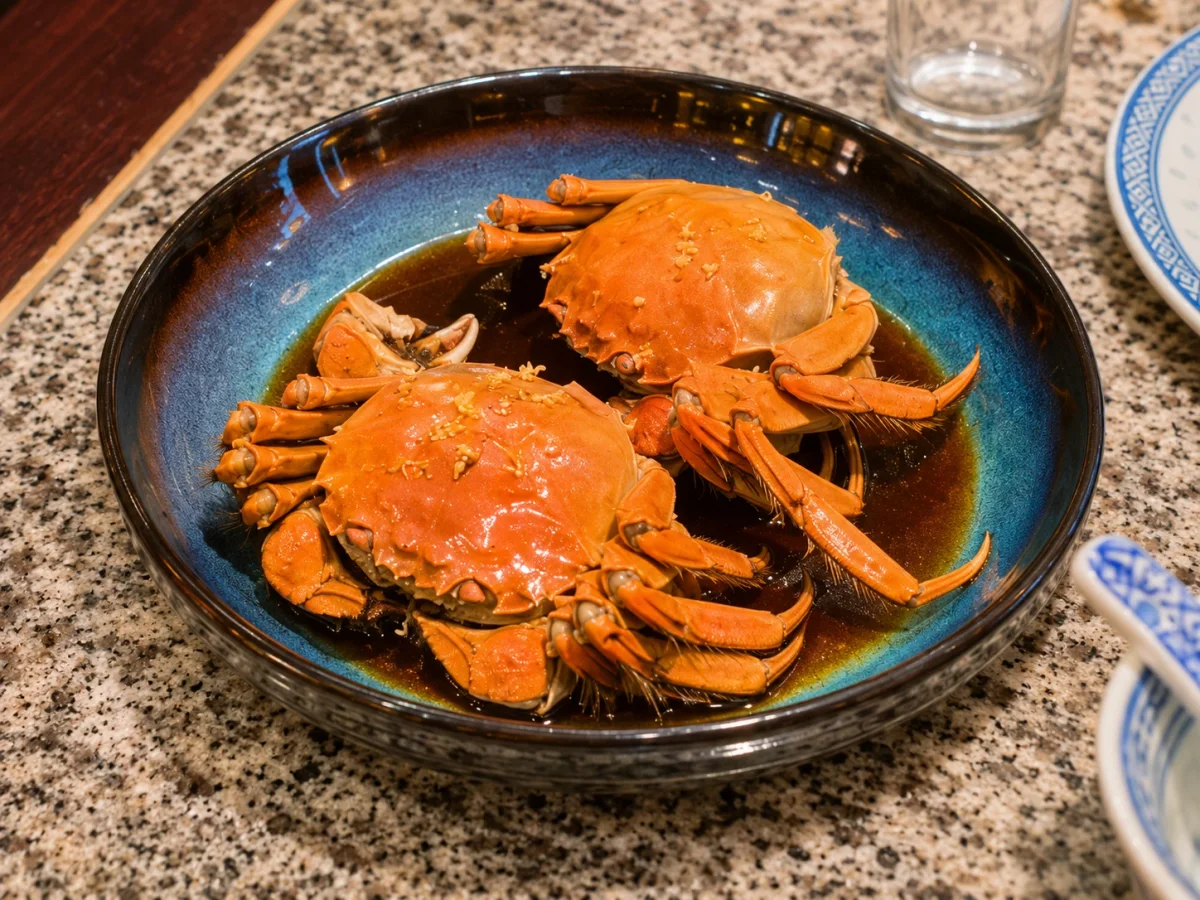
Hairy crabs steeped in huadiao wine, soy, sugar and spices and eaten cold. Raw drunk keeps the roe molten; Shanghai restaurants may serve only cooked drunk, steamed first.
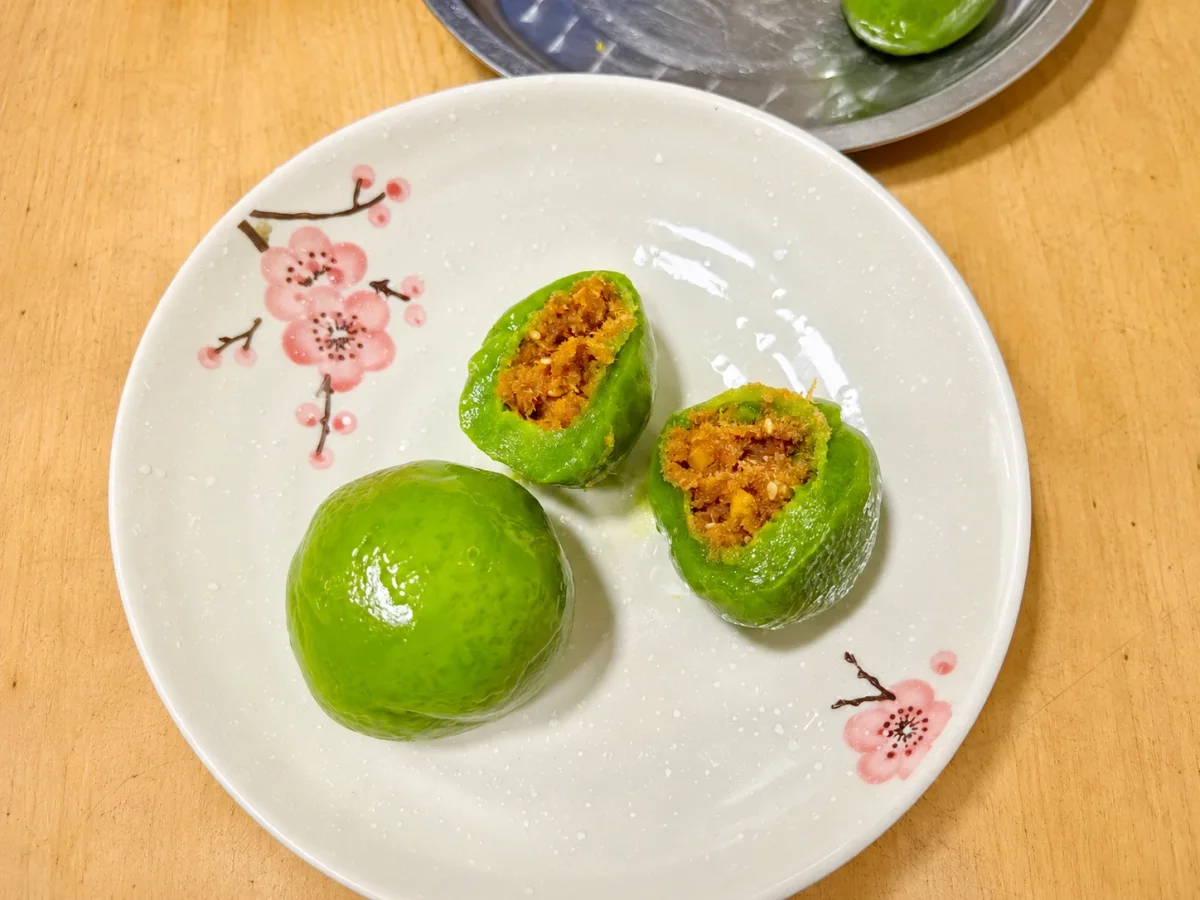
Green glutinous rice dumplings made only before Qingming, colored with mugwort or other spring plants. Shanghai queues for salted egg yolk and pork floss.
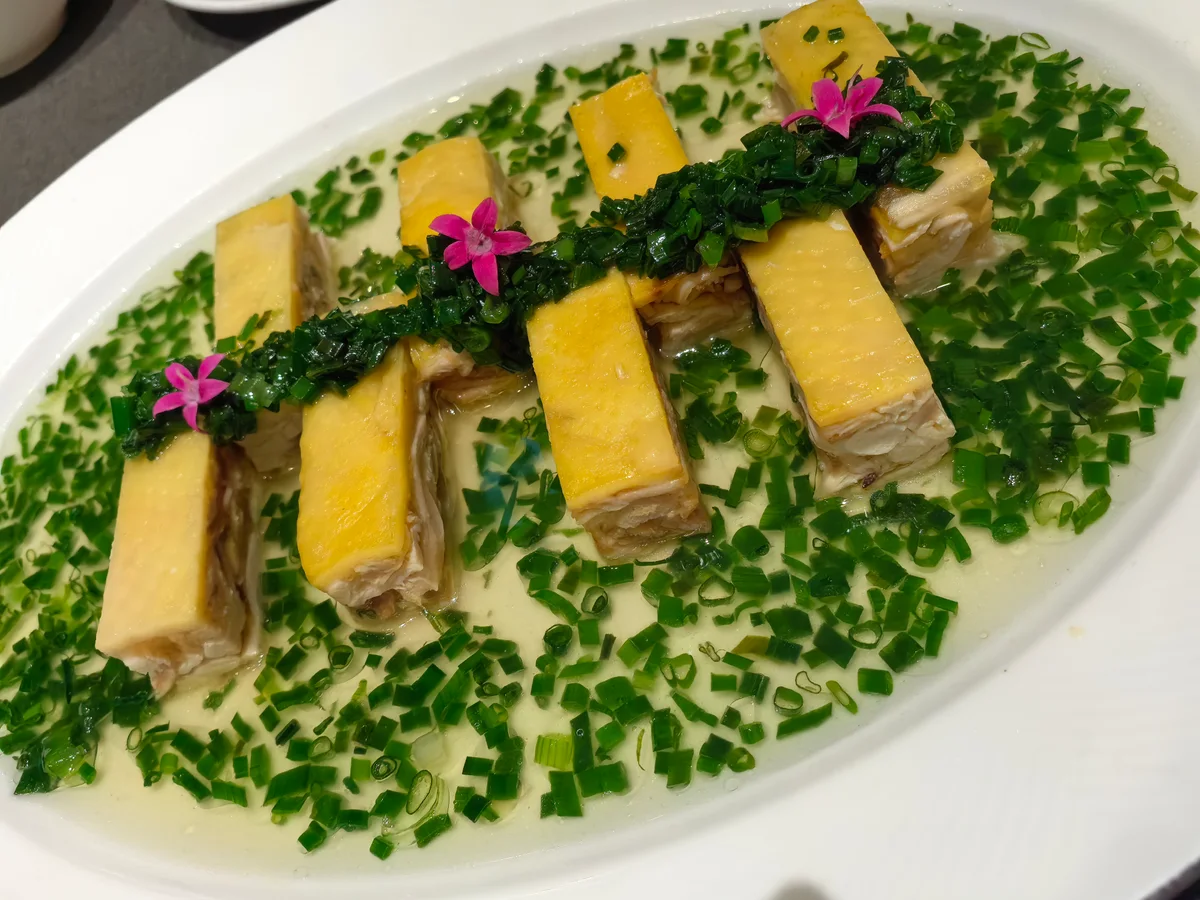
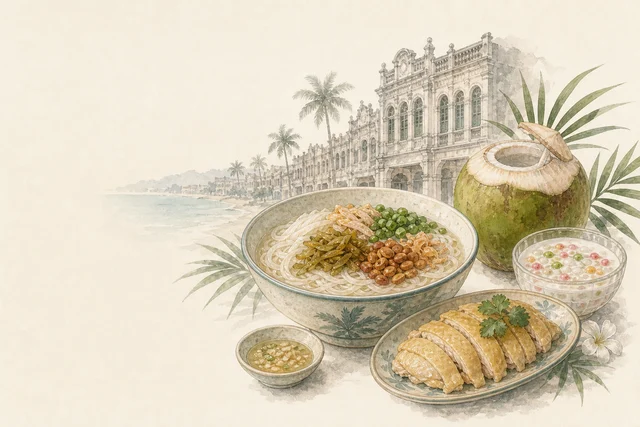
A small three-yellow chicken poached gently, chilled in iced water and cut up, then dressed with hot oil poured over chopped scallion. A standard Shanghai cold starter and once the whole chicken at every wedding feast.
01
For most of Shanghai’s history, its own cooking was the least fashionable food in town.
Shanghai calls its local cooking benbang cai, 本帮菜. Ben means local; bang is the word Shanghai used for the guilds and communities of people from other provinces living in the city, the Cantonese bang, the Ningbo bang and so on. The historian Mark Swislocki suggests that the best English for it is not “local cuisine” but “our people’s food”: the name only makes sense in a city where most cooking belonged to someone else. The term was in common use by the early twentieth century, and through all that time the restaurants that impressed visitors and guidebooks served the food of other provinces.
The national intangible-heritage entry for benbang cooking sums up its character in four words, 浓油赤酱, rich oil and red soy, and then glosses them: plenty of oil, strong flavor, heavy sugar and bright color. Its main techniques are red-braising in soy sauce and sugar, slow simmering, and cooking with fermented wine lees. The taste is salty with sweetness inside it, rich but not greasy. A good red-braised dish needs no starch: the sauce reduces until it coats the food on its own, a finish the entry describes as sticky as glue and glossy as lacquer. The lees dishes use a fragrant lees made only in Shanghai, mixed with aged Huadiao wine and other secret seasonings, stored and filtered again and again. The same entry is frank about where the style came from: it began with ordinary local home cooking in the late Qing and took what it could use from Anhui (Hui) cooking, Huaiyang, Suzhou and Wuxi, and Cantonese restaurants as they arrived in the city. In 2014 it was added to China’s fourth national list of intangible cultural heritage, with the Shanghai Classical Restaurant (上海老饭店) as its guardian.
02
The story of Shanghai food is the story of who came to the city, and when.
Before it became a treaty port in 1842, Shanghai was known for what it grew: cotton, salt and above all honey peaches, which local writers made into a symbol of the place. After 1842 merchants and workers poured in from across China, and each group opened restaurants serving its home cooking. Late-Qing guidebooks praised the Anhui and Tianjin restaurants and hardly mentioned local ones. A Shanghai newspaper song of 1911 listing the city’s famous foods began with Western-style “big meals” at Yijiachun, then named the mutton noodles at Xiandelou, Jinhua ham, Cantonese late-night food at Xinghualou and Suzhou braised pork, and conceded that Suzhou made better tangbao, while a local shop, Daguanlou, won on small steamed buns.
The mix kept changing. The writer Liu Yanong remembered that fifty years earlier, besides local food, there had only been Beijing, Suzhou, Huizhou and Ningbo restaurants, with Sichuan, Hunan, Fujian and Cantonese food not yet in fashion. The editor Yan Duhe counted four kinds, Suzhou, Beijing, Cantonese and Zhenjiang, and wrote that after the 1911 revolution, when politicians and Qing loyalists settled in the city, Fujian and Sichuan restaurants rose to meet their appetites. Swislocki points out that the grand restaurants of 1930s Shanghai, the decade the city is most nostalgic for, served Cantonese food, not Shanghainese. Local cooking only became the city’s most popular and talked-about style in the 1990s, when it also began to be called simply Shanghai cuisine, sold both in plain home-style restaurants and in “old Shanghai” theme restaurants dressed up as the 1930s.
| When | Who says | What the city ate |
|---|---|---|
| Half a century before he wrote | Liu Yanong | Local food, plus Beijing, Suzhou, Huizhou and Ningbo restaurants |
| Before 1911 | Yan Duhe | Four kinds: Suzhou, Beijing, Cantonese, Zhenjiang |
| 1912 | Shanghai Guide (Commercial Press) | Sichuan, Fujian, Cantonese, Beijing, Nanjing, Suzhou, Zhenjiang-Yangzhou, Huizhou, Ningbo and Muslim; Sichuan and Fujian the dearest, Beijing and Huizhou the cheapest |
| 1930s | Swislocki | The grandest restaurants were Cantonese |
| 1990s on | Swislocki | Local Shanghai cooking becomes the most popular style in the city |
Sources [2]
03
Menus and food writers use a second word, haipai, “Shanghai style.” It means something different.
Haipai was originally a label for Shanghai’s theatre, painting and fiction, set against the Beijing school; it was applied to food only recently. According to the accounts Swislocki follows, it first appeared on a menu in the mid-1980s, at a government-backed exhibition of Shanghai cooking, when the Meilongzhen restaurant labeled some of its dishes haipai cai. Meilongzhen had opened in 1938 as a Yangzhou restaurant and switched to Sichuan food after the war; its haipai dishes were Sichuan and Yangzhou cooking adjusted to Shanghai taste, the Sichuan dishes less hot and less numbing, the Yangzhou dishes lighter. Older examples are often cited: a Huizhou restaurant, Dazhonglou, that cooked shrimp wontons in a casserole with duck, or the Cantonese Xinghualou inventing Xishi shrimp, river shrimp slipped in fresh milk to suit Shanghai’s love of shrimp. Haipai means outside cooking adapted to Shanghai; benbang means the city’s own cooking. Swislocki notes the irony that the city celebrated for change ate local dishes that had barely changed in a century.
Sources [2]
04
These are the dishes the heritage entry and Shanghai writers return to.
Red-braised dishes come first: pork belly, fish, eel, river eel and pork intestine cooked down in soy sauce and sugar until the sauce glazes them. Wine-lees dishes are the second family. Many of the famous names come from Gaoqiao and Chuansha on the Pudong side of the river, which a Gaoqiao local historian told Shen Jialu were the two sources of benbang cooking. The gangster Du Yuesheng, a Gaoqiao man, entertained with benbang food; for the opening of his ancestral hall in 1931 the Gaoqiao chef Sun Bing fed more than a thousand guests a day for three days, and Shen writes that dishes such as eight-treasure duck, the lees casserole and sea cucumber with shrimp roe became famous across the city after it.
| Dish | What it is |
|---|---|
| Red-braised pork 红烧肉 | Pork belly braised in soy sauce and sugar to a sticky glaze; the base of the whole style |
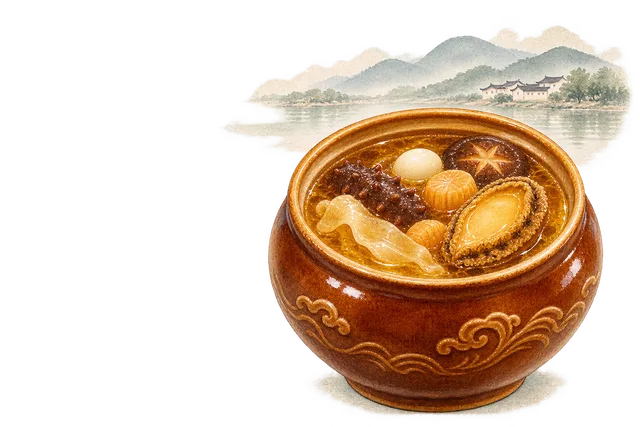
| Eight-treasure duck 八宝鸭 | A whole boned duck stuffed with glutinous rice, chestnut, ginkgo, ham, mushroom and more, steamed for hours; a banquet dish |
| Sea cucumber with shrimp roe 虾子大乌参 | Large black sea cucumber braised with dried shrimp roe; a banquet showpiece |
| Oil-blasted river shrimp 油爆河虾 | Whole small river shrimp flash-fried and tossed in a sweet soy glaze |
| Lees casserole 糟钵头 | Pork offal simmered and finished with fragrant wine lees |
| Black carp “bald lung” 青鱼秃肺 | Black carp liver braised in soy sauce |
| Caotou quanzi 草头圈子 | Braised pork intestine on a bed of quickly fried bur clover |
| Eight-treasure chili sauce 八宝辣酱 | Diced pork, shrimp, bamboo shoot and peanuts in a sweet bean-chili sauce, a cheap-restaurant staple |
| Yanduxian 腌笃鲜 | Salted pork, fresh pork and spring bamboo shoots simmered into a milky soup |
Eight-treasure duck shows how much time the style can take. At the Shanghai Classical Restaurant, founded in 1875, the duck comes from Zhejiang, is stuffed with four meats (chicken breast, pork, chicken gizzard and ham) and four vegetables (ginkgo, mushroom, chestnut and bamboo shoot) with dried scallop, and is steamed whole for eight hours. Steaming starts in the evening, the duck rests overnight and is served the next day. The vegetable in caotou quanzi should be bright and loose: bur clover is fried fast over high heat with a splash of liquor, never blanched in water first.
06
Shanghai snacks are ordered by weight and by a vocabulary of small instructions.
Xiaolongbao, the soup dumplings, came from the town of Nanxiang in 1871 and reached the City God Temple in 1900; the heritage standard gives them 18 pleats and a wrapper 1.5 millimeters thick. Shanghai also eats the larger, sweeter Suzhou- and Wuxi-style soup dumplings seasoned with soy and sugar, which are sold all over the city. Shengjian mantou, pan-fried pork buns, came from Suzhou in the early 1910s and reached Shanghai’s teahouses and hot-water shops in the 1920s. They are still ordered by the liang, which means four buns, because one liang of flour once made four. There are two schools. Hunshui buns use half-leavened dough with jelly in the filling and spurt soup; qingshui buns use fully leavened dough with no jelly and are pleated face up. Da Hu Chun, founded in 1932, is the best-known qingshui shop and charged 11 yuan for four in 2026.
Yangchun noodles, plain noodles in broth with scallion and lard, are the basic noodle; in Shen Jialu’s childhood a bowl cost eight fen and two liang of grain coupons. Their quality was in the stock: pork bones, chicken carcasses and even trotters, with a dedicated stock cook in larger shops, while Wuxi noodle shops used eel bones. Local shops served a clear broth; Suzhou shops a soy-dark one. Diners still order hard, soft or very soft noodles, a lot of broth or a little, or “dry-picked” noodles with none. Cong kai mian (葱开面) is noodles tossed with scallion oil and dried shrimp. For lunch, the lanes serve vegetable rice, rice cooked with greens and salted pork, with a bowl of pork-bone soup: one lane shop near the center charged 15 yuan for the set in 2023 and sold out before the lunch rush.
07
The old walled city and its temple were Shanghai’s snack market for a century.
Shen Jialu’s list of what the temple sold reads like a menu of lost foods. Fried gluten balls stuffed with pork and tofu-skin rolls, served in a broth of dried shrimp and bamboo shoot, were nicknamed shuang dang, 双档, “double gear”; one of each was called “mandarin ducks,” and regulars ordered a pair with a bowl of scallion noodles, asking for the noodles hard. The trick in the broth was a pinch of alkali that softened the tofu skin and turned it white. Huang jiang, “yellow sauce,” was pork wrapped in tofu skin, fried golden and simmered in soup, named because it looked like a stretched mahjong tile. A squid seller called the King of Squid cut soaked squid to order and deep-fried it; pigeon-egg dumplings, invented in the 1930s by a Suzhou hawker, were glutinous balls filled with mint syrup that ran cold when you bit them. Nanxiang Mantou Dian, by the Nine-Zigzag Bridge since 1900, is the survivor everyone queues for.
Sources [1]
08
Shanghai’s Western food is old enough to count as local.
After the Russian Revolution, White Russian refugees came south through Manchuria to Shanghai. Shen Jialu gives the numbers: 210 Russians in the French Concession in 1920, about 21,000 in Shanghai by 1936. They clustered on the stretch of Avenue Joffre, today’s Middle Huaihai Road, between Chongqing Road and Shaanxi Road, which Shanghai people called Luosong Avenue, “Russian Avenue,” and opened some forty Russian restaurants and cafés there. Many of the cooks were from Shandong, men who had gone north to Vladivostok and Harbin, learned Russian cooking there and followed the refugees south. They cut the beetroot in borscht and added tomato paste, and luosong tang, Shanghai’s tomato-red “Russian soup,” has been a home dish ever since. In the early 1950s a set Russian meal of soup, a main of two pork chops, two beef patties or three fried prawns, a cup of tea and unlimited bread cost 0.8 to 0.9 yuan. By the 1930s the city had more than a hundred Western restaurants and nearly a thousand by 1949.
The fried pork chop is eaten with la jiangyou, “spicy soy,” which is Shanghai’s name for Worcestershire sauce. Shen recommends the yellow-label bottle from the Shanghai brand Meilin. Pork chop rice cakes, paigu niangao, belong to Xiandelai: a Zhejiang man is said to have started the stall in a lane beside the Sino-French school in 1921, first selling milk and toast, then five-spice braised chops with rice cakes, then fried chops, which customers praised as xiandelai, “delicious”; the shout became the name. The chop is beaten, battered with flour, starch and egg, fried twice, and served with two sticks of rice cake brushed with a sweet bean sauce sharpened with hawthorn jam.
09
Shanghai’s white-cut chicken came with migrants from Shaoxing.
Shanghai bai zhan ji is a whole young hen dropped into boiling water, cooked until a chopstick draws no blood, cooled and chopped, and eaten with soy sauce. The prized bird was the Pudong “nine-jin yellow,” yellow in feather, foot and beak. In the 1940s a brother and sister from Shaoxing set up a chicken-congee stall on today’s South Yunnan Road, simmering congee with chicken heads and feet and selling the heads and feet to drinkers; they added white-cut chicken only later. Their shop, Xiao Shaoxing, became a legend in the 1980s, killing free-range Pudong chickens to order and plunging each cooked bird into cold filtered water so the skin turned crisp and the meat stayed tender. People queued an hour for a plate, and in the mid-1980s Shanghai had more than a thousand chicken-congee shops copying it, many of which soon closed on hygiene grounds.
Sources [1]
10
Benbang cooking follows the market, and the market follows the season.
Spring belongs to yanduxian, whose name spells out the method: yan is salted pork, du is the Shanghai word for the soft glug of a pot at a low simmer, and xian is fresh pork and spring bamboo shoots. Before Qingming, river snails are at their fattest; a Jiangnan saying values a Qingming snail as highly as a goose. In summer the 1912 city guide picked out cooked lotus root and sugared taro from the snack shops. Autumn is hairy-crab season, when crab goes into soup dumplings and much else. At New Year Shanghai families make four-joy kaofu, braised wheat gluten with day lilies and wood ear, and in Pudong red-braised tofu-skin rolls called “quilts.”
| Season | Eat |
|---|---|
| Spring | Yanduxian with spring bamboo shoots; Qingming river snails fried with scallion, ginger and wine |
| Summer | Cooked lotus root and sugared taro |
| Autumn | Hairy crab and crab-roe soup dumplings |
| Winter and New Year | Four-joy kaofu; tofu-skin “quilts”; eight-treasure duck at banquets |
11
The old towns inside today’s Shanghai keep their own tables.
A village banquet of four cold plates and six bowls (white chicken, white tripe, fried fish and jellyfish; then red-braised pork, red-braised fish, a whole chicken or duck, salted pork with bamboo shoots and pork-skin soup) was the set menu for weddings and funerals. The old restaurant Changxingguan opened in 1903 and was known for eight-treasure chili sauce, three-shred dome and stir-fried shelled shrimp. Gaoqiao song bing, flaky lard pastries with bean paste, are a Pudong heritage item.
A water town known for its rice and its snacks: pork and trotters tied with straw and braised, zongzi with pork, chestnut and salted yolk from some seventy shops, pumpkin cakes and lotus root stuffed with osmanthus rice.
The home of xiaolongbao. In 2025 a neighborhood shop in the town sold a basket of eight pork dumplings for 8 yuan.
12
Old state-owned names, neighborhood restaurants and snack shops cover most of what a visitor wants.
For a benbang meal, Lao Zheng Xing at 556 Fuzhou Road has held a MICHELIN star for nine years and averages about 153 yuan a person; Lyceum (兰心餐厅) at 130 Jinxian Road has been a Bib Gourmand eight years running and averages about 92. The Shanghai Classical Restaurant in Yu Garden, founded in 1875, is the heritage guardian and the place for eight-treasure duck. De Xing Guan, Guang Ming Cun and Wang Jia Sha are older chains with branches across the city; Wang Jia Sha is known for crab soup dumplings and pork tangyuan. Order the house red-braised dish, a stir-fried green, a lees dish and something from the river, and share.
| Where | What | Price |
|---|---|---|
| A neighborhood shop in Nanxiang, 2025 | Pork soup dumplings, basket of 8 | 8 yuan |
| Da Hu Chun or Lao Zheng He, 2026 | Shengjian, 4 buns | 11 yuan |
| A lane shop near the center, 2023 | Vegetable rice with pork-bone soup | 15 yuan |
| Lyceum, 2026 | Average per person | about 92 yuan |
| Lao Zheng Xing, 2023 | Braised intestine with bur clover | 94 yuan |
| Lao Zheng Xing, 2023 | Five dishes for two people | 368 yuan |
| Lao Zheng Xing, 2026 | Average per person | about 153 yuan |
13
Soup dumplings from Nanxiang: pork-skin jelly, 18 pleats, vinegar and ginger.
Read about xiaolongbao →Shanghai’s shepherd’s-purse big wontons and small wontons in clear broth, beside Cantonese yuntun and Sichuan chaoshou.
Read about wonton →The Cantonese cooking that filled Shanghai’s grand restaurants in the 1930s.
Explore Guangdong food →FAQ
The local benbang style is soy-dark, sweet and glossy, braised in soy sauce and sugar without starch. The city also eats dumplings, noodles and adapted Western dishes brought by migrants.
Ben means local and bang a community from one place. Benbang cai is the cooking of Shanghai’s own people, as opposed to the food of other provinces’ communities in the city.
Benbang is Shanghai’s own cooking. Haipai, a term applied to food since the 1980s, means dishes from elsewhere adapted to Shanghai taste.
Xiaolongbao, shengjian, a red-braised pork dish, scallion oil noodles and, in spring, yanduxian.
Yes, more than most Chinese cooking. Sugar balances soy sauce in red-braised dishes; Wuxi-style dishes in the city are sweeter still.
The Four Heavenly Kings: dabing flatbread, youtiao, cifantuan rice balls and soy milk, often salty. Shengjian and noodles are common too.
Shanghai’s Russian soup, a borscht made by Shandong cooks for White Russian refugees, with less beetroot and more tomato.
Shanghai’s name for Worcestershire sauce, “spicy soy,” eaten with fried pork chops.
Spring for bamboo shoots and yanduxian, autumn for hairy crab.
Lao Zheng Xing, Lyceum and the Shanghai Classical Restaurant are the best-known; De Xing Guan, Guang Ming Cun and Wang Jia Sha have many branches.
Sources
Last updated November 2026
Keep exploring