
01
Raw drunk or cooked drunk
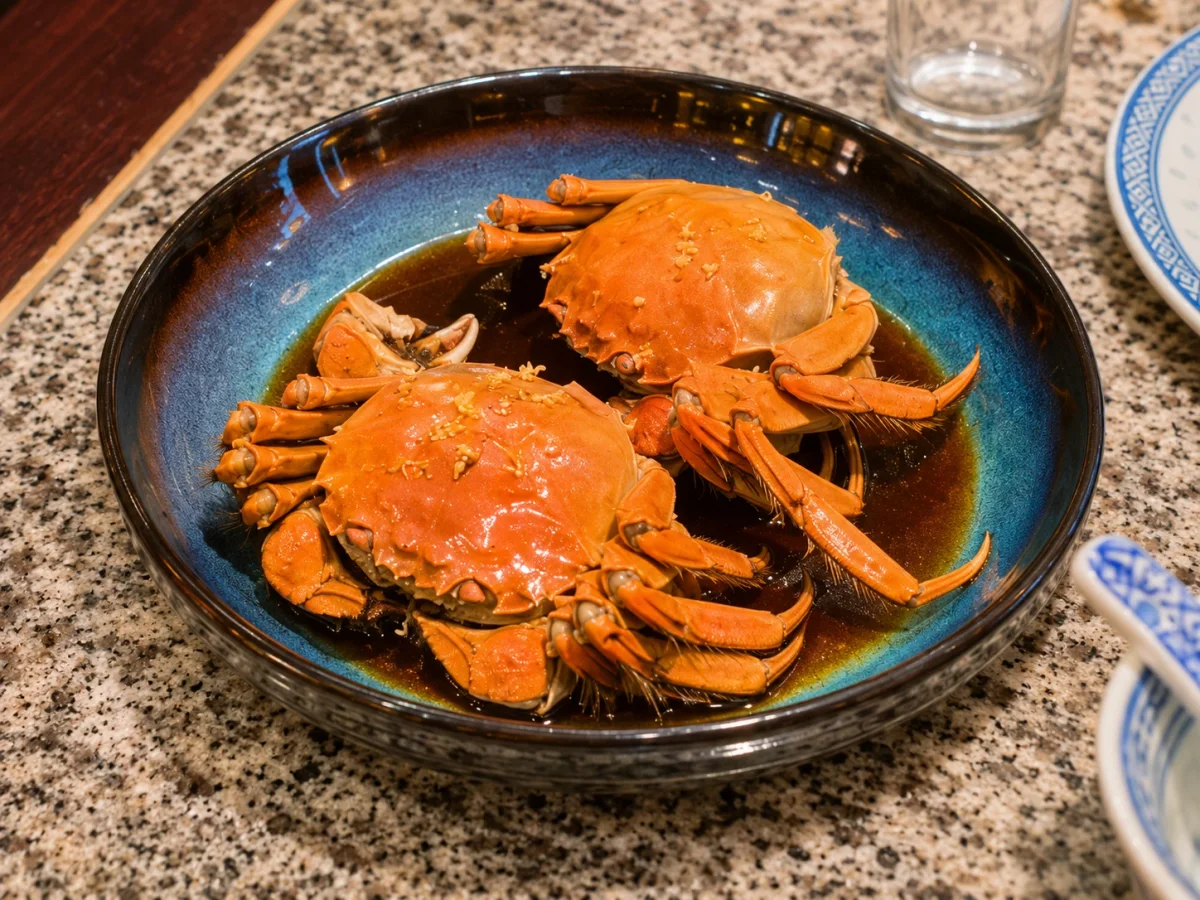
The color of the shell tells you which kind is on the plate.
Shēngzuì (生醉), raw drunk, starts with live crabs. They are cleaned, tied and put straight into the wine brine, where they stay for a day or more. The shell keeps its greenish color, and the roe of a female crab stays soft and molten, almost like sea urchin, the texture that makes raw drunken crab so prized. Shúzuì (熟醉), cooked drunk, starts by steaming the crabs. They come out orange-red, are cooled, and then soak in the brine for about a day. The meat is firm and the roe sets solid, but the wine, soy and spices work their way into both.
Both are served cold as a starter, whole or halved, with a little of the brine poured over. You eat them with your fingers, sucking the brine out of the legs. In Shanghai, raw drunken crab made in a restaurant or shop kitchen is now illegal, so the bright orange crab on most restaurant menus is the cooked kind. A greenish shell means raw.
The wine is almost always Shaoxing yellow wine, and the name on the bottle is usually huādiāo (花雕). Yellow wines are graded by how much sugar they keep, and huadiao is the semi-dry kind: good aged jiāfàn wine was once stored in jars carved with flowers, which is where the name comes from, and today the two names mean much the same thing. Its mellow, slightly sweet depth is what drunken crab tastes of. Cooks often add a spoonful of strong baijiu as well, for a sharper edge.
02
Wine crabs from the Song dynasty to Li Yu
Steeping crabs in wine is at least a thousand years old.
Fu Gong’s Crab Manual (蟹谱), written in 1059, gives a recipe for jiǔxiè, wine crabs. Make them in the twelfth lunar month, it says. Skim clear wine from the jar without letting it touch the lees, mix it with salt and soak the live crabs in it overnight. Take them out, clean the dirt from under the navel flap and pack it with pepper and salt, then stack the crabs in a clean vessel. Boil the salted wine once with a little fresh wine, let it cool overnight, and pour it over the crabs until they are covered. The same manual notes that a single evodia seed (茱萸) tucked under the flap of a crab preserved in wine lees keeps it from going “sandy” for a whole year.
Sandy, shā (沙), was the great fear: drunken crab whose flesh had turned grainy and broken down. Six centuries later the playwright and gourmet Li Yu, who ate twenty or more crabs a day in season, passed on a piece of kitchen lore about it in his Xianqing Ouji. Never take drunken crabs out of the jar by lamplight, he wrote, or the whole jar will turn sandy. The cure was to light an oil lamp over the jar from the first day of steeping, night and day, so the crabs grew used to it.
Li Yu relied on wine-pickled crabs to see him through the months when fresh crabs were out of season, and drank the wine afterwards so as not to waste any of the flavor. He still thought steaming was the best way to eat a crab. These old drunken crabs were all raw: live crabs, salt and wine, kept for months.
03
Why Shanghai restaurants serve only cooked drunken crab
Since 2023 Shanghai has allowed licensed factories to make drunken crab all year, but not restaurants.
Shanghai keeps a municipal list of foods that may not be produced or sold. Its current version, issued in December 2023, bans dead river crabs outright. It also forbids shops and restaurants from making their own raw drunken shrimp, drunken crab, drunken sesarmid crab, salted crab or drunken mud snails, and from serving self-made qiàng xiā, shrimp dressed raw at the table. The ban on restaurant-made raw drunken crab is long-standing and was kept.
What changed in 2023 was the rule for food factories. They used to be allowed to make drunken shrimp and crab only in certain seasons; the new notice lets licensed producers make them all year, with more monitoring and testing promised in return. So factory-made drunken crab from licensed producers can be sold in Shanghai, while restaurant kitchens may make only the cooked kind.
04
What wine does not kill
Alcohol, salt and soy sauce do not make raw crab safe.
The main worry with raw freshwater crab is the lung fluke, Paragonimus. Its cysts live in the flesh of stream crabs and crayfish, and people pick them up by eating those animals raw or half-cooked. Hangzhou’s disease-control doctors put it bluntly: salting and steeping in wine do not kill the cysts. Even a week in liquor leaves them alive, while boiling water kills them easily, and crab that is only partly cooked is still half-raw. In June 2008 an outbreak in Taizhou, Zhejiang, was traced to raw drunk crabs made from stream crabs; sixteen people who had eaten them fell ill, an attack rate of 87.5 percent, after an average of five days.
The same doctors point out that farmed crabs generally do not carry the parasite, and that stream crabs are the real danger. Farmed hairy crabs are the usual drunken crab in Shanghai, so the risk is lower than with wild crabs, but it is not zero. The safest choices are cooked drunken crab, made with crabs steamed all the way through, or raw drunken crab from a licensed producer. Never make drunken crab from dead crabs.
Some chefs have looked for a middle way. Parasite cysts are killed by a combination of temperature and time, not only by boiling: a minute at 100 °C, or around twenty minutes at much lower temperatures. One chef seals live-stunned hairy crabs in vacuum bags with the brine and holds them at 65 °C for twenty minutes before chilling and steeping them. The shell stays greenish and the roe stays soft, though the meat is no longer raw. It needs a thermometer and careful timing, so for most home cooks steaming the crabs through remains the reliable choice.
06
Cooked drunken crab at home
The brine takes ten minutes; the crabs need a day in it.
For 6 hairy crabs of about 150 g each: 300 ml Shaoxing huadiao wine, 150 ml light soy sauce, 50 ml dark soy sauce, 60 g rock sugar, 500 ml water, a few slices of ginger, 2 star anise, a piece of cinnamon, 2 bay leaves, a pinch of Sichuan pepper, 2–3 dried salted plums, a slice of lemon, and 1 tbsp baijiu (optional).
- 1. Make the brine
Simmer the water, soy sauces, sugar, ginger and spices for 10 minutes. Turn off the heat, add the dried plums and lemon, and leave to cool completely. Stir in the huadiao and baijiu only when it is cold.
- 2. Clean and steam the crabs
Use only live crabs. Scrub them, keep them tied, and steam belly up over high heat for about 15 minutes, then rest 2 minutes. Some Shanghai cooks take them off a few minutes early to keep the roe softer; steaming them through is the safer choice.
- 3. Cool and submerge
Let the crabs cool completely. Put them belly up in a container, pour over the brine to cover, and weigh them down with a small plate.
- 4. Chill and lift out
Refrigerate for 20–24 hours, then take the crabs out of the brine so they do not become too salty. Keep them chilled and eat within a few days.
Halve the crabs with scissors, spoon a little brine over them and serve cold. The strained brine can be boiled and reused once for shrimp.
Shanghai classics
- Scallion Oil Chicken
Cold poached chicken · Cold starter, family meals, banquets
- Xiaolongbao
Steamed soup dumpling · Breakfast, lunch or a snack
- Spring Rolls
Fried wrapped snack · Spring Festival, dim sum or a snack
- Scallion Pancakes
Layered wheat flatbread · Breakfast or a hot street snack
- Scallion Oil Noodles
Tossed noodles · Breakfast, lunch or a late snack
- Qingtuan
Steamed glutinous rice dumpling · The weeks before Qingming, early April
FAQ
Questions about Drunken Crab
What is drunken crab?
Crab steeped in Shaoxing wine, soy sauce, sugar and spices and eaten cold. In Shanghai it is usually made with hairy crabs.
What is the difference between raw and cooked drunken crab?
Raw drunken crab is made from live crabs and has soft, molten roe and a dark shell. Cooked drunken crab is steamed first, so the shell is orange and the roe firm.
Is raw drunken crab legal in Shanghai?
Restaurants and shops may not make it themselves. Since 2023 licensed food factories may produce it all year.
Does the alcohol kill parasites?
No. Disease-control doctors say even a week in liquor does not kill lung-fluke cysts. Only thorough cooking does.
What wine is used for drunken crab?
Shaoxing yellow wine, usually aged huadiao, sometimes with a little baijiu. Soy sauce, rock sugar and spices balance it.
How long does drunken crab need to soak?
Cooked drunken crab needs about 20–24 hours in the brine. Leave it much longer and it turns too salty.
How much does drunken crab cost in Shanghai?
A benbang restaurant near Chuansha charged ¥78 for two in 2024.
When is drunken crab in season?
Autumn, with full hairy crabs, and early summer, with young “June yellow” crabs.
Sources
Sources and further reading
- 1 Xiepu (Crab Manual), vol. 2: “Wine crabs” and keeping wine-lees crabs from turning sandy (in classical Chinese) (in Chinese)Fu Gong, Song dynasty (1059), Siku Quanshu text, Wikisource ↗
- 2 Xianqing Ouji, “Food and Drink: Meat,” on crabs and taking drunken crabs from the jar (in classical Chinese) (in Chinese)Li Yu, Qing dynasty (1671), Wikisource ↗
- 3 Shanghai’s revised list of banned foods: restaurants still may not make raw drunken crab (in Chinese)Chen Xihan, Jiefang Daily, via Shanghai Municipal Government (2024) ↗
- 4 Ancient China’s love of crab-eatingWang Lin, The World of Chinese (2021) ↗
- 5 Shanghai lifts the seasonal limit on factory-made drunken shrimp and crab (in Chinese)Laodong Bao, via Sina Finance (2023) ↗
- 6 Disease control experts: eating drunken crab means eating parasites (in Chinese)Zhang Yuxin, Dushi Kuaibao, via Hangzhou Net (2019) ↗
- 7 An outbreak of acute paragonimiasis caused by uncooked drunk crabs in Taizhou, Zhejiang (in Chinese)Lin Chunping, Disease Surveillance (疾病监测) ↗
- 8 Shanghai drunken crab and shrimp with exact proportions (video, in Chinese)Chihuo Shanghai Xiao Ayi (吃货上海小阿姨), Bilibili (2023) ↗
- 9 Huadiao cooked drunken crab: the brine, the steaming and a 24-hour soak (video, in Chinese)Xiao Wen Ge Chichichi (小文哥吃吃吃), Bilibili (2022) ↗
- 10 Molten crab roe and the food-safety problem of raw drunken crab: cooking at 65 °C (video, in Chinese)Yang Guang (杨光_建厨师), Bilibili (2023) ↗
- 11 A Shanghai benbang restaurant meal with huadiao drunken crab at ¥78 for two (video, in Chinese)Fang Fang de Kuaile Shenghuo (方芳的快乐生活), Bilibili (2024) ↗
Last updated November 2026