
01
A green dumpling for Qingming
Qingtuan are dumplings of green glutinous rice dough, filled and steamed, that usually appear in the weeks before Qingming.
The dough is glutinous rice flour worked with the juice or purée of a green spring plant, which gives it its color and a light grassy, herbal smell. It is wrapped around a filling, rolled into a ball and steamed. The skin is soft, chewy and slightly springy; anyone who has eaten Japanese mochi, and especially yomogi mochi, made with the same mugwort, will find it close kin. The classic filling is smooth red bean paste, mildly sweet.
Qingtuan are a food of the season, not of the year. They are sold for only a few weeks, usually in the run-up to Qingming, the festival in early April when families visit their ancestors’ graves, and they once went on the table as an offering. Today they are mostly eaten simply because it is spring.
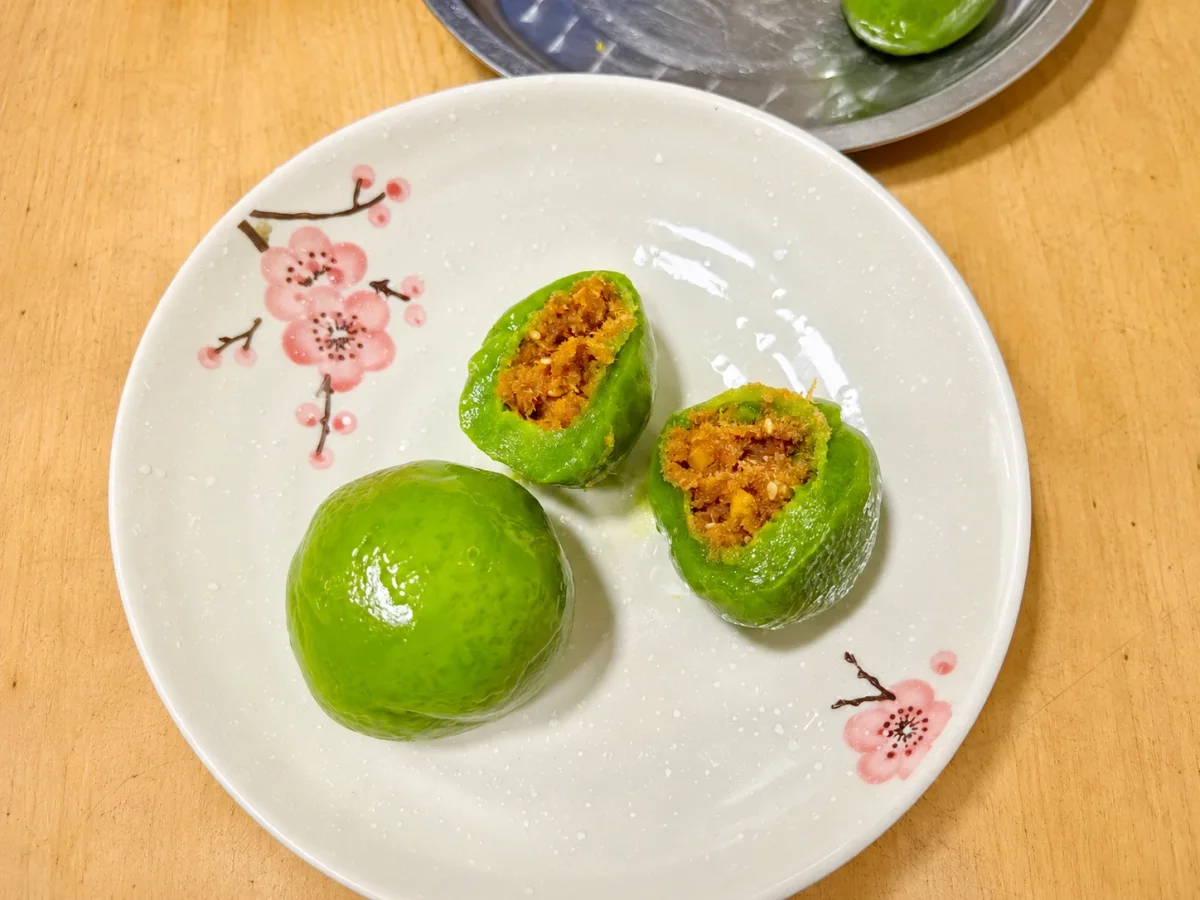
They belong to Jiangnan, the lower Yangtze. In Shanghai the name is qingtuan, “green dumpling”; in Ningbo and Jinhua, in Zhejiang province, the same thing is called qingmingguo, 清明粿, “Qingming cake.” Fillings have multiplied: alongside red bean paste, Shanghai now eats savory qingtuan of salted egg yolk with pork floss, or diced pork with spring bamboo shoots. The photograph on this page shows the salted egg yolk and pork floss kind, one whole and one cut in half: a shiny, bright green skin around a dense, savory filling flecked with sesame.
02
Where the green comes from
Mugwort is the best-known plant, but not the only one.
Some cooks use mugwort, 艾草; some use jiangmai grass, 浆麦草; others the juice of another green vegetable, pounded together with the glutinous rice flour. In Shanghai the shops talk about smell as much as color: Xinghualou’s qingtuan come out of the steamer with a strong young-wheat fragrance, while Wangjiasha’s best seller is made with mugwort. In Jinhua, cudweed, 鼠麴草, which grows along the local rivers, is used more often than mugwort, and gives the cakes a different color and texture.
Keeping the green bright takes work. One traditional method soaks the mugwort in lime water, boils it in a copper pot and presses out the juice; in Ningbo a pinch of baking soda goes into the pot while it boils. Home cooks blanch the leaves for thirty seconds in salted water, plunge them into iced water and use the purée quickly: left standing, it turns the dough a duller green.
The plants were chosen for more than color. Mugwort and other wild herbs were traditionally believed to keep away insects and the ailments of a warm, damp spring. In Shanghai, eating the first seasonal foods of the year is still called “tasting spring,” 尝春, and for many people qingtuan is one of the first signs that spring has come.
| Plant | Where it is used |
|---|---|
| Mugwort (艾草) | Ningbo; Wangjiasha in Shanghai; the home recipe on this page |
| Jiangmai grass (浆麦草) | Jiangnan |
| Cudweed (鼠麴草) | Jinhua, Zhejiang, where it is more common than mugwort |
| Other green vegetable juice | Pounded into the rice flour, another option |
03
From green rice to green dumplings
Qingtuan are usually traced to the old custom of eating cold food before Qingming.
Qingming absorbed an older festival, Hanshi, the Cold Food Festival, which fell a day or two before it. On Hanshi no fire could be lit, so food was prepared in advance and eaten cold, and qingtuan were traditionally eaten cold too.
The clearest early link is in a Ming notebook, the Qixiu Leigao of Lang Ying. Under the heading “Mantou and green-and-white dumplings,” he writes that the ancients, at the Cold Food Festival, gathered leaves to dye rice green as an offering, to nourish the yang energy, and that this had now turned into green and white dumplings, 青白團子, with the same meaning. It is his own reading of the custom, not a recipe, but it shows that green dumplings were eaten at this season in the Ming.
A recipe, of sorts, appears in Yuan Mei’s Suiyuan Shidan of 1792. In his list of dim sum he gives green cakes and green dumplings a single line: 搗青草為汁,和粉作粉團,色如碧玉. Pound green grass for its juice, mix it with rice flour into dumplings, and they come out the color of green jade. A few decades later, the Suzhou writer Gu Lu recorded in his Qing Jia Lu, as Tianjin Daily quotes it, that qingtuan and cooked lotus root were sold in the markets for households to offer their ancestors at Qingming.
04
Qingmingguo in Zhejiang
In Zhejiang villages they are still made at home.
In Anshan village in Ningbo, 69-year-old Tao Huifang makes qingmingguo every spring. She picks the youngest mugwort in the fields at dawn, then soaks rice, boils the mugwort, kneads the dough, fries the filling, shapes and steams, a routine she knows by heart. They are made before Qingming for two reasons: the mugwort is at its best then, and the cakes were needed for the ancestor offerings. Tao repeats a local saying, that eating qingmingguo keeps you from falling ill all year.
Ningbo makes them both sweet and savory. The sweet ones are filled with red bean paste or black sesame, rolled into balls and finished with a coat of soaked glutinous rice grains. The savory ones are filled with pork, spring bamboo shoots and pickled mustard greens, stir-fried first, and shaped into crescents like jiaozi with crimped edges. In the village they are steamed over a wood fire for about twenty minutes after the water boils. Old Ningbo families still prefer qingmingguo wrapped by hand to the factory-made kind, which they find lacks the plain, original taste; Tao learned from her mother and now teaches the village children.
In Jinhua, Lou Hongliang, a teacher who holds a provincial heritage title for Jinhua-style (婺式) pastries, sees qingtuan as a seasonal food made from edible plants growing close at hand; gathering them is still tied to spring outings into the countryside.
05
Shanghai’s queues and new fillings
Every spring the old pastry shops of Shanghai draw queues around the block.
The modern craze has a date. On March 31, 2016, more than 300 people stood in a 65-meter queue outside Xinghualou, 杏花楼, on Fuzhou Road, for a new qingtuan filled with salted egg yolk and pork floss, at 8 yuan each; one buyer had waited six hours. They were shaped and steamed on the spot, a chef turning out three or four a minute and each steamer taking just over ten minutes. Shendacheng and Wangjiasha had queues for the same filling that day, so who made it first is unclear. The popular newcomer of the previous few years had been malantou, a wild spring green, and it is still sold.
Now sales peak from mid-March and the shops compete on new fillings. In 2026 Xinghualou added a “spring three delicacies” qingtuan of fresh pork, bamboo shoots and shiitake, and a bean paste version with a quarter less sugar. Shendacheng’s mashed potato and bacon went viral on social media. Wangjiasha leans on the classics: most of the nearly 60,000 qingtuan it made a day were mugwort with red bean paste, made from Haimen red beans that are boiled, sieved of their skins and washed, then stirred by hand in an iron wok over the open fire of an old earthen stove. Xinya (新雅) turned yanduxian, the city’s spring soup of fresh and cured pork with bamboo shoots, into a filling, and sold a large-prawn qingtuan for 16 yuan apiece.
The buyers have changed too. Young people photograph their qingtuan and post them online, which spreads the craze further. Visitors from other provinces buy them as gifts to take home: one man from Anhui bought three of every flavor to send back by courier. Outside Xinya on Nanjing Road, a Russian family on holiday stopped, read the signs and bought two to eat on the spot.
| Shop | Known for |
|---|---|
| Wangjiasha 王家沙 | Mugwort and red bean paste, the bean paste fried by hand |
| Xinghualou 杏花楼 | Salted egg yolk and pork floss; a young-wheat fragrance |
| Shendacheng 沈大成 | Mashed potato and bacon, alongside classic red bean |
| Xinya 新雅 | Yanduxian filling; large prawn |
| Wangbaohe 王宝和 | Crab roe with shrimp; malantou with bamboo shoots |
| Taikang 泰康 | Red bean with malted milk |
06
Buying and eating qingtuan
Qingtuan need no cooking: buy them fresh and eat them the same day.
Fresh qingtuan are eaten as they are, at room temperature, as they traditionally were, or warm if you catch a batch straight from the steamer. They do not keep: Shanghai’s food inspectors class them as perishable, and chilled ones turn hard. To revive them, steam them briefly, or microwave them for about thirty seconds with any plastic wrap removed, and stop as soon as they are soft, or the skin slumps and splits. The dough is sticky, so take small bites, and remember that they are rich in sugar and fat.
Start with two
For a first try, have one mugwort and red bean paste, the classic, and one salted egg yolk and pork floss.
Buy singly
Shops sell them one at a time as well as in boxes, so a mix of flavors is easy.
Expect a queue
From mid-March the queues at the old Shanghai brands can be long, especially at weekends.
Check before you buy
Smell and look: buy ones that smell fresh and look naturally green, and skip any with an off smell through the wrapping.
Outside Shanghai
The old brands also sell through supermarkets, convenience stores and online shops, and Xinghualou ships boxes by courier to Jiangsu, Zhejiang and Anhui.
07
Mugwort qingtuan at home
The work is in the purée: keep it bright and use it fast.
This makes 15 with red bean paste, adapted from The Woks of Life. A blender struggles with a small amount of leaves, so the purée makes about 540 g, twice what you need; freeze the rest. Shop-bought red bean paste is fine. If you forage mugwort, be certain of the plant, since some poisonous plants look similar.
Makes 15: 6 ounces (about 170 g) tender mugwort leaves; 1 teaspoon salt; ¼–½ cup water for blending; ⅓ cup wheat starch; ½ cup (120 ml) boiling water; 2 cups glutinous rice flour; 1 tablespoon lard or butter; ⅓ cup powdered sugar; 1 teaspoon vanilla extract; 375 g red bean paste (15 balls of 25 g); a little oil for brushing.
- 1. Blanch the mugwort
Wash the leaves until the water runs clear. Boil 6 cups of water with the salt, blanch the leaves for 30 seconds and plunge them into iced water.
- 2. Purée
Squeeze the leaves lightly and blend with ¼–½ cup water until smooth, for about 540 g of purée. Use half, roughly 270 g, straight away.
- 3. Make the dough
Stir the wheat starch with the boiling water into a ball. In another bowl, knead 270 g mugwort purée with the glutinous rice flour, lard, sugar and vanilla, then knead in the wheat starch dough until smooth and evenly green. It should not crack when pinched.
- 4. Fill
Divide the dough into 15 pieces of about 50 g. Press a deep well into each, put in a ball of red bean paste, pinch the opening closed and roll smooth.
- 5. Steam
Set them on squares of parchment at least 1.5 cm (½ inch) apart and steam over boiling water on high heat for 10 minutes. Do not steam longer, or they burst.
- 6. Finish
Brush each with a very thin coat of oil to stop them drying and cracking. Keep 1–2 days at room temperature or 5–6 days in the refrigerator.
Sources [9]
08
More from Shanghai and the Chinese calendar
Other dishes on the atlas.
Chinese desserts for beginners
Nian gao, tangyuan, zongzi, mooncakes and the other sweets of the festival year.
Read the desserts guide →Mooncakes
The Mid-Autumn pastry, and how its fillings have changed.
Read about mooncakes →Xiaolongbao
Shanghai’s soup dumplings.
Read about xiaolongbao →Shanghai classics
- Spring Rolls
Fried wrapped snack · Spring Festival, dim sum or a snack
- Xiaolongbao
Steamed soup dumpling · Breakfast, lunch or a snack
- Scallion Pancakes
Layered wheat flatbread · Breakfast or a hot street snack
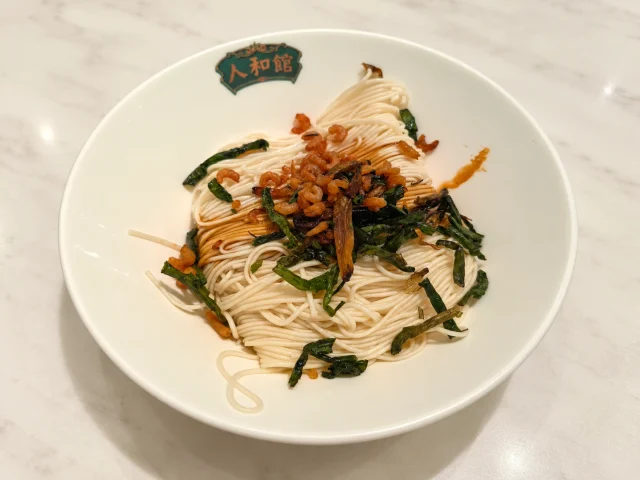
- Scallion Oil Noodles
Tossed noodles · Breakfast, lunch or a late snack
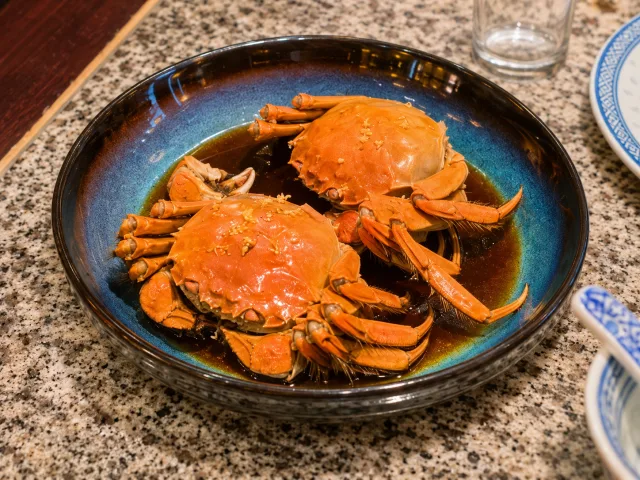
- Drunken Crab
Crab steeped in wine and soy · Cold starter in autumn and early summer
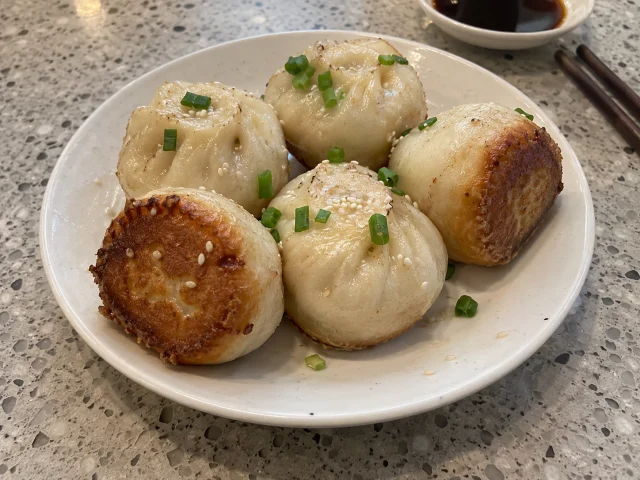
- Shengjian
Pan-fried pork bun · Breakfast, snack or light lunch
FAQ
Questions about Qingtuan
What does qingtuan taste like?
The skin is soft and chewy, like mochi, with a light grassy smell from the green plant. The classic filling is sweet red bean paste; savory ones taste of whatever is inside, such as salted egg yolk and pork floss.
Should qingtuan be eaten warm or cold?
Fresh ones at room temperature, as they traditionally were. Chilled ones harden; steam them briefly or microwave for about 30 seconds without the plastic wrap.
Is qingtuan the same as qingmingguo?
In Ningbo and Jinhua, yes: qingmingguo is the local name for qingtuan. Savory Ningbo ones are shaped like jiaozi.
Is qingtuan vegetarian?
The classic red bean paste kind usually is, though some recipes use lard in the dough. Savory fillings such as egg yolk with pork floss, or pork with bamboo shoots, are not.
How long does qingtuan keep?
Not long. Eat bought ones the same day; homemade ones keep 1–2 days at room temperature or 5–6 days chilled, reheated briefly.
Can I make qingtuan without fresh mugwort?
Yes. Cooks also use jiangmai grass, cudweed or the juice of other green vegetables; frozen mugwort purée, made ahead, works too.
Sources
Sources and further reading
- 1 Lang Ying, Qixiu Leigao (七修類稿), juan 43: “Mantou and green-and-white dumplings” (饅頭青白團) (in Chinese)Ming dynasty, Wikisource ↗
- 2 Yuan Mei, Suiyuan Shidan (隨園食單), dim sum list: “Green cakes and green dumplings” (青糕、青團) (in Chinese)1792, Wikisource ↗
- 3 “Qingming” (清明), on qingmingguo in Jinhua (in Chinese)China Culture Daily, via China Intangible Cultural Heritage Network (April 3, 2025) ↗
- 4 “Qingtuan: A taste of spring in every bite”Shanghai Municipal People’s Government, English website (April 2, 2026) ↗
- 5 “The taste of Qingming” (舌尖上的清明) (in Chinese)Tianjin Daily, via China Daily (April 3, 2023) ↗
- 6 Chen Yixin and Chen Yiping, “Old Shanghai brand’s new salted egg yolk and pork floss qingtuan goes viral; a six-hour queue to buy” (上海老字号新出蛋黄肉松青团成“网红”,排队6小时才能买到) (in Chinese)The Paper (March 31, 2016) ↗
- 7 Zhang Yuyun, “Shanghai queues again for qingtuan” (上海又开始大排排排长龙!不愧是时令顶流) (in Chinese)Xinmin Evening News, via Sina Finance (March 25, 2026) ↗
- 8 Lin Bo and Zhuang Yuan, “Qingmingguo, the taste of old Ningbo” (老宁波人的味道清明粿) (in Chinese)China News Service (April 1, 2023) ↗
- 9 Judy Leung, “Qingtuan (Mugwort Mochi)”The Woks of Life (updated March 17, 2024) ↗
Last updated November 2026