
01
A bun that is steamed and fried at once
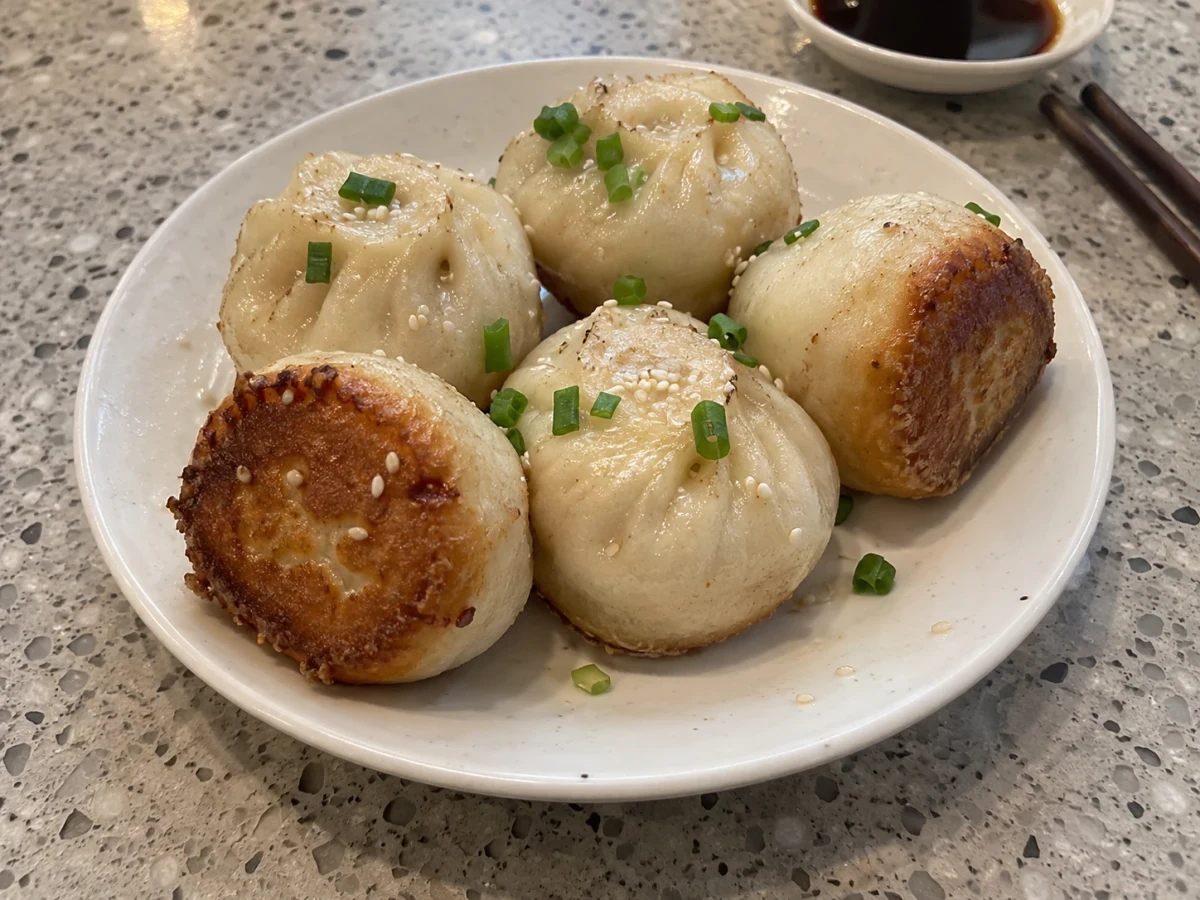
A good shengjian has three textures in one bite: a soft top, a juicy filling and a bottom fried hard enough to crack.
The cook lines the raw buns up in a wide, shallow cast-iron pan, pours a ring of oil around them, then throws in about half a bowl of water and slams on a heavy lid. There is a hiss and a cloud of steam. For the next few minutes the pan is turned on the fire by hand, with a cloth or tongs on the rim, so every bun gets the same heat. The water steams the tops; once it has boiled away, the oil fries the bottoms. Before the pan comes off, the cook scatters chopped scallion and white sesame over the top.
Shen Jialu, who has written about Shanghai food for decades, eats one in a fixed order: bite through the skin and drink the juice, eat the meat, and finish with the base, which by then is “golden, a little thick, hard in just the right way,” tasting of pork fat and rapeseed oil. That crisp base is what separates a shengjian from every steamed bun. It also explains the rule of eating them at once: the moment they leave the pan the steam inside starts softening the bottom.
02
Why a filled bun is called mantou, and why it comes four to a liang
The full name, 生煎馒头 (shēng jiān mán tou), means “raw-fried mantou,” and both halves need explaining.
“Raw-fried” means the buns go into the pan uncooked; nothing is steamed first. Mantou, in northern China today, is a plain steamed bun with no filling, and a filled one is a baozi. Shanghai and the rest of Jiangnan kept the older usage, in which every bun is a mantou, filled or not. That is why xiaolongbao are xiaolong mantou in Shanghai, and why a Shanghainese menu can list a pork-filled bun as a mantou without anyone blinking.
Shengjian are ordered by the liang (两), a weight of 50 grams. One liang of flour used to make four buns, so “one liang” became the name of a four-bun portion, and it still is: shops price shengjian per liang or per four. Under rationing a liang also meant a liang of grain coupons. Shen Jialu remembers paying one liang of coupons and ten fen for four at the shop at the end of his lane, and notes that the four-to-an-order rule has lasted to this day.
03
Tiger stoves, teahouses and Luo Chun Ge
Shengjian came up from the street: the snack of hot-water shops and teahouse customers, not of restaurants.
The Shanghai government’s food guide says the buns began in neighboring Suzhou in the early 1910s and reached Shanghai by the 1920s, where they were sold in teahouses and next to the hot-water shops called 老虎灶, “tiger stoves,” which sold boiling water to households without a stove of their own. Shen Jialu describes the classic setup: a half-width shopfront beside the tiger stove, a stove made from an old tar drum at the door, an iron pan on top, and two assistants pleating buns at a long board. The cooks, he writes, mostly came from Danyang, Wujin and Wuxi in Jiangsu, and when rain emptied the street they banged the rim of the pan with the spatula to call customers back.
The most famous early name was 萝春阁, Luo Chun Ge. In Shen Jialu’s telling it began as a teahouse owned by Huang Chujiu (1872–1931), the Shanghai entrepreneur best known for a patent “brain tonic” and the Great World amusement hall. In the 1920s teahouses did not make snacks, and customers sent waiters out to buy them. Huang liked the buns from a lane stall on Fuzhou Road, then called Simalu; when the stall’s cook was fired for refusing to skimp on ingredients, Huang hired the cook for Luo Chun Ge, and the teahouse’s buns became famous. After Huang’s death the business changed hands and eventually became a shop that sold only shengjian.
Luo Chun Ge closed around 2005. It reopened on Middle Zhejiang Road early in 2026, with queues before the 9 a.m. opening, selling four buns for 9 yuan. The Shanghai government guide calls it a pioneer of the soupy hunshui style and says the revived shop has gone back to seasoning the filling with traditional soy sauce, which gives a darker “red soup.”
04
Hunshui and qingshui: the two schools
Every Shanghai shengjian conversation turns, sooner or later, to “muddy water” and “clear water.”
Hunshui (浑水, “muddy water”) buns have aspic in the filling and burst with soup; qingshui (清水, “clear water”) buns have none and rely on the meat’s own juices. The aspic is pork skin simmered until it gives up its gelatin, set, chopped and mixed into the minced pork; in the pan it melts into hot broth. To hold that broth, hunshui buns use a semi-leavened dough, which stays thin and does not soak it up, and they are usually fried pleats down. Qingshui buns use fully raised dough and are fried pleats up, so they look like little baozi with a crisp foot.
The pleats have their own nicknames. In Shanghai kitchen talk, buns fried pleats-up are the 本帮 (benbang, local) kind and buns fried pleats-down the 洋帮 (yangbang, outside) kind. Pleats-down buns develop a broader, thicker crust because the gathered dough sits on the iron; pleats-up buns keep a smooth, round base. People who swear by one camp, it is often said in Shanghai, still slip off to the other.
Qingshui is not simply dry. In a fully raised bun the juice soaks into the dough, so the skin above the meat turns moist and savory. Huang Qifang, writing in 2012, explains that Da Hu Chun’s buns have no soup because “the juice has been absorbed by the skin.”
| Hunshui 浑水 | Qingshui 清水 | |
|---|---|---|
| Filling | Pork mixed with aspic | Pork only |
| Dough | Semi-leavened, thinner | Fully leavened, bready |
| Usually fried | Pleats down | Pleats up |
| Inside | Hot soup that spurts | Juice soaked into the skin |
| Best-known shops | Dong Tai Xiang, Luo Chun Ge, Xiaoyang (thin-skinned) | Da Hu Chun, Lao Zheng He |
05
Da Hu Chun: the clear-water standard
Da Hu Chun (大壶春) is the shop most Shanghainese name first for the qingshui style.
The Shanghai government dates it to 1932. Its main shop is at 136 Middle Sichuan Road, and in 2026 four buns cost 11 yuan. It appears on the Shanghai government’s 2024 list of Bib Gourmand restaurants in Huangpu district, and fans call its buns the “naked beauty with pleats facing the sky,” because they have no soup to hide behind. The buns are deliberately rough-looking. Huang Qifang describes them as lopsided, some almost cone-shaped, and says that is part of the house style, along with a base “like a crisp biscuit.”
Shen Jialu passes on a story from a cook who once worked there. In 1949, during the run on gold in Shanghai, Da Hu Chun stood across the street from the Central Bank. People queuing to change money had to hold their place for hours, so they ate shengjian on the spot, and business boomed; one quick-witted waiter slipped out, traded some gold himself and made a little fortune. Huang Qifang adds that the founder, Tang Miaoquan, was a nephew of Luo Chun Ge’s founder, which does not match Shen Jialu’s account of Huang Chujiu; the founder’s name also appears as 唐妙泉 in some records.
Today the shop sells more than plain pork. In 2021 a set of two shrimp-and-pork and two plain pork buns cost 13 yuan, a crab version 14.5 yuan and a foie gras version 25.5 yuan, with small wontons at 12 yuan a bowl. For a first visit, the plain pork bun is the one the shop’s reputation rests on.
06
Xiaoyang and the big, thin-skinned soup bun
Xiaoyang Shengjian (小杨生煎, Yang’s Fry-Dumpling) made the soup-filled bun bigger, thinner and famous.
Xiaoyang started on Wujiang Road in 1994 as a scruffy stall. Its buns are large, with a skin Huang Qifang compares to a xiaolongbao’s and a lot of soup. By the 2000s the queues on Wujiang Road were part of the city’s scenery: Shen Jialu likens them to the line for visas outside the American consulate, and Huang Qifang warns of three queues in a row, to order, to collect the buns and to find a seat, at least half an hour in all. The price rose from 2.8 yuan a liang to 6 yuan by 2012; in 2026 four buns cost 13 yuan at its Huanghe Road shop.
Traditionalists argue about whether it counts as a proper shengjian. Huang Qifang, who prefers the old style, points out that a traditional bun is only about two-thirds the size of a Xiaoyang bun and that the soul of shengjian is the base, not the soup. Still, Xiaoyang founded a school of its own: huge, thin-skinned, soup-filled buns, copied by many other shops. It has since grown into a national chain with shrimp and crab fillings.
07
Dong Tai Xiang, Shu Cai Ji and the neighborhood shop
The soupy style has its own heritage shop, and every district has its own neighborhood favorite.
Dong Tai Xiang (东泰祥) is the leading hunshui shop, and the Shanghai government guide says it is the only shengjian restaurant whose semi-fermented dough technique is listed as intangible cultural heritage. Its buns are known for staying plump instead of wrinkling as they cool. In this kitchen each wrapper is weighed at 20 grams, give or take half a gram, and each filled bun at 45 grams, and the time from mixing to frying is recorded for every batch. Many of the cooks are women. Four buns cost 12 yuan in 2023 and 13 yuan in 2026 at the 24-hour shop on North Chongqing Road.
Shu Cai Ji (舒蔡记), near People’s Square, keeps four big woks outside the door: two for buns, one for salted-pork rice and one for fried noodles. Huang Qifang describes the cook judging the heat by sound alone, never lifting the lid to look, and recommends standing first in line for the next pan. A liang of buns with a bowl of salted-pork-and-vegetable rice and the free soybean and pork-bone soup is, in Huang’s words, a meal full of Shanghai’s street-level spirit. Four buns cost 10 yuan there in 2026; Lao Zheng He (老正和), a few streets away, sells a juicier qingshui bun at 11 yuan.
Away from the famous names, shengjian are still cheap. In 2024 a neighborhood shop was selling a liang of four for 5 yuan and two liang for 10.
| Shop | Style | Address | Price |
|---|---|---|---|
| Da Hu Chun 大壶春 | Qingshui, pleats up | 136 Middle Sichuan Road | 11 yuan |
| Lao Zheng He 老正和 | Qingshui, a little juicier | 11 South Sichuan Road | 11 yuan |
| Dong Tai Xiang 东泰祥 | Hunshui, semi-leavened | 188 North Chongqing Road, open 24 hours | 13 yuan |
| Luo Chun Ge 萝春阁 | Hunshui, soy-dark “red soup” | 425 Middle Zhejiang Road | 9 yuan |
| Shu Cai Ji 舒蔡记 | Thin skin, sweet-savory broth | 120 Middle Zhejiang Road | 10 yuan |
| Xiaoyang 小杨生煎 | Big, thin-skinned, very soupy | 97 Huanghe Road and chain shops | 13 yuan |
08
Cinema dates, curry beef soup and a city map of buns
For many Shanghainese, shengjian are tied to a particular street and a particular decade.
Shen Jialu remembers that in the 1960s and 1970s the best-known shop was Chunjiang (春江) on Huaihai Road. Couples came out of the Huaihai Cinema opposite and happily queued half an hour for buns, and on Sundays the line outside ran beneath the political slogans of the day. The building later became a department store and then stood empty. He also lists Jinzhong on Middle Jinling Road, which sold its buns alongside snails in wine lees and, unusually, coffee.
As shops grew, they began serving the buns with soup: curry beef soup, or a soup of fried tofu puffs and glass noodles. Curry beef vermicelli soup is now the standard partner, and the Shanghai government guide calls it the classic pairing, its spice cutting the oil. Shanghai’s internet users have even drawn up maps of shengjian shops across the city, and chains such as Fengyu have put them on almost every street.
09
How to eat shengjian without scalding yourself
The soup in a hunshui bun is very hot and under pressure, so bite a small hole and drink it before you eat the bun.
Bite a small window first
Put the bun on a spoon, nip a small hole in the top and sip the soup before eating the rest. Biting straight in can send hot soup across the table and onto someone else’s clothes.
Vinegar comes last
Locals often skip vinegar for the soup and the meat so the pork tastes clean, and dip the crisp base and the dough in vinegar at the end.
Eat them straight from the pan
Order from a pan that has just come off the fire. Buns that have been sitting in the pan for a while lose their crunch.
Order by the liang
One liang is four buns. Four of the big soup-filled ones make a light meal; with soup, two liang is plenty for most people.
Add a bowl of soup
Curry beef with glass noodles is the usual choice; tofu-puff and glass-noodle soup, or small wontons, are common too.
10
Shengjian, xiaolongbao, guotie and shuijianbao
Several Chinese dumplings and buns are fried on one side or filled with soup, and they are easy to mix up.
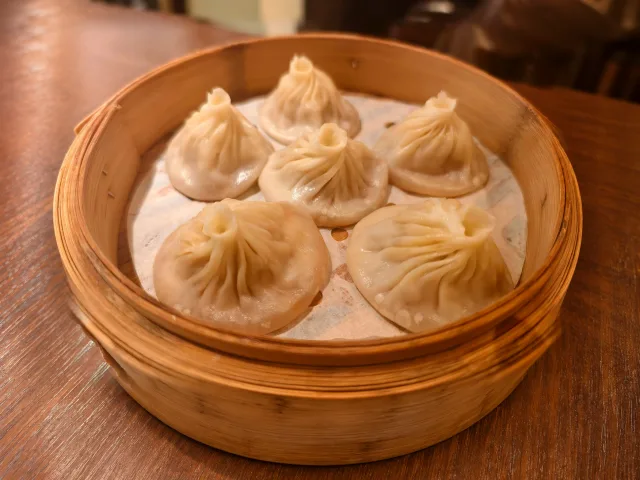
Xiaolongbao and hunshui shengjian both rely on aspic for their soup, but xiaolongbao are small, made with unleavened dough and steamed in bamboo baskets. Guotie, potstickers, are dumplings rather than buns: unleavened wrappers, usually long and open at the ends, fried on one side. Northern China has 水煎包, shuijianbao, water-fried buns made the same way as shengjian, usually larger and often filled with vegetables as well as meat.
| Name | Dough | Cooking | Soup inside? |
|---|---|---|---|
| Shengjian 生煎 | Raised or half-raised | Fried and steamed in one pan | Hunshui yes, qingshui no |
| Xiaolongbao 小笼包 | Unleavened, thin | Steamed in baskets | Yes |
| Guotie 锅贴 | Unleavened dumpling wrapper | Fried on one side | Little |
| Shuijianbao 水煎包 | Raised | Fried and steamed, northern style | Usually not |
11
Shengjian outside Shanghai
The bun has traveled with Shanghainese cooks, and its rules travel with it.
In Hong Kong, a Shanghai native who missed the buns opened Cheung Hing Kee (张兴记) in Tsuen Wan in 2012 after learning from an older Shanghai cook; it has been a Bib Gourmand in the MICHELIN Guide Hong Kong and Macau since 2016 and later moved to Tsim Sha Tsui. Its specification is as exact as any heritage shop’s: an 18-gram wrapper, 35 grams of filling and 18 pleats. The buns are made only to order, because a wrapped bun keeps rising and its dough starts to drink the soup, and they are fried in cast-iron pans brought from Shanghai, first on high heat for the crust, then for about ten minutes on lower heat.
Sources [5]
12
Soup-filled shengjian at home
For about 24 buns. Filling: 300 g minced pork (about 30 percent fat), 1 tablespoon light soy sauce, 1 teaspoon sugar, ½ teaspoon salt, white pepper, a little grated ginger, 3 tablespoons water in which a pinch of Sichuan peppercorns has been steeped, 1 teaspoon sesame oil, and about 200 g firm pork-skin aspic, finely chopped. Dough: 300 g plain flour, 3 g instant yeast, 2 g baking powder, a pinch of salt, about 165 ml water and 1 tablespoon lard or oil. To finish: oil, water, white sesame seeds and chopped scallion.
- 1. Make the filling
Stir the soy sauce, sugar, salt, pepper and ginger into the pork, then beat in the peppercorn water a little at a time until the meat is sticky and has absorbed it. Fold in the sesame oil and the chopped aspic and chill for 30 minutes so the aspic stays solid while you wrap.
- 2. Make a half-raised dough
Mix the flour, yeast, baking powder and salt, add the water and fat and knead to a soft, smooth dough. Rest it for 30 minutes only: you want it barely risen, so it stays thin enough to hold the soup.
- 3. Wrap
Divide into pieces of about 20 g, roll each into a round 10 cm across, thinner at the edge, and pleat it shut around a generous spoonful of filling. Set them on a floured tray.
- 4. Fry
Film a heavy frying pan with enough oil to cover the base, set the buns pleat side down and close together, and fry over medium heat until the bottoms are pale gold.
- 5. Steam
Pour in water to come about a third of the way up the buns, cover at once and cook over medium-low heat for 7 to 10 minutes, until the water has gone and you hear frying again.
- 6. Finish
Scatter sesame and scallion over the top, cover again and give it a minute over higher heat to crisp the base. Serve straight from the pan, with vinegar on the side.
For a qingshui bun, leave out the aspic, let the dough rise fully and fry the buns pleats up. If the bottoms soften as they sit, the oil was too scant: the base needs enough oil to fry, not just to stop sticking.
13
More from Shanghai
Xiaolongbao
The steamed soup dumpling that shares the aspic trick.
Read about xiaolongbao →Spring rolls
Shanghai’s New Year “gold bars,” sold at many of the same shops.
Read about spring rolls →Baozi
Steamed buns across China, from Beijing to Tianjin’s Goubuli.
Read about baozi →Shanghai classics
- Scallion Pancakes
Layered wheat flatbread · Breakfast or a hot street snack
- Xiaolongbao
Steamed soup dumpling · Breakfast, lunch or a snack
- Spring Rolls
Fried wrapped snack · Spring Festival, dim sum or a snack
- Scallion Oil Noodles
Tossed noodles · Breakfast, lunch or a late snack
- Drunken Crab
Crab steeped in wine and soy · Cold starter in autumn and early summer
- Qingtuan
Steamed glutinous rice dumpling · The weeks before Qingming, early April
FAQ
Questions about Shengjian
What is shengjian?
Shengjian, or shengjian mantou, are Shanghai pan-fried pork buns: raised-dough buns fried in oil and steamed under a lid in the same pan, so the tops are soft and the bottoms crisp.
Is shengjian the same as xiaolongbao?
No. Xiaolongbao are small steamed dumplings with unleavened skins. Shengjian are buns of raised dough, fried and steamed in a flat iron pan with a crisp base.
Why is shengjian called mantou?
In Shanghai and Jiangnan, mantou still means any bun, filled or not. The northern distinction between plain mantou and filled baozi never took hold there.
What does hunshui and qingshui mean?
Hunshui buns have pork-skin aspic in the filling and are full of soup. Qingshui buns have no aspic, use fully raised dough and keep the juice in the skin.
How many shengjian are in one liang?
Four. One liang of flour used to make four buns, and an order of shengjian is still called a liang.
How much does shengjian cost in Shanghai?
In 2026 well-known shops charged 9 to 13 yuan for four, and neighborhood shops can be cheaper; one was selling four for 5 yuan in 2024.
Where is the best shengjian in Shanghai?
For the clear-water style, Da Hu Chun on Middle Sichuan Road; for the soupy style, Dong Tai Xiang, Luo Chun Ge or Xiaoyang. Locals disagree, and that is part of the fun.
How do you eat shengjian?
Put it on a spoon, bite a small hole and sip the soup, then eat the filling, and dip the crisp base in vinegar last.
What do you eat with shengjian?
Curry beef soup with glass noodles is the classic partner. Tofu-puff and glass-noodle soup and small wontons are common too.
Should shengjian be pleats up or down?
Both are traditional. Qingshui buns such as Da Hu Chun’s are usually fried pleats up; soupy hunshui buns are usually fried pleats down for a thicker crust.
Is shengjian a breakfast food?
It is eaten at breakfast but also as a snack or a light lunch; many shops sell it from early morning to evening.
Can you freeze and reheat shengjian?
Freeze uncooked buns on a tray and fry them from frozen with a little extra water and time. Cooked buns can be crisped again in an oiled pan, but the base is never as good as fresh.
Sources
Sources and further reading
- 1 Shen Jialu, Shanghai Lao Weidao (上海老味道), 3rd ed., chapter “Huang Chujiu and shengjian mantou” (黄楚九和生煎馒头) (in Chinese)Shanghai Culture Publishing House (2017)
- 2 Huang Qifang, Shanghai Zheme Chi (上海这么吃), chapters on Xiaoyang Shengjian, Shu Cai Ji and Da Hu Chun (in Chinese)Publishing House of Electronics Industry (2012)
- 3 Pan-fried pork buns: why they are called mantou, hunshui and qingshui, and where to eat themInternational Services Shanghai, Shanghai Municipal People’s Government (2026) ↗
- 4 Michelin Bib Gourmand restaurants in Huangpu: Da Hu ChunShanghai Municipal People’s Government (2024) ↗
- 5 The devil is in the details: Cheung Hing Kee Shanghai pan-fried bunsThe MICHELIN Guide (2024) ↗
- 6 Dong Tai Xiang, the hunshui school: semi-leavened dough, pleats down, four buns for 12 yuan (video, in Chinese)Zhen Tan Gao Wenqi (真探高文麒), Bilibili (2023) ↗
- 7 Four buns for 5 yuan: working a shift in a Shanghai shengjian kitchen, with wrappers weighed to the half gram (video, in Chinese)Ri Shi Ji (日食记), Bilibili (2024) ↗
- 8 Luo Chun Ge reopens after twenty years: 9 yuan a liang, compared with Dong Tai Xiang next door (video, in Chinese)Xiao Zhu Hao Chi He (小猪好吃喝), Bilibili (2026) ↗
- 9 Da Hu Chun’s two-filling sets: shrimp, crab and foie gras shengjian, 77 yuan for two (video, in Chinese)Zhen Tan Tang Renjie (真探唐仁杰), Bilibili (2021) ↗
- 10 Soup-filled shengjian at home: aspic, half-raised dough and frying in plenty of oil (video, in Chinese)Jian Jian Chu Fang (简简厨房), Bilibili (2022) ↗
Last updated October 2026