Luosifen螺蛳粉
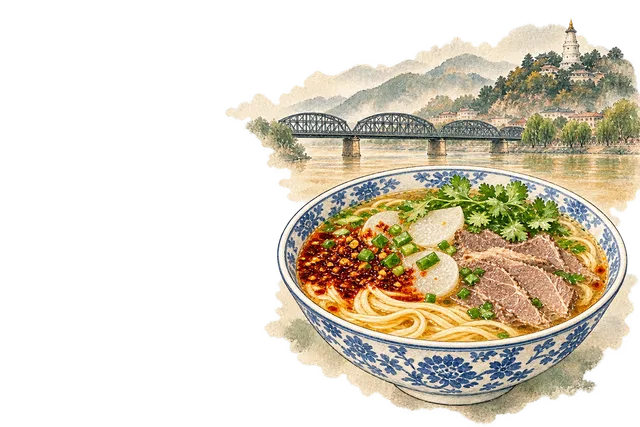
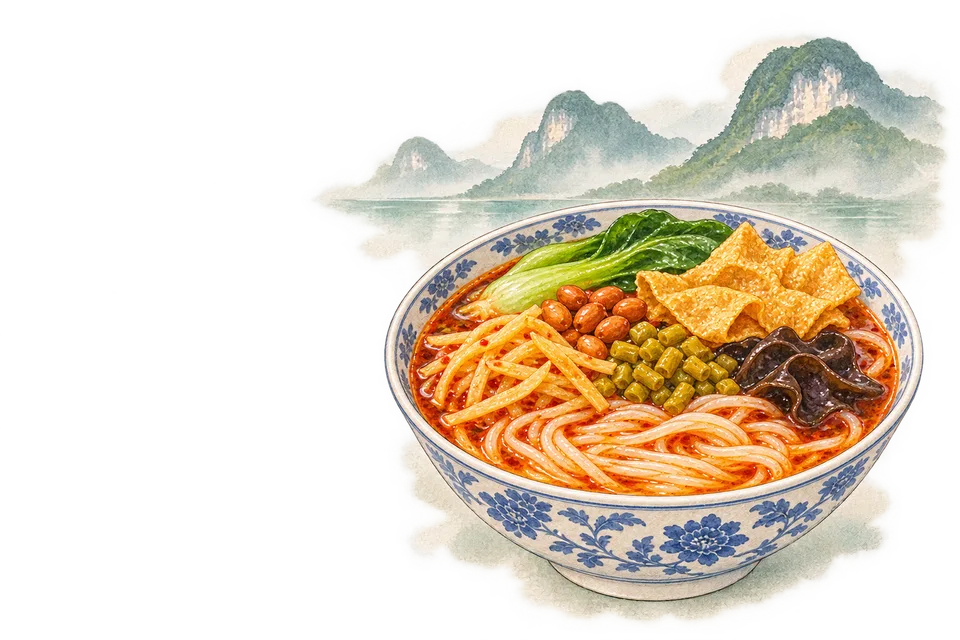
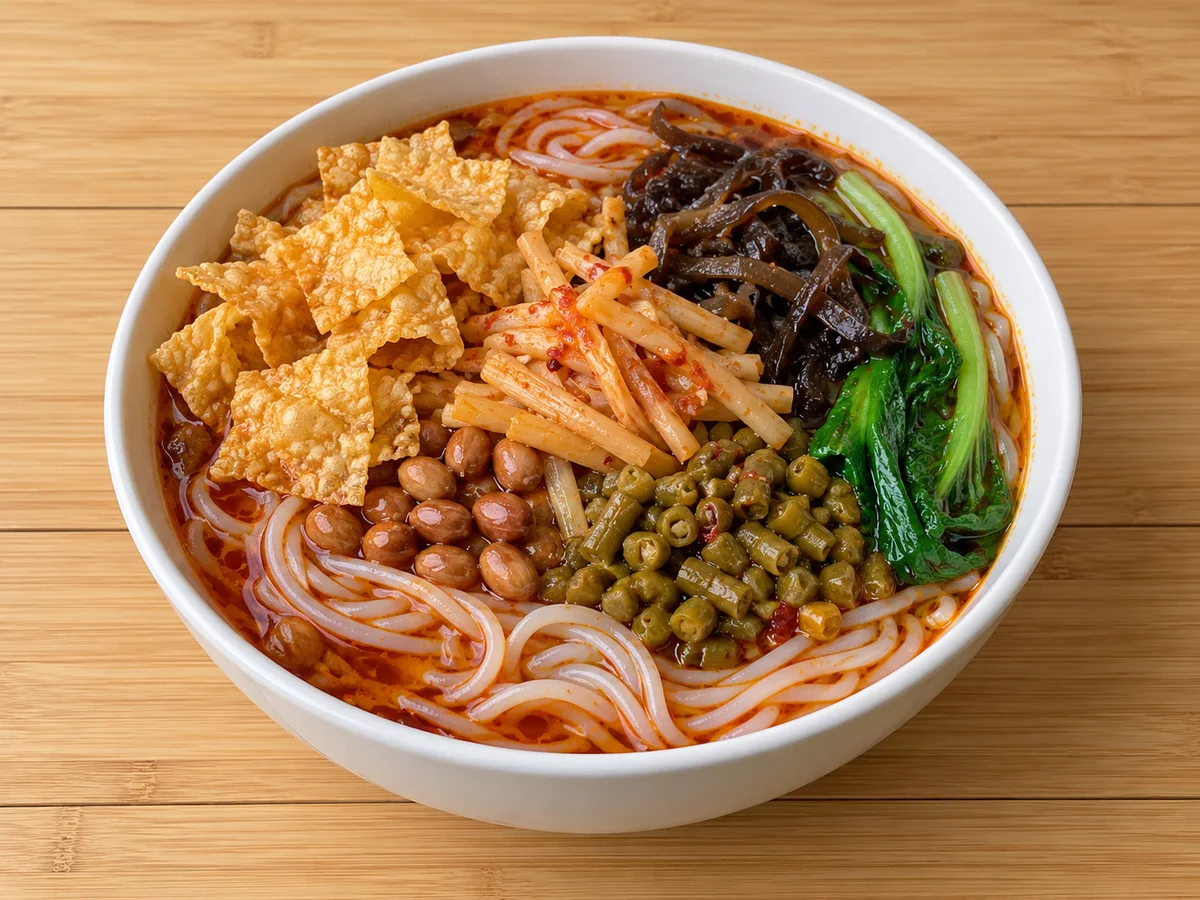
Dried rice noodles in a spicy river-snail and bone broth with fermented bamboo shoots; the smell is the bamboo, and the bowl has no snails.
Regional food guide
Rice noodles three times a day, sour pickles everywhere, and Zhuang five-color rice
Guangxi food is built on rice and sourness. This is the province where rice may first have been domesticated, and it eats rice as noodles three times a day: Liuzhou’s luosifen in snail broth, Guilin’s fresh noodles tossed with spiced brine, Nanning’s sour-hot laoyou noodles and dozens more. Around them are pickles of every kind, from fermented bamboo to chili-dusted green mango, and the cooking of the Zhuang, Yao, Dong, Miao and Jing peoples. Start with a bowl of noodles in each of the three cities, then eat by region: hot in the north, Cantonese-style in the southeast, seafood on the coast and sour in the western hills.
Start with the classics
Dried rice noodles in a spicy river-snail and bone broth with fermented bamboo shoots; the smell is the bamboo, and the bowl has no snails.
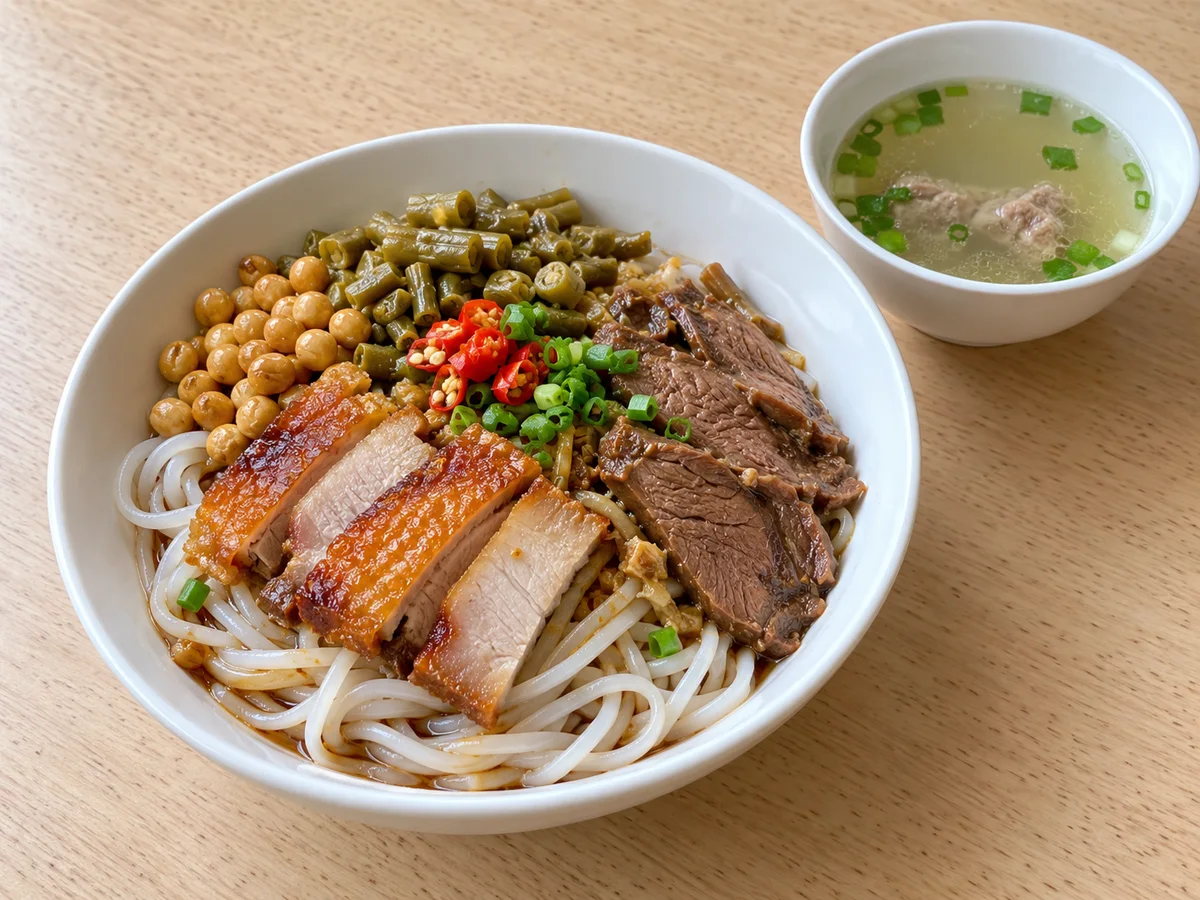
Fresh rice noodles tossed with spiced brine, crisp guoshao pork and fried soybeans; eat them dry, then add bone stock at the end.
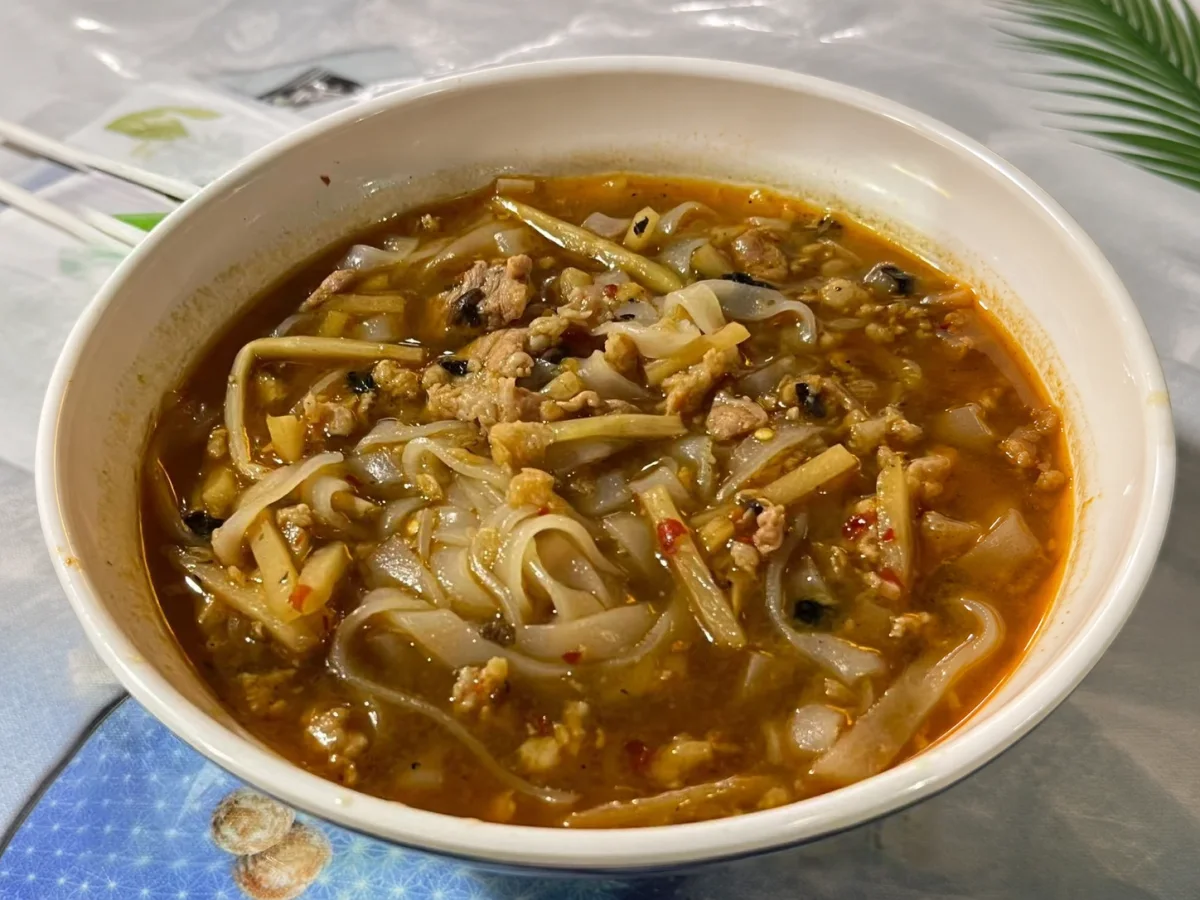
Sour bamboo shoot, black beans, garlic and pickled chili fried in a hot wok, then boiled with stock and fresh rice noodles, one bowl at a time.
01
Guangxi’s own cooks define its food in four words: rice-based, original flavors, many peoples and a love of sourness.
Guangxi Zhuang Autonomous Region lies between Guangdong to the east, Yunnan to the west, Hunan and Guizhou to the north and the Gulf of Tonkin and Vietnam to the south. Its food borrows from all of them. In February 2021 the Guangxi cooking and catering association published a standard for 桂菜, Gui cuisine, which divides it into four regional styles: the north around Guilin and Liuzhou, the west around Hechi, Baise and Chongzuo, the southeast around Nanning, Wuzhou and Yulin, and the coast around Beihai, Qinzhou and Fangchenggang. It sums up what they share as a base of rice and rice foods, a preference for original flavors, the mixing of many peoples and a liking for sour food.
An old saying divided the province as sweet east, sour west, fresh south and hot north. The standard refines it to salty-hot in the north, sour-hot in the west, sweet-hot in the southeast and fresh-salty on the coast. Neither phrase quite holds, as Guangxi writers admit: the whole region eats sour, Liuzhou in the north makes sour fish and sour pork, and Tiandeng in the southwest is famous for its chilies. The documentary director Chen Xiaoqing put it more simply: the defining feature of Guangxi food is variety, with a new surprise every twenty kilometers.
02
Rice in Guangxi is not just the staple. It may have started here.
In 2012 a team from the Chinese Academy of Sciences compared the genomes of more than 400 wild rice samples with cultivated rice and published the result in Nature: the wild rice closest to cultivated rice grows in Guangxi, and the sample came from Longan County near Nanning, suggesting that this is where rice was first domesticated. In 2018 rice phytoliths from Yahuai Cave in the same county were dated to about 16,000 years ago. Longan is also the place of the great stone spades, unused ritual blades about 4,500 years old. The Zhuang word 那 (na) means a rice field, and Guangxi writers call the whole rice-growing way of life na culture: villages, people and field gods named after paddies, the Longji terraces climbing whole mountains, a rice-god festival in Longan on the sixth day of the sixth lunar month, and the frog festival of the Hongshui River villages, because the frog brings rain.
Glutinous rice is the ritual grain. For Sanyuesan, the Zhuang festival on the third day of the third lunar month, and for Qingming, families dye sticky rice with the juices of wild plants and steam it in five colors. Maple leaves pounded in a pot give the black; other leaves and flowers give the other colors. The technique was listed as regional intangible heritage in 2010. Sticky rice is also pounded into ciba with sweet or savory fillings and kneaded with mugwort into green cakes before Qingming. Everyday rice is congee, eaten with diced papaya, sour-hot water spinach stems, pickled taro stems and dried radish, and, above all, rice noodles.
03
In Guangxi, rice noodles are breakfast, lunch and a late snack, and every town has its own.
Guangxi people say they would rather go three days without rice than one day without rice noodles. In 2021 Guilin rice noodles and Liuzhou luosifen were added to China’s national list of intangible cultural heritage, and twelve more noodle traditions are on Guangxi’s regional list, among them Nanning laoyou noodles, Nanning and Wuming fermented noodles, Binyang sour noodles and Quanzhou red-oil noodles. The noodles are made from early-season indica rice aged for a year or more, because new rice makes noodles that harden and break.
They come round and flat, thick and thin, fresh and dried. Guilin uses medium round fresh noodles; Liuzhou soaks dried ones back to life; Yulin’s dalu noodles are as thick as chopsticks and eaten on New Year’s Day for long fortune; laoyou noodles use flat fresh noodles about a centimeter wide; Binyang’s sour noodles are sheets three centimeters wide. Some are pressed through holes, some cut from steamed sheets, some rolled by hand into short “rice worms,” some dripped through a sieve into boiling water. They can be served in soup, tossed dry, stir-fried or cold.
| Noodle | Where | What makes it different |
|---|---|---|
| Luosifen 螺蛳粉 | Liuzhou | Dried noodles in spicy snail-and-bone broth with fermented bamboo shoots |
| Guilin rice noodles 桂林米粉 | Guilin | Fresh noodles tossed with spiced brine, crisp roast pork and fried soybeans; stock added last |
| Laoyou noodles 老友粉 | Nanning | Flat noodles cooked with sour bamboo, pickled chili, garlic and black beans |
| Fresh-pressed noodles 生榨米粉 | Nanning, Wuming | Batter fermented until faintly sour, pressed straight into the pot |
| Binyang sour noodles 宾阳酸粉 | Binyang | Wide sheets with rice vinegar, cucumber, herbs and roast meats, sweet and sour, a summer dish |
| Rolled rice sheets 卷筒粉 | Nanning and beyond | Steamed sheets rolled around egg, minced pork and vegetables, with wampee-fruit sauce |
| Quanzhou red-oil noodles 全州红油米粉 | Quanzhou, far north | Bone broth and brine under homemade chili oil |
| Niuba noodles 牛巴粉 | Yulin | Topped with sweet, chewy dried beef |
04
The 2021 standard maps Guangxi’s food onto its climate, from cool northern hills to the hot coast.
The north, next to Hunan and Guizhou, is rainy and cool in winter, and its cooking is rich, dark and hot, with mountain produce and chili to keep out the damp. The southeast is subtropical and was shaped most by Cantonese cooking: light, fresh, little chili, flavors kept close to the ingredient. The coast cooks seafood simply and seasons it with care. The west, the hill country of the Zhuang, Yao, Miao and other peoples, preserves fish and pork in jars of salt and fermented rice, and makes the soup outsiders find hardest: niubie or yangbie, cooked with the half-digested grass from a cow’s or goat’s stomach and chopped liver, intestine and lung, faintly bitter and valued for digestion.
| Style | Cities | Taste | Dishes to look for |
|---|---|---|---|
| Northern Guangxi 桂北 | Guilin, Liuzhou, Laibin, Hezhou | Salty and hot, rich and dark | Quanzhou vinegar-blood duck, Yangshuo beer fish, fish with soybeans and sour bamboo, snail and duck-feet casserole |
| Western Guangxi 桂西 | Hechi, Baise, Chongzuo | Sour and hot | Jar-fermented sour fish and pork, niubie soup, hemp-seed greens soup |
| Southeastern Guangxi 桂东南 | Nanning, Wuzhou, Yulin, Guigang | Sweet-hot, light, Cantonese-influenced | White-cut chicken, cured meats, Lingma catfish, Wuzhou paper-wrapped chicken |
| Coastal Guangxi 滨海 | Beihai, Qinzhou, Fangchenggang | Fresh and salty | Blanched peanut worms, mixed-fish soup, crab noodle soup, red whelks with radish greens |
Sources [1]
05
Every Guangxi town has its pickle jars, and Nanning puts them on the street.
酸嘢 (suanye), “sour things,” are Nanning’s street pickles: green mango, pineapple, papaya, guava, star fruit, white radish, lettuce stem, lotus root, long beans, young ginger and more, steeped in a sweet-sour chili brine and sold from glass jars on carts and at stalls by the jin or by the bag. A big stall may have eighteen or nineteen kinds; green mango is the favorite. Before eating, the fruit is shaken in a powder of sugar, brown sugar, licorice, sour plum, chili and salt, which makes it sweet, sour, salty and hot at once; firm fruit works and watery fruit such as watermelon does not. Nanning has a saying for it: a hero cannot resist a beauty, and a beauty cannot walk past a suanye stall.
Pickles in the hills are older and stronger. In Hechi people call their pickles simply 酸, “sour,” and eat them as a side dish, a snack and an ingredient year-round. The Mulao people of Luocheng ferment wild shallots with salt, garlic, chili, ginger and a little rock sugar and pound them before eating, while Du’an ferments its vegetables in brown-sugar water and likes them sweeter. Liuzhou ferments the bamboo shoots that give luosifen its smell, and the Miao and Dong pack fish and pork into jars with salt and fermented rice for festivals and guests. Guangxi writers explain the habit by the climate: in a hot, wet place, sour food keeps, wakes the appetite and settles the stomach.
06
Guangxi’s capital eats sour and hot in a city that otherwise cooks like Guangdong.
Nanning’s signature bowl is 老友粉, laoyou noodles, “old friend noodles.” The story told for it is set in a teahouse in the early twentieth century: when a regular customer fell ill with a cold, the owner cooked a bowl of noodles with fried sour bamboo shoots, pickled chili, garlic, fermented black beans and pepper; the friend sweated, recovered and gave the shop a plaque reading “old friends always welcome.” It began as wheat noodles; by around 1990 rice noodles had taken over. The flavor comes from the frying pan: sour bamboo, pickled chili, garlic and fermented black beans are fried until fragrant before the soup and noodles go in. Nanning people name Fuji on Zhongshan Road, Shuji on Qixing Road, Tianfuxiang on Linsheng Street and Sushi on Longsheng Street, or the unnamed stall near their home. In 2023 a bowl of two liang with pork and a trotter cost 18 yuan at one of the busiest shops. The dish was listed as municipal intangible heritage in 2007 and regional heritage in 2008. Guilin and Liuzhou noodles travel; laoyou noodles have mostly stayed home, and the reason is the wok. Huang Weining, founder of Nanning’s Laoyouwang restaurant, told CGTN in 2018 that each order is fried and then boiled for about three minutes, so with ten customers the tenth waits half an hour. In Nanning, he said, laoyou also means a whole sour, hot style of cooking, not only the noodles.
Breakfast is also 卷筒粉, rolled rice sheets: rice batter steamed thin on a tray, rolled around egg, minced pork, long beans or wood ear and served with a sweet-sour sauce made from wampee fruit; in 2023 a market stall charged 4 yuan with meat, and 1.5 yuan for fresh soy milk. Fresh-pressed noodles are pressed from slightly fermented batter straight into the pot. Around the old Shuijie quarter, named for a street that used to flood, the snacks include stir-fried rice worms, taro cake, beef offal skewers at 2 yuan, sticky rice with braised pork and sausage at 16 yuan, and street herbal teas such as raw 雷公根, gotu kola. Just north of the city, Wuming is known for lemon duck, created at the Gaofeng Jiepai restaurant: duck stir-fried with local lemons salted for three years or more, pickled shallots, pickled chili, sour plums, pickled ginger, fermented tofu, sugar, rice wine and perilla, then braised and reduced until sour, sweet and hot.
07
The karst north eats hotter and darker than Nanning, and every visitor eats beer fish.
Guilin rice noodles, fresh noodles tossed with a spiced brine, crisp roast pork and fried soybeans, are the region’s oldest famous noodle and have their own page. Down the Li River, 啤酒鱼, beer fish, is Yangshuo’s dish: a live Li River fish split in half but not scaled, fried in camellia oil until the scales soften and curl, then braised with tomato, chili, ginger, garlic and local beer. In 2017 four young singers living in Yangshuo put the shout of the West Street restaurants into a dialect song: “beer fish with rice, you’ll scrape the pot clean.” Riverside restaurants charge by weight; in 2026 carp cost 68 yuan a jin and grass carp 58, with pot-crust rice cooked over wood at 2 yuan a person to soak up the sauce.
Inland, Gongcheng Yao Autonomous County drinks 油茶, oil tea: tea leaves, ginger, garlic, scallion, peanuts, lard and coarse salt pounded and fried in a pot, then boiled with water into a golden, savory soup. A local legend says the Qianlong emperor, laid low by southern rain, recovered after three bowls and named it “refreshing soup”; the knock of pounding sticks still marks breakfast and every visit between neighbors. Lipu grows a taro so prized it was sent as tribute in the Ming and Qing, and 荔浦芋扣肉, slices of taro and pork belly steamed together, is essential at every Lipu banquet. Pingle County stuffs everything it can, from squash flowers and bamboo shoots to garlic and bean sprouts, into 十八酿, “eighteen stuffed dishes,” where eighteen just means many. Guilin’s Sanhua rice liquor, stored in caves for two years, is the drink.
08
The Cantonese-speaking southeast cooks like its neighbor, with its own specialties.
Yulin’s 牛巴, niuba, is dried and simmered beef. Rump of local yellow cattle is cut in a long continuous sheet, from a 5 cm block into a strip about 1.5 meters long and 3 mm thick, dried in the autumn sun for four or five hours, washed and steamed, then simmered twice and rested with more than a dozen spices, sugar and rice wine until soft, and kept under oil. It is sweet, chewy and the topping for Yulin’s niuba noodles. Bobai County, also in Yulin, is famous for its white-cut chicken: free-range birds of about 300 days are dipped in boiling water with ginger and scallion and lifted out three times, simmered for four minutes, left covered for thirty, chilled in ice water and rubbed with sesame oil.
Wuzhou, where the Xi River enters Guangdong, is a city of arcaded streets and damp heat. On summer nights stalls simmer field snails with ginger, perilla and chili, and people dip fried dough and sour bamboo in the broth. Herbal tea shops, the old saying goes, were as common as rice shops, and 龟苓膏, the dark, bitter herbal jelly, is eaten with honey, coconut milk or condensed milk. Bingquan soy milk is made with water from an ancient spring and is thick enough for a drop to sit on the surface as a bead.
Sources [1]
09
On the Gulf of Tonkin the food turns to seafood, and in one town to Vietnam.
Beihai, Qinzhou and Fangchenggang eat seafood plainly: blanched 沙虫, peanut worms dug from the sand flats, mixed small-fish soup, crab noodle soup and red whelks stir-fried with radish greens. A Beihai seafood noodle soup can hold prawns, fish, squid, clams and abalone. The Jing people, who live along this coast, fry dried rice noodles with dried shrimp and sea snails.
Qiaogang, a town on the edge of Beihai, was settled about forty years ago by Chinese families returning from Vietnam, and its food is still Vietnamese-style. Its breakfast lane, Hezaijie, sells 籺, sticky-rice cakes with coconut, sesame and peanut or mugwort, at a yuan each; 蟹仔粉, a rice noodle soup made from tiny crabs pounded and strained into broth with tomato; and Vietnamese rolled rice sheets with egg, fried shallots and fish sauce, 12 yuan in 2021. Go early: most of it is gone by ten.
10
The far west of Guangxi eats what the limestone hills give it.
In Bama, a county famous for long lives, an edible hemp is pressed for oil and its seeds are cooked into 火麻青菜汤, hemp and greens soup, the most common traditional dish in town.
The pith of the sugar palm is pounded and washed into 桄榔粉, a starch stirred with boiling water into a clear, sweet jelly.
Starch from canna roots, settled for five days and steamed into sheets, makes fine noodles that hold their shape however long they boil.
The Youjiang valley has grown mangoes for over 300 years, and some of its trees are centuries old.
Sources [1]
11
Plan around noodles at breakfast and one regional dish for dinner.
Luosifen in Liuzhou, rice noodles in Guilin and laoyou noodles in Nanning taste different at home than anywhere else; each is a quick, cheap breakfast.
Liuzhou and Nanning noodles are hot by default. Say 免辣 or 微辣 if you are not used to chili, and add it yourself.
In Nanning, point at three or four fruits and let the seller shake them in chili powder.
Beer fish in Yangshuo, lemon duck in Wuming or Nanning, seafood in Beihai, oil tea in Gongcheng.
On the third day of the third lunar month, Zhuang villages and cities sing, and five-color rice is everywhere.
12
Liuzhou’s snail-broth rice noodles, and where the smell comes from.
Read about luosifen →Fresh noodles tossed with spiced brine and crisp roast pork.
Read about Guilin rice noodles →The Cantonese cooking that shapes southeastern Guangxi.
Explore Guangdong food →FAQ
Rice-based, sour and varied. Rice noodles are eaten at every meal, pickles are everywhere, the north is hot, the southeast is close to Cantonese cooking and the coast eats seafood.
Liuzhou luosifen, Guilin rice noodles and Nanning laoyou noodles.
A bowl of each of the three famous noodles in its own city, a bag of suanye in Nanning, and beer fish in Yangshuo.
Often. Northern Guangxi and Liuzhou are hot, Nanning noodles are sour and hot, but Wuzhou and Yulin cook lightly like Guangdong.
Nanning’s street pickles: green mango, pineapple, papaya, radish and other firm fruit and vegetables steeped in a sweet-sour chili brine and shaken in a chili-plum powder before eating.
The name for Guangxi cooking. A 2021 standard divides it into northern, western, southeastern and coastal styles.
Glutinous rice dyed in five colors with the juices of wild plants, made by the Zhuang for Sanyuesan and Qingming.
A Yao soup of tea leaves, ginger, garlic, scallion, peanuts and lard, pounded and fried in a pot and then boiled.
Rice noodles above all, plus rolled rice sheets, congee with pickles and, in Gongcheng, oil tea.
Southeastern Guangxi cooks much like Guangdong, but the rest of the region eats more sour and hot food, more rice noodles and more pickles.
Sources
Last updated November 2026
Keep exploring