
01
Rice noodles in snail broth, with no snails in the bowl
Luosifen takes its name from the snail broth, not from snails on top: a proper bowl from Liuzhou has no snails or snail meat in it.
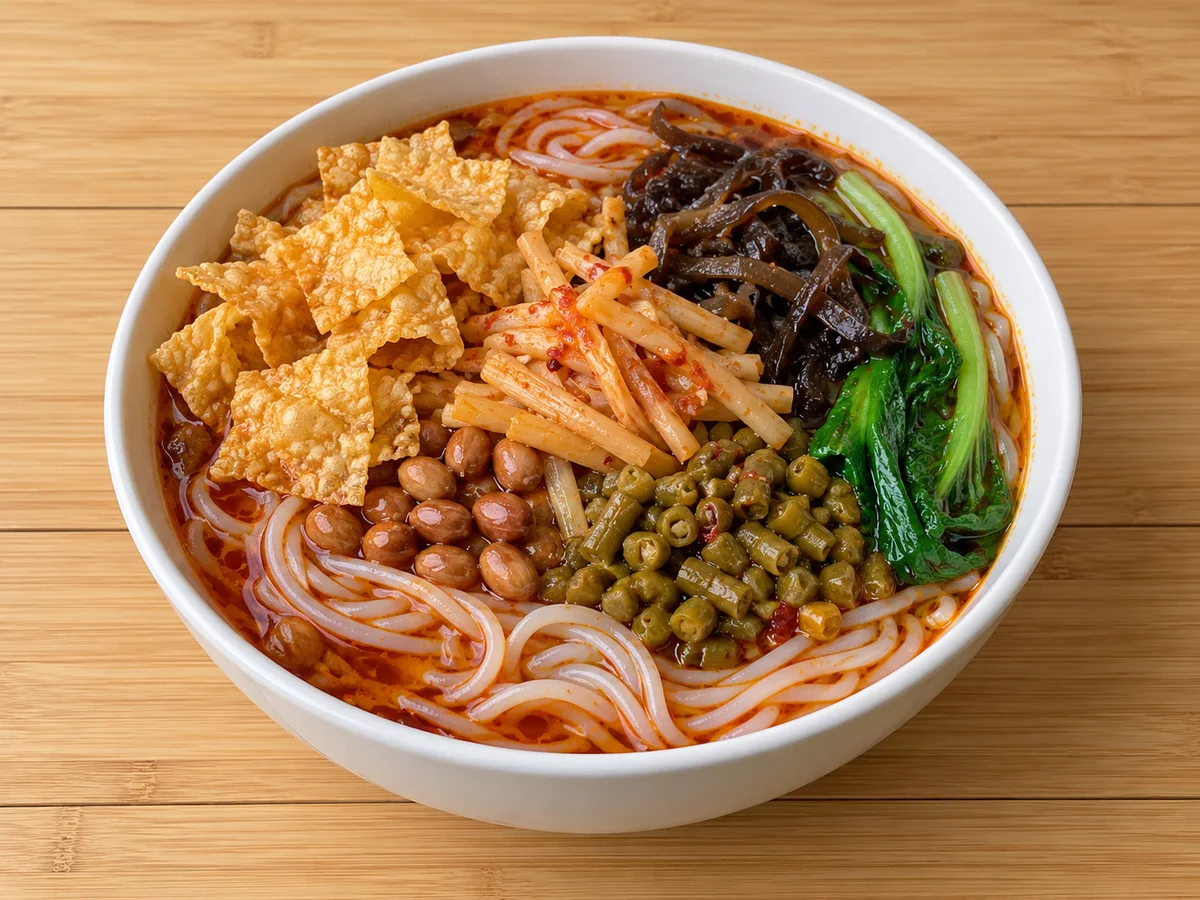
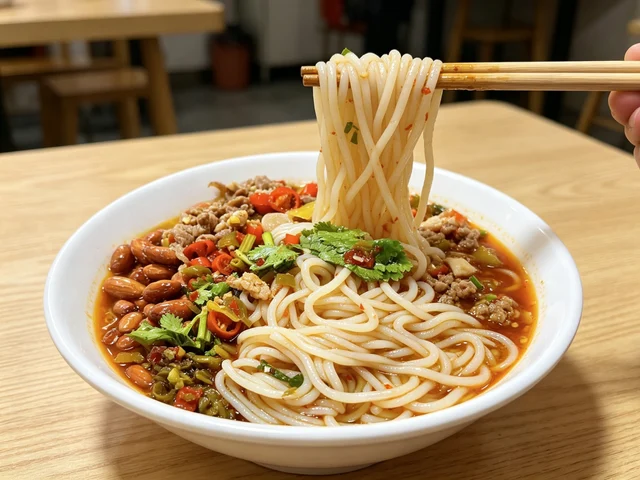
The noodles are round rice noodles, but unlike the fresh noodles of Guilin or Nanning they are dried first and soaked and boiled back to life, which makes them firmer and springier and lets them sit in hot soup without going soft. They are blanched, put in a bowl and covered with broth: a soup of river snails simmered with pork bones, chicken frames, sand ginger, star anise, cinnamon, cloves and several kinds of chili, finished with a layer of red chili oil. All of the snail’s flavor is in that broth, and the snails themselves stay in the pot.
On top go the things that make it luosifen: shredded fermented bamboo shoots, pickled long beans, deep-fried tofu skin, fried peanuts, wood ear mushroom, dried daylily flowers and a handful of greens. The local word for eating it is 嗦 (suō), to slurp or suck, the sound you make pulling a snail out of its shell. That word fools many visitors into expecting snails to suck on. The official description of the dish lists its five qualities as sour, hot, savory, refreshing and scalding, and Liuzhou people say 不食螺蛳粉,枉为柳州人: if you do not eat luosifen, you are not really from Liuzhou.
02
Where the smell comes from
The smell that makes luosifen notorious is fermented bamboo, and the snail broth itself is savory rather than smelly.
Liuzhou’s 酸笋, sour bamboo shoots, are made from fresh spring shoots, peeled, cut and sunk in jars of spring or well water, left in a cool place to ferment on their own. The national heritage description gives 72 days in mountain spring water; the Guangxi rice noodle book that documents the craft gives half a month to a month, and workshops vary. The one rule everyone repeats is that no oil may touch the shoots while they ferment. As they sour, sugars and proteins in the bamboo break down into acids and amino acids, and the compounds that come off them are what visitors smell from the end of the street.
Good sour bamboo, the same book insists, should smell appetizing rather than rotten, and Liuzhou people judge a shop partly by its bamboo shoots. Some shops outside Liuzhou exaggerate the smell, which is why people who tried luosifen elsewhere are often surprised that a bowl in Liuzhou is less pungent and more savory. If the smell is the obstacle, ask for less bamboo rather than none: without it the bowl is just a spicy noodle soup. China’s best-known food documentary, A Bite of China, showed Liuzhou’s sour bamboo shoots in its first episode in 2012, and the dish’s national fame dates from around then.
03
A night-market bowl from around 1980
People in Liuzhou have eaten river snails for more than twenty thousand years, but a bowl of luosifen is only about forty years old.
In the 1950s archaeologists found thick layers of snail shells at Bailian Cave and other prehistoric sites around Liuzhou, left by people who were gathering and cooking river snails more than twenty thousand years ago. Snails and rice noodles were both everyday food in Guangxi long before anyone put them in one bowl.
The most detailed account of how that happened points to Gubu Street (谷埠街) south of the Liu River, a grain wharf since the late Ming and one of the busiest quarters of the city. In the 1950s and 1960s its lanes had stalls boiling and frying snails. Around 1980, as private trade came back, Gubu’s market became Liuzhou’s biggest wholesale market for fresh snails, and a night market grew up beside the Workers’ Cinema next door. Its best-selling stalls were snail stalls and rice noodle stalls, and some owners started selling both. Hungry filmgoers coming out after the last show, in years when there was little meat to go round, asked the noodle sellers to ladle some of the rich snail soup over their noodles. That, in the local telling, is how luosifen began.
Through the 1980s the stalls refined the broth and toppings and spread from Gubu to Jiefang South Road, the Qingyun market and a lane off Yufeng Road that everyone called Snail Lane, though its real name was Milk Lane; it no longer exists. Cooks split into two camps. One kept insisting that a dish called snail noodles should be all about snails; the other worked on a sour, hot broth that tasted sweet and fresh and won the city over. The national heritage listing tells a longer story, saying that snails and noodles were combined from the Ming and Qing dynasties and the technique had largely taken shape by the early twentieth century; the Liuzhou rice noodle book and most local accounts date the dish as people know it to around 1980. In rural Liuzhou a generation ago, a plain bowl of rice noodles cost 50 fen and luosifen 1.5 to 2 yuan, a treat for a trip to town.
04
The broth: stone snails, bones and chili oil
Every shop’s broth is a secret, but the method behind it is the same, and it takes most of a day.
The snails of choice are 石螺, stone snails: small, hard-shelled, pointed snails about the size of a thumb that live in clean mountain streams, so they carry little muddy taste. The bigger, meatier field snails are better for stir-frying. The snails are kept in water for a day or two to purge, the tips of the shells are clipped, and they are rinsed again and again.
Meanwhile a stock of pork leg bones, beef bones and chicken frames, blanched first to remove the scum, simmers with ginger and a bag of herbs and spices. The snails are stir-fried hard with ginger, garlic, scallion, pickled chilies, sour bamboo and a second set of spices such as sand ginger, star anise, bay leaf, black cardamom, cassia bark and cloves, so that they soak up the aromatics. After about four hours the fried snails go into the bone stock for two more hours over low heat, and chili oil is added about 40 minutes before the end so that its heat and the savory broth blend into one. The heritage description adds fennel and perilla to the pot and says the finished broth is fresh, hot and scalding with a sweet aftertaste.
Sour bamboo for the bowl is shredded, dried in a wok and fried with salt, chili oil, coarse chili flakes and a little sugar. Pickled long beans are treated the same way, tofu skin and peanuts are deep-fried until crisp, and wood ear, shiitake and daylily flowers are stir-fried together as the “three delicacies.” To serve, soaked noodles are blanched in water above 85°C for about 30 seconds, drained, topped and drowned in broth.
| Part | What it is | Why it is there |
|---|---|---|
| Noodles | Dried round rice noodles, soaked and blanched | Firm and springy; they hold up in hot soup |
| Broth | Stone snails, pork and beef bones, chicken frames, spices, chili oil | All the snail flavor; the red oil on top |
| Sour bamboo shoots 酸笋 | Spring shoots fermented in water, then fried with chili | The sourness and the famous smell |
| Pickled long beans 酸豆角 | Fermented cowpeas, fried | A second, crunchier sourness |
| Fried tofu skin 腐竹 | Dried tofu skin deep-fried until crisp | Soaks up broth and turns soft and rich |
| Fried peanuts | Deep-fried until crunchy | Crunch; add late so they stay crisp |
| Wood ear, daylily, greens | Stir-fried fungus and flowers, blanched water spinach | Texture and something fresh; daylily is the old-style marker |
05
How to order in Liuzhou
A luosifen shop works like a canteen: you choose a size, a heat level and your add-ons at the counter, and the broth is the same for everyone.
Noodles are ordered by the liang, a measure of 50 grams of dry noodles; two liang is a normal bowl. Then comes the heat: 加辣 extra hot, 辣 hot, 微辣 mild and 不辣 or 免辣 none. Liuzhou’s “mild” is hot by most people’s standards, so if you are not used to chili, say 免辣 and add chili oil yourself. Many shops have the pickles, extra sour bamboo, chili and vinegar on a side counter to help yourself.
Then the add-ons, which are half the point. The classic ones are duck feet braised until the meat slips off the bone and small squares of fried tofu puff, both of which soak up the broth. Most shops also sell a 炸蛋, an egg deep-fried into a big, frilly, crisp-edged disc that turns into a sponge for the soup, and braised or deep-fried pig’s trotters. Quail eggs, sausage, pork skin, tripe and chicken wings are on many counters. Liuzhou people like more vegetables than noodles, and the greens should be water spinach or choy sum; lettuce, which wilts and soaks up oil, disappoints locals. Older people still expect dried daylily flowers, a topping many younger eaters have never noticed.
Prices are low. In 2026 a plain two-liang bowl at an old Liuzhou shop cost from about 9 yuan; with a fried egg and a bottle of soy milk, 16 yuan in 2024; and a bowl loaded with a trotter, egg, duck feet and tofu puffs, 38 yuan in 2022. The usual drink is chilled soy milk in a glass bottle, and some people dip a youtiao in the broth.
Pick a size
Two liang (二两) is a normal bowl; three liang if you are hungry.
Pick a heat
免辣 none, 微辣 mild, 辣 hot, 加辣 extra hot. Start lower than you think.
Add two things
A fried egg (炸蛋) and duck feet (鸭脚) or tofu puffs (豆泡) are the local favorites.
Ask for greens
Locals like plenty of vegetables (菜多) in the bowl; water spinach is the usual green.
Go at the right time
Many old shops sell out and close in the afternoon, while others only open at noon and run until 2 a.m. for late-night eaters.
06
Where to eat it in Liuzhou
Liuzhou people usually say the best luosifen is the one downstairs from their home, but a few old names come up again and again.
Luosifen shops line almost every street in Liuzhou, and most residents are loyal to one near home or work; the shops themselves vary from salty and dark to sweet and mild, from soft noodles to firm ones. Lists by locals in 2025 and 2026 keep returning to the same handful of decades-old shops, along with a couple of famous ones that now draw more tourists than neighbors. Expect plastic stools, big round tables and no menus in English.
| Shop | Known for | Notes |
|---|---|---|
| Tiesanzhong 铁三中 | A decades-old shop with a dark, salty-savory broth | Chili that is fragrant rather than fierce; a common first pick among locals |
| Jiaojie 娇姐 | Hot broth and braised trotters | A late-night shop: opens around 12:30 p.m. and runs to 2 a.m.; about 9 yuan a bowl, trotter 13 yuan (2026) |
| Ali 阿历 | A lighter, clearer broth from a big pot | Moved from its old Wuxing Street premises; regulars followed it |
| Mingao 民高 | A strong snail flavor, the old Liuzhou style | Eaten with the shop’s sweet milky tofu pudding |
| Xinyue 新月 | Genuinely hot broth | Soft-centered braised eggs |
| Caomei 曹妹 and Ajiao 阿姣 | The best-known names, on the same street | Queues of tourists and buyers taking packs home; locals are divided |
07
From night market to a billion packets
Luosifen is the rare street dish that became famous across China mainly in a plastic packet.
Its ingredients made it easy to package. The noodles are already dried, and the broth, bamboo shoots, beans, tofu skin and peanuts are all prepared ahead, so they can be sealed in separate sachets. Liuzhou is Guangxi’s industrial center and a southern railway hub, and its factories were quick to try. In 2014 the first company got a licence to make packaged luosifen; in 2015 the city issued local standards for the dish and for its packaged form; and in 2018 “Liuzhou luosifen” became a registered geographical indication. In 2021 the making of luosifen was added to China’s national list of intangible cultural heritage, alongside Guilin rice noodles.
Then the pandemic arrived. Stuck at home in 2020, people across China ordered it online, influencers filmed themselves eating it, and makers had order backlogs of nearly fifty days. NPR reported that dozens of brands sold 1.1 billion packets in a single year, and packaged sales reached 15.2 billion yuan in 2021. One large maker that produced 80,000 to 100,000 packs a day in the early 2000s was making 500,000 by 2021. By then 56 companies used the geographical indication, the industry employed more than 300,000 people, villages around Liuzhou were fermenting bamboo shoots and beans by the ton and farming snails for the factories, and exports reached 52.56 million yuan, mostly to the United States, Australia, Europe, Singapore and New Zealand. In 2025 the whole luosifen industry chain, from farms to restaurants, had sales of more than 80 billion yuan.
08
Cooking a packet at home
For 1 packet: the noodles and sachets from the pack; a handful of water spinach or choy sum; optional add-ons such as a fried egg, tofu puffs or braised duck feet. You need two pots.
- 1. Cook the noodles
Put the dried noodles in cold water, bring it to a boil and cook for about 10 minutes, until soft right through but still springy. Lift them out and drop them into cold water so they stay firm.
- 2. Fry the pickles
Heat a little oil and fry the sour bamboo shoot sachet, and any pickled beans, over medium-low heat for a few minutes until fragrant and dry.
- 3. Make the broth
In the second pot, bring water to a boil with the concentrated broth sachet as the packet directs. Add tofu puffs or the fried pickles to simmer briefly if you like.
- 4. Blanch the greens
Dip the noodles back in hot water to warm them, and blanch the greens. Put both in a large bowl.
- 5. Assemble
Pour over the broth, add the bamboo shoots and beans, then the fried tofu skin and peanuts, then chili oil and vinegar to taste. Stir and eat at once.
Even cooked with care, packaged noodles come out a little softer than at a Liuzhou shop, and the bowl lacks the braised trotters and duck feet that shops add. Frying the pickles first is what brings it closest.
09
Dry, fried and in a hot pot
Once a city has a broth like this, it puts it into everything.
干捞螺蛳粉 is the dry version: the noodles are tossed with a little thick broth, chili oil and the toppings, with a bowl of soup on the side. 炒螺蛳粉 is the same noodles stir-fried in a wok with the bamboo shoots, pickles and chili. 螺蛳鸭脚煲, snail and duck-feet casserole, is a claypot of duck feet first fried, then braised in luosifen broth until the skin falls off the bone, often with field snails, and it has become a dish in its own right at Liuzhou’s night markets. Restaurants also serve luosifen as a hot pot, with the broth bubbling in the middle of the table and noodles and toppings cooked to order.
10
More Guangxi rice noodles, and other strong flavors
Guilin rice noodles
Guangxi’s other famous rice noodle: fresh noodles tossed with spiced brine and roast pork.
Read about Guilin rice noodles →Changsha stinky tofu
Another fermented smell that tastes milder than it seems.
Read about stinky tofu →Acquired tastes
Chinese foods that take getting used to, and how to try them.
Read the guide →Guangxi classics
- Guilin Rice Noodles
Tossed rice noodles · Breakfast or any meal
- Laoyou Rice Noodles
Wok-fried rice noodle soup · Breakfast, late night, when you have a cold
Noodles from other regions
FAQ
Questions about Luosifen
What is luosifen?
A rice noodle soup from Liuzhou in Guangxi: dried round rice noodles in a spicy broth simmered from river snails and pork bones, topped with fermented bamboo shoots, pickled long beans, fried tofu skin, peanuts, wood ear and greens.
Are there snails in luosifen?
Not in a proper bowl. The snails are simmered into the broth and stay in the pot; the name comes from the broth.
Why does luosifen smell so bad?
Because of the fermented bamboo shoots, which are soaked in water for weeks until sour. The snail broth itself is savory. Good bamboo shoots smell appetizing rather than rotten.
What does luosifen taste like?
Sour, hot and savory, with a rich, slightly sweet broth, crunchy pickles and peanuts, and soft fried tofu skin. Locals sum it up as sour, hot, savory, refreshing and scalding.
Where is luosifen from?
Liuzhou, an industrial city in northern Guangxi. Most local accounts trace it to the night market on Gubu Street around 1980.
How spicy is luosifen?
Quite spicy in Liuzhou, where even “mild” is hot. Ask for 免辣 (no chili) and add chili oil yourself if you are not used to it.
How much does luosifen cost in Liuzhou?
From about 9 yuan for a plain bowl in 2026. With a fried egg and drink, about 16 yuan; loaded with a trotter, egg and duck feet, 30 to 40 yuan.
How do you cook packaged luosifen?
Boil the dried noodles from cold water for about 10 minutes and rinse in cold water, fry the bamboo-shoot sachet in a little oil, make the broth in a second pot, then combine everything with blanched greens, chili oil and vinegar.
Is luosifen vegetarian?
No. The broth is made with snails, pork and beef bones and often chicken frames.
What is the difference between luosifen and Guilin rice noodles?
Luosifen uses dried noodles in a spicy snail broth with fermented bamboo shoots. Guilin rice noodles use fresh noodles tossed with a spiced brine and roast meats, with plain stock added at the end.
Sources
Sources and further reading
- 1 Lin Yexin and Gong Zheng, Guangxi Mifen: Shejian shang de Chanmian (广西米粉:舌尖上的缠绵), chapters “Liuzhou luosifen: no snails in sight, but the smell of snails”, “The Na rice culture of Guangxi” and “All-embracing Guangxi rice noodles” (in Chinese)Guangxi People’s Publishing House (2022), “Intangible Heritage of Guangxi” series
- 2 Rice noodle making technique: Liuzhou luosifen, national intangible cultural heritage item Ⅷ-277 (2021) (in Chinese)China Intangible Cultural Heritage Network ↗
- 3 Humble street snack rides fresh wave of popularity: packaged luosifen sales, exports and the bamboo-shoot farmsAlexis Hooi and Zhang Li, China Daily (2022) ↗
- 4 Five flavors spread across the seas: Liuzhou luosifen, with the 2025 industry-chain sales figure (in Chinese)Xinhua (2026) ↗
- 5 Snail noodles go viral in China during the pandemic, but the dish is a bit funkyEmily Feng, NPR Goats and Soda (2022) ↗
- 6 Eighteen places in two days in Liuzhou with a local guide, and what it cost: the Caomei queue and a 16-yuan bowl at an old shop (video, in Chinese)Mai De Qiu (迈得丘MadQ), Bilibili (2024) ↗
- 7 A late-night luosifen shop recommended by locals: two liang extra hot with trotter, egg, duck feet and tofu puffs for 38 yuan (video, in Chinese)Da Wei De Wei (大魏的胃), Bilibili (2022) ↗
- 8 How someone from Liuzhou cooks a packet of luosifen: noodles from cold water, frying the bamboo shoots, and childhood prices (video, in Chinese)Wei Dawei (韦大维), Bilibili (2026) ↗
Last updated November 2026