
01
Nanning’s bowl: fried first, then boiled
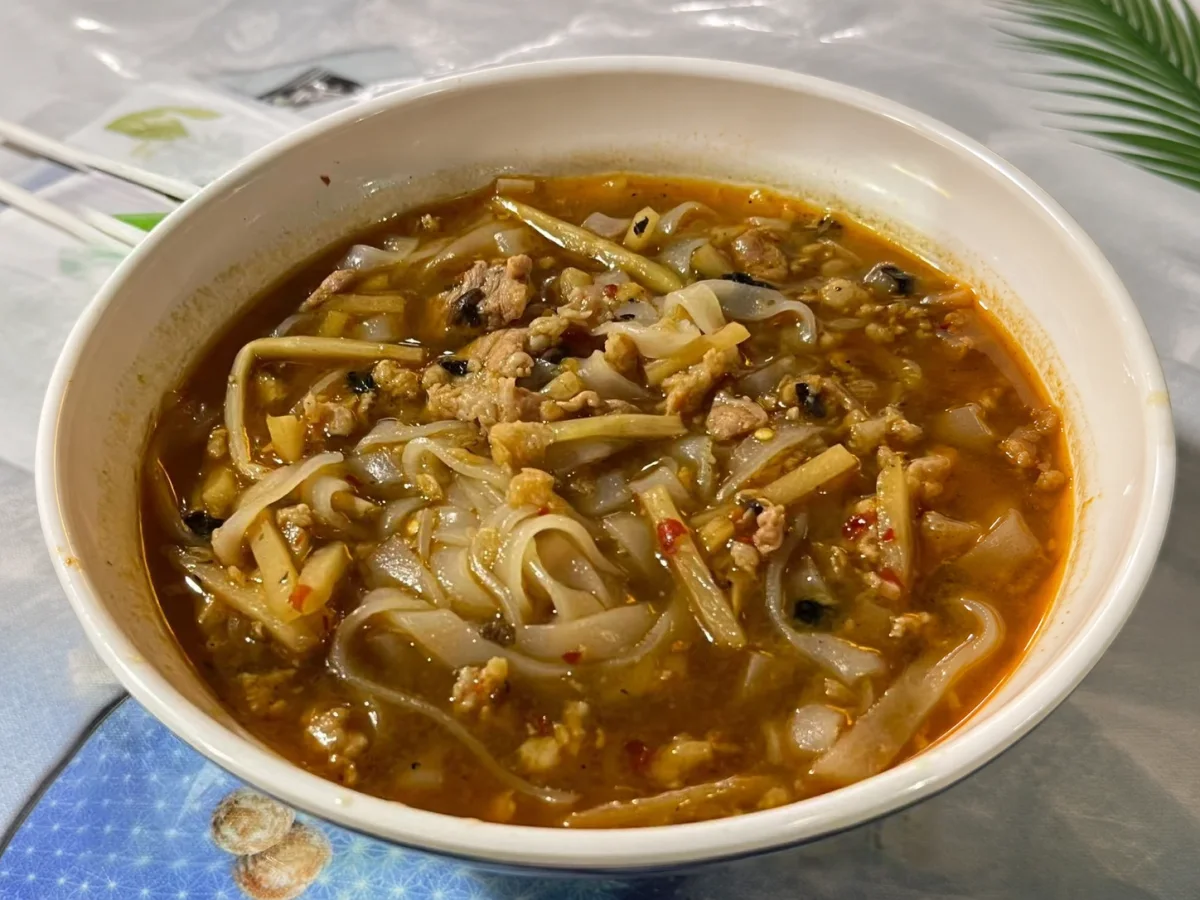
Laoyou noodles are made by frying sour bamboo shoot, black beans, garlic and chili in a wok, then boiling the noodles in the same wok with stock, one bowl at a time.
Most Chinese noodle soups are assembled: noodles in a bowl, a ladle of stock from a big pot, a spoon of topping. Laoyou noodles are cooked. For every order the cook heats an iron wok, fries the 老友料, the “laoyou mix” of sour bamboo shoot, fermented black beans, minced garlic and pickled chili, with minced or sliced pork over a fierce flame until it smells sharp and sour, then pours in pork-bone stock, brings it to a hard boil and drops in fresh rice noodles. The whole wok goes into the bowl. Nanning’s cooks call the result 有锅气, having wok breath, the smoky depth that only frying gives.
The taste is sour, hot, salty and savory, in roughly that order. A Guangxi saying sums up the province’s three famous rice noodles by their verbs: Guilin rice noodles are scalded, Liuzhou luosifen is boiled and Nanning laoyou noodles are fried. Nanning people eat them for breakfast, at midnight from night-market stalls, in summer to work up a sweat and in winter to warm up, and above all when they have a cold.
02
Why “old friend”: the teahouse legend
The dish is named after a friendship, and every version of the story has a cold in it.
Nanning people call their friends 友仔 and 友女, youzai and younü, and the name of the noodles comes from a story every guidebook tells. A regular customer of a Nanning teahouse failed to turn up for several days; the owner learned he was ill with a cold and sent him a bowl of hot noodle soup cooked with fried sour bamboo shoot, pickled chili, garlic, fermented black beans and pepper. The sour, hot smell revived the old man’s appetite; he ate it, sweated, and was soon well. In thanks he sent the teahouse a plaque reading 老友常临, “old friends, always welcome,” and the dish became 老友面, old friend noodles.
| Source | When | Where | Detail |
|---|---|---|---|
| Wenhua Guangxi (2021) | Late Qing | Zhou’s teahouse on the Yong River | Zhou later cooked rice noodles the same way |
| Guangxi Mifen (2022) | Early twentieth century | A Nanning teahouse | Plaque reads 老友常临 |
| National Geographic of China: Nanning (2020) | The 1930s | The Zhouji teahouse | Minced beef in the first bowl |
The story is a legend, and the dates disagree by decades, but the plaque and the cold are constant. When rice noodles replaced wheat noodles is harder to say: by the late 1980s Nanning people already preferred laoyou rice noodles, partly because the city’s fresh rice-noodle factories made them cheap and quick to cook. Noodle shops still offer the original wheat version, now usually made with yi mian, deep-fried egg noodles.
03
Sour bamboo shoot, dried in the wok first
The sour bamboo shoot is what makes laoyou noodles, and the first job is to fry the smell out of it.
酸笋, sour bamboo shoot, is fresh bamboo shoot sliced and left to ferment naturally in water for a long time, until it is sour and powerfully pungent. Nanning uses it in almost every rice noodle, and its smell, drifting from shop kitchens, is what northern visitors notice first in the city’s streets. The authors of a Guangxi heritage book on rice noodles explain that the rank, sour notes that put people off live in the brine, and that a good cook first stir-fries the drained shoot in a dry wok until the water has steamed away. What remains is its mellow, complex sourness. A laoyou bowl that smells rotten, they say, was made by a cook who skipped this step.
The other ingredients are chosen as carefully. The fermented black beans should be long-aged and not bitter; old cooks favored Nanning’s Tieniao brand, or beans from Huangyao and Yangmei. The pickled chili is from Tiandeng county, a yellow chili pickled sour, though many shops now use fresh bird’s-eye chili and a splash of rice vinegar instead. The meat was traditionally minced beef; most shops now use pork, sliced or minced.
04
One wok, one bowl
Every bowl is cooked separately, in a fixed order, in about two minutes.
Old cooks insist on a thick cast-iron wok, which heats fast and evenly and does not warp. Lard or peanut oil goes in, then the pork, fried until it smells meaty; then the black beans, garlic, pickled chili and the dried sour bamboo shoot, tossed over the highest flame. This is the first layer of flavor, sour and hot. Then pork-bone stock goes in and is boiled hard with salt and, in most shops, a spoon of the house sauce, the second layer, salty, savory and faintly sweet. Sliced pork, liver or offal are dropped into the boiling stock, the fresh noodles go in last, and the whole wok is tipped into a bowl. A counter of spring onion, coriander, perilla and extra fried bamboo shoot and pickled chili lets you finish it yourself.
The stock matters but stays in the background. The heritage book describes a “three-bone” stock of pork spine, shank and head bones, simmered with very little spice, occasionally a trace of licorice, monk fruit or dried tangerine peel for sweetness, so that the bamboo shoot and beans lead.
05
Soup, fried, dry-tossed and everything in it
Choose the noodle, the meat and whether you want soup.
| Choice | Options | Notes |
|---|---|---|
| Style | Soup 汤粉, fried 炒粉, dry-tossed 干捞 | Soup is the classic; fried laoyou rice noodles are thickened with a little starch |
| Noodle | Fresh cut rice noodles 切粉, fresh wheat noodles 面, fried egg noodles 伊面 | Rice noodles are the default; laoyou mian is the original |
| Meat | Pork slices, pork offal, beef, beef offal, “three delicacies,” seafood | A bowl with everything is called 全家福, “whole family” |
| Extras | Fried egg, extra bamboo shoot, pickled chili, perilla | From the counter or on request |
The laoyou mix has also left the noodle bowl: Nanning restaurants serve laoyou pork offal and laoyou beef offal as dishes, and the city once had a luxury laoyou noodle with lobster, abalone and sea cucumber that cost over a thousand yuan and had to be booked.
06
Where Nanning eats it
The best laoyou noodles are cooked at night, often from stalls without a sign.
Ask Nanning people for a laoyou shop, the heritage book says, and they will run through the old names: Fuji on Zhongshan Road, Shuji on Qixing Road, Tianfuxiang on Linsheng Street and Sushi on Longsheng Street. Ask a real enthusiast and you will get directions to stalls in urban villages and back lanes, with no sign or barely one, that open only for breakfast and late at night, where customers sit on stools on the pavement or squat by the road with their bowls.
Nanning is hot, so it lives at night, and laoyou noodles are night-market food. In 2025 one stall run by a woman who had been cooking laoyou for thirty years opened at midnight and still had a queue at two in the morning; a bowl with soup cost 12 yuan. At another famous shop the owner seasons every bowl in person, so waits of one to three hours are normal and customers leave a phone number and wander off; hurrying the owner gets your money refunded. A bowl with everything there cost 31 yuan in 2021. At the Langxi night market laoyou fried rice noodles with egg were 12 yuan.
07
Laoyou noodles and luosifen
Both use sour bamboo shoot, but they are built differently, and only one became a packet.
Liuzhou’s luosifen and Nanning’s laoyou noodles share sour bamboo shoot, and outsiders confuse them. Luosifen is a soup noodle in a long-simmered river-snail broth, loud with fermented funk, assembled from a pot; laoyou noodles are fried to order and the broth is plain pork stock, so the sourness comes forward without the snail. Visitors usually find laoyou the gentler of the two. One Guangxi writer compares luosifen to a brash personality and laoyou to a quiet old friend tucked away in the corners of the city.
That is also why laoyou never conquered China the way luosifen has. It needs a hot wok and a cook for every bowl, and the heritage book admits that even in one shop two cooks’ bowls taste different. Nanning set up a laoyou heritage base at the Gongyi laoyou shop in 2010, and Guangxi published a local food-safety standard for laoyou noodles in 2018, but packaged versions have not caught on, and the smell of the bamboo shoot still puts many outsiders off.
08
How to order, and what it costs
Expect 12 yuan for a basic bowl, and blow on it.
Know the price
A basic bowl with soup, or a plate of fried laoyou noodles with egg, cost about 12 yuan in Nanning in 2025; a loaded bowl with offal and fresh pork was 31 yuan at a famous shop in 2021.
Say soup, fried or dry
Soup is standard. Fried laoyou rice noodles are drier and stickier; dry-tossed comes with the broth on the side.
Pick the meat
Pork slices are the default; pork offal and beef are common; 全家福 means a bit of everything.
Season at the counter
Add spring onion, coriander, perilla, and more bamboo shoot or pickled chili if you like it sharper.
Sip, blow, eat slowly
Nanning people say 嗦粉, “slurping noodles.” Taste the broth first; it comes off the wok at a rolling boil.
Go at night
Many of the best stalls open late; some only at midnight.
09
Laoyou noodles at home
One bowl takes ten minutes once the bamboo shoot is ready.
For one bowl: 40 g sour bamboo shoot (from Chinese grocers), 3 cloves garlic, half a tablespoon fermented black beans, half a tablespoon pickled or chopped chili, 40 g lean pork and 40 g pork liver if you like it, 100 g fresh rice noodles, 600 ml pork or chicken stock, lard, soy sauce, rice vinegar, oyster sauce and spring onion.
- 1. Dry the bamboo shoot
Squeeze the sour bamboo shoot dry, slice it, and stir-fry it in a dry wok over medium heat for about two minutes, until the water has gone and it smells mellow. You can do a batch and keep it in a jar.
- 2. Prepare the rest
Mince the garlic, chop the black beans and chili. Slice the pork and liver thinly and toss each with a pinch of salt, sugar, cornstarch, soy and rice wine. Mix a sauce of 1 tablespoon soy sauce, 1 tablespoon rice vinegar, 1 teaspoon oyster sauce and a pinch of sugar. Boil the noodles until almost done.
- 3. Fry the pork
Heat half a tablespoon of lard over high heat and fry the pork for about a minute until cooked. Lift it out.
- 4. Fry the laoyou mix
Add another half tablespoon of lard, fry the garlic, black beans and chili for a few seconds, add the bamboo shoot and toss, then pour in the sauce and fry 15 seconds.
- 5. Boil and serve
Pour in the stock and bring to a hard boil. Add the pork and the raw liver, then the noodles, boil about 30 seconds and tip everything into a bowl. Finish with spring onion.
10
More from Guangxi
Luosifen
Liuzhou’s river-snail rice noodles, the other bowl with sour bamboo shoot.
Read about luosifen →Guilin rice noodles
Round noodles with brine sauce and crisp pork, scalded and dressed.
Read about Guilin rice noodles →Guangxi
Rice noodles three times a day, suanye and Zhuang five-color rice.
Explore Guangxi food →Guangxi classics
- Luosifen
Rice noodle soup · Any time, often late at night
- Guilin Rice Noodles
Tossed rice noodles · Breakfast or any meal
Noodles from other regions
FAQ
Questions about Laoyou Rice Noodles
What are laoyou noodles?
Nanning’s signature rice noodles: sour bamboo shoot, fermented black beans, garlic, pickled chili and pork fried in a wok, then boiled with stock and fresh rice noodles, one bowl at a time.
What does laoyou mean?
“Old friend.” A legend says a Nanning teahouse owner cooked the dish for a regular with a cold, who sent back a plaque reading “old friends, always welcome.”
What does laoyou fen taste like?
Sour, hot, salty and savory, with the smoky depth of the wok and the funk of fermented bamboo shoot.
Is laoyou fen the same as luosifen?
No. Both use sour bamboo shoot, but luosifen is a river-snail broth noodle from Liuzhou; laoyou noodles are fried to order with pork stock in Nanning.
Does laoyou fen smell bad?
It smells of fermented bamboo shoot, but a good cook dries the shoot in the wok first, which removes most of the rank smell.
How much are laoyou noodles in Nanning?
About 12 yuan for a basic bowl in 2025; around 30 yuan with plenty of offal and meat.
Is laoyou noodles a heritage dish?
Yes. Its making was listed as Nanning city heritage in 2007 and Guangxi autonomous-region heritage in 2008.
Is laoyou noodles spicy?
Moderately; the chili is pickled and sour. You can ask for less, but keep the bamboo shoot and black beans.
When do people eat laoyou noodles?
For breakfast, late at night and when they have a cold.
Can I make laoyou noodles at home?
Yes, with sour bamboo shoot, fermented black beans, garlic and pickled chili from a Chinese grocer, a hot wok and stock.
Sources
Sources and further reading
- 1 Lin Yexin and Gong Zheng, Guangxi Mifen: Shejian shang de Chanmian (广西米粉:舌尖上的缠绵), chapter “Nanning laoyou noodles” (in Chinese)Guangxi People’s Publishing House, Intangible Heritage of Guangxi series (2022; WeChat Read edition)
- 2 Zhongguo Guojia Renwen Dili: Nanning (中国国家人文地理·南宁), chapter “City of rice noodles” (in Chinese)SinoMaps Press (2020; WeChat Read edition)
- 3 Zeng Tao, Fengwu Guangxi (风物广西), chapter “Rice noodles on the tongue”: Nanning’s night markets and laoyou noodles (in Chinese)China Meteorological Press (2021; WeChat Read edition)
- 4 Zheng Weikuan, Wenhua Guangxi (文化广西), chapter “Folk customs and local character”: Guangxi’s three famous rice noodles (in Chinese)Guangxi Normal University Press (2021; WeChat Read edition)
- 5 “Ol’ Buddy” noodles from Nanning (广西老友面): a recipe for one servingChinese Cooking Demystified (2024) ↗
- 6 Nanning’s strictest laoyou noodle shop: queues of one to three hours, every bowl seasoned by the owner, a 31-yuan bowl with everything (video, in Chinese)Rou Rou Da Sou Suo (肉肉大搜索), Bilibili (2021) ↗
- 7 A Nanning laoyou noodle stall that opens at midnight, two hours’ queue, 12 yuan a bowl (video, in Chinese)Lao Wang Zai Zhongguo (老王在中国), Bilibili (2025) ↗
- 8 Ten Nanning shops in three days: 12-yuan laoyou fried noodles at the Langxi night market and laoyou soup noodles with offal (video, in Chinese)Dan Niu Shi Zou Qi (丹牛食走起), Bilibili (2025) ↗
Last updated November 2026