
01
Fresh noodles, a ladle of brine and no soup
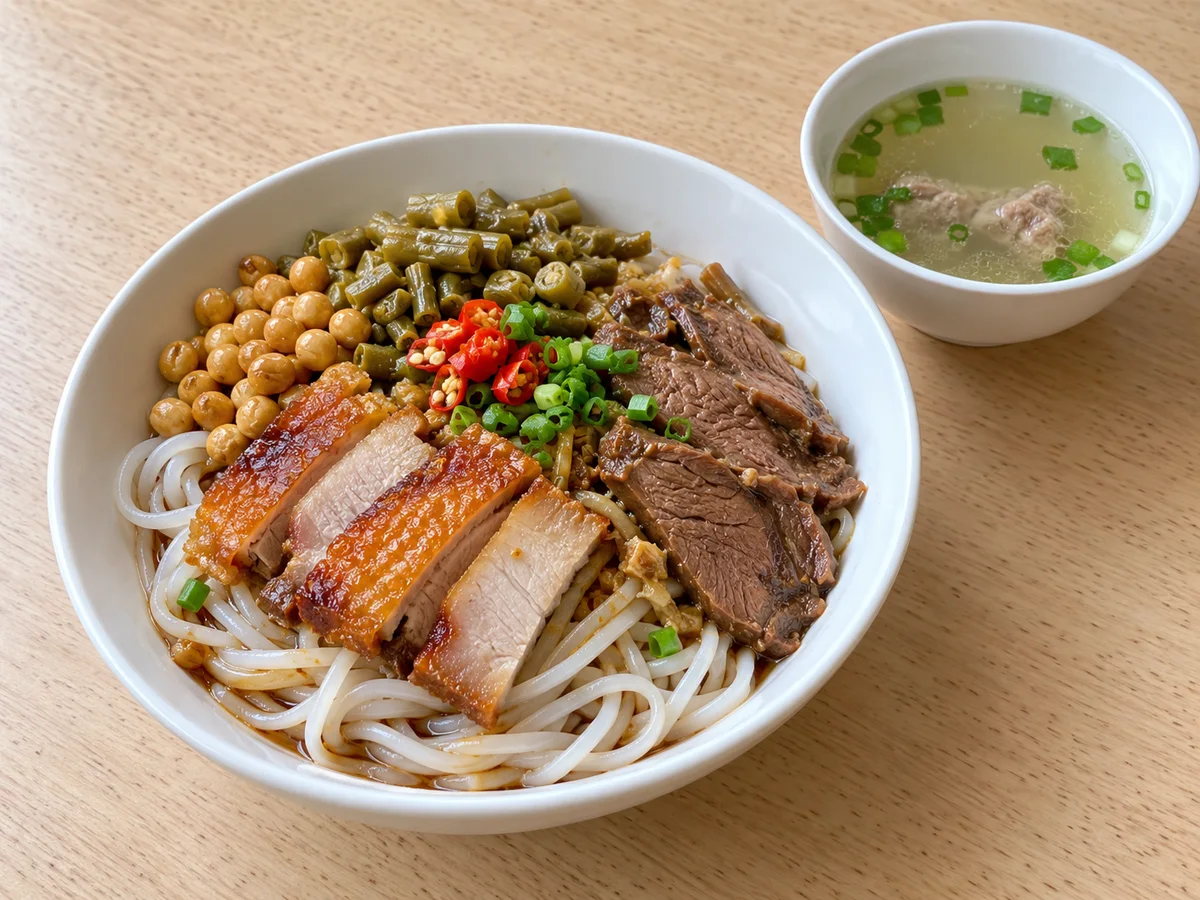
What most of China calls Guilin rice noodles is, to an older Guilin person, lucai fen: noodles with braised meats and brine, eaten without soup.
The noodles are fresh round rice noodles, made the same morning, white and slightly translucent, soft but with a bounce. A server grabs a portion, dips it in a basket into hot water for a few seconds, shakes it dry and drops it in a bowl. On top go the meats: 锅烧 (guōshāo), deep-fried pork with a skin that shatters like crackling, sliced braised beef and, at better shops, braised tripe, beef spleen or pork snout. Then a ladle of 卤水 (lǔshuǐ), the dark spiced brine that is the whole point, and a spoon of fried soybeans. There is no broth in the bowl.
You carry it to a counter of free toppings: sour bamboo shoots, pickled long beans, pickled radish, mustard greens, chopped green and red chili, garlic and scallions. Then you toss everything until each noodle is coated and eat it dry. Bone stock sits in a pot to help yourself, and the custom is to add it at the end. Locals also distinguish 米粉, the round noodle, from 切粉, flat “cut noodles” sliced from a steamed sheet; the toppings and brine are the same, and the round one is the classic.
02
The brine: every shop’s secret
Guilin people judge a noodle shop by its brine, and no two shops make it the same way.
Lushui starts as a stock of pork leg bones and beef bones, blanched with ginger and then simmered gently for about five hours. A set of spices built around cloves, Sichuan pepper, star anise, cassia bark, fennel, dried tangerine peel and licorice is fried in oil over low heat, tied in muslin and simmered in the stock for two hours or more; some makers fry each spice separately at its own temperature. Finally the spiced oil is used to fry fermented tofu, and salt, rock sugar and soy sauce go in before the stock is stirred back. The heritage listing names the brine and the noodles as the two crucial parts of the craft, and says every family’s brine is its own secret, often sweetened with luohan guo, a Guilin fruit. Old-style brine was also left to ferment before seasoning.
Good brine is salty, sweet and fragrant, and there should be just enough of it. Huixianzhai, a famous old shop, was known for 碗底见白, “white at the bottom of the bowl”: each portion of brine was exactly enough to coat the noodles, with not a drop left over, and its brine was flavored with luohan guo for a lingering sweetness. In 2015 the brine recipe of the Minggui chain was listed as municipal intangible heritage in its own right.
03
The noodles: aged rice, fermentation and “tiny holes”
Old noodle makers say the noodles matter as much as the brine, and that good ones are alive.
Traditional Guilin noodles are made from a mix of three rices: early-season indica aged for three years, which gives stickiness, new early indica for spring, and late indica for fragrance. The rice is soaked, ground into a slurry, pressed dry, kneaded into a dough and fermented in a jar for at least 24 hours. The dough is then steamed until about a third of it is cooked, pounded in a mortar (now beaten in a mixer), pressed through a perforated press straight into boiling water, boiled for about ten minutes until the noodles sink, and cooled in running water. A regional master of the craft says the old test was to whirl a long noodle round eight times without it breaking. Finally the noodles are wound into single portions.
Fermented noodles are full of tiny holes, which drink up the brine so that the bowl is nearly dry at the end. Many master makers say the best bowl is made with noodles less than two hours old. Most noodles sold today come from factories that skip the fermentation to work faster, and master noodle makers say the bowl has lost springiness and flavor as a result. Because the noodles are already cooked, they are only warmed: locals call it 冒粉, “dipping the noodles,” in water of about 80°C, not boiling, for 20 to 30 seconds at most. At a busy shop it takes seven seconds.
04
The old four: brined meats, original soup, horse meat and brisket
Traditional Guilin noodle shops served four bowls, and only one of them is what travelers now order.
The richest version of the brined-meat bowl is called 七星拱月, “seven stars around the moon”: crisp guoshao, braised beef, braised beef liver, beef spleen, braised tripe, pork snout and a roasted sausage, with soybeans and brine. Each takes time to make, so most shops offer two or three. The other three of the “old four” are harder to find. 原汤粉, “original-soup noodles,” are cooked in the water in which the fresh noodles were first boiled, with fresh pork, liver and intestine; the dish needed a shop that made its own noodles, so as factories took over noodle-making it nearly vanished. In 2024 one of the few places serving it charged 14 yuan for a bowl with wide sheet noodles and pork offal.
马肉粉, horse-meat noodles, began as a street-carrier noodle in the Republican years, served in teacup-sized bowls so that people could buy as few as they could afford, and sold only from the tenth to the third lunar month. The noodles are dipped in horse-bone broth, not water, and topped with slices of rose-red cured horse meat and horse sausage, green garlic, coriander, peanuts and sesame oil, with no brine. The dish had its heyday during the war against Japan, when refugees and writers crowded into Guilin. Youyixuan on Taiping Road, in business since 1932 and now run by its fourth generation, still serves it in a clear broth with braised fresh horse meat. 牛腩粉, brisket noodles, came from Hui Muslim shops: the brisket is simmered with beef bones and soybeans and served in soup.
| Bowl | How it is served | Toppings | Where to find it now |
|---|---|---|---|
| Brined-meat noodles 卤菜粉 | Tossed dry with brine; stock added at the end | Guoshao, braised beef, offal, fried soybeans | Every noodle shop |
| Original-soup noodles 原汤粉 | In the water the fresh noodles were boiled in | Fresh pork, liver, intestine | Rare; needs a shop that makes its own noodles |
| Horse-meat noodles 马肉粉 | In horse-bone broth, small bowls | Cured or braised horse meat, horse sausage, green garlic, peanuts | A few old shops such as Youyixuan |
| Brisket noodles 牛腩粉 | In soup | Brisket simmered with beef bones and soybeans | Specialist shops, often sold out by noon |
05
From a Qin legend to a 1341 record
Guilin likes to say its noodles are 2,200 years old. The written record is younger, but still old.
The favorite story goes back to the Qin dynasty. When the First Emperor sent an army south and dug the Lingqu Canal north of Guilin, his northern soldiers could not get used to rice, so the cooks ground it, pressed it into noodles like the wheat noodles of home, and an army doctor brewed a herbal soup against the southern damp, which became the brine. The Guangxi noodle book that tells it calls it folklore, without firm evidence and at odds with the history of grain processing.
The earliest record is a village name: the place-name gazetteer of Lingchuan County says that in 1341 a family named Qin moved to a spot outside the town and opened a small rice noodle shop, and the settlement that grew around it is still called Mifendian, “Noodle Shop.” So rice noodles were already a trade around Guilin in the Yuan dynasty. In the last years of the Qing, under the Xuantong emperor, a shop called Xuanchazhai was famous across the city for 炒片, beef dried on bamboo racks, braised and then sliced and fried; another, Huixianzhai, for its luohan-guo brine. The making of Guilin rice noodles was listed as municipal and regional heritage in 2010 and added to the national list in 2021, together with luosifen. By the early 2020s Guilin had more than 6,000 noodle businesses, over a hundred noodle makers and some thirty packaging firms, five of them able to keep fresh noodles fresh in a vacuum pack, with an output of nearly 10 billion yuan a year.
The legend is still the version most readers meet first. A 2018 China Daily article, drawing on Zhang Di’s book Guilin Rice Noodles, tells it as the start of rice noodles, and describes a method that has changed little: rice soaked for hours, ground wet to a paste like clotted cream, then left for several days to settle before the solids are filtered out.
06
How to order and eat it like a local
Ordering takes one sentence, and eating has an order of its own.
Purists add only soybeans, never peanuts, which they say are too strong, and many older Guilin people take a crushed clove of raw garlic and a few bird’s-eye chilies instead of pickles.
Order by the liang
Two liang (二两, 100 g of noodles) is a normal bowl. In Guilin dialect the order sounds like “e liang mi fen, yao guoshao”: two liang of noodles, with guoshao.
Pick your meats
Guoshao and braised beef are the standard; beef spleen, pork snout, sausage or a braised egg cost a little extra.
Go easy at the counter
Add sour bamboo, pickled beans, chili, garlic and scallion to taste, but not so much that you lose the brine.
Toss and eat it dry
Mix until every noodle is the same brown, and eat most of the bowl without soup to taste the brine.
Add stock at the end
When about a fifth is left, pour in bone stock from the pot and finish the noodles as a soup; some people tear a youtiao into it.
07
Five yuan a bowl, and two-price menus
Guilin rice noodles are one of the cheapest good meals in China, as long as you pay the local price.
In Guilin city in 2024 and 2026, an everyday two-liang bowl of brined-meat noodles cost about 5 to 8 yuan, and locals said it should not cost more than 10. A busy old shop charged 11 yuan for its loaded house bowl or beef noodles. Shops near scenic spots charge more, and some offer bowls with milk tea at well over ten yuan, which locals avoid. Two shops have been caught charging tourists more than locals for the same bowl: in January 2024 a Guilin shop sold a noodle listed at 10 yuan to residents for 6, and in May 2026 a shop in Yangshuo charged visitors 13 yuan and locals 7. In both cases the market regulator opened an investigation; the Guilin shop was closed for correction and Yangshuo promised the heaviest penalty the law allows. Check the price board before you order, and pay what it says.
08
Where to eat it in Guilin
Locals say to walk into any lane shop full of people in slippers, but a few names come up again and again.
The old advice in the Guilin noodle book is simple: for a traditional shop, go into the lanes and pick the busiest; for a brand, go to the main streets. Recommendations from residents in 2024 to 2026 keep returning to the same places. Avoid shops at stations, scenic-spot gates and walking streets if you want the everyday version.
| Shop | Known for | Notes |
|---|---|---|
| Axiu 阿秀米粉 | Soft, springy noodles and a well-liked brine | Main shop on Hangtian Road; several branches |
| Tianyuan 田园米粉 | A tiny old shop with sour-hot green chili | Many people eat standing outside |
| Youyixuan 又益轩 | Horse-meat noodles and brined-meat noodles | Taiping Road; open since 1932, fourth generation |
| Minggui 明桂米粉 | A chain whose brine is municipal heritage | Consistent and comfortable |
| Chongshan 崇善米粉 | A long-established chain | Heritage-listed technique; opinions among locals are mixed |
| Qiufu 秋福米粉 | Dry-tossed braised beef brisket, very hot | In Shegong Lane off Zhengyang pedestrian street |
| Qinyuan 沁园汤粉 | Brisket noodles in soup | Near the back gate of Seven Star Park; usually sold out by noon |
09
Guilin noodles, luosifen and laoyou noodles
Guangxi’s three famous noodles share a province and a grain, and almost nothing else.
Guilin rice noodles are the oldest of the three and were the first Guangxi noodle to become famous across China, long before luosifen overtook them. They are also the mildest: the heat and sourness come from the counter, not from the bowl.
| Guilin rice noodles | Liuzhou luosifen | Nanning laoyou noodles | |
|---|---|---|---|
| Noodles | Fresh, round, fermented | Dried, round, soaked | Fresh, flat |
| Liquid | A ladle of spiced brine; stock at the end | Spicy snail-and-bone broth | Sour-hot soup with fresh pork |
| Key flavor | Brine, guoshao, soybeans | Fermented bamboo shoots, chili oil | Sour bamboo, pickled chili, black beans |
| Heat | Mild; add chili yourself | Hot | Hot |
Sources [1]
10
A simple brine at home
For about 1 liter of brine (8 to 10 bowls): 1 kg pork and beef bones; a spice set of 3 star anise, 1 piece cassia bark, 5 cloves, 1 teaspoon Sichuan pepper, 1 teaspoon fennel seed, 1 piece dried tangerine peel and 3 slices licorice root; half a dried luohan guo; 2 cubes red fermented tofu; light soy sauce, salt and rock sugar. To serve: fresh round rice noodles, roast pork belly with crackling, braised beef, fried soybeans and pickles.
- 1. Make the stock
Blanch the bones with ginger, rinse, cover with fresh water and simmer gently for about five hours. Strain.
- 2. Fry the spices
Fry the spices in a little oil over low heat until fragrant, lift them out and tie them in muslin with the luohan guo.
- 3. Simmer the brine
Simmer the spice bag in the stock for two hours.
- 4. Season it
In the spiced oil, fry the mashed fermented tofu, add soy, salt and rock sugar, then stir in the stock. It should taste salty, sweet and strongly spiced.
- 5. Assemble
Dip the noodles in water just off the boil for 20 to 30 seconds, drain, top with the meats and a ladle of brine, add soybeans and pickles, toss and eat; add hot stock at the end.
Store-bought fresh rice noodles are unfermented and softer than Guilin’s, so drain them very well. The brine keeps for several days in the fridge.
Sources [1]
11
More Guangxi rice noodles
Luosifen
Liuzhou’s snail-broth rice noodles with fermented bamboo shoots.
Read about luosifen →Crossing-the-bridge noodles
Yunnan’s rice noodles cooked at the table in a scalding broth.
Read about crossing-the-bridge noodles →Hunan rice noodles
Another rice-noodle breakfast, in Changsha.
Read about Hunan rice noodles →Guangxi classics
- Luosifen
Rice noodle soup · Any time, often late at night
- Laoyou Rice Noodles
Wok-fried rice noodle soup · Breakfast, late night, when you have a cold
Noodles from other regions
FAQ
Questions about Guilin Rice Noodles
What are Guilin rice noodles?
Fresh round rice noodles tossed with a spiced brine called lushui, crisp guoshao pork, braised beef and fried soybeans, eaten dry with pickles before bone stock is added at the end.
What is lushui?
The brine that dresses the noodles: bone stock simmered with star anise, cassia, cloves, fennel, licorice and other spices, seasoned with fermented tofu, soy, salt, rock sugar and often luohan guo.
What is guoshao?
Deep-fried pork, usually belly, with a crisp crackling skin, sliced over the noodles.
Are Guilin rice noodles a soup?
Not at first. The classic bowl is tossed dry with brine; stock is added only when the noodles are nearly finished.
How much do Guilin rice noodles cost?
About 5 to 8 yuan for two liang in Guilin city in 2024–2026; around 11 yuan for a loaded bowl; more near scenic spots.
What is the difference between mifen and qiefen in Guilin?
Mifen are round noodles pressed through holes; qiefen are flat noodles cut from a steamed sheet. The toppings are the same.
Do Guilin people put peanuts on their noodles?
Purists do not. They use fried soybeans, saying peanuts are too strong for the brine.
Are Guilin rice noodles spicy?
No, unless you add chili. The brine is savory, sweet and spiced; chili and sour pickles are on a self-service counter.
What are horse-meat rice noodles?
One of Guilin’s “old four”: noodles in horse-bone broth topped with cured or braised horse meat, traditionally served in small bowls in winter.
How old are Guilin rice noodles?
A legend links them to the Qin army over 2,200 years ago. The earliest written record is a village founded around a noodle shop in 1341.
Sources
Sources and further reading
- 1 Lin Yexin and Gong Zheng, Guangxi Mifen: Shejian shang de Chanmian (广西米粉:舌尖上的缠绵), chapters “Guilin rice noodles: brine is the soul, a sweet aftertaste” and “All-embracing Guangxi rice noodles” (in Chinese)Guangxi People’s Publishing House (2022), “Intangible Heritage of Guangxi” series
- 2 Rice noodle making technique: Guilin rice noodles, national intangible cultural heritage item Ⅷ-277 (2021) (in Chinese)China Intangible Cultural Heritage Network ↗
- 3 Guilin rice noodles (桂林米粉/Guilin Mifen): round and cut noodles, the soups and the kindsChina Daily, english.gov.cn travel guide (2019) ↗
- 4 A history spanning soldiers and snails: the Qin canal story and how rice noodles are madeWang Xiaoyu, China Daily (2018) ↗
- 5 A Guilin locals’ favorite: brined-meat noodles for about 6 yuan, beef noodles for 11 and free pickles (video, in Chinese)Da Ge Zai Shanghai (达哥在上海), Bilibili (2024) ↗
- 6 Ten Guilin noodle shops with a local: brined-meat noodles at 5 yuan, horse-meat noodles at Youyixuan and original-soup noodles (video, in Chinese)Miao You Ji (喵游记MuaWoo), Bilibili (2024) ↗
- 7 A Guilin noodle shop charging visitors 10 yuan and locals 5 or 6; the district’s notice (video, in Chinese)Sina News, Bilibili (2024) ↗
- 8 A Yangshuo noodle shop charging tourists 13 yuan and locals 7; investigation announced (video, in Chinese)Red Star News (红星视频), Bilibili (2026) ↗
Last updated November 2026