
01
A plate that tests the cook
Beef chow fun has almost nothing in it, so there is nowhere for a careless cook to hide.
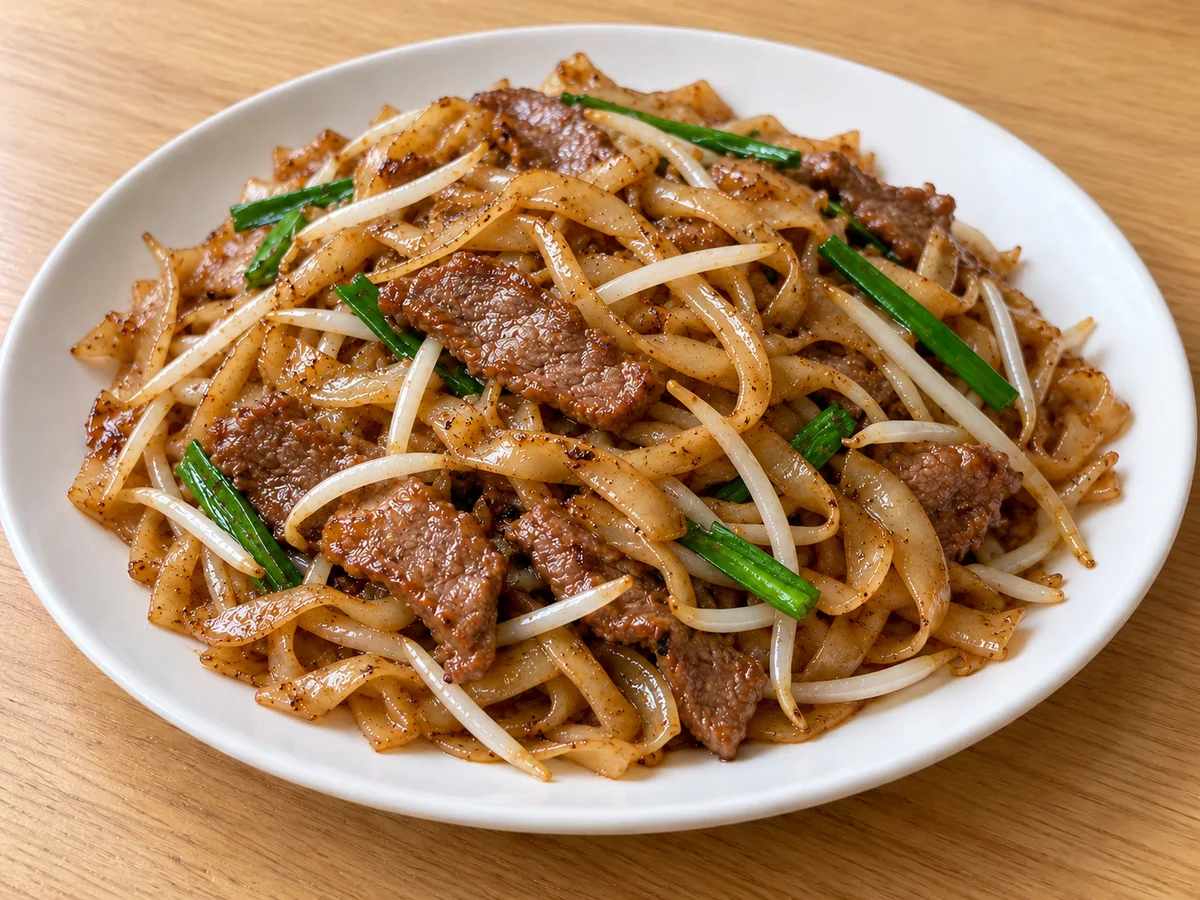
The Chinese name is a contraction. 牛河 is short for 干炒牛肉沙河粉, “dry-fried beef with Shahe noodles,” and the “dry” means what it says: unlike older fried noodles, there is no starch-thickened sauce poured over the top. A plate is noodles, beef and bean sprouts, with yellow chives and scallions thrown in at the end. The soy sauces color every strand the same even brown, and the plate should arrive too hot to eat at once.
Because the list of ingredients is so short, Cantonese cooks use it to judge one another. In a Cantonese restaurant kitchen the dish is officially the job of the lowest-ranking wok cook, but many places in the Pearl River Delta have the head chef make it, because a reputation can be built on it; some small shops were founded on nothing else. The New York chef Lucas Sin calls it a culinary school exit exam. In Guangzhou the saying is that a perfect plate leaves no oil behind: wipe the empty plate with your sleeve and the sleeve stays clean.
02
Rice noodles from Shahe
The noodle is named after a town.
Shahe noodles, 沙河粉, come from Shahe, a town at the foot of Baiyun Mountain on the north side of Guangzhou, where they were first made with the mountain’s spring water. Rice is soaked, ground to a batter, steamed into large thin sheets and cut into ribbons about a finger wide. They are cousins of the steamed rice noodle rolls sold for breakfast. Zhongguo Yuecai Gushi, recounting how the Chencun noodle was developed, gives the difference as the rice: the older pig-intestine rolls were made from japonica rice, which turns soft and smooth when steamed again, while Shahe noodles are made from long-grain indica rice, which stays springy when fried.
Good cooks want noodles made only from rice, with no added starch, and made that day. Overnight noodles turn brittle and break into short pieces in the wok. Before cooking, the sheets are pulled apart strand by strand so they go in loose.
| Noodle | What it is like | Good for chow fun? |
|---|---|---|
| Soup noodles 汤河粉 | The thinnest | No; made for noodle soup |
| Ordinary rice noodles 普通河粉 | Cheapest; starch added, slightly translucent when hot | Not recommended; breaks easily |
| Shahe noodles 沙河粉 | Pure rice batter, slightly yellow, wider, soft and smooth | The first choice |
| Kway teow 粿条 | Pure rice batter, a little narrower and springier, Chaozhou style | Works; chewier |
| Dried rice noodles | Sold far from Guangdong | Soak, then toss with oil, because fresh noodles come with a film of oil |
03
Before the war it came with gravy
Fried rice noodles in Guangzhou used to be finished with a starch sauce.
Before the late 1930s, Guangzhou’s fried beef noodles were “slippery-fried”: once the noodles were cooked, a wet slurry of starch was poured over them to make a glossy sauce. The story told for the dry version, set during the Japanese occupation of the city, which began in 1938, concerns a young man named Xu Bin who ran a small shop on Yangxiang Road with his parents, selling mainly wonton noodles and fried rice noodles. One night the starch ran out, and a checkpoint stopped Xu Bin from going out to buy more. A detective working for the occupation government came in after an opium session, demanded fried noodles and pulled out a pistol when told there were none. Xu Bin fried them dry: shallots first, then bean sprouts, then the noodles, and finally beef that had been passed through oil. The detective came back every night after that for the same plate, and the family stopped buying starch.
The story cannot be checked, but the change it describes is real: dry-frying replaced the old gravy, and later cooks refined it into the plate sold today. Both ways survive. Some Cantonese writers still prefer a wet fry, with the noodles finished in sauce; dry is so much more common that menus rarely bother to say so.
The dish belongs to the night. In 1983 Wen Wannian opened Shengji, the first privately run restaurant on Guangzhou’s riverside Changdi Road, under a bamboo shed with folding tables, and by night it ran thirty or forty tables along the road. Taxi drivers who brought late diners got a big plate of fried beef noodles and a bowl of lean-pork congee for five jiao. Around 1980, Guangzhou eaters went to the street stalls after midnight and ordered a new plate every ten minutes, eating one while the next was cooked, so that each arrived at its hottest.
04
What wok hei is
镬气, wok hei, is the reason people order this dish.
Literally “wok breath,” wok hei is the smoky, slightly charred smell of food tossed over a fierce flame. At the coal and kerosene stoves of Guangzhou’s street stalls around 1980, oil, wine and soy splashing over the rim of the wok caught fire and flared above it as the noodles and bean sprouts were thrown. America’s Test Kitchen traces the aroma to compounds formed when flame touches the food and the cooking fat goes past its smoke point, to the seasoned surface of the wok, and to browning and caramelization.
Wok hei is not only something you smell in the first minute. The food writer Lin Weihui describes a meal at Guangzhou’s Bingsheng restaurant where the host ordered stir-fried choy sum and beef chow fun and said both keep their wok hei even after they cool. They did: some of the aromatic compounds stay on the surface of the food instead of escaping into the air. The color comes partly from dark soy sauce. A spoonful turns the whole plate glossy brown, and at high heat its sugars caramelize; Guangzhou cooks who prefer a lighter taste use more light soy and less dark.
05
How a chef makes it
A Cantonese master chef’s method, for one plate: fresh Shahe noodles, about 150 grams of beef, a large handful of bean sprouts, yellow chives and scallions.
- 1. Slice and marinate the beef
Use good beef (the chef prefers beef from the Xijiang River area), sliced across the grain, neither thick nor paper-thin. Marinate with a little baking soda, sugar, light soy sauce and cornstarch for at least 25 minutes. No salt: salt in the marinade toughens the meat.
- 2. Pass the beef through oil
Slide the beef into oil at about 60 to 70°C until it just changes color, then lift it out. Pour the oil off and wipe the wok clean.
- 3. Fry the noodles
Heat the wok hard, add the loosened noodles and toss them gently so they do not break, letting them dry and color. Add the bean sprouts: their water steams into the noodles, which soak it up.
- 4. Season
Add a little sugar and chicken powder, light soy and dark soy, and keep tossing over full heat so the dark soy caramelizes and coats every strand evenly.
- 5. Finish
Return the beef, then add yellow chives and scallions last. Cantonese cooks say “raw scallion, cooked garlic, half-cooked yellow chives”: the chives are best barely wilted. The plate should be hot, aromatic, evenly brown and dry underneath.
High-end kitchens use 银芽, bean sprouts with their heads and tails pinched off, which cook evenly and look neater.
06
Dry or wet
The older gravy version never went away; it became a dish of its own.
In a wet fry, 湿炒牛河, the noodles are fried and seasoned on their own and turned out onto the plate, often ringed with blanched choy sum. The beef is cooked separately in a sauce of oyster sauce and water, colored with dark soy, thickened with starch and finished with onion, carrot or mushrooms and yellow chives, and the whole lot is poured over the noodles, much as a sauce is ladled over rice. Some Cantonese cooks use a spoonful of shacha sauce in the gravy. The result is softer and saucier, and many people in Guangdong order it as a late-night supper precisely because it is less dry.
| Dry-fried 干炒牛河 | Wet-fried 湿炒牛河 | |
|---|---|---|
| Sauce | None; soy sauces tossed into the noodles | Oyster-sauce gravy thickened with starch, poured over |
| Beef | Fried with the noodles at the end | Cooked in the gravy |
| Texture | Dry, smoky, every strand separate | Soft and saucy |
| Usual extras | Bean sprouts, yellow chives, scallions | Choy sum around the plate, onion, carrot or mushroom |
| What to judge | Wok hei and a dry plate | A glossy gravy that is neither gluey nor thin |
Sources [2]
07
How to tell a good plate, and what it costs
Look at the bottom of the plate first.
Prices run from a street-stall supper to a banquet course. In 2023 a street stall in old Guangzhou that locals ranked among the city’s five best charged 17 yuan for a large plate, with soup. In 2025 Lei Garden in Guangzhou charged 128 yuan, with same-day noodles, bean sprouts fried in the wok rather than blanched, sauce worked evenly into every strand and almost no oil on the plate. In Hong Kong the same year, a MICHELIN-starred Cantonese restaurant charged 228 Hong Kong dollars. Hong Kong’s Ho Hung Kee, better known for wonton noodles, has a dry-fried beef noodle that the writer Chua Lam called the best in Hong Kong: springy noodles, tender beef and no oil left on the plate.
In old Guangzhou, the restaurant Miaoqixiang Liji stayed cheap and popular, and its best-selling dish was dry-fried beef noodles. Away from China, beef chow fun is on the menu of Cantonese restaurants, tea houses and Hong Kong-style cafés almost everywhere.
The plate is dry underneath
Lift a few noodles: there should be little or no oil pooled below. Too much oil makes the noodles greasy in the mouth.
Every strand is the same color
The sauce is worked in by tossing, not by adding extra liquid, so no pale or soggy patches.
The noodles are whole and hot
Long, unbroken ribbons that are hot right through; broken stubs mean old noodles or a heavy hand.
The bean sprouts crunch
They should be stir-fried in the wok, not blanched first, so they stay crisp without a raw bean taste.
The beef is tender
Soft but still tasting of beef, not mushy from too much tenderizer.
08
Why it breaks, sticks or turns greasy
Broken noodles, a stuck pan and a greasy plate are the three ways a home plate goes wrong.
Almost every failure traces back to one of three things: the noodles, the heat or the order. Fresh noodles, a very hot pan and one plate at a time solve most of them.
| Problem | Usual cause | What cooks do |
|---|---|---|
| Noodles break into short bits | Day-old noodles turn brittle; stirring too hard | Use same-day noodles, separate them by hand first, toss gently with two pairs of chopsticks or a spatula |
| Noodles stick to the pan | Bits of beef left in the pan; pan not hot enough | Wipe the pan clean after the beef, heat it well, spread the noodles and let them fry before tossing |
| Plate is greasy | Too much oil to stop sticking | Fry the noodles dry; a good plate leaves almost no oil when the noodles are lifted |
| Color is patchy or pale | Soy poured straight onto the noodles | Pour the sauce down the side of the hot pan and keep tossing so it coats every strand |
| Watery and soft | Bean sprouts release water; pan overloaded | Fry the noodles dry before the sprouts go in so they absorb the water; cook one plate at a time |
| Beef is tough | Salt in the marinade; cut along the grain | Slice across the grain and marinate with a little baking soda, sugar, soy sauce and starch, no salt |
09
At home: fry first, then toss
For one large plate: 250 grams of fresh Shahe noodles, 150 grams of beef, a handful of bean sprouts with tops and tails removed, half an onion in strips, yellow chives and scallions in finger lengths. Sauce: light soy, dark soy, a pinch of sugar.
- 1. Prepare the beef
Slice it against the grain about 3 millimeters thick. Mix with soy sauce, oyster sauce, Shaoxing wine, a little sugar, white pepper and a spoonful of water until the water is absorbed, then cornstarch and a little oil. Leave 30 minutes.
- 2. Loosen the noodles
Pull the sheets apart into single strands. If you only have dried noodles, soak them and toss them in a little oil first.
- 3. Sear the beef and vegetables
In a very hot pan, sear the beef in a single layer on both sides until about two-thirds cooked and set it aside. Fry the onion and bean sprouts for about ten seconds and set them aside too. Wipe the pan clean, or the noodles will stick to the bits left behind.
- 4. Fry, then toss
Add fresh oil and spread the noodles flat. Let them fry for about ten seconds, turn them and fry the other side until lightly crusted. Only then start tossing, gently, with two pairs of chopsticks or a spatula.
- 5. Bring it together
Return the beef and vegetables, drizzle the sauce down the side of the pan rather than onto the noodles, add the yellow chives and scallions, and toss until the sauce is absorbed. Cook one plate at a time so the pan stays hot.
A nonstick pan can manage the browning, because the coating holds up to about 260°C and caramelization starts near 200°C; a well-seasoned iron wok, heated until it smokes, gives the best aroma. In an air fryer, mix the sauce into the noodles first, use fattier beef, brush the basket with oil and turn everything every three minutes.
10
More rice noodles and roast meats
Rice noodle rolls
The steamed cousin of Shahe noodles, a Guangzhou breakfast.
Read about rice noodle rolls →Char siu
Cantonese barbecued pork from the same roast-meat and noodle shops.
Read about char siu →Guangdong food
Guangzhou, Chaozhou and Hakka cooking, and Guangdong breakfasts.
Read the Guangdong guide →Guangdong classics
- Wonton Noodles
Noodle soup · Breakfast to late-night snack
- Cantonese Yum Cha
Yum cha · Morning tea, weekends with family
- Char Siu
Roast pork · Lunch or dinner, with rice
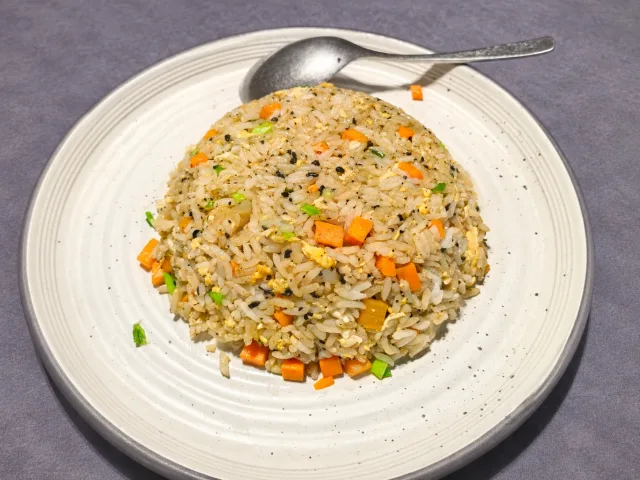
- Egg Fried Rice
Fried rice · Lunch, dinner, end of a meal
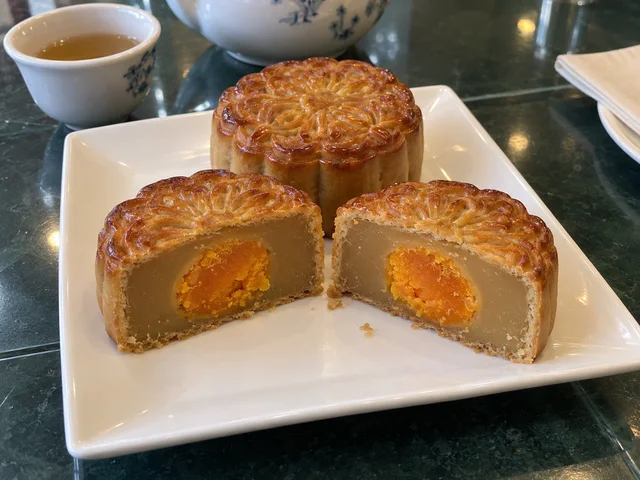
- Mooncake
Festival pastry · Mid-Autumn Festival
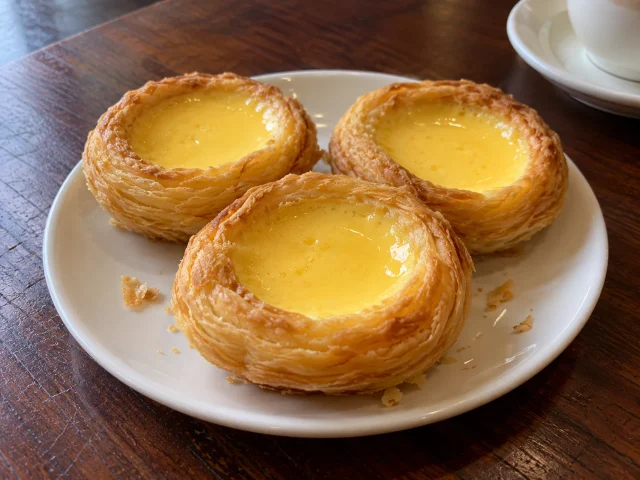
- Egg Tart
Custard tart · Dim sum, afternoon tea or bakery snack
Noodles from other regions
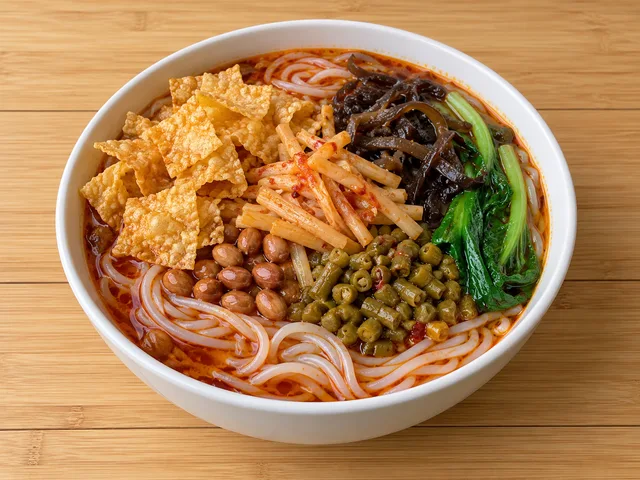
FAQ
Questions about Beef Chow Fun
What is beef chow fun?
Dry-fried wide rice noodles from Shahe with sliced beef, bean sprouts, yellow chives and scallions, colored with light and dark soy sauce. The Chinese name is 干炒牛河.
Why is it called niu he?
牛河 is short for 牛肉沙河粉, beef with Shahe rice noodles, named after Shahe near Guangzhou.
How do I keep the noodles from breaking or sticking?
Use same-day fresh noodles, separate them by hand, wipe the pan clean and heat it well, let the noodles fry before tossing, and cook one plate at a time.
What is the difference between dry-fried and wet-fried beef ho fun?
Dry-fried has no gravy; the soy is fried into the noodles. Wet-fried pours an oyster-sauce gravy with the beef over noodles fried separately.
What does “dry-fried” mean?
No starch-thickened sauce is poured over the noodles. Before the late 1930s Guangzhou’s fried beef noodles were finished with gravy; the dry version replaced it.
What is wok hei?
The smoky, slightly charred aroma of food tossed over a very hot flame, partly from browning and caramelization and partly from oil and soy catching fire at the rim of the wok.
Can I use dried rice noodles?
Fresh Shahe noodles made that day are best. Dried ones work if soaked and tossed with a little oil first, but they stick more easily.
How much does it cost in Guangzhou?
From 17 yuan at an old-town street stall (2023) to 128 yuan at a high-end Cantonese restaurant (2025).
Sources
Sources and further reading
- 1 Zhongguo Yuecai Gushi (中国粤菜故事), chapters “Cantonese wok hei and an ideal plate of dry-fried beef noodles,” “Drinking the first soup” and “Chencun noodles” (in Chinese)Guangdong Vocational and Technical Teaching Research Office; Guangdong Science and Technology Press (2022)
- 2 Sheng Hui, Yuecai Ji (粤菜记), chapter “Notes on morning tea” (早茶小札) (in Chinese)People’s Literature Publishing House (2023)
- 3 Lin Weihui, Fengwei Lingnan (风味岭南), chapter “Wok hei” (镬气) (in Chinese)Huacheng Publishing House (2025)
- 4 Zhao Liping, Da Yuecai (大粤菜), chapter “A thousand years of roots”: light and dark soy sauce (in Chinese)Guangzhou Publishing House (2023)
- 5 Fei Yong and Han Bangwen (eds.), Guangzhou She Hua Lu (广州舌华录), chapter “253 days in Guangzhou, 43 restaurant meals for Lu Xun”: Miaoqixiang (in Chinese)Guangzhou Publishing House (2019)
- 6 How to make ho fun: the noodles, wok hei and beef chow fun at homeDavid Yu and Liz Bomze, America’s Test Kitchen (2025) ↗
- 7 Beef chow fun for beginners: four kinds of rice noodle, slicing the beef, and a nonstick pan, a wok and an air fryer (video, in Chinese)Ma Ti Chu Fang (马蹄厨房), Bilibili ↗
- 8 What a 128-yuan beef chow fun looks like: Lei Garden, Guangzhou, 2025 (video, in Chinese)Te Chu Sui Po (特厨隋坡), Bilibili ↗
- 9 Master chefs’ dishes: beef chow fun, the beef, the noodles and “half-cooked yellow chives” (video, in Chinese)Da Shi De Cai (大师的菜), Bilibili ↗
- 10 A 228-Hong-Kong-dollar beef chow fun at a MICHELIN-starred Cantonese restaurant, 2025 (video, in Chinese)Zhongguo BOY Chaoji Da Xingxing (中国BOY超级大猩猩), Bilibili ↗
- 11 A top-five beef chow fun in old Guangzhou, with soup, for 17 yuan, 2023 (video, in Chinese)Pin Cheng Ji (品城记本地版), Bilibili ↗
Last updated October 2026