
01
A pastry case and a steamed-egg filling
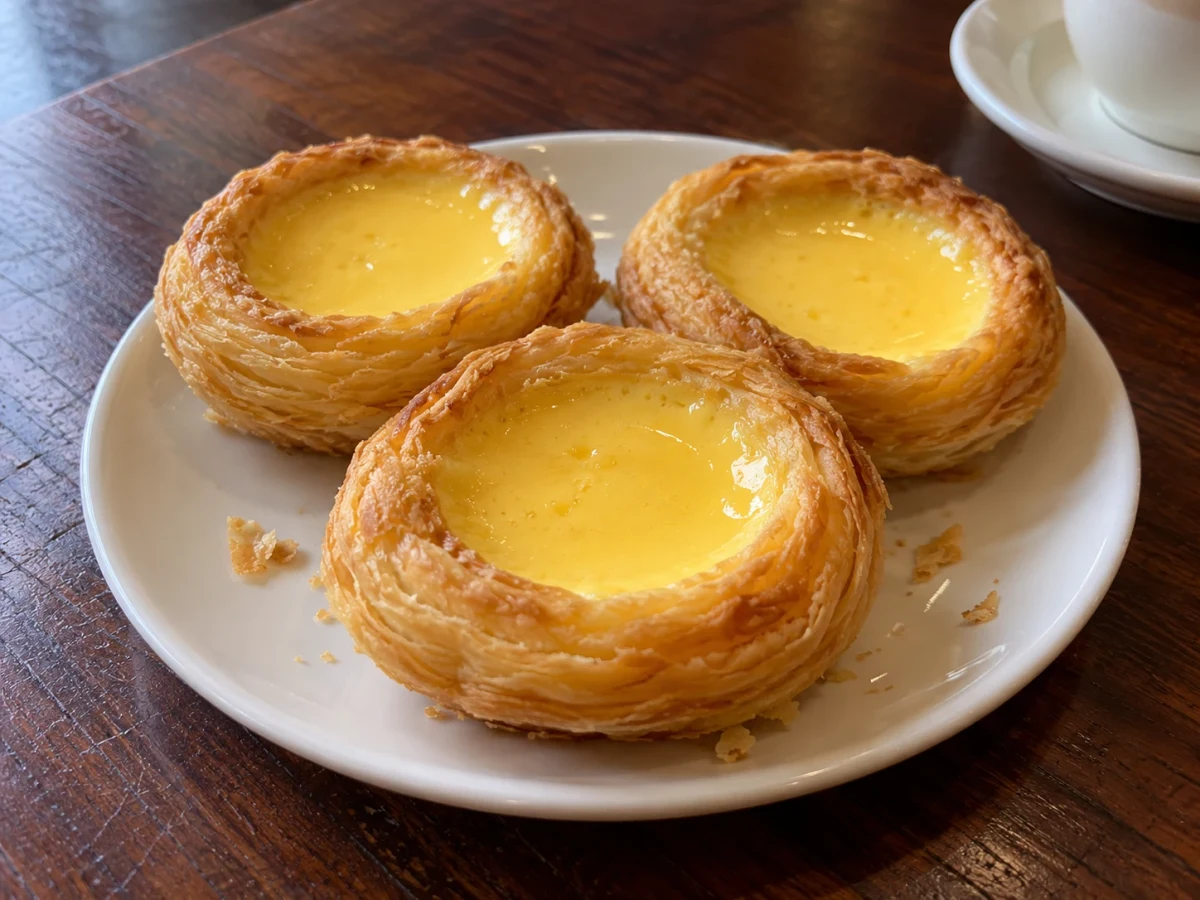
A Cantonese egg tart is a Chinese steamed-egg custard baked in a Western pastry case.
The filling is mostly egg, sugar and water, often with some evaporated or fresh milk, strained so that it sets without a single bubble or grain. Sheng Hui, a writer on Cantonese food, describes the surface as smooth and shining under the lights, as if the custard were still slowly moving, and the pastry as flaking “like petals” when you bite. The taste is gentle: eggy, not very sweet, with the fat of the crust doing most of the work.
That makes it quite different from the Macau or Portuguese tart (葡挞), which has cream and egg yolk in a richer custard and a top blistered black in a very hot oven. In Guangzhou, Hong Kong and Macau the two are sold side by side, and a menu that just says 蛋挞 nearly always means the Cantonese one.
02
Guangzhou in the 1920s: a weekly special that stayed
Many people take the egg tart for a Western pastry. Its creators were Cantonese pastry cooks.
Sheng Hui writes that in the 1920s Guangzhou dim sum cooks put Chinese steamed egg into a Western tart shell, and that the first tins were oval, shaped like the small boats on the Pearl River. The word 挞 (taat) is simply a Cantonese rendering of the English “tart.” The Hong Kong historian Ng Ho (吴昊), quoted by the Guangzhou writer Huang Aidongxi, traced it to the competition between Guangzhou’s big Western-style department stores, whose kitchens invented a new “weekly special” (星期美点) every week to draw shoppers; the egg tart was one that stayed. Another account names the Zhen Guang restaurant as making the modern kind around 1927.
Old Guangzhou menus show it already had variants. The Guangzhou Museum’s study of Republican-era menus found items such as a flaky egg-yolk tart and a “melt-in-the-mouth egg-yolk tart,” written with the shorthand cooks used, 旦 for 蛋 (egg) and 王 for 黄 (yolk). From Guangzhou the tart went to Hong Kong. Accounts vary on when: Hong Kong bakeries may have sold them from the 1940s, and between the 1950s and the 1980s they reached most of the city’s cha chaan tengs.
03
One of the four kings of dim sum
In Cantonese teahouses the egg tart is not an afterthought.
The Cantonese trade calls four items the 四大天王, the four heavenly kings of dim sum, meaning the four that sell the most: shrimp dumplings, dried-steamed siu mai, char siu bao and egg tarts. The list is credited to the dim sum master Chen Xun (陈勋). Asked which items test a dim sum chef most, Chen named the skin and shape of the shrimp dumpling, the puff pastry of the egg tart and the dough of the char siu bao.
Size depends on where you buy it. Teahouse tarts are small, so you still have room for other dim sum; bakery tarts are bigger; and the largest are in cha chaan tengs. Huang Aidongxi recalls being treated to afternoon tea at a Hong Kong café and facing an egg tart the size of a rice bowl.
04
Butter crust or puff pastry
Hong Kong and Guangzhou divide egg tarts by their crust: a short butter “cookie” crust or a flaky puff pastry made with lard.
A butter crust (牛油皮, also called 曲奇皮, cookie crust) is thin, crumbly and fragrant, like shortbread. A puff pastry crust (酥皮, or 千层酥, thousand-layer pastry) was traditionally made with lard; it smells less of butter but shatters into layers, and because the pastry takes up more room it holds less custard. Huang Aidongxi notes that lard was easier to get than butter in the old days, which is why teahouse tarts were a Chinese-Western hybrid from the start.
Puff pastry tarts are built from two doughs. An oil dough of fat and flour is wrapped in a water dough of flour, egg and water, then rolled and folded again and again, with rests in the fridge so the layers stay separate. The most famous example is the Honolulu Coffee Shop’s tart in Hong Kong, said to have 192 layers. The fillings vary too: plain egg, fresh milk, coconut, egg white, even bird’s nest. Taotaoju in Guangzhou once made a “mandarin-duck” tart with egg custard and coconut together in one case.
| Butter crust 牛油皮 | Puff pastry 酥皮 | Portuguese 葡挞 | |
|---|---|---|---|
| Crust | Short, crumbly, like shortbread | Layered, flaky; lard or butter | Flaky puff pastry |
| Filling | Egg, sugar, water, some milk | Egg, sugar, water, some milk | Yolks, milk, cream, sugar |
| Top | Smooth, glossy yellow | Smooth, glossy yellow | Scorched brown and black patches |
| Where | Hong Kong bakeries such as Tai Cheong | Teahouses, cha chaan tengs, Honolulu | Macau, KFC across mainland China |
05
Hong Kong: Tai Cheong, Honolulu and a heritage listing
Hong Kong turned the egg tart into a city symbol, and its two most famous shops stand for the two crusts.
Tai Cheong Bakery (泰昌饼家) opened on Lyndhurst Terrace in Central in 1954 and is known for its butter-crust tarts. They became famous when Chris Patten, Hong Kong’s last British governor, called them the best egg tarts in the world. When the original shop closed in May 2005 over rising rent, it made the news; the bakery reopened and is now a chain. Sheng Hui notes it is also one of the few places still making sa yung, a sugared fried puff that was once as popular as the egg tart.
Honolulu Coffee Shop (檀岛咖啡饼店) stands for the puff pastry side. It opened in Sham Shui Po in the 1940s as a bing sutt, a café serving drinks and bakes but no hot meals, and its egg tart is now its signature. In 2014 the egg tart making technique was entered on Hong Kong’s first intangible cultural heritage inventory, and the government’s heritage office still runs public egg tart demonstrations, as it did at its 2026 “ICH Cuisine” carnival alongside dim sum, mooncakes and milk tea.
06
From Belém to Macau: the Portuguese tart
The “Portuguese” egg tart sold in China was created in Macau in 1989 by a British pharmacist.
Its ancestor is Lisbon’s pastel de nata. When Portugal closed its convents and monasteries in 1834, someone from the Jerónimos Monastery in Belém began selling sweet pastries at a shop next to a sugar refinery, and from 1837 the pastries were baked there to the monastery’s recipe, still kept secret by the Pastéis de Belém bakery today.
Andrew Stow, an English pharmacist who had lived in Macau since 1979, tasted them in Belém and wondered why Macau, then Portuguese-run, had nothing like them. On 15 September 1989 Stow and Margaret Wong, then married, opened Lord Stow’s Bakery in Coloane village. The tart was Stow’s own version, which dropped the flour that thickens a Lisbon custard and the cinnamon on top, cut the sugar and kept the blackened, caramelized spots. The first batch did not sell, because customers thought the tarts were burnt, and they won people over only after being handed out free. Chinese customers called them 葡挞, Portuguese tarts, to tell them apart from the Cantonese egg tart, and the name stuck. Hong Kong visitors carried boxes home, and by 2018 the bakery was making about 13,000 a day.
07
How the Macau tart reached KFC
Most people in mainland China first met the Portuguese tart at KFC, and that is a Macau story too.
By the late 1990s Stow and Wong had divorced. Stow kept Lord Stow’s; Wong kept a café called Café e Nata, now Margaret’s Café e Nata. Egg tart fever had swept Hong Kong around 1997, copycats were opening in Taiwan and Southeast Asia, and businesspeople queued to buy the recipe. Wong turned most away, but sold it for a lump sum to a KFC executive who could pick Wong’s tart out of a blind tasting. “Margaret’s Egg Tarts” appeared on KFC menus in Hong Kong and Taiwan in 1999 (some accounts say 1998), and on the mainland in the early 2000s, starting in Shanghai in 2003. KFC built a factory just for egg tarts in 2008 and sold about 300 million in China in 2010.
Andrew Stow died in 2006; Stow’s sister Eileen runs Lord Stow’s, and the two shops remain friendly rivals and fixtures of every Macau itinerary. In 2022 a Lord Stow’s tart cost 10 patacas, Margaret’s sold six for 55, and an old café nearby sold Cantonese-style tarts at 5.5 each.
08
How to choose and eat egg tarts
An egg tart is at its best within minutes of leaving the oven, while the custard still trembles and the pastry is warm.
Look at the surface
A Cantonese tart should be smooth and shiny, without bubbles, cracks or a sunken middle. A Portuguese tart should have dark caramelized patches, not an even pale top.
Pick your crust
Ask for 牛油皮 (butter crust) if you like shortbread, 酥皮 (puff pastry) if you like flakes. Puff pastry drops crumbs everywhere, so eat it over a plate.
Mind the size
At yum cha, tarts come two or three to a small plate. In a cha chaan teng one big tart with milk tea is an afternoon snack in itself.
Eat them warm
Many shops bake through the day; buy from a fresh tray. A day-old tart can be warmed for a few minutes in a 180°C oven, never a microwave, which makes the pastry soggy.
09
Hong Kong butter-crust egg tarts at home
For 12 tarts in 7 cm tins: about 325 g sweet shortcrust dough (butter creamed with sugar, then egg, a spoonful of custard or milk powder and cake flour, chilled for an hour). Filling: 100 g sugar, 240 g boiling water, 120 g egg yolks (about 8 eggs) and a spoonful of evaporated milk.
- 1. Make the syrup
Dissolve the sugar in the boiling water and leave it to cool completely. Hot syrup will cook the yolks.
- 2. Mix the filling
Beat the yolks, stir in the cooled syrup and the evaporated milk, and strain through a fine sieve so the tarts bake smooth.
- 3. Line the tins
Divide the dough into 27 g pieces, roll them into balls and press each into a tin with your thumbs, evenly to the rim, with a little lip at the top and no cracks.
- 4. Fill and bake
Fill each case nine-tenths full. Bake at about 190°C above and 200°C below, with an empty tray on the shelf above to stop the tops browning, for 15 to 20 minutes, until the custard is just set and still wobbles.
If the custard puffs and cracks, the oven is too hot; take the tarts out as soon as the center stops being liquid. For a whole-egg version, closer to many Cantonese teahouses, use beaten whole eggs instead of yolks.
10
More from the Cantonese tea table
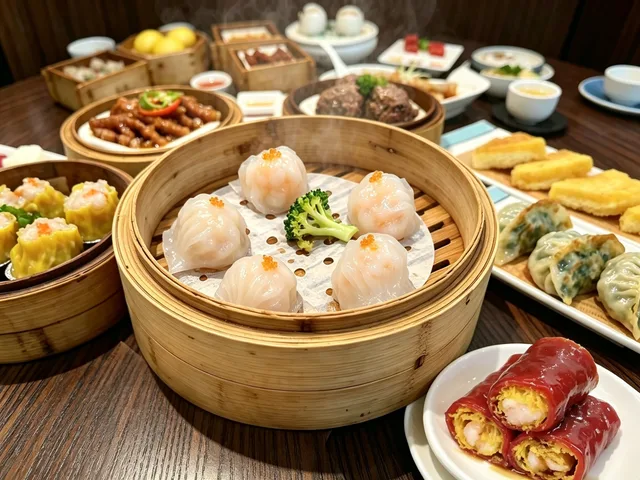
Cantonese yum cha
Where egg tarts sit with shrimp dumplings, siu mai and char siu bao.
Read about yum cha →Char siu
The roast pork inside the char siu bao, another of the four kings.
Read about char siu →Double-skin milk
Another Cantonese sweet built on milk and egg white.
Read about double-skin milk →Guangdong classics
- Cantonese Yum Cha
Yum cha · Morning tea, weekends with family
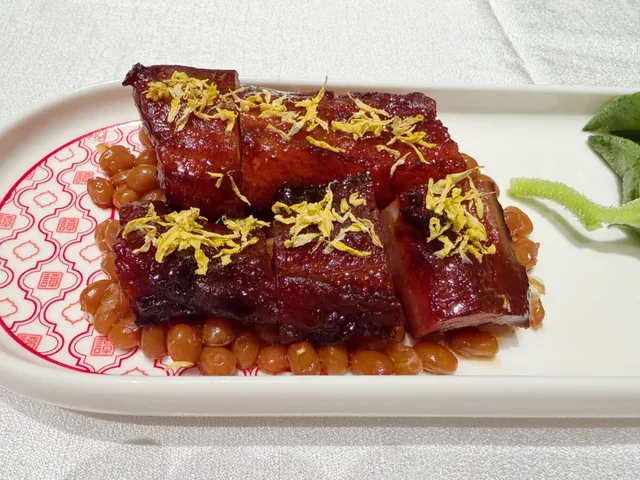
- Char Siu
Roast pork · Lunch or dinner, with rice
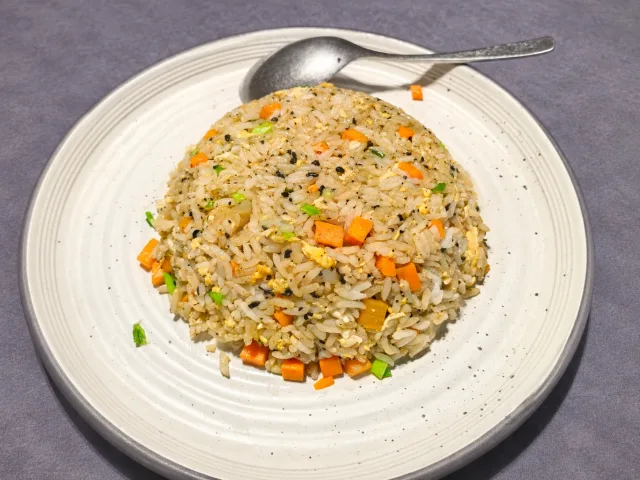
- Egg Fried Rice
Fried rice · Lunch, dinner, end of a meal
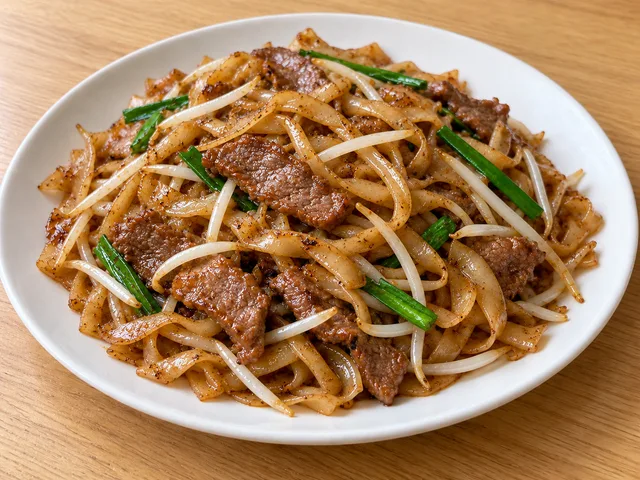
- Beef Chow Fun
Fried rice noodles · Lunch, dinner or late-night supper
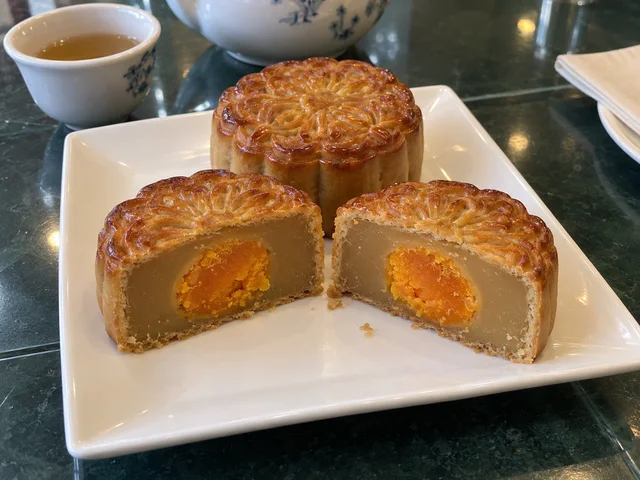
- Mooncake
Festival pastry · Mid-Autumn Festival
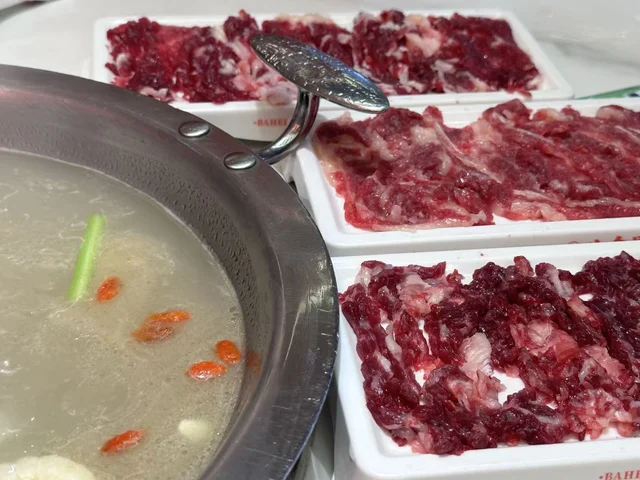
- Chaoshan Beef Hot Pot
Beef hot pot · Shared meal
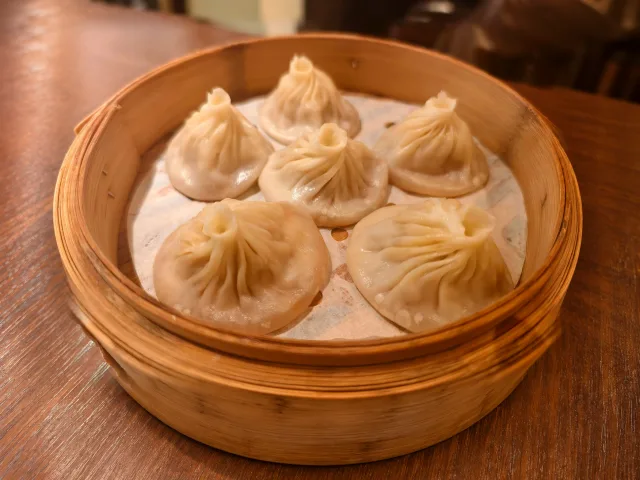
Dumplings and dim sum from other regions
FAQ
Questions about Egg Tart
What is a Chinese egg tart?
A small tart of butter shortcrust or puff pastry filled with a smooth, glossy custard of egg, sugar and water, like a steamed egg pudding. It is a Cantonese pastry from 1920s Guangzhou.
Are egg tarts Chinese or Portuguese?
Both kinds exist. The Cantonese egg tart was created in Guangzhou in the 1920s from the English custard tart. The Portuguese-style tart sold in Macau and at KFC was created in Macau in 1989 from Lisbon’s pastel de nata.
What is the difference between Hong Kong and Portuguese egg tarts?
Hong Kong tarts have a smooth, shiny yellow custard of egg, sugar and water. Portuguese tarts have a richer custard with cream and a caramelized, scorched top.
What is the difference between butter crust and puff pastry egg tarts?
Butter crust is short and crumbly like shortbread. Puff pastry, traditionally made with lard, is flaky and layered, and holds a little less custard.
Who invented the Portuguese egg tart in Macau?
Andrew Stow, an English pharmacist, who opened Lord Stow’s Bakery in Coloane with Margaret Wong in 1989.
Where do KFC egg tarts come from?
Margaret Wong sold the recipe that Wong and Andrew Stow had developed to KFC for a lump sum; the tarts went on KFC menus in Hong Kong and Taiwan in 1999 and reached mainland China in the early 2000s.
Where are the best egg tarts in Hong Kong?
Tai Cheong Bakery, opened in 1954, is famous for butter crust; the Honolulu Coffee Shop for its many-layered puff pastry. Locals argue about many others.
Why are egg tarts one of the four kings of dim sum?
The phrase means the four best sellers in Cantonese teahouses: shrimp dumplings, siu mai, char siu bao and egg tarts.
How much does an egg tart cost?
In Macau in 2022 a Lord Stow’s tart cost 10 patacas and a Cantonese tart in an old café 5.5. Teahouse portions of two or three cost more than a single bakery tart.
Why did my egg tart custard crack or bubble?
The oven was too hot or the tarts baked too long, or the filling was not strained. Bake gently and take them out while the center still wobbles.
Are Chinese egg tarts vegetarian?
Not always: traditional puff pastry crusts use lard. Butter-crust tarts use butter instead of lard, but ask if it matters to you.
Sources
Sources and further reading
- 1 Sheng Hui, Yuecai Ji (粤菜记), chapter “Notes on morning tea” (早茶小札): the four kings of dim sum, the 1920s egg tart, Cantonese and Portuguese tarts (in Chinese)People’s Literature Publishing House (2023)
- 2 Huang Aidongxi, Huacheng Ji: Zhiwei Xiguan (花城记:至味西关), chapter “Old dim sum by old moonlight” (旧时月色旧点心): butter and puff crusts, Taotaoju’s mandarin-duck tart, Ng Ho on the 1920s (in Chinese)Huacheng Publishing House (2025)
- 3 Guangzhou Museum, Xiaoshi de Mingcai (消失的名菜), chapter “Naming dishes” (起菜名,大讲究): egg-yolk tarts on Republican-era menus (in Chinese)Guangzhou Publishing House (2025)
- 4 “ICH Cuisine” carnival: demonstrations of dim sum, egg tart, moon cake and milk tea making techniquesLeisure and Cultural Services Department, Hong Kong SAR Government (2026) ↗
- 5 Classic Hong Kong restaurants: Honolulu Coffee Shop, for egg tartsSouth China Morning Post (2014) ↗
- 6 História: the Jerónimos Monastery, the 1834 closure of the convents and the secret recipe since 1837 (Portuguese) (in Chinese)Pastéis de Belém, Lisbon ↗
- 7 How Macau got its famous Portuguese egg tartTama Lung, Goldthread (2018) ↗
- 8 Eat It: KFC’s egg tarts, and how Margaret Wong’s recipe reached KFCSmartShanghai (2017) ↗
- 9 Lyndhurst Terrace: Tai Cheong Bakery, 1954, Chris Patten and the 2005 closureWikipedia ↗
- 10 Egg tart: Guangzhou department stores, Zhen Guang Restaurant around 1927, Hong Kong and the 2014 heritage inventoryWikipedia ↗
- 11 Four Macau egg tarts compared: Lord Stow’s at 10 patacas, Margaret’s at 55 for six and a Cantonese tart at 5.5 (video, in Chinese)Jason Liu Yuxin (JASON刘雨鑫), Bilibili (2022) ↗
- 12 Honolulu’s 192-layer egg tart: butter-and-lard pastry folded by hand, 180°C for 15 minutes (video, in Chinese)Fei Shu Zhi Shi (菲叔芝士), Bilibili (2023) ↗
- 13 Hong Kong shortcrust egg tarts at home: 120 g yolks, 240 g water, 100 g sugar (video, in Chinese)Mian Yang Liao Li (绵羊料理), Bilibili (2017) ↗
Last updated October 2026