
01
Glossy strips of roast pork in the shop window
Cantonese cooks add sugar for savor and shine more than for sweetness, and char siu shows it: the glaze should gleam without tasting like syrup.
Char siu comes out of the oven in long strips, reddish-brown and glossy, with blackened tips where the fat has caught. Sliced across the grain, each piece shows a lacquered rim around pink, juicy meat, with seams of fat if it is cut from a fatty piece. It tastes savory first, then sweet, with a smoky, caramelized edge, and it is eaten hot from the chopping block or at room temperature from a lunch box.
In Guangdong almost every market has a roast-meat shop. White-cut chickens, roast ducks and roast geese hang in the top row of the window; below them are strips of char siu, roast ribs, crisp roast pork belly, roast wings and braised intestines; braised goose feet and wings and other odds and ends are piled at the bottom. Cantonese cooks divide their roasts into two kinds: crisp-skin roasts of whole suckling pigs and geese with their skin on, and the “wet” roasts, in which the meat is first seasoned or marinated and then roasted over charcoal. Char siu is the classic wet roast.
Take it apart
Chrysanthemum char siu, part by part
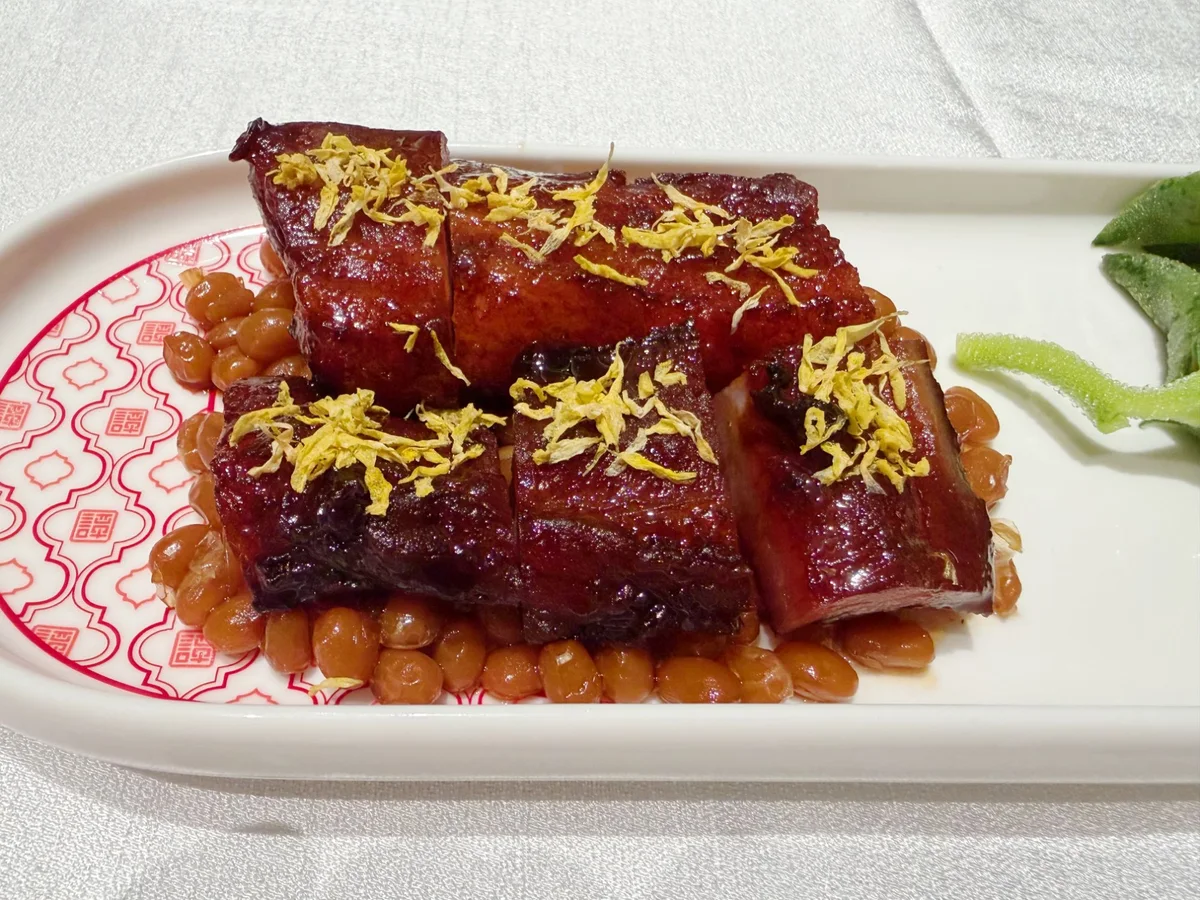
- Charred edges
Roasted until the edges char
- Chrysanthemum petals
Yellow petals scattered on top
- Fat and lean
Thick pieces of pork shoulder
- Sweet pickled beans
A bed beneath the pork
02
Fork-roasted
The two characters mean “fork” and “roast.”
For most of its history the name described a method, not a cut of pork. In his cookbook Suiyuan Shidan of 1792, Yuan Mei writes of roast duck that a young duck is put on the fork and roasted, 上叉烧之, and that a suckling pig of six or seven jin is roasted on a fork over charcoal, brushed again and again with a butter-like fat until it turns deep yellow. For roast pork he advises roasting the meat side first so the fat runs into the skin. A Hong Kong folk story, retold by the MICHELIN Guide, credits a gourmand who skewered pieces of pork loin and roasted them over a fire.
In Guangdong the name settled on the strips of marinated pork. A 1959 Guangzhou recipe notes that northerners simply called the same thing roast meat, 烤肉. In English the Cantonese pronunciation, char siu, is the usual name; menus also say Chinese barbecued pork or BBQ pork.
Early spellings varied. Sheng Hui’s Yuecai Ji (粤菜记, 2023) says the dish was first written 插烧, “stuck and roasted,” for pork pierced on a fork; char siu made from collar meat was called 梅叉 and from belly 花叉. When the Guangzhou Museum went through Republican-era Guangzhou menus, it found 叉烧 often printed as 义烧, as if the 叉 had lost its top stroke, and on the same menus “char siu bao” written with 饱 (full) instead of 包 (bun).
03
An oil-drum oven in Guangzhou, 1959
The state series Famous Chinese Dishes printed the method of a Guangzhou roast-meat workshop.
The recipe comes from the roast-meat workshop of the catering trade in Guangzhou’s Northern District, which called it 明炉叉烧, open-oven char siu, one of the city’s famous specialties, “good hot or cold, never tiresome.” The oven was a round iron drum made from an oil drum and sheet iron, narrower at both ends, about 68 centimeters across and lined with asbestos board, with a coal fire beneath it and a pipe that drained the melted fat into a basin. It held five racks of forks at a time and could also roast whole pigs, geese and ducks. The forks themselves were iron frames 40 centimeters long.
The meat was true hind leg and front shoulder, half fat and half lean, skinned and cut into strips about 40 centimeters long, 5 centimeters wide and under 2 centimeters thick. The strips were mixed by hand with the marinade and left for an hour, then threaded ten to a fork, five on each side, lean strips and half-fat strips on separate forks; the half-fat strips had to be threaded through both the fat and the lean, or the fat would tear off and fall into the fire.
The fire was lit fifteen minutes before the meat went in, so that the oven reached about 150 degrees, and the lid went on at once. The heat started gentle and rose; the lean side faced the fire and the fat side faced the wall, and near the end the forks were turned so the fat would not lose too much of its oil. Too fierce a fire burned the strips black-brown; too weak, and the color was dull, the meat soft, and it spoiled overnight. After 25 to 30 minutes the strips were golden, and they were dipped in maltose syrup. There is no red coloring and no fermented bean curd in the 1959 recipe: the color came from soy, sugar and the fire, and the shine from maltose added after roasting.
| Ingredient | Amount | If you have none, use |
|---|---|---|
| White sugar | 1 liang | |
| Salt | 3 qian | |
| Light soy sauce | 2 qian | |
| Dark soy sauce | 2 qian | |
| Ground bean paste 面豉酱 | 2 qian | 2 qian of hoisin sauce |
| Star anise powder | 3 fen | 2 qian of sesame paste, or 3 fen of five-spice powder |
| White spirit, 40 percent | 4 qian | 2½ qian of rose wine, or 3 qian of sorghum spirit |
Sources [1]
04
From floor-scraping pork to collar butt
What counts as good char siu has followed the pig.
In Hong Kong in the 1950s the favorite was “floor-scraping” char siu, 擸地叉烧, made from pigs so fat their bellies scraped the ground. Yuecai Ji, which calls it 拖地叉烧, dates the fashion to the 1950s and 1960s and says it used the belly of big white pigs from Yuen Long in the New Territories. By the 1990s diners wanted a more even balance, and pork collar butt, 梅头, became the standard cut; in recent years high-end Cantonese restaurants have made char siu from Spanish Iberico pork. One hotel restaurant uses only the two prime pieces of each pig’s collar and so can make just two portions per pig; another serves a leaner and a fattier char siu side by side on the same plate.
The glaze is maltose or honey, or both. Maltose boiled into a glaze gives the pork a shine, a reddish gloss and a light caramel smell, and it is less cloying than a syrup of white sugar. Some restaurants brush it on before roasting; the 1959 workshop dipped the strips in it after.
| Ask for | What you get |
|---|---|
| Half-fat 半肥瘦 | Lean with a band of fat: the classic balance |
| Lean 瘦叉 | Firmer meat, less juicy, for people who avoid fat |
| Fatty 肥叉 | More fat and more charred edge; richer, and the cut that goes into stir-fries |
| Collar butt 梅头 | The cut most shops now use: evenly marbled and tender |
| Iberico pork 伊比利亚猪 | A premium version at high-end Cantonese restaurants |
05
Roasted to the “fire chicken” edge
Half of good char siu is the moment it leaves the oven.
The marinated pork is roasted, rose dew liquor (玫瑰露酒) and sea salt are added for aroma and color, and it goes on until it is “roasted fragrant, with fire chicken showing” (烧至焦香,尤见火鸡). The “fire chicken” has nothing to do with a bird: it is the almost-burnt rim along the edges, the sweetest and most savory part. Only after syrup is poured evenly over the strips are they chopped.
Experienced cooks cut it thick, to keep the juices and the smell of the meat. Char siu is best straight from the oven, before the fibers tighten and the glaze sets, when it tastes of char, honey and a faint rose from the liquor.
To keep the meat tender, most restaurants add meat tenderizer powder (松肉粉) to the marinade. Some will not: 烽味小馆, a small restaurant in Foshan, marinates its pork for four hours in baijiu of over 60 percent alcohol, massaging it the whole time. Among Hong Kong shops the book names Joy Hing (再兴烧腊) as one of the oldest, and 新桂香烧腊, recommended by the Hong Kong chef Dai Long, as still roasting over charcoal.
Sources [7]
06
Black char siu, braised instead of roasted
Guangzhou also makes a char siu that never sees an oven.
蜜汁黑叉烧, honey black char siu, is a Guangzhou variation for kitchens without a roasting oven. A Cantonese chef’s version uses skinless pork belly, about 1.25 kilograms, browned with ginger and scallion in a little oil on every side until golden, which stands in for the oven. Rice wine goes in, then hot water just to cover, and the seasonings: white pepper, fish sauce, light soy sauce, plenty of rock sugar, a few pieces of licorice root and two star anise. It simmers covered for an hour and a half.
Dark soy sauce goes in only near the end. Added early, the chef warns, it settles heavily, dulls the gloss and can turn sour over the long braise. The sauce is then reduced until it is thick and shiny, the pork cools before it is sliced, and the reduced juice is poured over it. The result is darker than roast char siu, very tender and sweet, without the charred edges.
Restaurants have their own black char siu too: Guangzhou’s Bingsheng (炳胜) serves a house version the color of ripe mulberries.
07
Over rice, inside buns and in the wok
It is bought by the strip and eaten in a dozen ways.
Char siu is the roast meat Cantonese families send out for when guests arrive: a child is sent downstairs to have a few strips chopped, and Hong Kong films are full of the line 今晚斩料,加餸, “cut some roast meat tonight, add a dish.” A good exam result might be rewarded with roast meat. Cantonese parents even scold with it: better to have given birth to a lump of char siu than to you. Roast meats like char siu and roast duck are also held to be “heating” if eaten too often, and Guangzhou She Hua Lu (广州舌华录, 2019) ties the city’s herbal-tea habit, liangcha, partly to that.
Char siu rice, 叉烧饭, is the everyday lunch: slices of char siu over white rice with some of the roasting juices. Stephen Chow’s film The God of Cookery made it the “rice of sorrow,” char siu over rice with a runny fried egg. In 2020 a busy shop in a Guangzhou residential neighborhood sold char siu with scrambled egg over rice for 20 yuan, a lemon tea included.
In the teahouse it fills char siu bao, one of the four classics of yum cha, a dim sum that appeared, like most teahouse snacks, only in the Republican period. A good bun is tall like a birdcage, round-bellied, and split open just enough at the top to show the filling of char siu and its sauce, with a dough soft enough not to stick to the teeth. Old Guangzhou cooks also stacked a slice of sugared pork fat, a slice of chicken liver and a slice of lean char siu on a skewer and roasted them as golden coin chicken, 金钱鸡. And fatty char siu goes into the wok: one Guangzhou restaurant charges 48 yuan for fatty char siu stir-fried with gai lan, the sweetness of the pork against the bitterness of the greens. Restaurants also plate it as a dish of its own. The photograph at the top of this page is chrysanthemum char siu (菊花叉烧) at 谭厨中山传家菜, a Zhongshan-style restaurant in Shenzhen, in October 2026: 78 yuan for thick pieces with charred, glossy edges, scattered with yellow chrysanthemum petals and set on a bed of sweet pickled beans (甜酱豆).
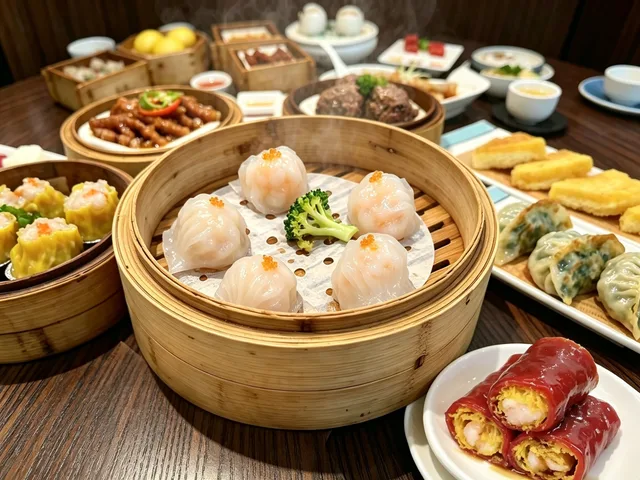
Cantonese yum cha
Tea and dim sum in a Guangzhou teahouse, char siu bao included.
Read the yum cha guide →Roast goose
The other star of the roast-meat shop window, roasted whole with its skin.
Read the roast goose guide →08
Hong Kong, Lima and New York
Char siu went wherever Cantonese cooks went.
In Hong Kong it is close to a civic dish. The MICHELIN Guide calls it a local food Hong Kongers cannot live without and in 2025 listed ten starred and Bib Gourmand restaurants for theirs, from a thick-cut char siu of collar butt in Tai Wai to Iberico versions in hotel dining rooms.
In Peru, Chinese Peruvian butchers’ shops sold Cantonese cha-siu as cerdo asado, along with whole roast pig, and both seeped into Peruvian cooking, one strand of the Chinese Peruvian food called chifa. In New York’s Chinatown in 2025, people queued for two hours for a char siu rice with cabbage that cost 5.50 dollars.
09
Marinate for hours, roast for minutes
Use pork neck or collar butt, cut into thick strips. Pound the thicker parts with a meat mallet, or prick both sides all over with the tip of a knife, so the marinade gets in. Season with black pepper and salt, then a generous amount of honey, which the meat takes up only slowly, and light soy sauce, dark soy sauce and oyster sauce; massage it in and leave it for at least three hours. Fermented bean paste or hoisin sauce and a splash of spirit, as in the 1959 recipe, make it more savory.
In an air fryer at 180°C, cook the strips for 10 minutes, turn them and brush with the marinade, cook 5 minutes more, turn again and cook a final 5; thinner strips of collar butt need about 15 minutes in all, turned once. In an oven, keep the lean side toward the heat and start gently. Brush with maltose or honey when the pork comes out, let it rest a few minutes, and slice it across the grain.
10
Claypot rice and white-cut chicken
Claypot rice
Rice cooked in a clay pot with cured meats until a crust forms.
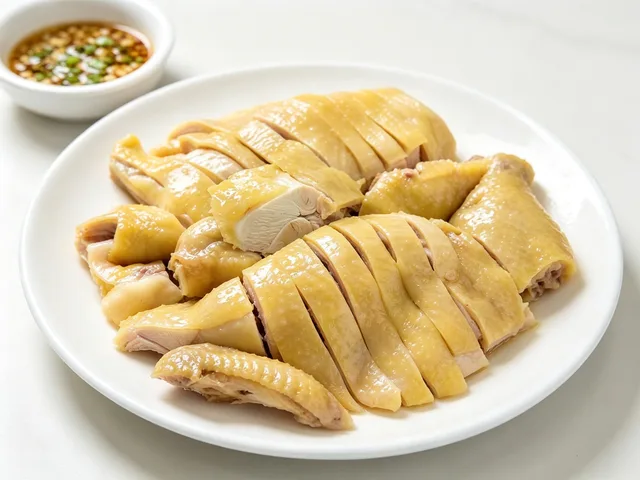
Read the claypot rice guide →White-cut chicken
A whole chicken poached gently and chopped, with ginger and scallion.
Read the white-cut chicken guide →Guangdong food
Guangzhou, Chaozhou and Hakka cooking, and the province’s breakfasts.
Read the Guangdong guide →Guangdong classics
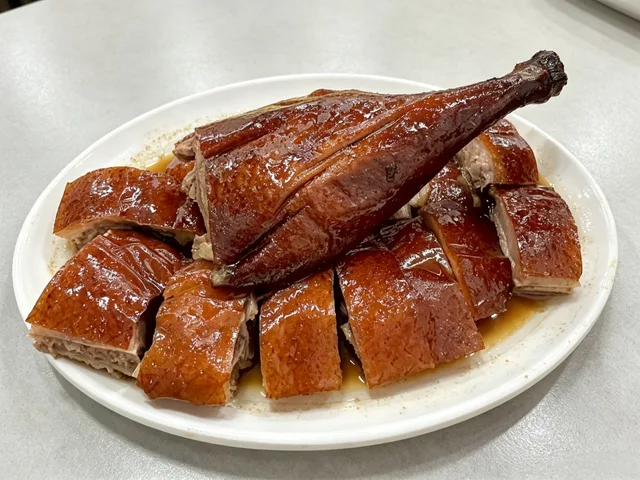
- Roast Goose
Cantonese roast meat · Lunch or dinner, or over rice
- White Cut Chicken
Poached chicken · Lunch or dinner
- Cantonese Yum Cha
Yum cha · Morning tea, weekends with family
- Egg Fried Rice
Fried rice · Lunch, dinner, end of a meal
- Beef Chow Fun
Fried rice noodles · Lunch, dinner or late-night supper
- Mooncake
Festival pastry · Mid-Autumn Festival
FAQ
Questions about Char Siu
What is char siu?
Cantonese barbecued pork: strips of pork shoulder or collar marinated in soy, sugar, bean paste and spirits, roasted on forks until the edges char, and glazed with maltose or honey.
What does char siu mean?
叉烧 means “fork-roasted.” In the eighteenth century it described a way of roasting duck, piglets and pork on a fork; in Guangdong it came to mean the strips of marinated pork.
Why is char siu red?
Its color comes from soy sauce, sugar and the heat of the oven, then a maltose or honey glaze. The 1959 Guangzhou recipe used no red coloring at all.
What cut of pork is used?
Traditionally hind leg and front shoulder, half fat and half lean. Most shops now use pork collar butt, and some high-end restaurants use Iberico pork.
What is the difference between char siu and roast pork?
Char siu is skinless meat marinated and glazed before and after roasting. Cantonese roast pork, 烧肉, is pork belly roasted with its skin until the skin is crisp.
Sources
Sources and further reading
- 1 Famous Chinese Dishes, vol. 5: Guangdong (中国名菜谱·第五辑), pp. 80–84: open-oven char siu from the Guangzhou Northern District roast-meat workshop (in Chinese)Ministry of Commerce catering bureau; Light Industry Press (1959)
- 2 Suiyuan Shidan (隨園食單): roast duck, roast piglet and roast pork (in Chinese)Yuan Mei (1792); Chinese original on Wikisource ↗
- 3 Zhao Liping, Da Yuecai (大粤菜): sugar in Cantonese seasoning, crisp-skin and wet roasting, and siu mei in Hong Kong (in Chinese)Guangzhou Publishing House (2023)
- 4 Wang Liang, Yuecai (粤菜), chapters “The taste of siu mei” and “Teahouse dim sum” (in Chinese)Guangdong People’s Publishing House (2021)
- 5 Lin Weihui, Fengwei Lingnan (风味岭南): char siu bao and a Guangzhou restaurant’s fatty char siu with gai lan (in Chinese)Huacheng Publishing House (2025)
- 6 Lok Siu, “Chifa,” in Modern Chinese Foodways, ed. Jia-Chen Fu, Michelle T. King and Jakob A. Klein, pp. 261–62: cha-siu in PeruMIT Press (2025, open access)
- 7 Sheng Hui, Yuecai Ji (粤菜记), chapter “Roast meats and cured meats” (烧味与腊味) (in Chinese)People’s Literature Publishing House (2023)
- 8 Guangzhou Museum, Xiaoshi de Mingcai (消失的名菜), chapter “Naming dishes” (起菜名,大讲究): misprints on Republican-era menus (in Chinese)Guangzhou Publishing House (2025)
- 9 Fei Yong and Han Bangwen (eds.), Guangzhou She Hua Lu (广州舌华录), chapter “The study of herbal tea” (凉茶的学问) (in Chinese)Guangzhou Publishing House (2019)
- 10 Best char siu in Hong Kong: the name, the cuts from floor-scraping pork to collar butt and IbericoThe MICHELIN Guide (updated 2025) ↗
- 11 Guangzhou black char siu without an oven: pan-fried pork belly braised with rice wine, rock sugar and fish sauce (video, in Chinese)Gu Zhihui (古志辉), Bilibili ↗
- 12 Char siu at home in an air fryer: pork neck, plenty of honey, soy and oyster sauce (video, in Chinese)Ben Pao De Ye Zi Ya (奔跑的椰子呀), Bilibili ↗
- 13 A Guangzhou char siu and scrambled egg rice for 20 yuan, lemon tea included (video, in Chinese)Dan Niu Shi Zou Qi (丹牛食走起), Bilibili ↗
- 14 A two-hour queue for a 5.50-dollar char siu rice in New York’s Chinatown (video, in Chinese)Times Rikan (Times日刊), Bilibili ↗
Last updated October 2026