
01
Leftover rice, one egg and a hot wok
Egg fried rice has almost nothing in it, which is exactly why it has long been used to test a cook.
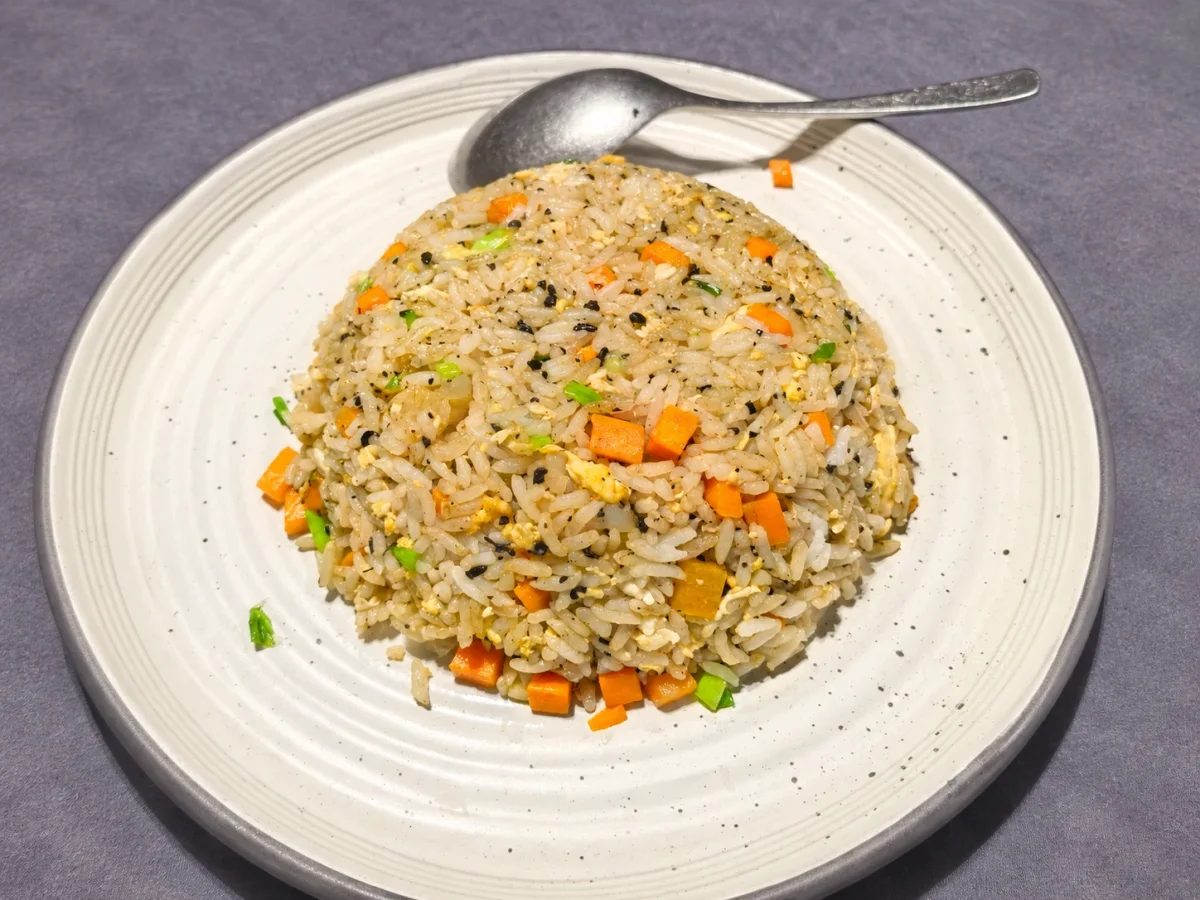
A good plate of egg fried rice is loose, not clumped. Each grain is separate and lightly coated with oil, some flecked with yellow egg, and the rice smells of the hot wok and the scallions that went in at the end. It should not be greasy, wet or mushy, and the egg should taste of egg, not of oil. It is seasoned with salt and perhaps a little soy, and it is eaten on its own with a bowl of soup or as the last dish at a meal.
At home it began as a way to use up last night’s rice. A Cantonese writer remembers eating the previous evening’s rice fried with egg and scallions as a child and thinking it a feast; lard, for frying the egg and the scallions, made it better still. In Yangzhou, the old households had three kinds: rice fried with egg, called egg fried rice; rice fried together with leftover dishes; and rice fried dry with soybean oil, a little salt and scallions. None of them was considered fit for a proper dinner. Yet the plainest version is also a test of skill. The writer Tang Lu-sun recalled that when the family hired a cook, the trial was a chicken soup, shredded pork with green peppers, and a bowl of egg fried rice.
02
Why cold rice, and whether it has to be overnight
Fried rice starts with rice that was cooked earlier and allowed to cool.
Fuchsia Dunlop says it is “vitally important” to use rice that has cooled completely. The anthropologist E. N. Anderson noted that most of the world boils raw rice or fries it raw before cooking, and that the Chinese habit of cooking rice first, cooling it and frying it afterwards is unusual. Freshly cooked rice is soft, sticky and full of water; it clumps and turns mushy in the wok. Rice that has cooled has firmed up and dried a little at the surface, so the grains come apart and take the oil.
Overnight rice is simply the easiest way to get there, and restaurants do not have an endless supply of it. As cooks point out, the goal is less water, not age. Cook the rice with a little less water than usual, about half a knuckle above the rice; stir in a little oil and salt, spread it on a tray and chill it for half an hour. One cook’s trick is to rub the cold rice with a little cornstarch to absorb surface moisture and sift off the excess. Then fry it longer than you think, at least five minutes, until the grains jump in the wok.
Leftover rice is also where fried rice can go wrong for safety. Hong Kong’s Centre for Food Safety traced an unsatisfactory restaurant sample to cooked rice left at room temperature for too long. Spores of Bacillus cereus survive cooking and, if rice sits warm, germinate and form heat-stable toxins that frying will not destroy. Cool cooked rice quickly, ideally to 20°C within two hours and to 4°C within the next four, keep it in the refrigerator, and fry it hot.
03
Three ways to add the egg
Where the egg goes changes the dish.
The usual home method is to scramble the egg in hot oil, then add the rice and break it up; some cooks fry the egg a little longer, until firm, for more fragrance. In “gold wrapping silver,” 金裹银, the rice goes into the wok while the egg is still half set, so that each grain is coated: you taste egg but see almost none. In Shunde, cooks stir a raw yolk into cold rice before it goes in the wok, so every grain is already golden. For an elegant Yangzhou fried rice, chefs make egg threads, 蛋丝: two whole eggs beaten with four extra yolks and strained, then poured in a thin stream into oil at about 90°C so that they set into fine golden strands, which are drained and added later.
| Method | Chinese | Result |
|---|---|---|
| Scramble first, then rice | 先炒蛋 | Visible pieces of egg; the everyday home version |
| Rice into half-set egg | 金裹银 | Every grain coated, little visible egg |
| Yolk stirred into cold rice | 黄金炒饭 | Golden grains throughout; used in Shunde and for “golden fried rice” |
| Egg threads | 蛋丝 | Fine golden strands; restaurant Yangzhou fried rice |
04
What Yangzhou fried rice is
In its home city, Yangzhou fried rice is a refined dish built on egg fried rice.
Yangzhou fried rice, also called Yangzhou egg fried rice, is egg fried rice made the Huaiyang way: careful choice of ingredients, fine knife work and attention to color. The Yangzhou Cuisine Association first published a reference standard in 2002, with ten ingredients and even a suggested price of 25 yuan a plate. In October 2015 the city’s quality bureau issued a revised local standard, drafted by the association, that cut the list to eight: besides indica rice and three or four fresh eggs, rehydrated sea cucumber, chicken leg, Chinese ham, dried scallop, river shrimp, flower mushroom, fresh bamboo shoot and green peas, all diced small. The grains should be separate and glossy and the plate should show red, green, yellow, white and orange. The official who released it called it a recommendation, not a rule, and said that a cook who used only three or four toppings was still making Yangzhou fried rice. The association’s secretary-general put the fixed points differently: however a chef innovates, the way the rice is steamed, the way the egg is fried and the way rice and toppings are combined must not change. Dunlop notes that many cooks, even in Yangzhou, make it as simple fried rice, but her recipe follows the classic version with a splash of chicken stock, which she says adds extra deliciousness.
Its origin story is old and impossible to check. In the tenth century Tao Gu copied fifty-three dishes from the Sui-dynasty Shi Jing of Xie Feng into his notebook Qingyi Lu, and one of them is “the Duke of Yue’s broken-gold rice,” 越國公碎金飯; the Duke of Yue was Yang Su. The entry is a name only, with no recipe. Yangzhou tradition holds that this was rice fried with egg and that Emperor Yang brought it to Yangzhou on imperial visits there. Some writers go further and identify a dish named in the Mawangdui bamboo slips of the Han dynasty as the ancestor of egg fried rice. The name is recorded; the rest is tradition. The plain dish, at least, is well documented: Xu Ke’s 1917 compendium of Qing life notes that ordinary rice shops everywhere sold three kinds of fried rice, with ham and egg, with shrimp and egg, and with egg alone. What is certain is that in Yangzhou itself fried rice was everyday food, and the famous name grew abroad. The Yangzhou writer Wei Minghua recounts that an elder brother in the family, studying in Europe, first saw the words “Yangzhou fried rice” in a Chinese restaurant in Germany at the end of the 1970s or the early 1980s, and then found them on Chinese menus all over Europe.
05
How Cantonese restaurants spread the name
The Yangzhou fried rice most of the world knows is Cantonese restaurant food.
The historian Cheng Pei-kai grew up in Taiwan eating egg fried rice with shredded pork, sausage, ham, shrimp or peas, and never heard of Yangzhou fried rice until ordering it in a Cantonese restaurant in New York’s Chinatown about thirty years before writing the essay. It arrived as a generous mix of diced char siu, Chinese sausage, peas, shrimp and egg, with scallions, shredded cabbage and diced onion: tasty, the essay says, but “a plate of fried rice Yangzhou people would not recognize,” better called chop-suey fried rice. The same dish later turned up at Hong Kong banquets, and older connoisseurs of Huaiyang food insisted that Yangzhou had no such thing. One explanation offered is that Cantonese speakers once called everyone from north of Guangdong “Shanghainese,” so naming a dish after Yangzhou was a compliment.
The food writer Shen Hongfei, writing in 2002, adds that until at least 1990 Hong Kong people who visited Yangzhou came home announcing that you could not get Yangzhou fried rice there. In Hong Kong restaurants the name described a method, not a place: Yangzhou fried rice was the dry one, and its usual partner on the menu, Fujian fried rice, was the wet one, with a sauce poured over, unknown in Fujian. The Hong Kong chef Yeung Koon-yat told him there was no rule about what went in, though it usually meant char siu, green peas and scallion, with shrimp or sea cucumber in grander versions.
Because Yangzhou fried rice was a standard dish in Cantonese restaurants, it went wherever they went. Other menus across China copied it, and so did Chinese restaurants in Europe, Africa and the Arab world. Some even argue the dish itself came from Guangzhou in the Qing dynasty, since most early Chinese restaurants abroad were Cantonese. Cantonese home fried rice, for its part, has changed little: rice cooked with a little less water so it stays dry, egg fried half set, then diced ham or cured pork, blanched peas and carrots, scallions and salt.
Shunde
Overnight rice coated with a raw yolk and fried with Shunde’s fish floss, neither too dry nor too wet.
Heshan
Fried rice with treated, diced pomelo peel and ham, with a fresh citrus note.
Nan’ao island
Seaweed fried rice with dried shrimp, dried scallop, mushrooms, sausage, egg and preserved radish; the laver is deep-fried first so it stays crisp.
Shunde in winter
Raw glutinous rice fried slowly with stock from soaked dried seafood, then with cured meats, using no oil beyond what the sausages release.
Hong Kong
The chef Dai Long’s “God of Cookery” fried rice, topped with crab roe; it is said to sell for up to 5,000 Hong Kong dollars.
06
Yangzhou’s heritage version, with stock
Yangzhou has since claimed the dish back, and made it grander.
Yangzhou fried rice-making is now on Jiangsu province’s intangible heritage list, and the city’s showpiece version is cooked differently from ordinary fried rice. Scallions go in three times: first with the diced bamboo shoot, mushroom, chicken, ham and dried river-shrimp roe, to bring out their aroma; again with the rice; and a final handful at the end. Every topping is blanched or cooked in advance. Then chicken stock is added to the rice and cooked off, more than once, so that the grains absorb flavor without drying out. Chefs describe the result as moist rather than dry and hard, and serve it with a spoon. A third of the toppings is kept back and piled on top at the end.
Done this way it is slow. In 2024 one Yangzhou restaurant charged more than 500 yuan for its heritage fried rice on its own, or 268 yuan with a large enough order. Restaurant kitchens keep dressing it up; the plate at the top of this page is one restaurant’s version with black truffle. The city has also tried to put the dish in the record books. In October 2015, for Yangzhou’s 2,500th anniversary, 300 people spent four hours cooking 4.19 tonnes of fried rice for a Guinness record, at a reported cost of about 140,000 yuan. Most of it was given away, but 150 kilograms went to pig farms, and Guinness refused the record because food in a record attempt must be eaten, not wasted.
| Egg fried rice | Yangzhou fried rice, heritage style | |
|---|---|---|
| Rice | Cold cooked rice | Cold cooked rice |
| Egg | Scrambled or coating the rice | Coating the rice (金裹银) or as threads |
| Toppings | Scallion; sometimes ham or peas | Sea cucumber, chicken, ham, dried scallop, shrimp, mushroom, bamboo shoot, peas |
| Liquid | None | Chicken stock, added and reduced more than once |
| Scallion | Once, near the end | Three times |
| Texture | Dry, separate grains | Moist yet separate |
07
Chaufa: fried rice in Peru
The most thorough adoption of Cantonese fried rice happened in Peru.
Peruvians call fried rice arroz chaufa, from the Cantonese pronunciation of 炒饭. More than a hundred thousand Cantonese laborers came to Peru from the mid-nineteenth century, and they fried leftover rice with vegetables, and meat when they could afford it. By the 1920s the dish was well known: when Kuong Tong, the “Canton restaurant,” opened in Lima in 1921, its fried rice was already popular. Lok Siu notes that during Peru’s economic crises, when meat was scarce, Chinese-run eateries won customers with the Cantonese habit of adding small amounts of meat to dishes such as chaufa, which kept them filling and cheap.
Peruvian chaufa is darker and bolder than the Cantonese original: it always gets dark soy sauce, often five-spice and sesame oil, and three or more kinds of diced meat such as roast duck, roast pork and chicken, plus shrimp. Cooks there use sesame and peanut oil rather than lard and toss the rice high over a fierce flame. A former Peruvian consul in Guangzhou once said that every Peruvian woman knows how to make it.
08
On the menu
A few names cover most of what you will see.
Fried rice can be the main dish for one person or the last dish of a shared meal, when people want something to fill up on. If a menu lists both egg fried rice and Yangzhou fried rice, the second will cost more and carry more toppings; outside Yangzhou, it is often the Cantonese restaurant version with char siu and shrimp rather than sea cucumber.
| Name | Chinese | What you get |
|---|---|---|
| Egg fried rice | 蛋炒饭 | Rice, egg, scallion and salt |
| Yangzhou fried rice | 扬州炒饭 | Egg fried rice with diced ham or char siu, shrimp, peas and more |
| Soy sauce fried rice | 酱油炒饭 / 豉油皇炒饭 | Rice colored and seasoned with light and dark soy |
| Golden fried rice | 黄金炒饭 | Rice coated in yolk before frying |
| Mixed fried rice | 什锦炒饭 | Whatever the kitchen has: meat, seafood and vegetables |
| Fried glutinous rice | 生炒糯米饭 | Raw glutinous rice fried slowly with cured meats; a Cantonese winter dish |
09
Egg fried rice at home
For two: about 400 g cold cooked rice (from 200 g raw rice cooked with slightly less water than usual), 2 eggs, 3 spring onions, 2 to 3 tablespoons of lard or neutral oil, salt, and a little light soy sauce if you like.
- 1. Ready the rice
Break up the cold rice with your hands so there are no lumps. If it is freshly cooked, spread it out and chill it for half an hour first; a little cornstarch rubbed through and sifted off helps dry it.
- 2. Season the wok
Heat the wok until it smokes, swirl in oil, pour it off, then add fresh oil. This keeps the egg and rice from sticking.
- 3. Cook the egg
Beat the eggs with a pinch of salt and scramble them in the hot oil. For loose grains coated in egg, add the rice while the egg is still half set.
- 4. Fry the rice
Add the rice and press and toss it over high heat for at least five minutes, until the grains are dry and jumping in the wok.
- 5. Season and finish
Add salt and half the spring onion and toss. If using soy, drizzle it around the hot edge of the wok, not onto the rice. Toss for half a minute, add the rest of the spring onion and serve.
Do not rush the frying: several minutes over high heat is what dries the grains and gives the rice its wok aroma.
10
More Cantonese rice and noodles
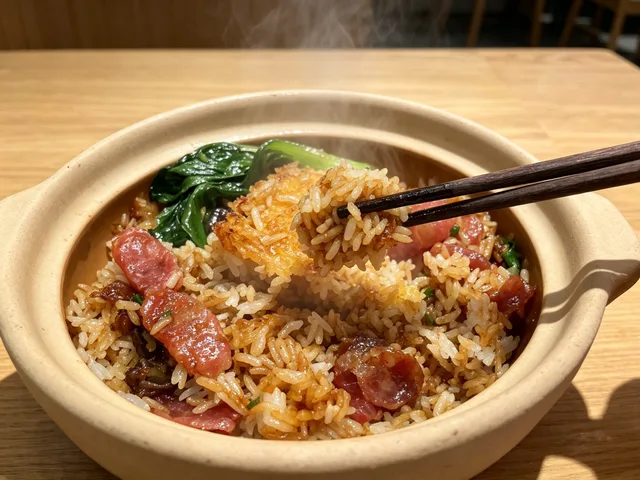
Claypot rice
Rice cooked in a clay pot with cured meats until a crust forms at the bottom.
Read about claypot rice →Char siu
The barbecued pork diced into Cantonese-style Yangzhou fried rice.
Read about char siu →Beef chow fun
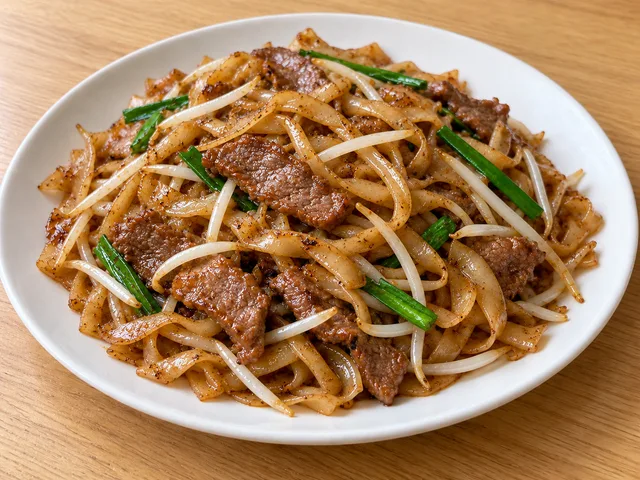
The noodle dish that, like fried rice, is judged by wok hei.
Read about beef chow fun →Guangdong classics
- Claypot Rice
Claypot rice · Lunch or dinner, best in autumn and winter
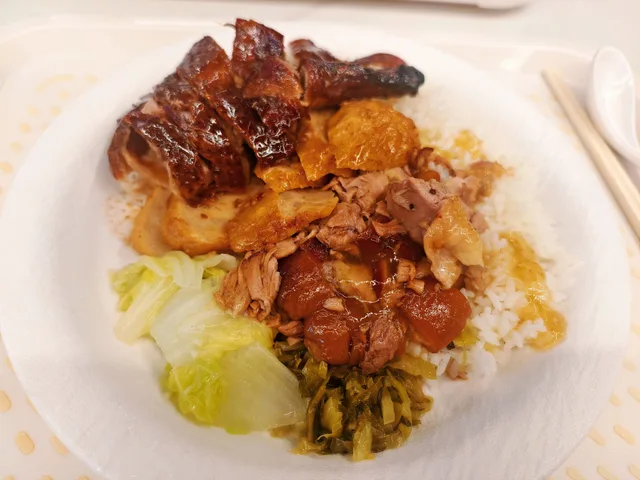
- Pork Knuckle Rice
Braised pork over rice · Lunch or dinner
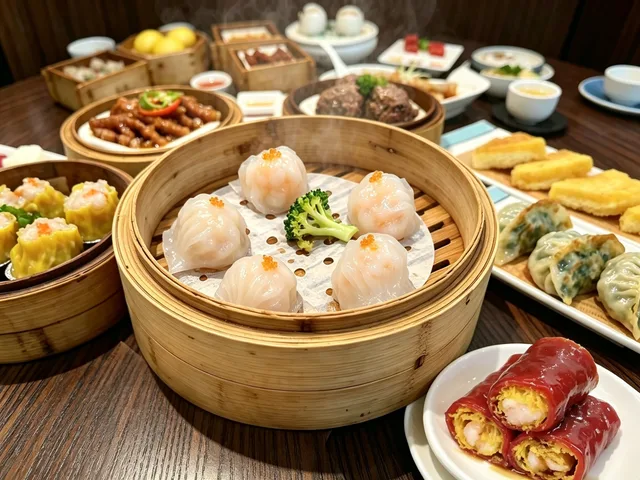
- Cantonese Yum Cha
Yum cha · Morning tea, weekends with family
- Char Siu
Roast pork · Lunch or dinner, with rice
- Beef Chow Fun
Fried rice noodles · Lunch, dinner or late-night supper
- Mooncake
Festival pastry · Mid-Autumn Festival
FAQ
Questions about Egg Fried Rice
What is egg fried rice?
Cold cooked rice stir-fried with egg, scallions and salt over high heat until the grains are separate and fragrant.
What is the difference between egg fried rice and Yangzhou fried rice?
Yangzhou fried rice is egg fried rice with diced toppings. In Yangzhou’s standard version these are sea cucumber, chicken, ham, dried scallop, shrimp, mushroom, bamboo shoot and peas; in Cantonese restaurants abroad, usually char siu, shrimp and peas.
Is Yangzhou fried rice really from Yangzhou?
The name and the legend come from Yangzhou, where fried rice was everyday food. The version with char siu that most of the world knows was spread by Cantonese restaurants.
Do I have to use overnight rice?
No. What matters is that the rice is cool and not too wet. Cook it with a little less water and chill it on a tray for half an hour.
Why is my fried rice mushy or sticky?
The rice was too fresh or too wet, the wok was not hot enough, or there was too much rice in the pan. Fry smaller batches over high heat for longer.
Should the egg go in first or last?
Either. Scrambling first gives pieces of egg; adding the rice while the egg is half set coats every grain; Yangzhou chefs sometimes make separate egg threads.
Is it safe to eat fried rice made from leftover rice?
Yes, if the rice was cooled quickly and refrigerated. Cooked rice left warm at room temperature can grow Bacillus cereus, whose toxin survives frying.
Does egg fried rice need soy sauce?
Not usually; salt is enough. Soy sauce fried rice is a separate dish, and Peruvian chaufa always uses dark soy.
What is the best oil for fried rice?
Lard gives the most fragrance in Chinese home cooking; peanut or another neutral oil also works.
What is chaufa?
Peruvian fried rice, named from the Cantonese word for fried rice and brought by Cantonese immigrants in the nineteenth century.
What is “gold wrapping silver”?
金裹银, a method in which the rice goes into the wok while the egg is still half set, so each grain is coated in egg.
Sources
Sources and further reading
- 1 Wei Minghua, Yangzhou Zhuan (扬州传), chapter “A world city of gastronomy” (世界美食名城): Yangzhou fried rice (in Chinese)New Star Press (2021)
- 2 Cheng Pei-kai (郑培凯), Pinwei de Jiyi (品味的记忆), essay “Yangzhou fried rice” (in Chinese)Guangxi Normal University Press (2014)
- 3 Zhongguo Yuecai Gushi (中国粤菜故事), chapter “Every Peruvian woman can make Cantonese fried rice” (in Chinese)Guangdong Vocational and Technical Teaching Research Office; Guangdong Science and Technology Press (2022)
- 4 Sheng Hui, Yuecai Ji (粤菜记), chapter “Even rice can make you hungry” (米饭也能馋死人) (in Chinese)People’s Literature Publishing House (2023)
- 5 Fuchsia Dunlop, Every Grain of Rice, pp. 257–58: egg-fried rice and Yangzhou fried riceW. W. Norton (2013) ↗
- 6 Lok Siu, “Chifas,” in Modern Chinese Foodways, ed. Jia-Chen Fu, Michelle T. King and Jakob A. Klein, p. 261: chaufa in PeruMIT Press (2025, open access)
- 7 Qingyi Lu (清異錄), “Food” section: fifty-three dishes copied from Xie Feng’s Shi Jing (in Chinese)Tao Gu, 10th century, Wikisource ↗
- 8 Qingbai Leichao (清稗類鈔), “Food”: “Rice in the north and south” (in Chinese)Xu Ke (1917), Wikisource ↗
- 9 Bacillus cereus in Fried Rice, Food Safety Focus no. 192 (July 2022)Centre for Food Safety, Hong Kong SAR Government ↗
- 10 Official Yangzhou fried rice standard issued (扬州炒饭官方标准出台) (in Chinese)CNR News (October 23, 2015) ↗
- 11 New Yangzhou fried rice standard issued (“扬州炒饭”新标准出台) (in Chinese)China News Service (October 22, 2015) ↗
- 12 The highs and lows of China’s fried rice capitalClarissa Wei, MUNCHIES / VICE (2016) ↗
- 13 Shen Hongfei, “So there really is Yangzhou fried rice” (原来真的有扬州炒饭) (in Chinese)Sanlian Life Week (September 25, 2002) ↗
- 14 Yangzhou stripped of fried rice record after waste scandalXinhua, via People’s Daily Online (October 26, 2015) ↗
- 15 A head chef’s Yangzhou fried rice: egg threads, eight toppings and three lots of scallion (video, in Chinese)Wang Gang (美食作家王刚R), Bilibili (2020) ↗
- 16 A 268-yuan heritage Yangzhou fried rice in Yangzhou, cooked with stock (video, in Chinese)Dao Cao Fang Du (稻草放毒), Bilibili (2024) ↗
- 17 Yangzhou fried rice with fourteen ingredients and repeated additions of stock (video, in Chinese)Xia Shu Chu Fang (夏叔厨房), Bilibili (2023) ↗
- 18 Separate grains without overnight rice: less water, a quick chill and a dusting of starch (video, in Chinese)An Qiu Jin (安秋金), Bilibili (2022) ↗
- 19 Does fried rice have to use overnight rice? (video, in Chinese)Chou Shi Ji (仇食记), Bilibili (2025) ↗
Last updated November 2026