
01
Braised trotter over rice, with the brine poured on
Pork knuckle rice is judged by its skin: it should be sticky, springy and rich, and still not taste greasy.
The pork comes out of a dark pot in whole legs, the skin lacquered reddish-brown. Sliced, it is a mix of soft, gelatinous skin, a layer of fat and tender lean that pulls apart without a knife, laid over a bowl of white rice. A ladle of the braising liquid goes over the top and soaks into the rice. Alongside come pickled mustard greens fried with chili, a few leaves of blanched cabbage or choy sum, often a braised egg, and a Chaoshan chili sauce or a little dish of garlic vinegar to cut the fat.
The name on most shop signs is Longjiang trotter rice, after Longjiang, a town in Huilai county in Jieyang, in the Chaoshan region of eastern Guangdong. In English menus say pork knuckle rice or pork trotter rice; although the dish is called “trotter” rice, much of what shops serve is the meaty hock above the foot. A plate costs about the price of any fast-food lunch, and many shops let customers top up the rice and help themselves to pickles.
Take it apart
A plate of pork knuckle rice, two ways
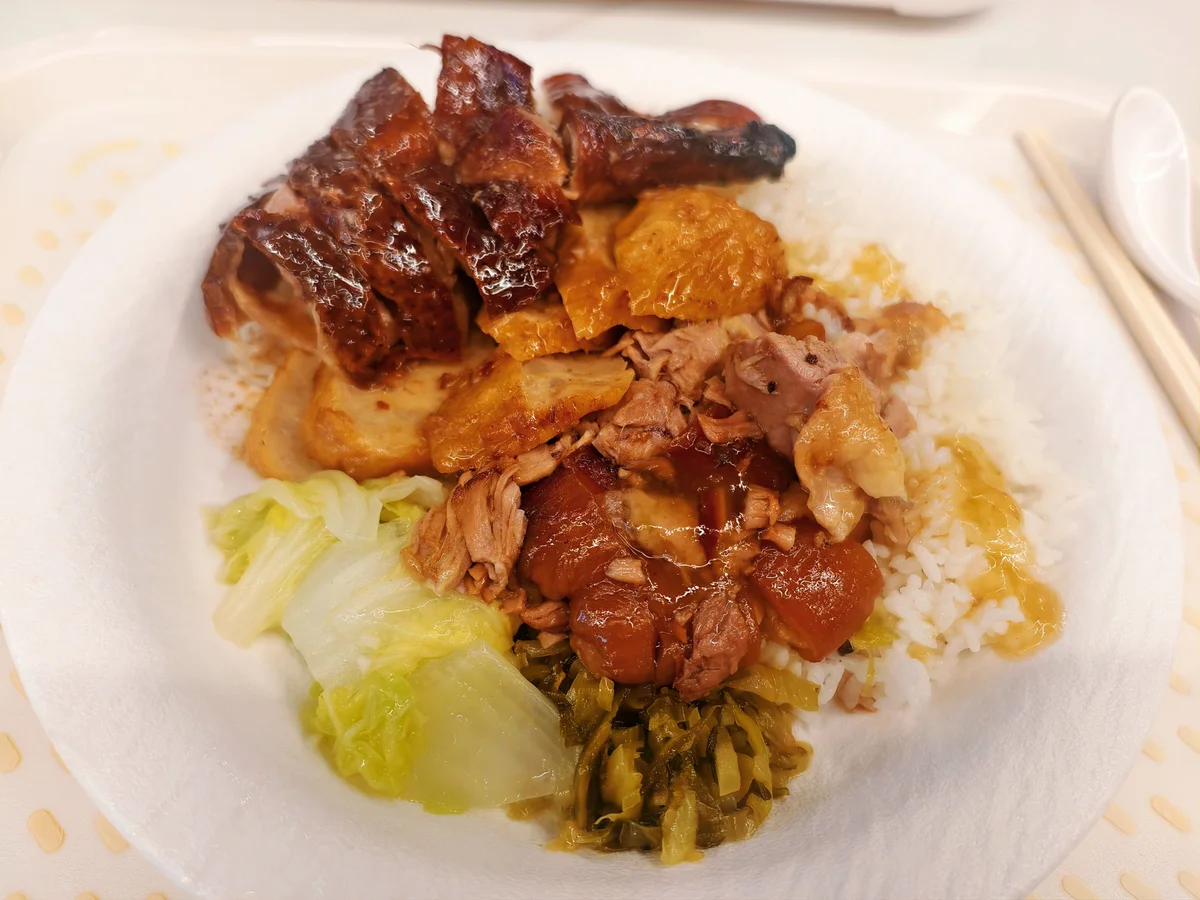
- Braised knuckle and pork roll
Two or three yuan more makes it a double
- Roast goose
From the roast-meat counter
- Pickled mustard greens
The usual side
- Blanched greens
The other usual side
- Rice
With a spoon of braising liquid
02
A breakfast for porters in a small port
It began as a meal for people who carried loads before dawn.
Longjiang was long a small coastal port and trading point for Huilai county, with easy routes by land and water. Farm goods moved on porters’ shoulders, and the porters set out before daybreak. To keep going until noon they ate a breakfast of dry rice with braised trotter, and in time the whole town took to eating trotter rice in the morning; the braised trotter became Longjiang’s signature dish. Some people in the area still eat it for breakfast.
A story often told credits the dish to a cook who served it to the Tang official Han Yu when he was exiled to Chaozhou in the ninth century. No record supports it. What can be said is that the dish is a Chaoshan braise, made with the same spices and soy as the region’s braised goose, and that its present fame was made far from Longjiang.
03
Four cuts from one leg
Longjiang cooks braise the whole hind leg and sell it in four pieces.
Longjiang cooks choose plump hind legs and braise them whole, rather than only the two lower joints as in some places, a habit Chen Yiqun traces to customers who did heavy physical work and wanted fat. Each leg is then sold in four segments. The two lower segments, almost all skin and tendon, are the ones regulars ask for, and they sell out first. One of the best-known restaurants in Shantou, which started out selling Longjiang trotters, serves the third segment on its own as a dish called “four golden corners,” 四点金.
| Segment | Order on the leg | What it is like |
|---|---|---|
| 头圈 head ring | First, at the top | The fattiest and meatiest piece |
| 回轮 second wheel | Second | More tendon and bone |
| 四角 / 四点金 four corners | Third | Mostly skin and tendon, very gelatinous; falls off the bone; sells out early |
| 蹄尾 trotter tail | Fourth, the foot | Gelatinous and not too oily; a favorite with regulars |
04
Chaoshan brine: three parts braising, seven parts soaking
The brine is the shop’s secret, and every shop’s is different.
Chen Yiqun describes the Longjiang method: the hair is singed off over a flame and the leg washed and laid whole in a clay pot with a bamboo mat on the bottom so it will not stick, with a little water, light soy sauce, some dark soy and a bag of spices, star anise, fermented black beans, tsaoko, cassia, dried tangerine peel and bay leaf among them. It comes to a boil and then simmers, turned from time to time so it cooks and colors evenly, until it is soft through, and is lifted out to cool. Chaozhou braising in general starts by turning the meat in an iron wok so the skin takes the color, then adds water with shallot, galangal, cassia, star anise and fennel, and simmers until a chopstick slides in.
One shop recipe builds the brine on a stock of pork skin and bones simmered for hours, so the liquid is already rich in collagen and draws less out of the trotters; it uses plenty of galangal, the Chaoshan region’s own soy sauces, one savory and one sweet for color, and an oil of onion and garlic fried golden, poured over the pot to seal it. The hocks boil hard for 10 minutes, then cook at a medium heat for 20 and on a low heat for an hour, and then soak off the heat for another hour: cooks call it three parts braising and seven parts soaking. Traditional shops simmer their stock for seven or eight hours a day and baste the pork with brine as it cooks.
Chen Yiqun puts the softness down to collagen: a well-braised trotter is springy and sticky at the same time, and drawing the collagen out without turning the meat to mush is the cook’s skill.
05
Pickles, a ladle of brine and a second meat
In Longjiang and in Shenzhen the plate is built the same way.
In Longjiang in 2024 a plate of trotter rice cost 25 yuan. It came with salted pickled greens and a bowl of soup of pork bones and winter melon, and the table had a Chaoshan chili sauce made with fresh chilies. Trotter rice is not especially cheap in its home town, because shops there use fresh pork, never frozen. One old shop serves it in old-fashioned bowls painted with a rooster, and shops pair the trotter with hand-made pork rolls (肉卷) or braised duck; some offer a sour chili sauce to cut the richness. Across Chaoshan a dish of crushed garlic in white vinegar goes with every kind of braised meat.
In the big cities the plate is the same idea. Shops charge a couple of yuan more to add pork roll or a piece of roast meat as a two-meat plate, and signs on the wall promise as much rice as you want and free pickles. The plate at the top of this page, from the roast-meat counter of a company canteen in Shenzhen, is one of these: braised pork knuckle and pork roll with roast goose, over rice with pickled mustard greens, cabbage and a ladle of brine.
Roast goose
The roast-meat counter’s most famous bird, often the second meat on a plate.
Read the roast goose guide →06
Two-meat and three-meat plates at the roast-meat counter
At a Cantonese roast-meat counter, trotter is one choice on a plate you build yourself.
Many shops and canteen counters that sell trotter rice are really roast-meat counters, 烧腊档, where braised meats and roasts hang side by side in the window: white-cut and soy-sauce chickens, roast ducks and geese on top, and below them char siu, roast pork belly, roast ribs and braised meats. Customers pick one meat, or two or three, as a single, two-meat (双拼) or three-meat (三拼) plate, chopped and laid over rice; each extra meat costs a few yuan more. Every plate gets the same sides, pickled mustard greens and a blanched green, and usually a ladle of brine or roasting juices over the rice. The sauces sit on the counter, and each meat has its usual partner; the white-cut chicken and roast goose pages explain the ginger-scallion, sand-ginger and plum dips in more detail.
| Choice | What it is | Usual sauce |
|---|---|---|
| Braised trotter 猪脚 | Hock and trotter braised in Chaoshan soy brine | Its own brine; chili sauce or garlic vinegar |
| Pork roll 肉卷 | A pork roll, sliced | Brine or chili sauce |
| Braised egg 卤蛋 | An egg simmered in the same brine | Brine |
| White-cut chicken 白切鸡 | Whole chicken poached and chopped | Ginger-scallion oil, or sand ginger with soy |
| Soy-sauce chicken 豉油鸡 | Chicken cooked in sweetened soy sauce | Its soy sauce |
| Roast duck 烧鸭 / roast goose 烧鹅 | Crisp-skinned roast bird, chopped on the bone | Plum sauce, or the roasting juices |
| Char siu 叉烧 | Strips of glazed roast pork, sliced | Its glaze and juices |
| Roast pork belly 烧肉 | Pork belly roasted until the skin crackles | Eaten as it is |
The usual sauces are the braising brine, a Chaoshan chili sauce, garlic in white vinegar, ginger-scallion oil, sand ginger in soy sauce, and plum sauce. A common order is trotter with roast duck or roast goose, or trotter with pork roll; ask for the brine and the roasting juices over the rice, take a spoon of chili, and the pickles are free.
07
Shenzhen’s workday lunch
The dish made its name in the factories and offices of the Pearl River Delta.
When Shenzhen became a special economic zone, Chaoshan migrants came with it and opened trotter-rice shops in the urban villages and around the office towers. The dish suited the city: the pork is braised in the morning, so a plate is sliced and served in a minute, and it is filling and cheap. Across Guangdong, Chaoshan cooking became known to most people through two things, the late-night braised-meat stalls called 打冷 and Longjiang trotter rice.
By the early 2020s it had spread well beyond Guangdong. Meituan, the delivery platform, sold more than 70 million orders of Longjiang trotter rice in 2021, growing faster than any other rice fast food for two years running and spreading from the coast inland and from south to north; by one count there were about 5,000 recorded shops nationwide, close to the number of McDonald’s or braised-chicken rice outlets. In Hangzhou’s business district in 2023 a plate cost about 16 yuan in a shop.
The spread came at a price. Most shops are small family businesses, and there is no national brand. Many owners learned in a few days’ course in Shenzhen or Longjiang for a few thousand yuan; others buy ready-made spice packs, about 30 yuan for a kilogram that braises around a hundred portions, and the brine, and the taste, varies from shop to shop.
08
Other pork trotters in Guangdong and beyond
Pork trotters are loved all over China, cooked in many ways.
| Dish | Where | How it differs |
|---|---|---|
| Longjiang trotter rice 隆江猪脚饭 | Chaoshan, now everywhere | Whole leg braised in soy brine, sliced over rice |
| Jellied trotter 猪脚冻 | Chaozhou | A winter cold dish of set trotter jelly, eaten with fish sauce and pepper |
| Heyuan trotter noodles 河源猪脚粉 | Heyuan, Hakka | A breakfast of trotters over rice noodles; the trotters are washed and cooked in Wanlü Lake water |
| Zhuangyuan trotter 状元蹄 | Guiyang, Guizhou | Braised trotter tied to a story of a scholar who passed the imperial exam |
| German pork knuckle | Germany | Also a fatty hind leg, roasted in the south and boiled in the north, with sauerkraut |
09
Braise, then let it soak
Buy a pork hock or front leg of about a kilogram, singe off any hairs over a flame, scrub the skin and blanch it from cold water. For the brine, use light soy sauce with a little dark or sweet soy for color, a few slices of galangal, and a spice bag of star anise, cassia, tsaoko, dried tangerine peel, bay leaf and fermented black beans; onion and garlic fried golden in oil add depth. Bring the hock to a boil in the brine for 10 minutes, cook it at a medium heat for 20 and a low heat for an hour, then turn off the heat and let it soak for another hour. In a pressure cooker, with dark soy, ginger, garlic, Sichuan pepper, star anise and cassia, 15 to 20 minutes at low heat after it comes up to pressure is enough.
Chop pickled mustard greens, soak them briefly and stir-fry them with scallion, ginger and chili; blanch some cabbage or bok choy. Slice the pork, lay it on hot rice with the greens and pickles, and spoon over the brine. Serve with chili sauce or garlic in white vinegar.
10
Chaoshan beef hot pot and roast goose
Chaoshan beef hot pot
Freshly cut beef cooked for seconds in clear broth.
Read the Chaoshan beef hot pot guide →Claypot rice
Rice cooked in a clay pot with cured meats until a crust forms.
Read the claypot rice guide →Guangdong food
Guangzhou, Chaozhou and Hakka cooking, and the province’s breakfasts.
Read the Guangdong guide →Guangdong classics
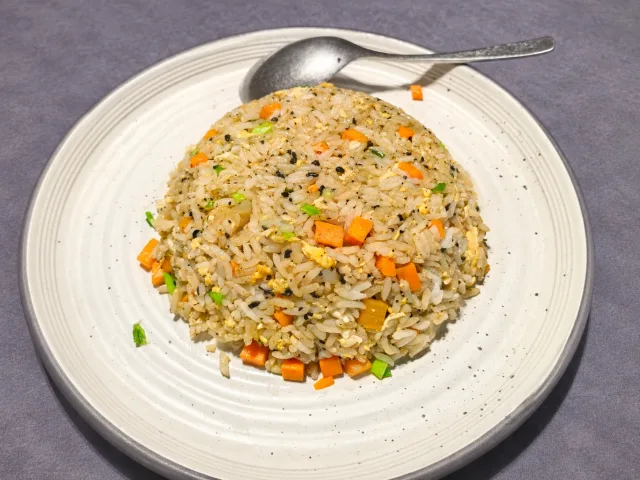
- Egg Fried Rice
Fried rice · Lunch, dinner, end of a meal
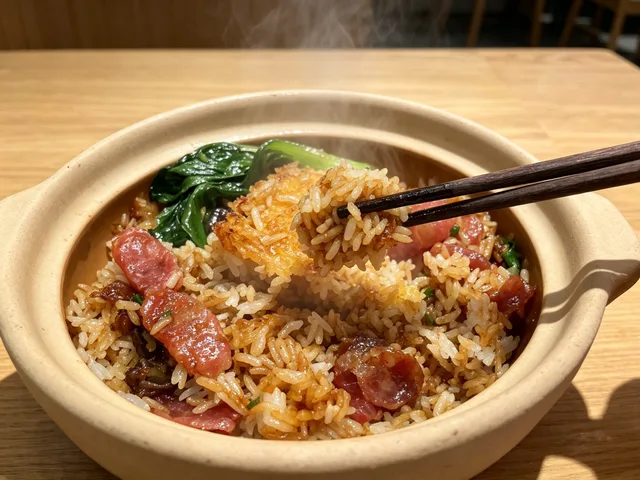
- Claypot Rice
Claypot rice · Lunch or dinner, best in autumn and winter
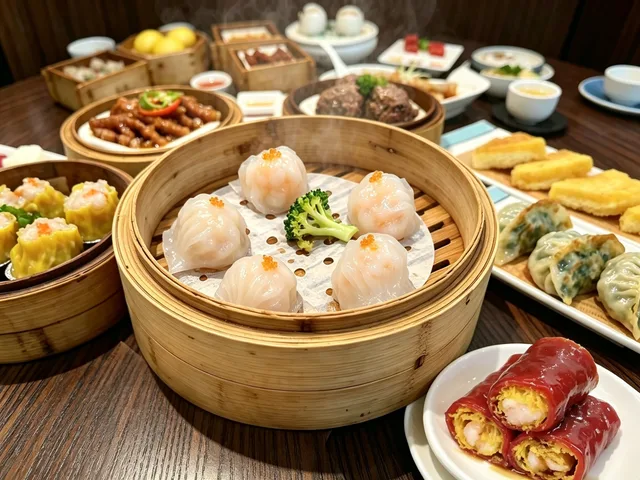
- Cantonese Yum Cha
Yum cha · Morning tea, weekends with family
- Char Siu
Roast pork · Lunch or dinner, with rice
- Beef Chow Fun
Fried rice noodles · Lunch, dinner or late-night supper
- Mooncake
Festival pastry · Mid-Autumn Festival
FAQ
Questions about Pork Knuckle Rice
What is Longjiang pork knuckle rice?
A Chaoshan dish from Longjiang town in Huilai county, Guangdong: whole pork legs braised in a soy-based brine with galangal and spices, sliced over rice with pickled greens and a ladle of the brine.
Is it trotter or knuckle?
Both. Shops braise the whole hind leg and sell it in four pieces, from the meaty hock to the foot; the lower pieces are almost all skin and tendon.
Which part is best?
Regulars ask for the lower two segments, the “four corners” and the foot, for their gelatin; the top piece has the most meat and fat.
Why is it so popular in Shenzhen?
Chaoshan migrants brought it to Shenzhen as the city grew; it is filling, cheap and served in a minute, so it became an everyday lunch for office and factory workers.
What do you eat it with?
Rice, pickled mustard greens, blanched greens and a ladle of the brine, often with a braised egg, pork roll or roast meat, and chili sauce or garlic vinegar.
Sources
Sources and further reading
- 1 Chen Yiqun, Chaoshan Shihua (潮汕食话), essay “Pork trotters for the carnivore” (肉欲猪脚): Longjiang trotters (in Chinese)Minzhu yu Jianshe Publishing House (2022)
- 2 Zhong Chengquan Jingdian Chaocai Jifa (钟成泉经典潮菜技法), preface: dalang and Longjiang trotter rice across Guangdong (in Chinese)Guangdong Science and Technology Press (2023)
- 3 Chen Yukai and Chen Junsheng, Chaocai Gongyixue (潮菜工艺学): Chaozhou braising and jellied trotters (in Chinese)Jinan University Press (2021)
- 4 Qiu Zhencheng and Huang Jinglin, Chibian Guangdong zhi Chaoshan de Yuanwei Shiguang (吃遍广东之潮汕的原味时光): garlic vinegar for braised meats (in Chinese)Chongqing Publishing House (2014)
- 5 Zhongguo Yuecai Gushi (中国粤菜故事): Heyuan trotter rice noodles (in Chinese)Guangdong Vocational Technical Teaching and Research Office; Guangdong Science and Technology Press (2022)
- 6 Wang Liang, Yuecai (粤菜), chapter “The taste of siu mei”: the roast-meat shop window (in Chinese)Guangdong People’s Publishing House (2021)
- 7 More than 5,000 shops: Longjiang trotter rice and China’s office workers (in Chinese)Ye Chen, Tianxia Wangshang, via Jiemian (2023) ↗
- 8 Clay-pot trotter rice in Longjiang town: a 25-yuan plate, two pieces of si dian jin and Chaoshan chili sauce (video, in Chinese)Da Ge Zai Shanghai (达哥在上海), Bilibili ↗
- 9 A Longjiang trotter shop of more than 40 years: old brine, rooster bowls and a sour chili sauce (video, in Chinese)Renyi Yige (Renyi毅哥), Bilibili ↗
- 10 Seventy million orders a year: why Longjiang trotter rice has no big brand (video, in Chinese)Cai Jing Bu Mian Jie (财经不眠姐), Bilibili ↗
- 11 A shop recipe for Longjiang trotters: pork-skin stock, galangal, Chaoshan soy and three parts braising to seven parts soaking (video, in Chinese)Da Chu A Dou (大厨阿斗), Bilibili ↗
Last updated October 2026