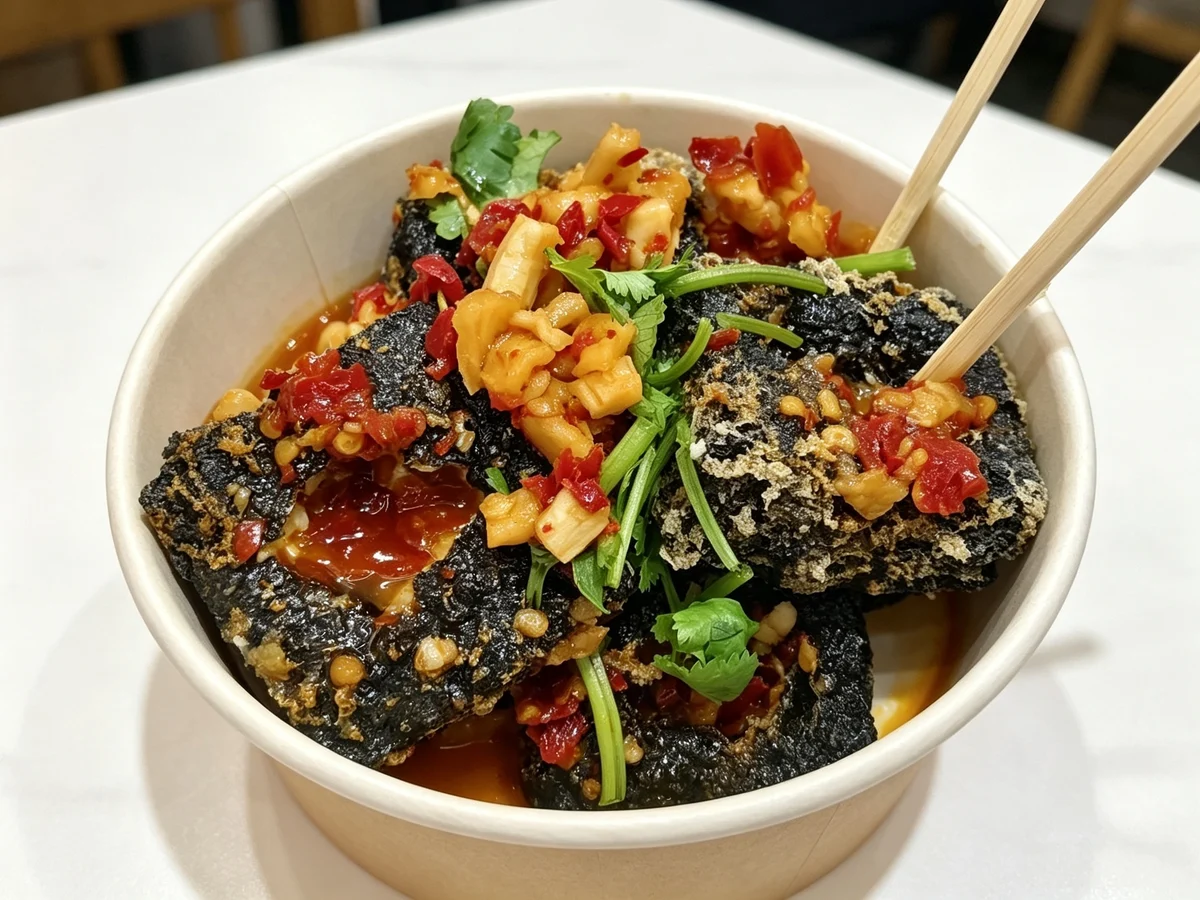
What “smells strong, tastes fragrant” actually means
Changsha stinky tofu—called chòu dòufu in Mandarin and often chòu gānzi in Changsha speech—is the city’s emblematic fried fermented-tofu snack. Tofu blanks take on aroma and color from a maintained vegetable, bean and aromatic brine, then are fried until the exterior turns dark and crisp. Vendors split or pierce each piece so chilli, garlic and seasoned liquid reach the pale, porous center. Its identity is the contrast between assertive fermented aroma and a clean, hot, juicy bite.
Common ingredientsFirm tofu blanks, a maintained fermentation brine, fresh frying oil, chilli, garlic, scallion or cilantro and a seasoned liquid; garnishes vary.
01
Start with a small batch fried to order
How to order it
Start with a small portion if fermented tofu is unfamiliar. Choose a busy, visibly clean stall that fries in small batches, separates raw tofu tools from ready-to-eat service and has fast turnover. Ask whether the standard seasoning contains chilli, garlic, cilantro, sesame, peanuts or meat broth if allergies, vegetarian eating or preferences matter. Eat immediately: steam and liquid soften the crust within minutes. Use a skewer or chopsticks carefully—the opened center may hold very hot seasoned broth. A cleaner, drier version and a broth-heavy juicy version can both be local; decide whether crispness or abundant seasoning matters more to you.
How to eat and pair it
In Changsha this is everyday street and snack-shop food, not a dare. Official Hunan sources describe the ideal as crisp but not burnt, tender but not greasy, with a smell that is strong yet an eating aroma that is savory and clean. Fire Palace is the best-known heritage name, but many contemporary stalls serve darker, wetter or more aggressively chilli-garlic versions. Stories that trace all stinky tofu to one inventor or one north-to-south transmission route are repeated in tourism writing; the well-documented point is the mature Changsha craft and its living local name, not a single uncontested invention tale.
Easy mix-ups
Misconception: The stronger and dirtier the smell, the more authentic it is. In practice: Controlled fermentation should smell assertive but clean; rancid oil or poor hygiene is never desirable. Misconception: All authentic stinky tofu is black. In practice: The dark fried exterior is characteristic of Changsha. Other regions make pale, steamed, braised or differently fermented forms.
02
Judge the crust, center, aroma and finishing liquid
Tofu blank
It must be firm enough to survive frying yet porous enough to take in brine and finishing liquid.
Mature fermentation brine
Traditional descriptions mention fermented vegetables, black beans, mushrooms, bamboo shoots, grain liquor and old brine. Exact shop formulas are closely held and modern food-safety practice matters.
Frying oil
Fresh, well-managed oil creates a crisp shell. Rancid oil is a defect, not part of the desired aroma.
Chilli-garlic seasoning
Chilli, garlic, scallion, soy-based liquid and sometimes pickled vegetables are added after frying so the center becomes juicy and savory.
Fire Palace heritage style
A famous Changsha lineage associated with dark tofu, careful low-temperature frying and seasoning inserted after the crust forms.
Street-stall juicy style
Pieces are split or punctured and flooded with chilli-garlic broth; the interior is especially wet and the crust softens quickly.
Drier crisp style
Less finishing liquid preserves the shell longer and foregrounds fermented tofu flavor.
- Pieces are fried to order with a crisp, unburnt dark surface
- The center remains pale, porous and tender rather than dry or collapsed
- Fermented aroma is assertive but free of rancid-oil, putrid-protein or sewage-like notes
03
From tofu blank and brine to frying and filling
Tofu blanks are soaked in a controlled mature brine, drained and fried in batches until a dark crisp shell forms around a hot tender center. Each piece is opened or pierced after frying so freshly handled chilli, garlic and seasoned liquid can reach the pores.
04
An everyday Changsha snack, not a visitor challenge
Changsha’s black stinky tofu—locally also called chou ganzi—is one of the city’s emblematic snacks. Tofu blanks are conditioned in a maintained fermentation brine, then fried until the exterior becomes dark and crisp. Several shops and storytellers claim a decisive role in its origin, but these accounts remain local lore rather than a settled invention record.
Controlled fermentation is not the same as spoilage, and Changsha’s dark exterior is a local style rather than a universal standard for all Chinese stinky tofu. A good piece is fried to order, smells assertive but clean, opens to a pale porous center and carries freshly handled chilli, garlic and seasoned liquid without stale oil or ammonia-like harshness.
05
How to say Changsha Stinky Tofu—and what the name tells you
Pronounced cháng shā chòu dòu fu.
Chou describes the assertive aroma created by controlled fermentation; it does not authorize spoiled tofu, rancid frying oil or an unclean stall. Ganzi is a regional everyday word for a firm tofu product.
The English label stinky tofu covers many Chinese regional traditions. Changsha’s dark fried shell and chilli-garlic liquid are distinctive, but pale, steamed, braised and differently fermented stinky tofus elsewhere are not failed copies.
One-inventor stories remain contested: Tourism accounts repeat several origin and transmission stories. Fire Palace is an important documented heritage name, but no single colorful tale accounts for the invention history of every Changsha stinky-tofu shop.
Fermentation creates the identity; frying creates the contrast
Changsha stinky tofu begins with tofu exposed to a seasoned fermentation brine, then fried for service. The famous dark exterior is associated with the local style, but color alone cannot prove a traditional process: shops differ in brine, tofu, frying oil and coloring. The useful sensory sequence is a fermented aroma, a crisp or craggy shell and a pale, tender interior that still tastes of soy. A black block that is dry all the way through has achieved appearance without the desired contrast.
The fryer has to drive moisture from the surface while leaving the center soft enough to take seasoning. Oil that is not hot enough produces a greasy sponge; excessive frying hardens the shell and hollows the tofu. Many vendors open or puncture the fried pieces so chilli-garlic liquid, preserved vegetables and aromatics can enter. That finishing broth should season the interior without turning the shell into wet bread before the first bite.
The smell is noticeable, but “the worse the smell, the better” is not a quality rule. Clean fermentation can be assertive without smelling rotten, chemical or rancid. Fresh frying oil, active turnover and garnishes added to order matter more than theatrical odor. The flavor after biting is often milder than the aroma approaching the stall, with soy, salt, chilli and garlic becoming clearer.
Changsha’s black fried style is one member of a wider stinky-tofu family
Stinky tofu across China and Taiwan can be pale or dark, fried, steamed, braised or served with pickles. Changsha is especially associated with small dark fried pieces dressed with chilli, garlic and savory liquid. Taiwanese night-market versions are often paler, larger and paired with pickled cabbage; other mainland traditions may be steamed or cooked in sauce. These are related fermented-tofu foods, not failed copies of one another.
When ordering in Changsha, choose the number of pieces and state chilli tolerance before the vendor spoons in the final liquid. “No chilli” still leaves fermentation, garlic and savory seasoning, while “less spicy” may retain some red oil. Eat a freshly fried piece carefully: liquid trapped inside can be much hotter than the exterior suggests. A skewer or toothpick is convenient, but bite through the shell without squeezing hot broth toward another diner.
Fermented brine and frying oil require professional handling. Diners cannot validate a recipe by color or smell alone, so choose a busy, clean stall that protects raw tofu, drains finished pieces and refreshes garnishes. People with soy allergy should avoid the dish; wheat, sesame, peanuts, animal stock or shared oil may also appear in seasoning and preparation. Vegetarian diners need to ask about the finishing broth rather than relying only on the tofu base.
- The shell should remain crisp at the first bite even after liquid has been spooned into the center.
- The interior should be moist, pale and recognizably tofu-like rather than hollow or rubbery.
- Fermented aroma, garlic, chilli and soy should remain separable instead of collapsing into stale oil.
A standard portion is best shared only if everyone eats immediately. Cutting each small piece into many samples releases steam, spills the seasoned center and lets the shell soften. Order a second fresh batch instead of preserving the first while the group decides whether it likes the aroma.
Sources
Sources and further reading
- Changsha stinky tofu: brine, frying and flavorPeople’s Government of Hunan Province ↗
- Changsha stinky tofu, locally called chou ganzi, in living heritageHunan Provincial Department of Culture and Tourism ↗
- Traditional seasonal snacks of Hunan: fried stinky tofuHunan Provincial Archives ↗
- Hunan cuisine and local food traditionsHunan Provincial Government ↗