
01
A preserved egg, not an old one
A century egg is cooked by chemistry rather than heat, in weeks rather than a century.
Peel a century egg and the white is no longer white. It has set into a firm, springy jelly, brown and see-through like amber or dark tea, sometimes with fine white crystals across the surface in the shape of pine needles. The yolk is dark green, shading lighter toward the middle, and it can be firm, or soft and creamy at the center. It smells faintly of sulfur when first cut. The first taste is sharp and a little astringent; as you chew, it turns long, savory and rich.
Chinese has three common names for it. 皮蛋, “skin egg,” because the peeled white is springy like a skin. 松花蛋, “pine-flower egg,” for the feathery crystal pattern on a well-made egg. 变蛋, “changed egg,” because a fresh egg turns into something else. English calls it century egg, hundred-year egg, thousand-year egg or simply preserved egg; Hong Kong’s food safety authority uses “lime-preserved egg.” The dramatic names are a joke that stuck: Fuchsia Dunlop notes that it is called the thousand-year-old egg “in the West,” and Chinese writers point out that the egg itself has existed for well under a thousand years.
Most century eggs are duck eggs. Chicken eggs are cured the same way; having thinner shells, they often come out with golden rather than dark-green yolks.
Take it apart
A plate of century eggs
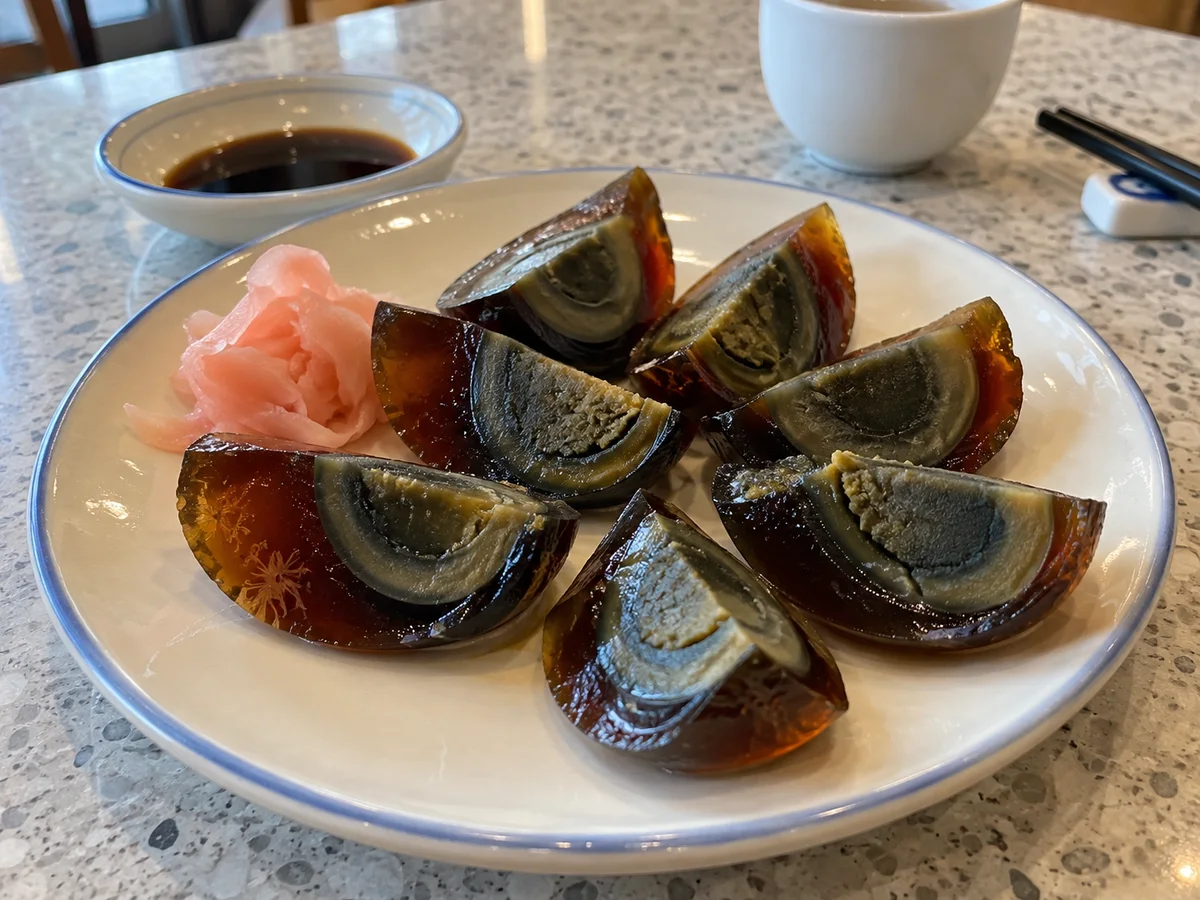
- The white
Set into a clear amber jelly
- The yolk
Soft and dark green, paler towards the middle
- Pickled ginger
Served with the wedges; its sourness tames the alkaline taste
02
What happens inside the shell
The whole process depends on alkali seeping through the shell, and stopping it at the right moment.
Traditionally, fresh duck eggs were caked in a paste of mud, strong tea, salt and alkaline ingredients such as wood ash, soda, lye and quicklime, rolled in rice husks so they did not stick together, and packed in jars. Dunlop gives about three months as the traditional curing time.
Alkali passes through the tiny pores in the shell. The egg white first turns liquid and then sets again as an elastic gel; when the alkali reaches the yolk, it breaks down proteins and fats into the savory compounds that give the egg its taste, including glutamates and the hydrogen sulfide that gives the sulfurous smell. The difficulty is timing: if the alkali keeps flowing in after the white has set, the gel liquefies again before the yolk is ready. The answer was to block the pores. Old recipes added huangdan powder, a lead oxide, which seals the shell; lead also builds up in the egg. Modern eggs use copper or zinc compounds to seal the pores instead, which is what packaging calls “lead-free.”
The white pine-flower crystals are mainly magnesium hydroxide. A soft-centered yolk comes from stopping the cure early, while the yolk is still creamy; golden yolks come from letting the hydrogen sulfide escape, through thinner shells or a crack, and a stronger alkali.
| Kind | Chinese | What it is like |
|---|---|---|
| Soft-centered | 溏心皮蛋 | Yolk creamy and runny in the middle; the usual choice for eating cold |
| Firm | 硬心皮蛋 | Yolk set all the way through; easier to dice for congee |
| Golden | 黄金皮蛋 | Usually chicken eggs; golden yolk and lighter white |
| Pine-flower | 松花蛋 | Any good egg showing white crystal patterns on the white |
03
Five hundred years of written recipes
Nobody knows who first made a century egg, but the recipes go back to the Ming.
The earliest clear recipe is in Zhuyu Shanfang Zabu, compiled by Song Xu and Song Gongwang, father and son, of Huating, today’s Songjiang in Shanghai, and finished in 1504. It calls the eggs 混沌子 and tells you to mix a dou of burnt charcoal ash and a sheng of lime with brine, bring it to the boil, let it cool, coat the eggs and wait five to seven days until “yolk and white are mixed in one.” A late-Ming book, Yangyu Yueling, describes 牛皮鸭子, “ox-hide duck eggs”: a hundred eggs with ten liang of salt, five sheng of chestnut-wood charcoal ash and a sheng of lime, turned every three days three times and sealed for a month. The scholar Fang Yizhi, writing around the Ming–Qing transition, says Chizhou in Anhui produced “changed eggs” cured with ash from five kinds of trees, and already distinguishes two results: buckwheat-straw ash gave a yolk and white mixed together, while adding charcoal and lime made them green and firm.
Where it was invented is unknown. The first written recipe comes from near Shanghai and the first named place is in Anhui. Local stories of duck eggs found, by luck, after lying in lime or ash cannot be traced either. What is certain is that by the Qing dynasty the egg was eaten from Beijing to Guangdong and admired, not merely tolerated. Yuan Mei, while ill in Guangzhou, recorded a poem by a Guangdong county magistrate, Wu Shixian, who wrote that inside the egg were “the colors of rosy clouds” and beyond its taste “the smoke of pine and bamboo.” Xu Ke’s Qing Bai Lei Chao explains that in Beijing people avoided the word 蛋, “egg,” because it was used in insults, so a century egg was simply called 松花, “pine flower”; the book also lists century eggs among the four cold plates of a Shanghai tavern set meal.
Outsiders were less sure. In colonial Hong Kong, the physician and lawyer Ho Kai, who opposed the food bylaws of the 1887 Public Health Ordinance, argued that words like “tainted” and “unwholesome” were culturally relative, pointing out that preserved eggs, which Europeans found distasteful, were delicacies to Chinese people.
04
How Guangdong eats it
In Cantonese cooking the century egg is a seasoning as much as a dish.
Century egg and pork congee, 皮蛋瘦肉粥, is the way most people first meet the egg. A restaurant version starts with rice simmered for about two hours at a lively boil, with a little oil so it is silky rather than thin, until the grains break down. Diced century egg and shredded ginger go in about five minutes before the end and are stirred until the yolk dissolves into the congee and seasons it. Thin slices of pork, marinated and massaged with a little water and starch so they stay tender, go in last for two or three minutes, then salt, white pepper and spring onions. Heating also drives off much of the egg’s sulfurous smell.
As a cold starter, century eggs are cut into wedges and served with slices of pickled young ginger, 皮蛋酸姜, or with a ginger-and-vinegar dip; the acid takes the edge off the alkaline taste. In soup, diced century egg, often with salted duck egg, is fried in a little lard until lightly browned, then simmered with ginger, garlic and stock until the broth turns milky, and poured over blanched greens such as amaranth or bok choy: 上汤苋菜, amaranth in superior stock, is the best-known version. Cantonese bakers have long used the egg in pastry too: preserved-egg puff, 皮蛋酥, is a traditional wedding pastry, and preserved-egg mooncakes appeared in Guangzhou tea houses in the Republican period.
05
Tofu, peppers and other ways across China
Most other regions eat century eggs cold, with something sour, salty or hot.
Dunlop describes a home cook who sets out century eggs cut into “rainbow segments” to keep guests going while she finishes cooking. In Beijing banquets it is a standard cold dish. With silken tofu it becomes the simplest dish in the repertoire: the tofu is turned out whole, the eggs are chopped on top, and a dressing of soy sauce, vinegar, sesame oil and garlic or chili is poured over; many people mash the two together and eat it with rice.
| Dish | Chinese | Where | How |
|---|---|---|---|
| Century egg and pork congee | 皮蛋瘦肉粥 | Guangdong, Hong Kong | Diced egg melted into long-simmered congee with sliced pork |
| Century egg with pickled ginger | 皮蛋酸姜 | Guangdong, Hong Kong | Cold wedges with pickled young ginger |
| Greens in superior stock | 上汤苋菜 / 上汤白菜 | Guangdong | Diced century and salted eggs simmered in stock over blanched greens |
| Century egg with silken tofu | 皮蛋豆腐 | Nationwide | Cold, with soy, vinegar, sesame oil and garlic or chili |
| Pounded roasted peppers with century egg | 擂辣椒皮蛋 | Hunan | Green peppers charred, pounded in a mortar and mixed with the eggs |
| Sour-and-hot century eggs | 酸辣皮蛋 | Home cooking | Wedges dressed with black vinegar, soy and chili oil, with green pepper |
| Three-egg steamed custard | 三色蛋 | Home cooking | Beaten fresh eggs steamed with chopped century and salted eggs |
The Hunan version is the boldest. Green chilies are charred over a flame or charcoal, peeled, and pounded in a mortar, seasoned simply with salt, soy sauce and a little vinegar; the century eggs are added in pieces and pounded gently with a circular motion, so that the creamy yolks coat the peppers. A Yunnan restaurant in Beijing pairs golden century eggs with sour tree tomatoes.
06
If you are trying it for the first time
Many people dislike century eggs at first; plenty of them change their minds.
Fuchsia Dunlop, who went on to become one of the best-known English writers on Chinese food, describes her first century egg, in a Hong Kong restaurant in 1992, as something she could barely swallow. Later in the same book she writes that preserved duck eggs, like fermented tofu, are prized in China for their strong and complex umami.
The smell is the main hurdle, and it fades. Cut eggs left to stand for a while lose some of their hydrogen sulfide, heat drives off more, and an acid such as vinegar or pickled ginger tempers the alkaline taste. So start with congee, where the egg is cooked and diluted, or with century egg and tofu, then try a plain wedge with ginger.
07
Lead, safety and buying
Lead was a real problem in older century eggs; current standards deal with it.
Lead oxide was a traditional additive, and eggs made with it were high in lead. China’s current standard for century eggs, GB/T 9694-2014, in force since December 2015, applies the general contaminant limits of GB 2762, which cap lead at 0.5 milligrams per kilogram. “Lead-free” on the box means within that limit, not zero. In 2013 there were reports of industrial-grade copper sulphate being used to speed up production on the Mainland; Hong Kong’s Centre for Food Safety noted that copper sulphate is a permitted processing aid there, used in place of lead oxide, and that its own tests for lead and other heavy metals in preserved eggs had all been satisfactory. Dunlop describes visiting an unlicensed workshop near Chengdu whose eggs were ready in seven to ten days, a sign, her companion said, of shortcuts with additives. Buy eggs with a brand, a production date and a standard number on the box, from shops you trust.
A good century egg has a clean, intact shell; once peeled, the white is a translucent dark brown and springy. If the white is light green, soft and falling apart, throw the egg away, since it may be contaminated; if you are unsure about an egg, steaming it thoroughly makes it safer. To peel, crack the broad end, where the air pocket is, and roll the egg under your palm. A knife dipped in cold boiled water, or a length of thread pulled tight, cuts the sticky yolk cleanly; steaming the eggs for a few minutes first firms them for dicing.
08
Century egg and pork congee at home: the slow version
For four or five bowls: 100 g rice, 2.5 liters water (for a pot about 20 cm across), 2 century eggs, about 100 g lean pork from the shoulder, a small piece of ginger, spring onions, a little oil, salt, white pepper and sesame oil; for the pork, salt, sugar, Shaoxing wine, a spoonful of water and a little cornstarch.
- 1. Start the congee
Bring the 2.5 liters of water to the boil, add the washed rice and about two teaspoons of oil, return to the boil and stir the bottom. Leave the lid off and keep the heat at a level where the grains keep rolling, stirring now and then, for about 70 minutes, until about 1.5 liters remain and the grains have broken down into a silky porridge. A wider pot loses more water, so start with more.
- 2. Prepare the pork
Slice the pork thinly. Season with salt, a pinch of sugar and a splash of wine, stir hard until sticky, then work in a spoonful of water, a little cornstarch and a few drops of oil.
- 3. Add the egg
Peel and dice the century eggs; steaming them for a few minutes first makes them easier to cut. Add with shredded ginger and stir until the yolks melt into the congee, about five minutes.
- 4. Season
Mix salt, white pepper and sesame oil into a ladle of congee and stir it back into the pot, so the seasoning does not form lumps.
- 5. Cook the pork
Add the pork, separate the slices and cook for two to three minutes, until just done. Scatter with spring onion and serve.
Keep the heat lively rather than low: a brisk simmer is what makes the rice break down and the congee turn creamy. Short on time, use the quick version on the congee page, where the base cooks for 25 to 40 minutes.
09
More to try
Congee
Cantonese congee, from plain rice porridge to century egg and pork, and how it is cooked.
Read about congee →Acquired-taste foods
Stinky tofu, river-snail noodles and other foods that take some getting used to.
Read the guide →Chinese tofu
Silken, firm, fermented and dried tofu, and how to cook them.
Read the tofu guide →Guangdong classics
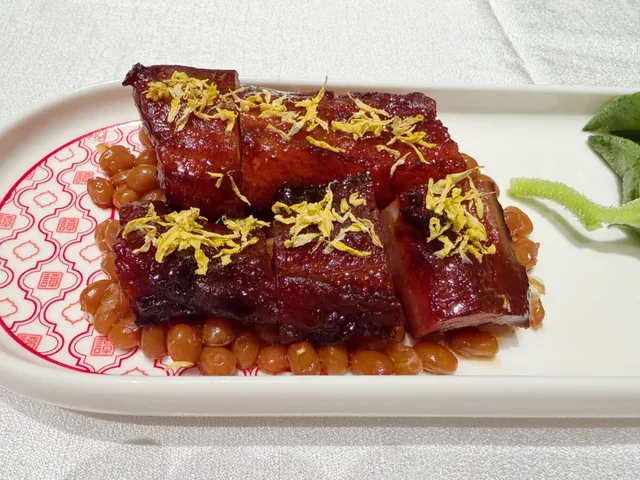
- Char Siu
Roast pork · Lunch or dinner, with rice
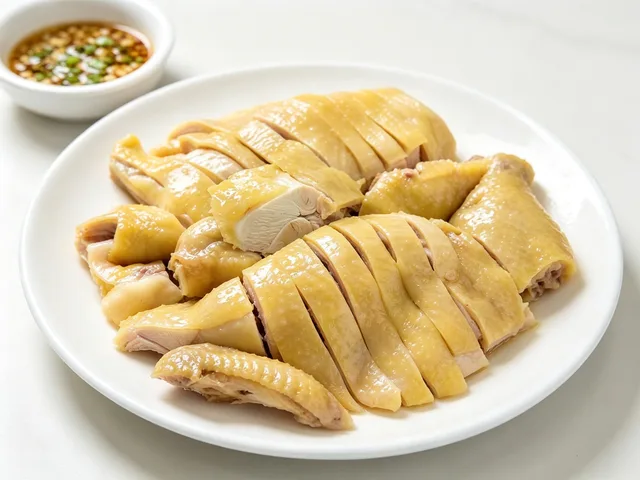
- White Cut Chicken
Poached chicken · Lunch or dinner
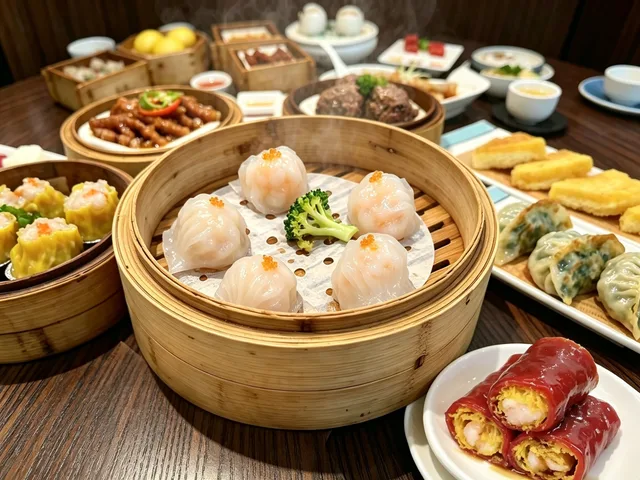
- Cantonese Yum Cha
Yum cha · Morning tea, weekends with family
- Egg Fried Rice
Fried rice · Lunch, dinner, end of a meal
- Beef Chow Fun
Fried rice noodles · Lunch, dinner or late-night supper
- Mooncake
Festival pastry · Mid-Autumn Festival
FAQ
Questions about Century Egg
What is a century egg?
A duck egg cured in an alkaline mixture of lime, ash and salt until the white sets into translucent brown jelly and the yolk turns creamy and dark green.
Is a century egg really a hundred years old?
No. It takes weeks to a few months to make. “Century egg” and “thousand-year egg” are nicknames.
Is a century egg raw?
It is not cooked with heat, but the alkali sets the white and yolk much as cooking does, so it is eaten as it is. Steaming it makes it firmer and safer if you are unsure of the egg.
What does a century egg taste like?
Savory, rich and slightly mineral, with a creamy yolk and a springy white. It smells of sulfur at first.
Why does it smell?
The alkali breaks down the yolk and releases hydrogen sulfide. Letting cut eggs stand, heating them in congee or adding vinegar or pickled ginger softens it.
Do century eggs contain lead?
Old methods used lead oxide. China’s current standard limits lead to 0.5 mg/kg, and “lead-free” eggs use copper or zinc compounds instead; “lead-free” means within the limit, not zero.
What are the white patterns on the egg?
Crystals, mainly magnesium hydroxide, that form on a well-made egg. They gave it the name pine-flower egg.
What is the difference between a century egg and a salted egg?
A salted duck egg is cured in brine and cooked before eating; its yolk is orange and oily. A century egg is cured in alkali and turns dark and jelly-like.
How should I eat a century egg the first time?
In century egg and pork congee, or chopped over silken tofu with soy and vinegar.
How do I peel and cut one?
Crack the broad end and roll the egg to loosen the shell. Cut with a knife dipped in water or with a piece of thread.
Where were century eggs invented?
Nobody knows. The earliest written recipe is from 1504, by a family from Songjiang near Shanghai, and a seventeenth-century writer names Chizhou in Anhui; local stories of a lucky discovery cannot be traced.
Sources
Sources and further reading
- 1 Lin Weihui, Chi Dui Le Ma (吃对了吗), chapter “The mischievous preserved egg” (调皮的皮蛋) (in Chinese)Guangdong People’s Publishing House (2022)
- 2 Fuchsia Dunlop, Shark’s Fin and Sichuan Pepper, pp. 8, 10, 97 and 277–78: preserved duck eggs in Hong Kong in 1992, umami, and a Chengdu workshopW. W. Norton (2008) ↗
- 3 Fuchsia Dunlop, Every Grain of Rice, pp. 33, 41, 54, 130, 176, 263 and 334: preserved duck eggs in the glossary and in recipesW. W. Norton (2013) ↗
- 4 Robert Peckham, “Bad Meat: Food and the Medicine of Modern Hygiene in Colonial Hong Kong,” in Moral Foods, ed. Angela Ki Che Leung and Melissa L. Caldwell, p. 193University of Hawai‘i Press (2019, open access)
- 5 Suiyuan Shihua, juan 10: Wu Shixian’s poem on the preserved egg (in Chinese)Yuan Mei, Wikisource ↗
- 6 Qing Bai Lei Chao, food and drink: why Beijing called the egg songhua, and the Shanghai four-plate set (in Chinese)Xu Ke, Wikisource ↗
- 7 Guang Jiu Jun (广酒君), Guobing: Guangshi Yuebing de Qianshi Jinsheng (国饼——广式月饼的前世今生), chapters “The birth of the Cantonese mooncake” and “Major events”: preserved-egg pastries and mooncakes (in Chinese)Guangzhou Publishing House (2025)
- 8 GB/T 9694-2014 Pidan (Preserved eggs), national standard of China, in force from 1 December 2015, with contaminant limits under GB 2762 (in Chinese)General Administration of Quality Supervision, Inspection and Quarantine; Standardization Administration of China
- 9 Heavy Metals in Lime-preserved Eggs, Food Safety Focus no. 84 (July 2013)Centre for Food Safety, Hong Kong SAR Government ↗
- 10 Hotel-style century egg and pork congee: rice, timing and seasoning (video, in Chinese)Zhu Chu Nong Guo Dong (主厨农国栋), Bilibili (2019) ↗
- 11 Hunan pounded roasted peppers with century eggs (video, in Chinese)Da Shi De Cai (大师的菜), Bilibili (2021) ↗
- 12 Century eggs with silken tofu: peeling, cutting and two dressings (video, in Chinese)Da Chu A Dou (大厨阿斗), Bilibili (2023) ↗
- 13 Amaranth in superior stock with century egg fried in lard (video, in Chinese)Da Chu A Dou (大厨阿斗), Bilibili (2024) ↗
- 14 Cantonese slow-cooked plain congee base: water, heat and timing (video, with the cook’s own figures in the comments, in Chinese)A Li Chu Fang (阿李厨房), Bilibili (2019) ↗
Last updated November 2026