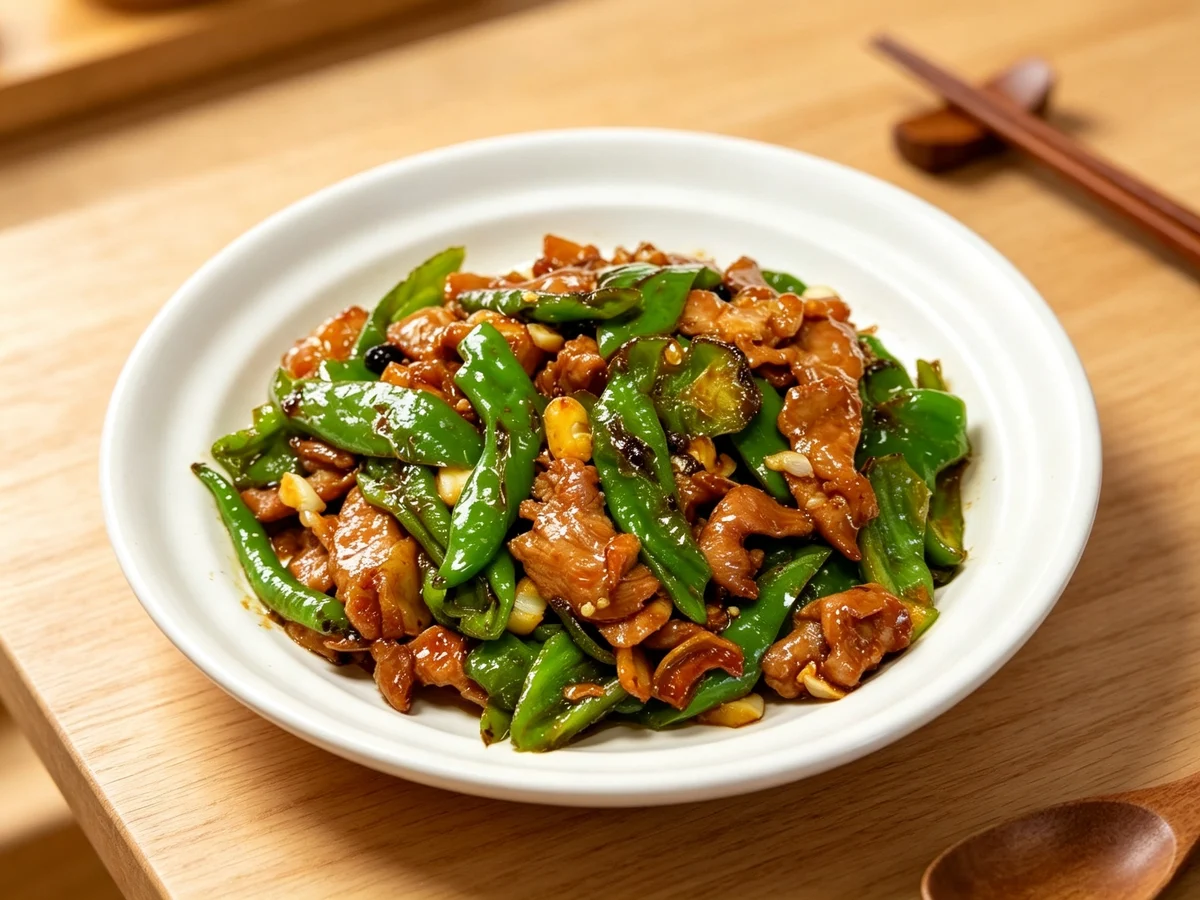
The more ordinary the dish looks, the more technique it reveals
Lajiao chaorou—literally “chilli stir-fried with pork”—is a benchmark Hunan home dish in which fresh peppers are a major ingredient, not garnish. Thin lean pork and a smaller amount of belly or fatty pork are cooked quickly with blistered green or mixed chillies. Garlic, soy and sometimes fermented black beans deepen the pan aroma, but the defining flavor is fresh pepper: green, direct and fragrant rather than the numbing málà profile associated with Sichuan.
Common ingredientsLean pork plus pork belly or fatty pork, a substantial quantity of fresh green or mixed chillies, garlic, soy and salt; fermented black beans are optional.
01
Ask about the day’s chillies and order enough rice
How to order it
Order plain rice; the dish is designed to season several mouthfuls of rice. Ask how hot the peppers are that day—fresh-chilli heat changes by variety and season. If you request less heat, ask whether the kitchen can use milder peppers rather than simply removing most of the chilli. Pair it with a steamed egg, mild soup or simply cooked green vegetable. Specify pork if a translated menu says only “farmhouse stir-fry”; related xiaochao dishes may use beef or other meats.
How to eat and pair it
On a Hunan table, this is a test of ordinary cooking done precisely. The cook must render enough pork fat to perfume the peppers, sear without drying the lean slices and stop while the chillies still have color and structure. The 2010 Hunan recommended standard provides a reference formula and sensory description, but it is not a claim that every household must use one ratio. Restaurants outside Hunan often thicken the sauce, sweeten it or reduce the pepper until the plate resembles generic green-pepper pork; those changes make it more approachable but blur the dish’s fresh-chilli identity.
Easy mix-ups
Misconception: It is just generic green-pepper pork with a Hunan name. In practice: The Hunan dish is distinguished by the quantity and fragrance of fresh chilli, the purposeful lean-fat pork balance and a relatively dry, fast stir-fry. Misconception: Authenticity requires one exact chilli-to-pork ratio. In practice: Hunan issued a recommended standard for reference and training, but official reporting at the time also recorded restaurant disagreement and household variation.
02
Four details distinguish a good plate of Hunan chilli pork
Lean and fatty pork
Hunan’s published reference standard describes both lean pork and pork belly; household ratios vary, but some fat is important for aroma and texture.
Fresh chilli
Long green peppers, local screw peppers or a green-red mixture may be used. The peppers are cooked as a vegetable and can equal or exceed the pork visually.
Garlic and soy
They season the meat and reinforce wok aroma without turning the plate into a thick brown sauce.
Fermented black beans
Douchi is common in some homes and restaurants, but it is a variation rather than a universal requirement.
Lajiao chaorou
The direct, widely understood name. The plate may use green peppers alone or a green-red mixture, with both lean and fatty pork.
Nongjia xiaochao rou
“Farmhouse small-stir-fried pork” is a common restaurant label with strong overlap, often emphasizing belly, mixed chillies and rustic presentation. It is not a legally fixed synonym.
Douchi version
Fermented black beans add salty, earthy depth; good versions use them as an accent rather than letting them smother fresh pepper aroma.
- Fresh peppers occupy a substantial share of the plate
- Pepper skins are blistered or wrinkled yet retain green color and some bite
- Lean pork remains tender while fatty pieces show lightly rendered edges
03
Build chilli and pork-fat aromas before the lean meat cooks quickly
The chillies are blistered to remove raw moisture while retaining color and bite. Fatty pork is rendered for aroma, then lean pork, garlic, optional douchi and the peppers are brought together quickly over high heat without a heavy starch sauce.
04
Why fresh chilli can stand for Hunan home cooking
Pork stir-fried with fresh green chillies is a foundational Hunan home-style combination rather than the invention of one restaurant. Lajiao chaorou and nongjia xiaochao rou overlap heavily, but restaurant usage and household ratios are not fixed by one translated name or reference standard.
Fresh chilli is a substantial vegetable and aroma source, not garnish. Skilled cooks blister the peppers, render a little fatty pork and keep lean slices tender in a dry high-heat stir-fry; fermented black beans are a valid option, while Sichuan-pepper numbness and a sweet thick brown sauce are not defining features.
05
How to say Hunan Pork with Fresh Chilli—and what the name tells you
Pronounced là jiāo chǎo ròu.
Nongjia xiaochao rou, “farmhouse small-stir-fried pork,” overlaps strongly and may emphasize belly, mixed chillies or fermented black beans, but restaurant usage is not legally fixed. Ask what the kitchen actually cooks rather than treating the translated titles as perfect synonyms.
“Hunan pork with fresh chilli” is more informative than generic green-pepper pork: fresh chilli is a substantial vegetable and aroma source, not a token garnish in a thick sweet sauce.
Fresh chilli is a vegetable and primary flavor, not a decorative heat setting
Hunan lajiao chaorou uses a generous amount of fresh green or mixed chilli with sliced pork. The peppers bring grassy aroma, bitterness, sweetness and heat, changing with variety and season. They are not the few red rings scattered over a generic pork stir-fry. Removing them entirely removes the dish’s structure; a milder kitchen version must still preserve enough fresh pepper to remain recognizable.
Pork often combines lean and fatty slices. Fat renders first and perfumes the wok, while lean meat supplies chew and savoriness. Garlic, fermented black beans or soy-based seasoning may support the stir-fry, but the plate should remain relatively dry and direct. Heavy starch sauce, excessive sweetness or a pool of oil makes it harder to taste the fresh chilli-pork exchange.
Heat control keeps the two main ingredients distinct. Chilli needs blistering and fragrance without turning limp grey; pork needs browning and full cooking without drying. Batch size matters because a crowded wok steams both. The characteristic “small stir-fry” idea points to fast high-heat cooking, not necessarily a tiny portion.
Several menu names overlap, so ask what the kitchen actually cooks
辣椒炒肉 means chilli stir-fried with pork. 农家小炒肉, farmhouse small-stir-fried pork, often overlaps but can vary in cuts, peppers and seasoning. “Hunan pork,” “pork with green pepper” and “xiaochao rou” on English menus may point toward the same family without guaranteeing one formula. A photo and a question about fresh chilli are more useful than relying on translation alone.
Ask for the house spice level before ordering, understanding that chilli quantity affects vegetable volume as well as heat. A kitchen may select milder peppers or adjust hot varieties; simply removing all pepper leaves oily pork. Confirm whether the plate uses pork belly, lean pork or a mix, and whether fermented black beans or soy are present for allergies.
This is a rice-driving shared dish. Pair it with plain rice, steamed egg, a mild soup or a green vegetable rather than several other fresh-chilli stir-fries. Take pork and pepper in the same bite. If only meat disappears and a heap of peppers remains, the table misses the balance the cook built.
- Peppers should smell fresh and show blistered edges while retaining color.
- Pork fat should be rendered and translucent, not rubbery or raw.
- The bottom of the plate should hold seasoning and a little oil, not thick gravy.
Pepper season changes the plate more than a fixed heat number can express
Fresh peppers vary in water, skin thickness, aroma and capsaicin even within one named type. A Hunan kitchen may combine fragrant mild peppers with a smaller number of hot ones, or use green and red stages of the same pepper. This lets the cook build volume and aroma without making every plate a dare. Ask whether the day’s peppers are especially hot rather than demanding an exact universal spice score.
The dish is best immediately, when pork edges are browned and peppers still have snap. Refrigeration makes rendered fat firm; reheating can dry lean slices and collapse peppers. Warm leftovers quickly in a hot pan without adding a sweet sauce. A little fresh pepper or scallion can restore aroma, but it cannot recreate the original wok timing.
For diners who avoid pork, ordering the same dish “without meat” is not a useful workaround because pork fat structures the stir-fry. Choose a purpose-built Hunan fresh-chilli vegetable or beef dish instead, and confirm its cooking fat and fermented seasonings separately.
Sources
Sources and further reading
- Local standard DB43/T 423.3-2010: Hunan-style chilli-fried porkNational Public Service Platform for Standards Information ↗
- How Hunan dish standards describe chilli-fried pork and Mao-style red-braised porkPeople’s Government of Pingjiang County ↗
- A taste of Hunan cuisine and its representative dishesHunan Provincial Department of Culture and Tourism ↗
- Hunan cuisine and local food traditionsHunan Provincial Government ↗