
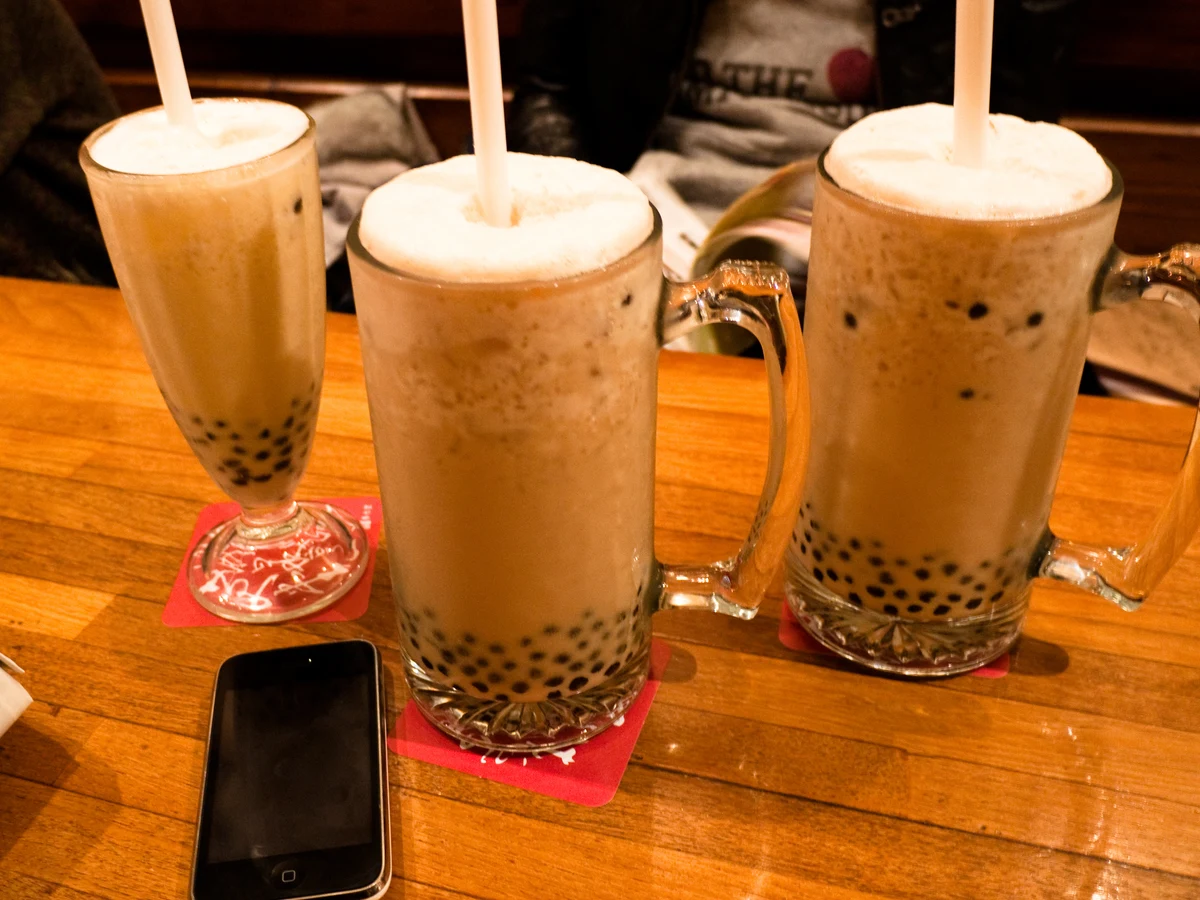
01
Four milk teas you can order by name
Milk tea covers several different drinks. In a Taiwanese tea shop it is iced tea with tapioca pearls you drink through a wide straw. In a Hong Kong cha chaan teng it is strong black tea poured over evaporated milk in a small cup. At an Inner Mongolian breakfast it is brick tea boiled with fresh milk and ladled from a shared pot. In a mainland tea chain, fresh-milk teas, tea lattes and fruit teas share one menu. Even the point at which the milk goes in differs.
Start with the style, then ask how the shop serves it. “Milk tea” on a cha chaan teng menu will usually bring you the local tea with evaporated milk. A Taiwanese shop might list pearl milk tea and boba milk tea side by side. At a northern restaurant the choice may be between a plain salted bowl and a pot substantial enough to eat with breakfast. In a mainland tea shop, a tea latte can put jasmine or oolong in the foreground, with no topping needed. For specific cups, see the tea shops and their signature orders.
| Look for | Base and serving style | First sip |
|---|---|---|
| 珍珠奶茶 · Taiwanese pearl milk tea | Black tea, dairy or creamer, and cooked tapioca pearls; often shaken with ice | Sweet and cool, with springy pearls |
| 絲襪奶茶 · Hong Kong milk tea | Strong, cloth-filtered black tea with evaporated milk; hot or iced | Full-bodied, with a pronounced tea edge |
| 蒙古奶茶 · Mongolian milk tea | Simmered brick tea and fresh milk; salt and grains vary | Warm and milky, often gently salty |
| 鲜奶茶 / 茶拿铁 · Fresh milk tea / tea latte | A brewed tea and milk; black, jasmine or oolong tea may be named | Aroma changes with the named tea |
02
Eighteen milk tea shops and what to order
If you already know you like milk tea, choose what you want to taste first: the tea, the topping, or the milk.
Compare pearls across two cups: small ones from Chun Shui Tang and big boba from 50 Lan. To taste what the tea brings, put Molly Tea’s scented jasmine beside Quchashan’s Guizhou matcha. One leaves a floral finish, the other brings a grassy note that carries through the cheese.
Drink names can be deceptive. Chayan Yuese’s Youlan Latte is a tea drink under whipped cream and pecans. Tiger Sugar’s brown sugar boba milk has no brewed tea in the version listed below. HEYTEA’s brown sugar bobo milk tea does. The difference is in the words “milk” and “milk tea” in the two names.
| Shop | What to order | What’s in it and how it tastes |
|---|---|---|
 Chun Shui Tang · Taichung | Classic Pearl Milk Tea 珍珠奶茶 | Black tea, creamer, cane sugar and small tapioca pearls. The shake leaves a light foam; the small pearls come up several at a time. |
 50 Lan · Taiwan | Boba Milk Tea 波霸奶茶 | Classic milk tea with large, springy tapioca balls. At branches that list both, order 珍珠奶茶 for smaller pearls, 波霸奶茶 for bigger ones. |
 Tiger Sugar · Taiwan | Brown Sugar Boba Milk with Cream Mousse 黑糖波霸厚鲜奶 | Milk, brown sugar syrup, large tapioca pearls and a cap of cream. The dark syrup gives it a toffee taste; choose the tea-latte version if you want a tea base. |
 A Little Tea · mainland China | Boba Milk Tea 波霸奶茶 | Sri Lankan black tea in a creamy base with large pearls. Look for the black tea’s fruity edge behind the chew of the boba. |
 MIXUE · Zhengzhou | Pearl Milk Tea 珍珠奶茶 | Black tea, dairy ingredients and tapioca pearls, as listed in the prospectus. A sweet, milky cup with chewy pearls; for a floral variation, look for the chain’s Jasmine Green Milk Tea. |
 YIHETANG · Wuhan | Yihe Roasted Milk Tea 益禾烤奶 | Black tea in a milky base with a house caramel syrup that leaves a faint charcoal-roasted note. It is the drink the chain opened with in Wuhan in 2012; Mint Milk Green Tea is its newer signature. |
 Good me · Wenling | Good me Milk Tea 古茗奶茶 | Milk tea on a blend of black teas from India, Sri Lanka and Yunnan, according to the brand’s filing. Choose it for a deeper black tea base rather than a floral one. |
 Auntea Jenny · Shanghai | Purple Rice Milk Tea 血糯米奶茶 | Soft, sweet purple glutinous rice in smooth milk tea, something to chew as well as sip. The chain opened in 2013 selling milk tea with cooked grains: purple rice, red beans and oats. It settles if left, so shake it gently first. |
 CHAGEE · Kunming | Bo Ya Jasmine Green Milk Tea 伯牙绝弦 | Jasmine-scented green tea and milk. The jasmine fragrance comes through on the first sip; try it plain if you want to follow the tea into the finish. |
 Shangshan Hecha · Kunming | Butter Ripe Pu’er Latte 黄油熟普拿铁 | Seven ripe pu’ers from Lincang, Menghai and Yiwu blended into a tea base with milk. Caramel and nut come first, then red date and longan, and the butter leaves a slightly salty finish. The Dianhong Latte 滇红拿铁 blends five Yunnan black teas instead. |
 Chayan Yuese · Changsha | Youlan Latte 幽兰拿铁 | Ceylon black tea and milk under whipped cream and chopped pecans. Try the nut crunch and soft cream first, then sip the black tea for its dry finish. Shengsheng Oolong 声声乌龙 is a lighter house classic. |
 ChaHalo · Xi’an | Osmanthus Oolong Milk Tea 桂花引 | Osmanthus-scented oolong with milk: the osmanthus comes first, then the milk, then a roasted tea finish. For a taste of Shaanxi, Fusheng Banrixian 茯生半日闲 is a salty-sweet milk tea made with Jingyang fu brick tea. |
 Quchashan · Guiyang | Tongren Matcha and Cheese Milk Tea 干酪贵州铜仁抹茶鲜奶茶 | Matcha from Tongren, Guizhou, with fresh milk and cheese. The green, grassy matcha gives way to a thicker dairy finish. |
 ChaPanda · Chengdu | Soybean Oolong Milk Tea 豆乳玉麒麟 | Oolong milk tea, finely ground soybeans and a sweet-salty cheese cap. Sip from the rim to get the creamy topping and the nutty soy and tea together. |
 Naixue · Shenzhen | Golden Mountain Pearl Milk Tea 金色山脉珍珠奶茶 | Honeyed black tea and milk with soft brown sugar tapioca. For a fruit and foam cup, the signature Cheese Strawberry Tea pairs fresh strawberries and jasmine maojian with a cheese cap. |
 Molly Tea · Shenzhen | Premium Jasmine Milk Tea 茉莉奶白 | The namesake drink combines milk and high-mountain tea scented seven times with double-petal jasmine. The floral aroma lingers after the light, milky sip. |
 HEYTEA · Jiangmen | Brown Sugar Bobo Milk Tea 黑糖波波奶茶 | Black tea, milk and brown sugar tapioca: dark sugar sweetness over a tea base. For a fruit-and-foam comparison, Cheese Grape Boom pairs grapes and a cheese topping; that is a cheese-topped fruit tea. |
 Lan Fong Yuen · Hong Kong | Hot silk-stocking milk tea 热丝袜奶茶 | Cloth-filtered strong black tea and evaporated milk. It is silky, with a tea bite in the finish. |
Recipes, cup sizes and sweetness options change from market to market. To compare two cups fairly, set the ice and sugar the same and take the first sip before the ice melts. Brand logo sources.
Sources [8][13][14][15][16][28][29][30][31][33][34][35][36][37][38][39][40][41][42][43][44][45][46][47][48][49]
03
Taiwan put something to chew in an iced tea
The step before the pearls was a cold drink made to order. In Chun Shui Tang’s account of its early Taichung tea shops, the staff shook tea with ice and got a cap of fine bubbles. A plain shaken tea can still be called 泡沫紅茶, foamy black tea. The pearls in 珍珠奶茶 are the cooked starch balls at the bottom of the glass. English menus now use bubble tea or boba for a family of drinks that can also include fruit tea and toppings other than tapioca. If you want the Taiwanese milk-tea combination, “pearl milk tea” is the more specific order.
There are two well-known accounts of how the pearls got there. Chun Shui Tang’s company history describes tests with the small dessert balls known as 粉圓 in iced milk tea and dates its formal launch to 1987. Its account names founder Liu Han-chieh and his colleague Lin Hsiu-hui in the development. Hanlin Tea Room traces its version to founder Tu Tsong-ho seeing white starch balls at Tainan’s Yamu Liao Market. The account presented by Hanlin at the National Center for Traditional Arts describes a drink with white pearls. The dark pearl that many drinkers picture today is only one way to make the topping.
The drink took shape in Taiwan in the late 1980s. The identity of the first maker is disputed. The two companies did go to court in Tainan, in 2006 and 2007, but over damages for what one had published about the other; the claim was dismissed and the appeal failed, and no court has ruled on who made the first cup. Food historian Yujen Chen, writing about twentieth-century Taiwanese cuisine, puts pearl milk tea alongside beef noodle soup as a food associated with Taiwan today.
The pearls and the tea are usually made separately. A published recipe from Ching Shin Fu Chuan cooks the pearls in water, stirs them, lets them rest and cools them before serving them with Ceylon black tea. The texture you want is a pearl that yields and springs back under your teeth. A hard center or a swollen, mushy ball changes the drink even if the tea is fine. Chun Shui Tang says it uses small pearls and keeps its own cooked batch for a three-hour window. At a busy counter the short hold matters because the topping is made ahead of the moment when a customer orders.
On one 50 Lan menu in New Taipei, 珍珠奶茶 and 波霸奶茶 are two separate drinks. Where that distinction is made, 珍珠 means the smaller pearls and 波霸 the larger ones. Small pearls fit several to a sip, while large ones give you a slower chew. At another shop 珍珠 may simply be the house name for the standard size. A black tea latte, 紅茶拿鐵, usually signals a fresh-milk base in this setting. A classic 奶茶 may use creamer. Chun Shui Tang’s own pearl milk tea lists creamer containing milk, so ask about ingredients if it matters to you which dairy product goes in.
04
Hong Kong pulls its tea through cloth
A Hong Kong tea maker works with a cloth bag hung between kettles. A blend of black teas is brewed strong and passed through the bag repeatedly. At the end the cook pours the tea onto evaporated milk in the cup. Watch for the stream: the liquor that looks almost black in the pot turns tawny as it meets the milk. The fine cloth strains the leaves and small particles. Its resemblance to a stocking after repeated staining gave 絲襪奶茶, silk-stocking milk tea, its everyday name. Hong Kong put the craft on its first representative intangible heritage list in 2017.
The book The Craft of Hong Kong-style Milk Tea traces the local drink to tea-with-milk habits of the British colonial period. Its research summary places the development of the distinct Hong Kong technique in the years after World War II. A concentrated tea that holds up to evaporated milk is the point of the preparation. The cup should retain the grip of black tea through the richness of the milk. In a hot cup you can taste it before adding sugar. Over ice, the tea starts cold and may become lighter as the cubes melt.
Three orders can sit next to one another on the menu. 熱奶茶 is hot milk tea. 凍奶茶 is iced. 鴛鴦, usually written yuenyeung or yin yeung in English, combines coffee and tea with milk. 茶走, cha zau, changes the dairy and sweetening: the version explained in a Hong Kong Legislative Council debate uses sweetened condensed milk in place of evaporated milk and separate sugar. That order brings its own sweetness. If you want your regular milk tea without added sugar, say so directly, especially when ordering it cold.
The cup belongs with food as much as it does with the tea maker. In her memoir, Christine Cappio recalls going with a Hong Kong friend to a Sham Shui Po cha chaan teng, drinking tea with a bitter edge and evaporated milk, and sharing hot French toast while the butter melted into it. A small bite of Hong Kong egg tart gives you a similar alternation of buttery pastry, sweet filling and strong tea.
05
On the grassland, milk tea can be breakfast
Inner Mongolia’s gazetteer describes a pot of water and broken green or dark brick tea, with the leaves either bagged or put straight into the water. After three or four minutes at a boil, the cook adds fresh milk. A ladle keeps the milk and tea moving together as the pot comes back up. The same account leaves room for household preferences in the amount of milk and whether to add salt. The plain version tastes of the cooked tea and warm milk, with a little salt in the versions served savory.
Tea with dairy appears much earlier in written recipes. In the Yuan-era Yinshan Zhengyao, Hu Sihui gives a preparation called 炒茶 that heats tea shoots in an iron pan with cow’s milk and a dairy fat called masige oil. A separate entry describes tea simmered with clarified butter.
In a grain tea, 米茶, the cook first warms toasted grain or millet in butter, then adds the brewed brick tea and milk. 炒米 in this context can mean roasted broomcorn millet, a grain with a toasted smell and small kernels that soften as they sit. It can go straight into the pot or be served for people to add to their bowls. Thin sheets of milk skin, 奶皮子, give richer bites as they soften. The essayist Hasen Gaowa describes a pot method from home where the butter and grain go in first, followed by water and milk and then crushed tea. At Yiru in Hohhot, pot tea comes to the breakfast table beside lamb and wild-chive buns, a camel-meat pie and toasted millet with cream.
A menu can use 蒙古奶茶 for a plain cup or bowl and 锅茶 for a shared pot with more in it. Some pots have dairy pieces, roasted grain, or air-dried meat, and those additions vary. Ask “咸奶茶是按碗还是按壶?” for bowl versus pot, and “锅茶有炒米吗?” if you want the grain. With a group, it is worth finding out whether the add-ins arrive in the pot or on the side. The latter gives you a chance to sip the tea plain and add grain a little at a time. The Xinjiang regional guide describes the separate ways that Kazakh and northern Uyghur households serve milk tea.
06
Mainland China went from powder to tea chains
On the mainland, the first street milk-tea shops mostly mixed their drinks from creamer and milk-tea powder. When Nayuki listed in Hong Kong, its industry consultant sorted Chinese tea shops into three generations. The first used creamer, milk-tea powder and synthetic additives, sold boba milk tea as its signature, averaged no more than ¥10 a cup in 2020 and worked from takeaway street counters. The second moved to broken tea leaves and creamer and sold flavored teas such as mango green tea and honey citron tea for ¥10 to ¥20. The third uses whole-leaf tea, fresh milk and seasonal fruit, charges ¥20 or more and gives customers somewhere to sit. Guming’s prospectus dates the first made-to-order tea shops to the 1990s and 2000s, spreading mostly by franchise. Mixue began in that period: in 1997 Zhang Hongchao opened a shaved-ice shop in Zhengzhou, and the Mixue Bingcheng name came in 1999. ChaPanda opened its first shop in Chengdu in 2008, and Guming its first in Zhejiang in 2010.
Another line of milk tea never needed a shop. Xiangpiaopiao made its first instant cup milk tea in 2005, and its 2008 advertisement claimed it sold more than 300 million cups a year, enough to circle the Earth. From 2014 to 2016 it held more than 55% of the cup milk tea market, and it listed on the Shanghai Stock Exchange in November 2017. Growth in instant milk tea slowed after that: one industry estimate put its compound annual growth from 2014 to 2020 at only 5.29%, and the company’s 2021 revenue and net profit both fell from the year before.
In 2012 Heytea started out as Royal Tea in Jiangmen, Guangdong, and became known for cheese tea, tea under a cheese foam cap; it took the Heytea name in 2016. In the 2020s the large chains turned to scale and value-for-money drinks and expanded by franchise. By the end of 2023 franchised stores made up 91.9% of China’s tea-chain shops. Guming’s filing puts tea-shop gross merchandise value at ¥70.2 billion in 2018 and ¥211.5 billion in 2023. In 2023 a mainland resident drank 11 made-to-order tea drinks a year on average, against more than 50 in Hong Kong and in Taiwan; the figure was 27 in first-tier cities and under 10 in smaller ones. Online, “the first milk tea of autumn” (秋天的第一杯奶茶) has been a running joke since about 2020, and on the start of autumn in 2025 it still left milk-tea shops in many cities with more orders than they could fill.
07
On a modern tea menu, the tea itself has a name
The Chinese phrase 新茶饮 covers a wide range of shops in everyday use. On the ground you will see classic pearl milk tea, fruit tea, milk-foam drinks and tea lattes sold under the same roof. A 2021 China Chain Store & Franchise Association standard uses 现制茶饮 for the wider class of tea drinks made to order, and uses 新茶饮 more narrowly for a category built around original tea leaves or their infusions with ingredients such as dairy or fruit. Its narrower definition excludes solid beverage powders.
For a fresh milk tea, look first for the named tea. 茉莉 points you toward the fragrance of jasmine, a roasted 乌龙 toward a nuttier, toasted aroma, and 红茶 toward the more direct taste of black tea. 鲜奶 tells you what kind of milk is being advertised. 原叶 describes the tea ingredient. In a tea shop 拿铁 can describe tea with milk, as in 茉莉绿茶拿铁, jasmine green tea latte. 奶盖 describes a layer of milk foam that sits above the drink. Sip through the top for foam and tea together, or through a straw for more of the tea beneath it.
Read the toppings as a separate choice. Tapioca gives an elastic chew; coconut jelly snaps a little; pudding is soft. A cheese cap adds a creamy, sometimes salty first sip above the tea. Fruit tea puts juice or pieces of fruit in the foreground and may have no milk at all, even when it comes from the same shop. A cup of brown sugar milk with no tea belongs with milk drinks.
08
Order the tea, then the topping, sweetness and ice
At a Taiwanese-style counter, try “珍珠奶茶,中杯,半糖少冰” for a medium pearl milk tea, half sugar and less ice. If the shop has a sweetness ladder, 微糖 is a lower setting and 无糖 or 無糖 asks for no added sweetener at the mixing stage. The pearls may already have been sweetened, so a drink with no added syrup can still taste sweet. 少冰 leaves some ice. 去冰 asks for the cubes to be left out, and the tea can still arrive cold. If a fixed recipe gives you fewer choices, the shop can tell you what it can change.
If you want milk rather than creamer, ask “可以做鲜奶的吗?” or order a named black tea latte. For a brown-sugar pearl drink, look for 茶 in the name or ask whether the base contains tea. A cup labeled 黑糖珍珠鲜奶 may be milk and brown-sugar pearls, depending on the recipe. Pick 珍珠 for the chew of cooked starch pearls. If the menu lists 爆爆珠, expect a topping that bursts instead. In Hong Kong start with 熱 or 凍, and at a Mongolian breakfast ask for a bowl or a pot.
Check the cup size and the way it is sold. A medium from a 50 Lan delivery menu and a medium in a Chun Shui Tang tea house are not the same purchase: one is a takeaway cup, the other comes with a seat. At Lan Fong Yuen’s Tsim Sha Tsui branch, a sign photographed in October 2026 also set a HK$40 minimum per person for dining in.
| Order | Recorded price | Setting |
|---|---|---|
| Hot / iced silk-stocking milk tea | HK$25 / HK$28 | Lan Fong Yuen, Tsim Sha Tsui, photographed October 2026 |
| Medium pearl or boba milk tea | NT$55 | 50 Lan, Xindian Minquan branch, delivery menu checked November 2026 |
| Medium classic pearl milk tea | NT$200 | Chun Shui Tang, northern Taiwan tea houses from November 1, 2026 |
| Classic pearl milk tea | ¥6 | Mixue’s typical price, February 2025 prospectus |
Across China classics
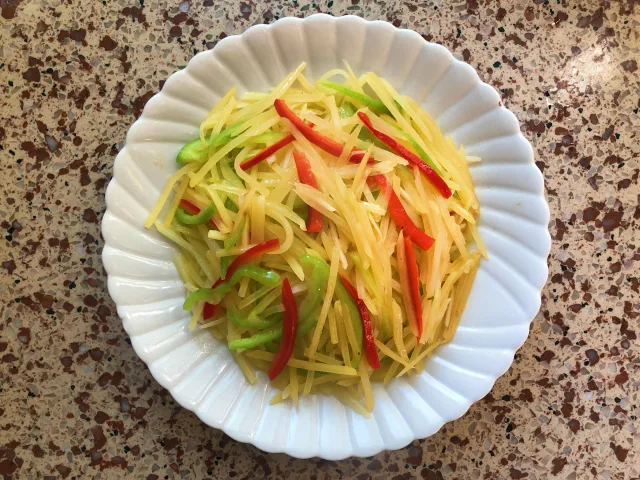
- Stir-Fried Shredded Potatoes
Stir-fried vegetable side dish · Everyday meals with rice
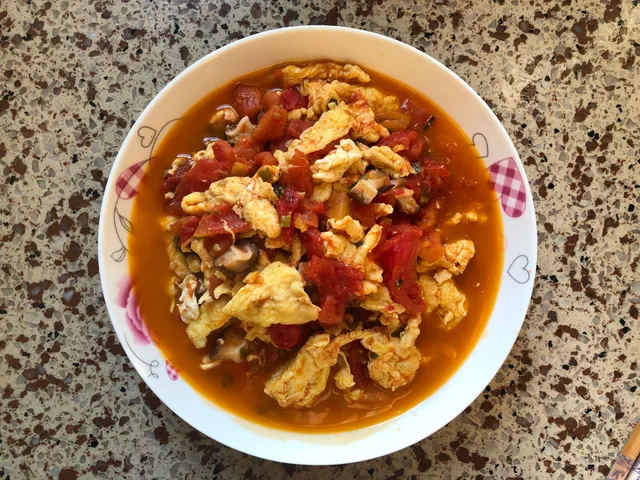
- Tomato and Egg
Home stir-fry · Everyday meals, canteens
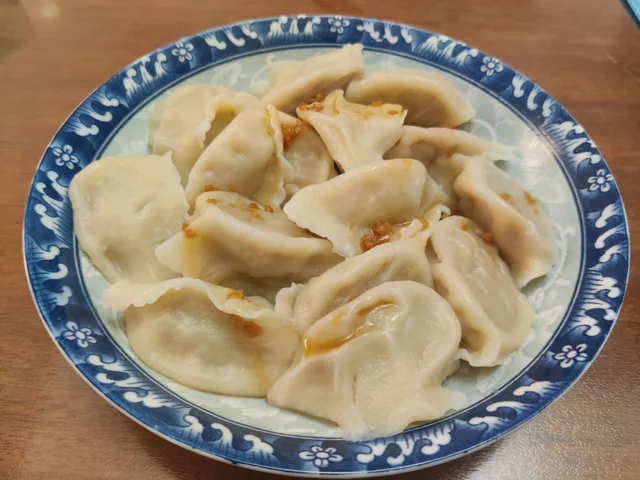
- Jiaozi
Boiled, steamed or pan-fried dumplings · Everyday meals; New Year’s Eve in the north
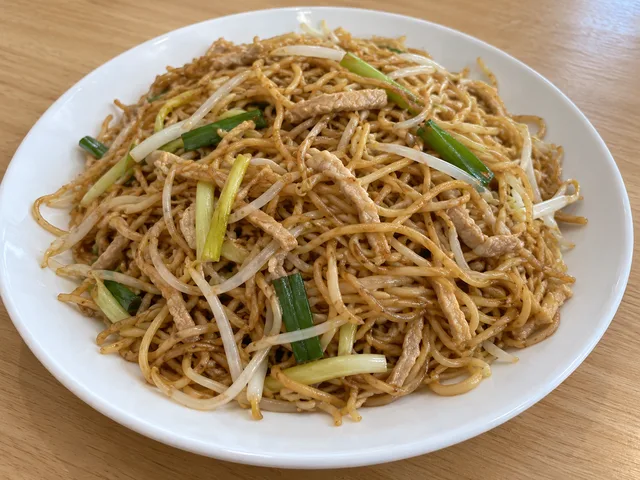
- Chow Mein
Fried wheat noodles · Lunch, late-night meals, takeaway
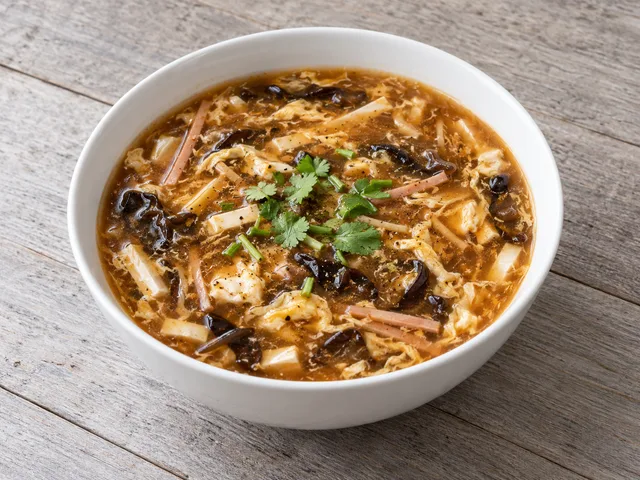
- Hot and Sour Soup
Thickened soup · With dumplings, at banquets
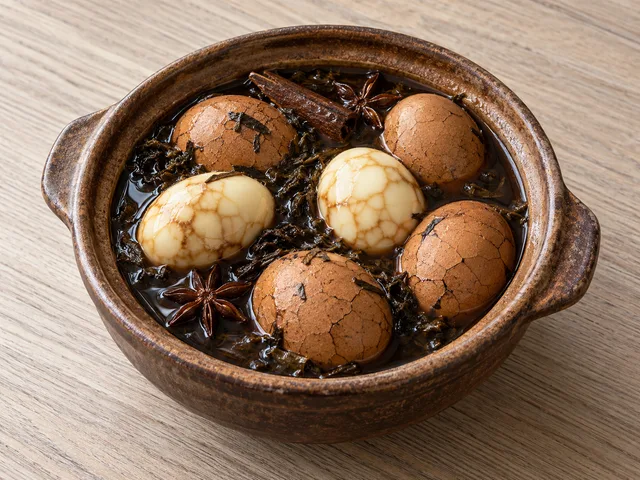
- Tea Eggs
Tea-marbled boiled eggs · Breakfast and snacks
FAQ
Questions about Milk Tea
What is the difference between milk tea and bubble tea?
Milk tea is tea made with milk or creamer. Taiwanese pearl milk tea adds cooked tapioca, while English menus often use bubble tea or boba for a broader category that can include fruit tea and other toppings.
Where did bubble tea originate?
Taiwan in the late 1980s. Chun Shui Tang in Taichung and Hanlin Tea Room in Tainan have competing accounts. The earliest cup and its maker remain disputed.
Are pearls and boba the same thing?
Both can mean tapioca pearls. On menus that distinguish them, such as some 50 Lan menus in Taiwan, 珍珠 are smaller and 波霸 are larger. In English, boba can also mean the finished drink.
What does Hong Kong silk-stocking milk tea taste like?
It has a strong black-tea flavor and a smooth, full body from evaporated milk. The name refers to the cloth bag used to filter the tea.
Is Mongolian milk tea always salty?
Salt is common and the amount varies. Some households leave it out. A restaurant’s shared pot can also include toasted grain, milk skin or air-dried meat.
How do I order pearl milk tea with less sugar?
Ask for half sugar (半糖) or lightly sweetened (微糖) if the shop offers those settings. No added sweetener (无糖 / 無糖) may still leave sweetness from the topping.
Sources
Sources and further reading
- 1 Hu Sihui, Yinshan Zhengyao, vol. 2, “Various decoctions”: chao cha and dairy ingredients (in Chinese)Yuan-dynasty text, Wikisource ↗
- 2 Yujen Chen, “Taiwanese Cuisine and Nationhood in the Twentieth Century,” p. 169 (in Chinese)Modern Chinese Foodways, MIT Press (2025) ↗
- 3 Liu Chi-pang, Wong Kwan-kin and Lo Wai-ling, The Craft of Hong Kong-style Milk TeaChung Hwa Book Co. (Hong Kong), 2023; Lingnan University research record ↗
- 4 Hong Kong intangible cultural heritage stamps: milk-tea technique and the cloth filter (in Chinese)Hongkong Post (2023) ↗
- 5 Debate on local culture, with an explanation of cha zau (in Chinese)Hong Kong Legislative Council (December 19, 2007) ↗
- 6 Mongolian tea traditions: brick tea, milk tea and grain tea (in Chinese)Inner Mongolia Gazetteer, via Ulagai administrative district (2024) ↗
- 7 Chagee’s 2025 annual report: tea lattes and the jasmine green tea latte (in Chinese)Chagee, Form 20-F filed with the U.S. SEC (2026) ↗
- 8 Lan Fong Yuen in Central and its signature silk-stocking milk teaHong Kong Tourism Board ↗
- 9 “The Milk Tea of My Home”: a first-person account of Mongolian milk tea (in Chinese)People’s Daily Overseas Edition (January 6, 2024) ↗
- 10 Xiangpiaopiao’s instant cup milk tea: the 2008 advertisement, the listing and falling results (in Chinese)Caiwen, republished by Jiemian (May 31, 2022, Chinese) ↗
- 11 Xiangpiaopiao opens its IPO subscription: cup milk tea market share, 2014–2016 (in Chinese)Jiemian (November 22, 2017, Chinese) ↗
- 12 “The first milk tea of autumn”: start-of-autumn orders in 2025 (in Chinese)Securities Daily via Xinhua (August 11, 2025, Chinese) ↗
- 13 Quchashan’s cheese and fresh milk tea made with Guizhou Tongren matcha (in Chinese)Xinhua (January 2026) ↗
- 14 Auntea Jenny, founded in Shanghai in 2013, began with freshly cooked grain milk teas: purple glutinous rice, red beans and oats in milk tea (in Chinese)Xinhua (May 2023) ↗
- 15 ChaHalo, founded in Xi’an in 2016, and Guihua Yin, its osmanthus oolong milk tea: nearly 50 million cups in nine years (in Chinese)Xinhua (September 2025) ↗
- 16 Shangshan Hecha opened its first shop on Tongren Street, Kunming, in 2021 and reached Yongkang Road, Shanghai, in early 2025 (in Chinese)Yunnan.cn (May 2026) ↗
- 17 The invention of pearl milk tea: Chun Shui Tang’s account of the trials and launch (in Chinese)Chun Shui Tang ↗
- 18 Hanlin Tea Room’s account: the white pearls at Tainan’s Yamu Liao Market (in Chinese)Yilan Park, National Center for Traditional Arts ↗
- 19 Who invented bubble tea? A reading of the 2006–07 Tainan judgments, with case references (in Chinese)APPI ↗
- 20 Pearl milk tea: Ceylon tea and the shop’s tapioca cooking sequence (in Chinese)Ching Shin Fu Chuan ↗
- 21 Classic pearl milk tea: small pearls, ingredients and three-hour batch window (in Chinese)Chun Shui Tang ↗
- 22 Xindian Minquan branch: pearl, boba and fresh-milk tea delivery menu (in Chinese)50 Lan via Uber Eats, New Taipei (menu checked November 2026) ↗
- 23 Northern Taiwan tea-house pricing: NT$200 for a medium Chun Shui Tang pearl milk tea (in Chinese)Central News Agency (November 1, 2026) ↗
- 24 Hong Kong Intangible Cultural Heritage Inventory, entries 5.36 and 5.37 (in Chinese)Hong Kong Intangible Cultural Heritage Office (2024) ↗
- 25 Christine Cappio, Gweimui’s Hong Kong Story, chapter “Hong Kong-style milk tea” (in Chinese)Commercial Press (Hong Kong), 2016; WeRead edition ↗
- 26 Lan Fong Yuen, Tsim Sha Tsui: a firsthand visit with photographed menu and bill (in Chinese)Wanko Tabigohan (October 18, 2026, Japanese) ↗
- 27 Terminology and classification of freshly prepared tea drinks, T/CCFAGS 027–2021 (in Chinese)China Chain Store & Franchise Association (2021) ↗
- 28 Mixue Group’s prospectus, “Business,” p. 197: ¥6 listed as the typical pearl milk tea price (in Chinese)Mixue Group, filed with HKEX (February 2025) ↗
- 29 Nayuki prospectus: the three generations of Chinese tea shops (“Industry Overview,” p. 130) and its drinks (in Chinese)Nayuki Holdings, filed with HKEX (2021, Chinese edition) ↗
- 30 Guming prospectus: industry timeline, market size and cups per person (p. 120), first store (p. 140) and its drinks (in Chinese)Guming Holdings, filed with HKEX (2025, Chinese edition) ↗
- 31 ChaPanda prospectus: first store in Chengdu (p. 49) and bestselling drinks (in Chinese)ChaPanda, filed with HKEX (2024, Chinese edition) ↗
- 32 Heytea: Royal Tea in Jiangmen, cheese tea and the 2016 renamingWikipedia ↗
- 33 How the classic is made: black tea, creamer, cane sugar, ice and small tapioca pearls (in Chinese)Chun Shui Tang ↗
- 34 Branch menu: boba milk tea and milk tea with smaller pearls (in Chinese)50 Lan, Taipei Changchun branch (Foodpanda) ↗
- 35 Brown sugar milk menu: milk, large or small pearls and cream mousse; tea lattes are listed separately (in Chinese)Tiger Sugar, Carle Place branch ↗
- 36 Brand description of its original boba milk tea: Sri Lankan black tea and large tapioca pearls (in Chinese)A Little Tea (1 Diandian) ↗
- 37 Bo Ya: jasmine-scented green tea and milk, the main ingredients named by the brand (in Chinese)CHAGEE Singapore ↗
- 38 Youlan Latte’s Sri Lankan black tea, milk, whipped cream and pecans; the lighter Shengsheng Oolong (in Chinese)Zhidian Finance interview with Chayan Yuese founder Lü Liang (2020) ↗
- 39 Pp. 7–10: brown sugar bobo milk tea, brown sugar bobo milk, and the grape and cheese series (in Chinese)HEYTEA product brochure, IFE (2024) ↗
- 40 Golden Mountain Pearl Milk Tea: honeyed tea, milk and shop-cooked brown sugar tapioca (in Chinese)Naixue K11 Art Mall branch menu, Hong Kong (Foodpanda) ↗
- 41 Dou Ru Yu Qi Lin: oolong milk tea, ground soybeans and cheese topping (in Chinese)What to Drink, menu listing for ChaPanda ↗
- 42 The namesake milk tea pairs milk with high-mountain tea scented seven times with double-petal jasmine (in Chinese)Molly Tea official product menu ↗
- 43 Purple Rice Milk Tea: purple glutinous rice cooked from a blend of rices, in milk tea; shake before drinking (in Chinese)What to Drink, menu listing for Auntea Jenny ↗
- 44 Founded in Wuhan in 2012 with the Yihe Roasted Milk Tea; the Mint Milk Green Tea series from 2022 (in Chinese)YIHETANG, company profile ↗
- 45 Yihe Roasted Milk Tea: black tea and a house caramel syrup with a faint charcoal-roasted note (in Chinese)What to Drink, menu listing for YIHETANG ↗
- 46 Guihua Yin: osmanthus first, then milk, then a roasted finish (in Chinese)ChaHalo official menu: osmanthus drinks ↗
- 47 Fusheng Banrixian: Jingyang fu brick tea milk tea with a salty-sweet taste (in Chinese)ChaHalo official menu: milk teas ↗
- 48 Butter Ripe Pu’er Latte: seven ripe pu’ers from Lincang, Menghai and Yiwu, milk and butter (in Chinese)What to Drink, menu listing for Shangshan Hecha ↗
- 49 Dianhong Latte: five Yunnan black teas blended with fresh milk (in Chinese)What to Drink, menu listing for Shangshan Hecha ↗
- 50 A Hohhot breakfast with pot tea, lamb buns and camel-meat pie (video, in Chinese)Guangchi Xiaozhuzhu, Bilibili (2024) ↗
Last updated November 2026