
01
Sour from vinegar, hot from pepper
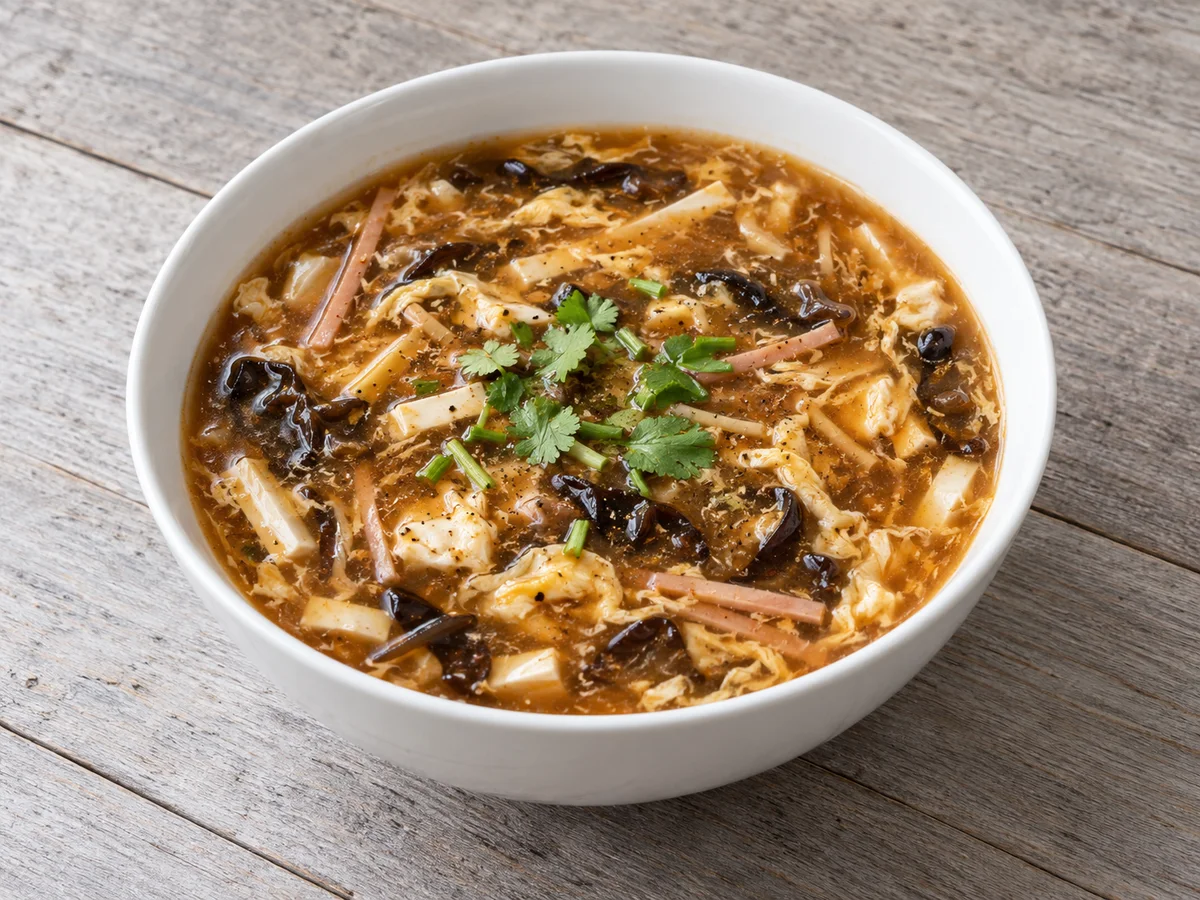
The heat in hot and sour soup comes from white pepper, not chili, and the sourness from vinegar.
Hot and sour soup is a 羹, a thickened soup. A stock or plain water is seasoned with salt, a little sugar and plenty of ground white pepper, then thickened with starch until it will run off a ladle in a long thread; shredded tofu, wood ear fungus, ham or dried shrimp, and often strips of pork blood go in, then vinegar, and finally beaten egg is drizzled through so it sets in ribbons. A few drops of sesame oil and some coriander or scallion finish it.
The pepper is the point. A chef teaching the home version uses two and a half spoonfuls of white pepper for one pot and says plainly that the heat comes from pepper and not from chili, because only pepper can be hot without hurting the stomach. In Fuzhou, the writer Chen Zhou describes white pepper as the gentle, not sharp, spice that local cooks use to suppress fishiness and lift a sour dish, and tastes its heat arriving slowly, after the sourness.
02
A northern restaurant soup that travelled with its cooks
In the first half of the twentieth century, hot and sour soup was what a northern-style restaurant was expected to serve.
Republican-era restaurant guides show the soup on the menus of the Peking- and Tianjin-style restaurants that opened all over China. A Hangzhou guide of the time described Jindeji, a Tianjin restaurant, as selling mainly noodles, boiled jiaozi and guotie, with muxu pork, red-braised pork, fried shredded beef and hot and sour soup as its specialties. In Kunming, a writer of the period found Peking-style restaurants whose liu huangcai, wakuai fish and hot and sour soup were no worse than in Peiping itself. Wherever northern cooks went, the soup went with the dumplings and guotie.
Liang Shiqiu, who grew up in Beijing, remembered a related street soup: after eating a flatbread at a Beijing stall, a bowl of 罐儿汤, “jar soup,” seemed essential. It was close to hot and sour soup, Liang wrote, but neither sour nor hot, with an egg cracked into it, and better still with day-lily buds and wood ear. Decades later, eating at a famous Chinese restaurant in Washington, Liang was disappointed when the first dish was an enormous bowl of hot and sour soup, followed by a half-hour wait for anything else.
03
Fuzhou: the sour soup that wakes up a banquet
Fuzhou times its hot and sour soups for the moment a banquet starts to drag.
Chen Zhou lays out the order of soups at a Fuzhou banquet: first rich or clear soups such as Buddha Jumps Over the Wall or chicken broth with clams; about a third of the way through, Taiping yan with its duck eggs, when the firecrackers go off and the host rises to toast; and then, past halfway, when the diners are full and the palate has gone numb, the hot and sour soups of 鱼唇, “fish lip,” or sea anemone. Last comes a sweet soup to clear the mouth.
For sea anemone soup the anemones are rubbed again and again with salt and vinegar until the slime is gone and the flesh turns crisp, coated in sweet-potato starch and blanched. Ginger and chili are fried in oil, stock goes in with mushrooms and the anemones, then salt and sugar, a sweet-potato starch thickening, rice vinegar, white pepper and coriander. Chen describes the taste in order: a flash of sourness, then the pepper heat seeping through, then a thread of sweetness. Fish-lip soup is made the same way. At home, a Fuzhou cook makes it with shark skin, mushrooms, wood ear, tomato and minced pork, adds vinegar twice, at the start and just before serving, and uses more sugar than most of China would, with pepper again as the only heat.
04
Jiangnan: hot and sour soup in a clay pot, with guotie
In the Yangtze delta, the soup has its own shops.
Shops that sell only hot and sour soup and guotie are rare among the wonton, xiaolongbao and noodle shops of the Yangtze delta, which is why one corner shop stood out to the food writers Zhang Jianping and Gao Feng. The menu was four wooden boards, four items, four prices. A clay pot of hot and sour soup and a plate of five lean-pork guotie came to 25 yuan. The soup was deep orange, with glass noodles, shredded tofu skin and chopped zhacai pickle under a scatter of red diced yao pork and green scallion; neither too thick nor too thin, sour and hot at the same time and faintly sweet at the end, in what the writers called the true Wuxi taste. The guotie were arranged like chrysanthemum petals. The writer, who had walked past for years without going in, resolved to come back.
The cooking channel Chinese Cooking Demystified goes further and thinks the hot and sour soup served all over Taiwan probably came from Wuxi, while pointing to older relatives in Henan’s hulatang and in a Shandong version. Even in Wuxi the soup is not fixed: some shops stir egg into it and some do not.
05
The Wuxi bowl: beef broth and day lilies
One well-documented version starts with a pot of beef shank.
The Wuxi recipe published by Chinese Cooking Demystified makes 1.4 liters of broth from 500 g of beef shank, simmered with star anise, Sichuan peppercorn, white peppercorn, ginger, scallion and Shaoxing wine. The writers mention some evidence that the soup was first made by Wuxi’s Muslim community, which would explain the beef, and they note that such a version would not have had the wine. Into the broth go 20 g of dried day lilies, 5 g of dried shiitake, 5 g of wood ear and 35 g of sweet potato noodles, all soaked in cool water for about two hours, then 250 g of soft tofu and a sheet of 千张, pressed tofu skin. About 6 tablespoons of potato starch in half a cup of water thickens the pot.
Of all this, only the day lilies and shiitake are treated as essential; everything else can change with what a kitchen has. The same writers add that a soup so familiar on takeout menus abroad is not especially common across mainland China and is popular only in pockets.
Sources [7]
06
Why foreign diners order it
Hot and sour soup is one of the few Chinese soups Western diners order on their own.
Fuchsia Dunlop observes that Chinese restaurants abroad make slow-simmered clear soups of poultry, vegetables and tonic herbs, but Western customers rarely order them: the good ingredients are invisible and the flavour seems thin. They choose chicken and sweetcorn soup or a steaming hot and sour soup instead, where the richness and the ingredients are obvious on the tongue. Dunlop adds a cook’s point: a stock of MSG and bouillon powder can just about pass once it is made into hot and sour soup, whose vinegar and pepper cover a lot, but not in a pure, clear soup where nothing can hide. That robustness is part of why the soup travels, and why, as Liang Shiqiu found in Washington, it was often the first thing on the table.
In the United States the soup was in print by the early 1960s. The word historian Barry Popik found it in the New York Herald Tribune in March 1961, as the first lesson of a Chinese cooking class, and in 1965 Craig Claiborne printed a full recipe for it in The New York Times. Joyce Chen, who opened a Mandarin restaurant in Cambridge, Massachusetts, in 1958, is often said to have introduced it, but Popik found no record that she served it under that name at the time.
07
Craig Claiborne’s 1965 recipe
The recipe printed in The New York Times was gentle by Chinese standards.
Craig Claiborne’s 1965 recipe for The New York Times used four cups of chicken broth, dried tree ears and mushrooms, eight tiger-lily buds, bamboo shoots, shredded pork, bean curd and an egg, thickened with two tablespoons of cornstarch. Most of that would be familiar in Wuxi or Beijing. The seasoning would not: wine vinegar in place of a Chinese vinegar, and a quarter teaspoon of black pepper, far less than the spoonfuls of white pepper in a Chinese home version.
By the 1970s the soup was a fixture of Manhattan menus. New York magazine priced a bowl at 85 cents in 1971, and in 1980 Claiborne named hot and sour soup and moo shu pork as undoubtedly the two best-known dishes using tree ears.
Sources [6]
08
How to make it at home
A chef’s method for one pot, with the reasons for each step.
For 3 to 4: a small block of firm tofu and one of pork blood, both cut into fine strips; a handful of soaked wood ear, shredded; a little ham or cooked sausage in strips; a thumb of ginger, shredded; a few leaves of greens, shredded; 3 eggs, beaten; 20 g dried shrimp; 2½ tablespoons ground white pepper; salt, a little sugar, starch slurry, vinegar, sesame oil, coriander or scallion.
- 1. Blanch the soft things
Boil salted water and blanch the tofu and pork blood for 20 seconds so they firm up and do not break in the soup; drain.
- 2. Season the broth
Bring fresh water or light stock to the boil. Salt it more than seems right, because vinegar will mute the salt, then add a little sugar and the white pepper.
- 3. Thicken off the heat
Take the pot off the heat and stir in starch slurry until the soup runs off a ladle in a long thread, about 20 cm.
- 4. Add the shreds and vinegar
Return to the heat with the wood ear, ham, ginger and dried shrimp; when they are cooked, add vinegar to taste.
- 5. Ribbon the egg
Pour in the beaten egg in a thin stream and stir in slow circles, not back and forth, so it sets in ribbons.
- 6. Finish
Add the tofu, blood and greens, bring back to the boil, then a few drops of sesame oil and a scatter of coriander or scallion.
Tofu, pork blood and the other shreds can change with what you have; the egg should not be left out.
Sources [8]
09
Hot and sour soup around China
The name stays the same; the bowl does not.
| Where | What goes in | What to know |
|---|---|---|
| Peking- and Tianjin-style restaurants | The house thick soup | A standard beside jiaozi and guotie |
| Fuzhou banquets | Sea anemone or “fish lip” with mushrooms | Served past halfway to wake the palate; sweeter |
| Jiangnan shops | Glass noodles, tofu skin, zhacai, yao pork | In a clay pot, with guotie; slightly sweet |
| Home kitchens | Tofu, pork blood, wood ear, egg, dried shrimp | Heat from white pepper, not chili |
| Chinese restaurants abroad | Plenty of visible ingredients | Ordered far more than clear soups |
10
More on the atlas
Related soups and the dishes it is eaten with.
Xi’an meatball hulatang
A peppery thickened soup from the northwest, with meatballs.
Read about hulatang →Jiaozi
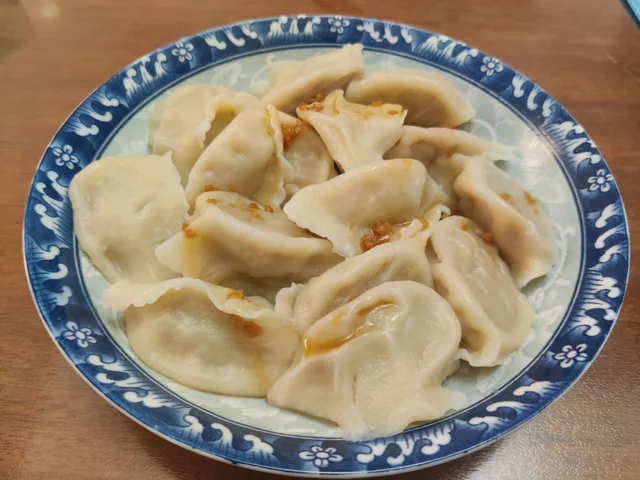
Dumplings and guotie, the soup’s usual partners in northern restaurants.
Read about jiaozi →Egg drop soup
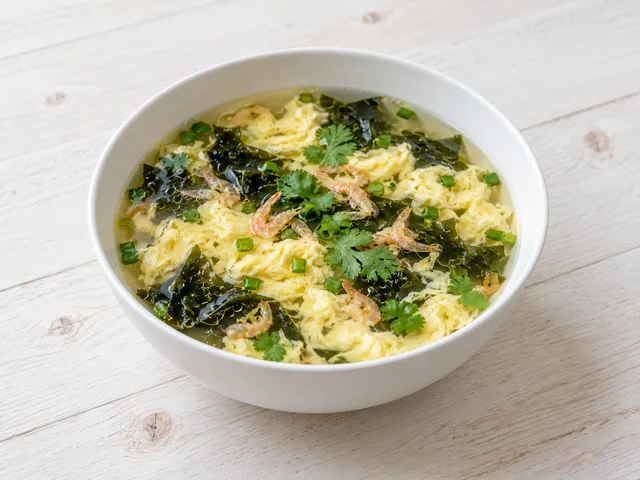
Another everyday soup: egg flowers in a light broth.
Read about egg drop soup →Food guides
Comparisons and first steps in Chinese food.
Browse the guides →Across China classics
- Egg Drop Soup
Light egg soup · With any everyday meal
- Jiaozi
Boiled, steamed or pan-fried dumplings · Everyday meals; New Year’s Eve in the north
- Chow Mein
Fried wheat noodles · Lunch, late-night meals, takeaway
- Tea Eggs
Tea-marbled boiled eggs · Breakfast and snacks
- Stir-Fried Shredded Potatoes
Stir-fried vegetable side dish · Everyday meals with rice
- Wonton
Wontons in broth · Breakfast to late night
Soups and stews from other regions
FAQ
Questions about Hot and Sour Soup
What is hot and sour soup?
A thick Chinese soup made sour with vinegar and hot with white pepper, with tofu, wood ear, egg and often pork blood.
Where does the heat come from?
White pepper, not chili; cooks say pepper heats without hurting the stomach.
Which region is hot and sour soup from?
None in particular. It was a standard of Peking- and Tianjin-style restaurants, and Fuzhou and Jiangnan have their own versions.
Why is hot and sour soup thick?
It is thickened with starch, traditionally until it runs off a ladle in a long thread.
What vinegar is used?
Rice or dark vinegar, added near the end so its aroma stays; some cooks add it twice.
What is the difference between hot and sour soup and hulatang?
Hulatang is a peppery thickened soup eaten for breakfast; hot and sour soup is defined by vinegar as much as by pepper.
What is Fuzhou fish-lip hot and sour soup?
A banquet and home soup made with shark skin, mushrooms and vinegar, sweeter than most versions.
Is there meat in hot and sour soup?
Often: pork blood, ham or shredded pork; ask if you need it meat-free.
What do you eat with hot and sour soup?
Jiaozi or guotie in the north and Jiangnan; at a Fuzhou banquet it comes between the dishes.
How much does it cost?
In a 2025 book, a Jiangnan shop charged 25 yuan for a clay pot of soup and five guotie.
Can hot and sour soup be vegetarian?
Yes. Leave out the pork blood, ham and dried shrimp, and use water or the soaking liquid from dried shiitake. Check whether the egg suits you.
What are the day lilies in hot and sour soup?
Dried day lily buds, 黄花菜, soaked for about two hours. Chinese supermarkets abroad sell them, sometimes as tiger-lily buds.
Sources
Sources and further reading
- 1 Zhou Songfang, Yinshi Jianghu (饮食江湖): chapters on Peking- and Tianjin-style restaurants in Kunming, Hangzhou and Suzhou (in Chinese)Zhonghua Book Company (2026)
- 2 Liang Shiqiu, Yashe Tan Chi (雅舍谈吃): essays on Beijing street food and on Chinese restaurants in America (in Chinese)China Women’s Publishing House (2019 edition)
- 3 Chen Zhou, Min Wei’er (闽味儿): the chapters on Fuzhou banquet soups and sweet-and-sour dishes (in Chinese)SDX Joint Publishing (2021)
- 4 Zhang Jianping and Gao Feng, Chichi Baixiangxiang (吃吃白相相): the essay “The hot and sour soup on the corner” (in Chinese)Sichuan Literature and Art Publishing House (2025)
- 5 Fuchsia Dunlop, Invitation to a Banquet, Chinese edition Jun Xing Shi (君幸食): chapters on soup and on ingredients (in Chinese)Shanghai Translation Publishing House (2024)
- 6 Hot and Sour Soup: historical citationsBarry Popik, The Big Apple (2010) ↗
- 7 Hot and sour soupChinese Cooking Demystified (2024) ↗
- 8 A chef’s home hot and sour soup: tofu, pork blood, wood ear, egg, white pepper and a thread-thick broth (video, in Chinese)Mei Shi Zuo Jia Wang Gang (美食作家王刚R), Bilibili (2021) ↗
- 9 Fuzhou hot and sour “fish lip” soup with shark skin, vinegar twice and plenty of sugar (video, in Chinese)Li Li Jie De Chu Fang (丽丽姐的厨房), Bilibili (2021) ↗
Last updated November 2026