
01
Thirty ingredients in a wine jar
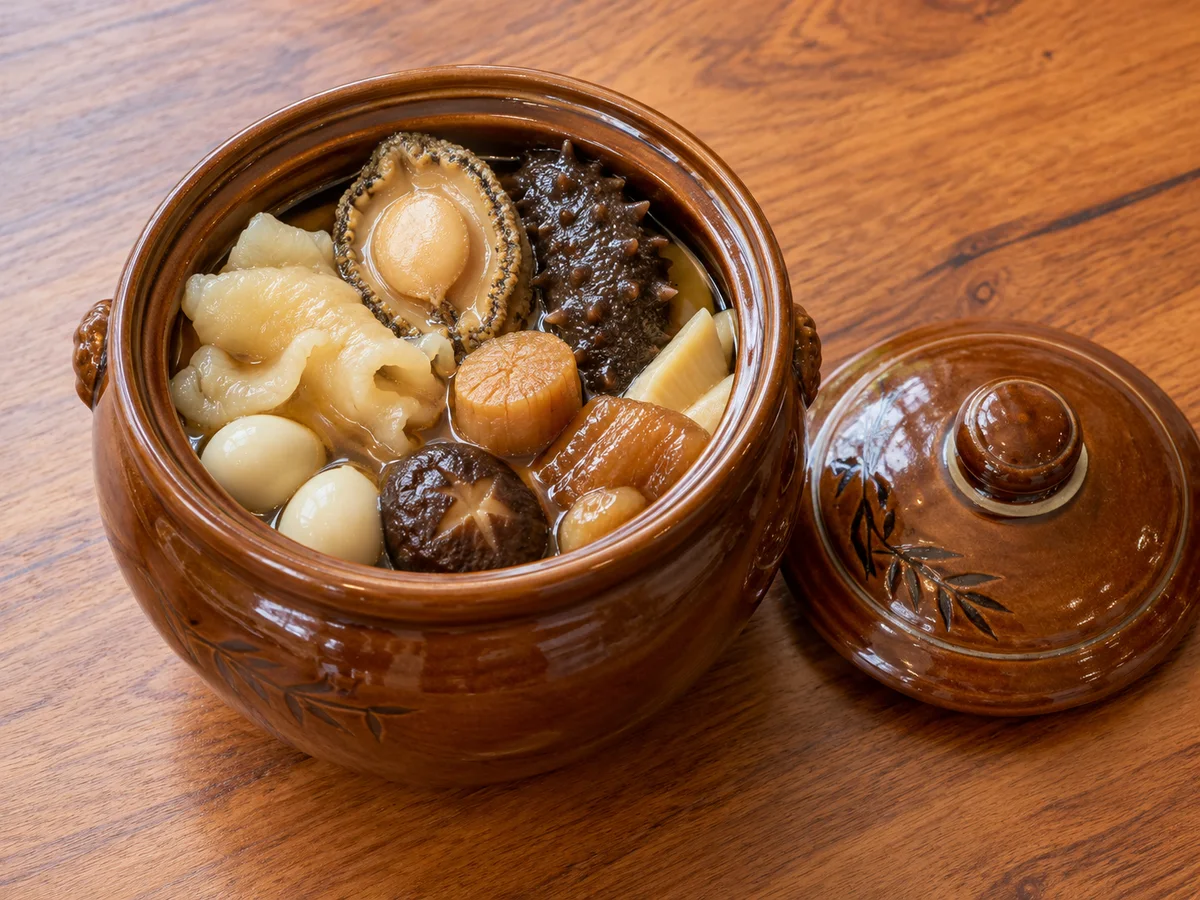
Buddha Jumps Over the Wall is the one dish that stands for Fujian cooking: a jar of luxury dried seafood and slow-cooked meat in a thick, wine-scented stock.
Fujian cooking, and above all the cooking of its capital Fuzhou, is usually light: clear soups, quick stir-fries, sweet-and-sour sauces. Fotiaoqiang is the exception. The Fuzhou writer Chen Zhou compares the cuisine to a watercolor and this dish to a lacquer painting, heavy in color but restrained. Close to thirty ingredients go into one jar: dried sea cucumber, abalone, fish maw, dried scallops and shark fin, together with tendons, turtle skirt, pork tripe, pigeon eggs, winter bamboo shoots and dried mushrooms, over a base of pork trotters, chicken and duck. They are prepared separately, packed into a jar in layers, covered with stock and old Shaoxing rice wine, sealed with a lotus leaf and simmered over a low flame for hours. When the jar is opened, the smell of wine and seafood fills the room.
It is the most decorated dish in the province. It won a national quality award from the Ministry of Commerce, has been served at state banquets to Norodom Sihanouk, Ronald Reagan and Queen Elizabeth II, and the technique as practiced at Juchunyuan was added to China’s national list of intangible cultural heritage in 2008. A recent CCTV heritage series called it the pinnacle of Fuzhou cuisine.
02
From “fortune and longevity” to a leaping monk
Every account agrees on a late-Qing Fuzhou official’s kitchen and a cook named Zheng Chunfa. The details vary.
The version remembered by Juchunyuan’s old cooks, as Chen Zhou records it, is set in the Guangxu reign, around the 1870s. An official giving a dinner for Fujian’s provincial judge, a famous gourmet, wanted something new and put a woman of the household, a native of Shaoxing, in charge. She packed several kinds of meat and soaked dried seafood into a Shaoxing wine jar and simmered it. The judge was delighted. His own cook, Zheng Chunfa, learned the dish, called it 福寿全 (fushouquan), “fortune and longevity complete,” and improved it: pork trotters and lamb hock at the bottom, then tripe, chicken, duck, mushrooms, bamboo shoots and cuttlefish, and on top shark fin, abalone, sea cucumber, fish maw and scallops, with cassia, fennel, ginger and star anise, bone stock and Shaoxing wine, all sealed with a lotus leaf and simmered over charcoal. The MICHELIN Guide tells it slightly differently: the man who tasted it was the provincial administrator Zhou Lian, who had his kitchen master Zheng refine an official’s stew. The Fujian government calls Zheng the dish’s creator.
The new name came at a gathering of scholars: when the jar was opened, one of them made up a couplet saying that when the jar opens the smell drifts to the neighbors, and a Buddha would give up meditation and jump the wall. Zheng later became a partner in a restaurant called Sanyouzhai and, in the early twentieth century, made it his own as Juchunyuan, at Dongjiekou in central Fuzhou, which still claims the dish. Some cooks add that fushouquan and fotiaoqiang sound alike in Fuzhou dialect, but not all Fuzhou speakers agree.
The name can still cause trouble. In January 2014 a hot pot restaurant in Jinan advertised the dish with giant sculptures of naked Buddhas climbing its wall. Pictures spread online, Buddhists objected, and NPR, citing Xinhua, reported that the statues had been destroyed.
03
What goes into the jar
The ingredients fall into two groups: the meats that make the stock, and the luxuries that sit on top.
One Fujian master explains the dish as eight things melted into a stock and ten displayed on top, eighteen in all, like the eighteen arhats of Buddhist temples. Chen Zhou lists what top kitchens choose today: Kanto sea cucumber from Japan, golden shark fin from South America, deep-sea fish maw from Vietnam, dried abalone from Australia, Japanese dried scallops, farm-raised trotters, chickens and ducks, top-grade flower mushrooms and aged Huadiao Shaoxing wine. Dried seafood is preferred to fresh because drying turns its proteins into savory amino acids and nucleotides, so the dried versions taste stronger.
| Group | Ingredients | What they do |
|---|---|---|
| Stock meats | Pork trotter tips, pork tail bones, chicken, duck, chicken feet | Simmered for two days into a thick, sticky stock |
| Luxury seafood | Sea cucumber, abalone, fish maw, dried scallops, shark fin, fish lips, turtle skirt | Soaked for days, added late so they keep their shape |
| Supporting pieces | Pork tripe, cuttlefish, pigeon eggs, pork tendons | Texture and extra savoriness |
| Vegetables | Winter bamboo shoots, flower mushrooms | Crunch and an earthy note |
| Liquid and seasoning | Stock, aged Huadiao wine, soy, rock sugar, star anise, cassia | The amber color and the smell of wine |
04
Eight days of soaking, a day of layering
A proper jar has to be ordered days ahead, because most of the work happens before anything goes into it.
Dried abalone and shark fin are soaked in warm water for seven or eight days. Sea cucumber is soaked for two or three days, gutted, brought to a boil and simmered for half an hour, left to cool in the water, then soaked for two more days. Fish maw is soaked for five or six hours and blanched; dried mushrooms are soaked in water at about 70°C. Pork tendons are puffed in oil: soaked in cold oil, warmed, fried golden, then simmered and soaked in water, twice. Everything is cut into pieces the size of mahjong tiles. Two days ahead, duck, chicken feet, trotter tips and tail bones are simmered with soy, rock sugar, wine, milky stock and spices into a gelatinous base. One master makes the stock in three stages: a milky stock simmered eight hours with fried crucian carp, a clear stock after the wine is added and its alcohol burned off, and a golden stock once the fat has been lifted off cold.
Cooks learned not to put everything in together: shark fin masked the poultry, cuttlefish masked the shark fin, sea cucumber dissolved when cooked with fatty trotters, and fin and maw shrank when salted. Now each ingredient is cooked on its own and they go into the jar in a fixed order. A bamboo rack goes in the bottom, then halved trotter tips bone side down, then tripe, cuttlefish, pigeon eggs, bamboo shoots and mushrooms. The strained stock and old Huadiao wine are poured over, the jar is brought to a boil and simmered gently for an hour. Then shark fin, held flat in a bamboo rack, and scallops and abalone wrapped in muslin go in; the mouth is sealed with a lotus leaf and the lid put on upside down, and it simmers for two hours. Last come sea cucumber, tendons, fish lips, fish maw and turtle skirt, and the jar is sealed again for a final hour. The jar itself began as a Shaoxing wine jar, wide in the belly and narrow at the mouth, so it holds heat and smell.
05
From a pushcart jar to a fist-sized pot
How the dish reaches the table has changed more than what is in it.
It used to be wheeled out on a little cart in its big jar, opened in front of the guests and tipped out, luxuries and stock meats together, into one great bowl. It smelled wonderful and looked like a stew. In the 1980s Juchunyuan’s chefs moved the opening to the kitchen: the best pieces are taken out and arranged in small jars about the size of a fist, filled with the stock, steamed and served one to each guest. That change made it fit for state banquets, and it is how Juchunyuan serves it today.
Even in Zheng Chunfa’s day some diners found it too rich, so it came as the center of a whole banquet: eight small dishes, two pastries, a sweet soup and fruit, mixing sweet and sour flavors and vegetables. In 2002 Juchunyuan’s Buddha Jumps banquet was named a “China famous banquet” by the China Cuisine Association; its menu includes wine-lees chicken, drunken crab, red-lees eel, sesame flatbread and a sweet bird’s-nest soup. People in Fuzhou also tear 光饼 (guangbing), a small ring-shaped baked bread, into the broth, and finish the meal with jasmine tea to clear the palate.
06
What a good one tastes like
Fuzhou cooks judge it on three things: the look of the pieces, the body of the stock and the texture in the mouth.
Glossy pieces
Each ingredient should be translucent and shiny, as if coated in a thin glaze.
A sticky stock
The stock should be full and gelatinous enough to make your lips stick together, amber-brown and smelling of wine.
Soft but whole
Sea cucumber springy, abalone tender with a little bite, fish maw soft and sticky, nothing falling apart.
Rich, not greasy
Too much star anise or cassia turns it into red-braised pork; wine not cooked off properly makes it sour.
07
Tanshao bawei and the street-stall jars
Most people in Fuzhou have eaten something called Buddha Jumps; fewer have eaten the real thing.
From the 1990s, banquets in Fujian often served 坛烧八味, “jar-cooked eight flavors”: chicken and duck pieces, duck gizzards, tripe, trotter tips, cuttlefish, scallops and mushrooms, topped with a tuft of glassy imitation shark fin that diners nicknamed “Shandong vermicelli.” Many Fuzhou people took it for fotiaoqiang. Chen Zhou calls it a distant country cousin, not even of the same family. Street stew-pot stalls still sell small jars under the name, often with a lid shaped like the laughing Maitreya Buddha, a style that only appeared in the 1990s: in 2024 one charged 37 yuan for a pot of chicken, gizzards, tendons and mushrooms, and in 2026 a stall sold a 28-yuan pot of pork bone, tripe, quail eggs, mushrooms, duck and razor clams that smelled strongly of rice wine. They are good soups, but a different dish.
08
Where to eat it in Fuzhou, and what it costs
Prices for a single serving in Fuzhou run from under thirty yuan to nearly eight hundred.
Juchunyuan is the place for the dish’s history. In 2026 its supreme Buddha Jumps cost 798 yuan for one person’s jar of sea cucumber, abalone, fish maw, shark fin, scallops, flower mushrooms and tendons, with a 498-yuan version, and it needed ordering ahead. The same menu had the other famous Fuzhou banquet dish, clams poached in chicken broth, at 68 yuan, red-lees conch slices at 270 and lychee pork at 58. In 2024 a local favorite charged 159 yuan for a jar with sea cucumber, abalone and pigeon eggs, and a Black Pearl restaurant served it in ten-course set menus at 598, 798 and 1,288 yuan.
| Where | What you get | Price |
|---|---|---|
| Street stew-pot stall, 2026 | A pot of pork bone, tripe, quail eggs, duck, razor clams | 28 yuan |
| Street shop, 2024 | A small pot of chicken, gizzard, tendon and mushrooms | 37 yuan |
| Popular local restaurant, 2024 | Sea cucumber, abalone, pigeon eggs, fish maw | 159 yuan |
| Juchunyuan, 2026 | Supreme jar for one, ordered ahead | 498 or 798 yuan |
| Black Pearl restaurant, 2024 | Ten-course set menu built around the jar | 598–1,288 yuan |
09
Cantonese, Taiwanese and Michelin versions
The dish has traveled, and each place has changed it.
The Fujian style keeps a chicken-and-duck stock and a glossy, amber-brown broth scented with Shaoxing wine. Cantonese restaurants build theirs around abalone sauce. Taiwanese versions, a fixture of the New Year table there, add fried taro, fried pork ribs and quail eggs. Restaurants in the MICHELIN Guide have turned it into a clear consommé, a stir-fry and a jar that takes a week to prepare and eight hours to simmer. In Fujian itself, cooks have made mushroom versions, replaced the trotter-and-chicken-foot stock with a clear one, and cut back the wine. In Fujian and Taiwan it is still above all a dish for year-end family dinners.
10
More Fuzhou dishes
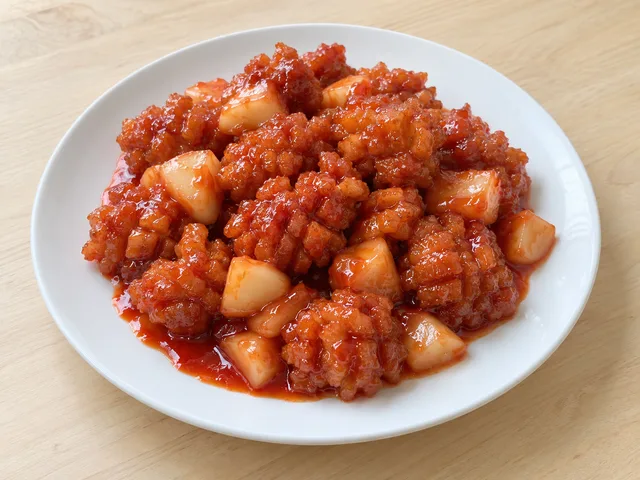
Lychee pork
Fuzhou’s sweet-and-sour pork, cut and fried to look like lychees.
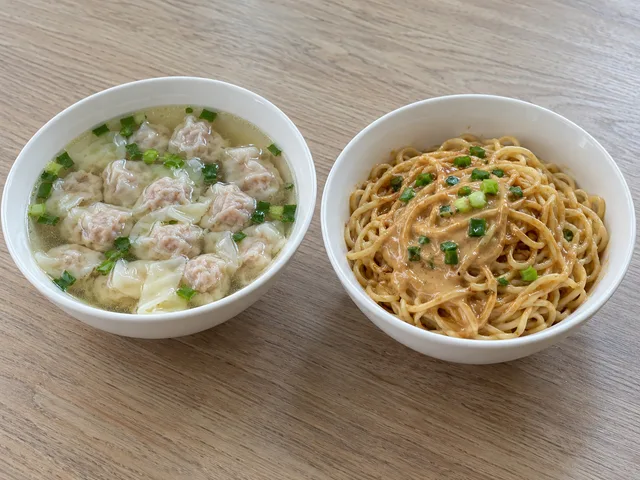
Read about lychee pork →Shaxian wontons and peanut noodles
Fujian’s most famous everyday snack, from a mountain county.
Read about Shaxian snacks →Beijing roast duck
Another banquet centerpiece with a restaurant that claims it.
Read about Beijing roast duck →Fujian classics
- Shaxian Bianrou and Banmian
Wontons and tossed noodles · Any meal, often late at night
- Lychee Pork
Sweet-and-sour fried pork · Family meals and banquets
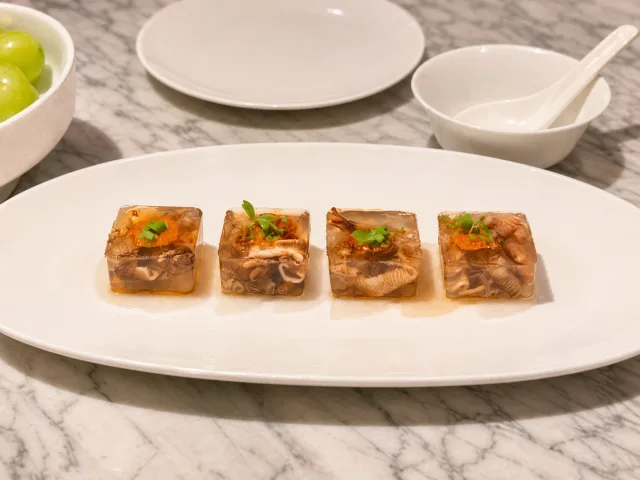
- Tusundong (Sea Worm Jelly)
Cold seafood jelly · Snack, summer evenings
FAQ
Questions about Buddha Jumps Over the Wall
What is Buddha Jumps Over the Wall?
A Fuzhou banquet soup: sea cucumber, abalone, fish maw, scallops, shark fin and other dried seafood layered over pork, chicken and duck in a wine jar with stock and Shaoxing wine, sealed and simmered for hours.
Why is it called Buddha Jumps Over the Wall?
From a couplet made up when the jar was opened at a scholars’ gathering: the smell would make a Buddha give up meditation and jump the wall. Its earlier name was fushouquan, “fortune and longevity complete.”
Who invented Buddha Jumps Over the Wall?
Accounts credit Zheng Chunfa, a Fuzhou official’s cook in the Guangxu reign, who refined a jar dish first made in an official’s household and later served it at his restaurant, Juchunyuan.
How long does it take to make?
About a week in all: seven or eight days to soak the dried seafood, two days for the stock and several hours of layered simmering in the jar.
How much does Buddha Jumps Over the Wall cost?
In Fuzhou, from 28–37 yuan for a street-stall pot to 159 yuan at a popular restaurant and 498–798 yuan for one person at Juchunyuan (2024–2026).
What does it taste like?
Rich, savory and wine-scented, with a thick, sticky amber stock and soft, glossy pieces of seafood, meat and mushroom.
Does it contain shark fin?
The classic recipe does. Many versions today leave it out or use imitation fin, and street versions use none.
Is it the same as tanshao bawei?
No. Tanshao bawei is a cheaper banquet jar of poultry, offal and a little seafood that many people mistake for it.
How is it served?
In a small individual jar, a change Juchunyuan made in the 1980s; it used to be wheeled out in one big jar and tipped into a bowl.
What do you eat with it?
Guangbing, a small ring of baked bread, to dip in the broth, and jasmine tea afterwards.
Sources
Sources and further reading
- 1 Chen Zhou (沉洲), Min Wei’er (闽味儿), chapters “A legend: mountains and seas meeting in a wine jar,” “Chinese red in the scent of wine” and the preface (in Chinese)SDX Joint Publishing (2021)
- 2 Fuzhou’s iconic dish showcases rich culinary heritage: Juchunyuan fotiaoqiang and its eighth-generation inheritorChina Daily, on the Fujian Provincial People’s Government English site (2025) ↗
- 3 Buddha Jumps Over the Wall at MICHELIN restaurants: tradition meets modern creativityJenna Yang, MICHELIN Guide (2026) ↗
- 4 Om My: Chinese Buddha Booted Over Booty: the Jinan restaurant’s wall sculpturesKrishnadev Calamur, NPR (2014) ↗
- 5 Juchunyuan, where the dish was born: the supreme Buddha Jumps at 798 yuan, chicken-broth clams and lychee pork (video, in Chinese)Te Chu Wei Wei (特厨魏味), Bilibili (2026) ↗
- 6 Buddha Jumps in Fuzhou at 37, 159 and 798 yuan: a street pot, a local favorite and a Black Pearl set menu (video, in Chinese)Dan Niu Shi Zou Qi (丹牛食走起), Bilibili (2024) ↗
- 7 A 28-yuan street Buddha Jumps at a Fuzhou stew-pot stall (video, in Chinese)Ye Wen Bu Dong Chi (野文不懂吃), Bilibili (2026) ↗
- 8 A Fujian master chef’s Buddha Jumps: eighteen ingredients, three days and three stocks (video, in Chinese)Da Shi De Cai (大师的菜), Bilibili (2020) ↗
Last updated November 2026