
01
Egg flowers in broth
Egg drop soup is named for what the egg does: poured into hot broth, it opens into “flowers.”
The Chinese name is plain description. 蛋花 means “egg flowers,” the soft petals and threads that form when beaten egg meets hot liquid, and 汤 is soup. There is no fixed recipe beyond that. The broth may be stock or simply boiled water seasoned in the bowl; the egg may be one or two for a whole family; and what goes with it depends on the season and the cupboard.
Fuchsia Dunlop describes the place of soup at a Chinese meal as the equivalent of a glass of water or wine at a Western one, and pictures a light vegetable soup in which, freed from gravity, clusters of greens, slices of tomato and wisps of golden egg float like a three-dimensional abstract painting. Egg drop soup is the humblest version of that idea: two eggs make a whole basin of it for about two yuan. It is the soup of school canteens, quick weekday dinners and the end of a cheap restaurant meal, which is also why few people think of it as a dish at all.
02
The one thing to get right
Good egg flowers depend on the temperature of the broth at the moment the egg goes in.
If the broth is boiling hard, the egg seizes into small tough curds; if it is too cool, the egg clouds the soup. Cooks agree on the fix even when they differ on details. The usual method is to bring the water to the boil, turn the heat to its lowest or off, wait until the bubbling stops and only then pour in the egg. Then they pour slowly in a circle, push the soup gently in one direction rather than stirring, and do not let it boil again, because that turns the flowers hard.
Two smaller tricks are common. A spoonful of starch slurry beaten into the egg makes the flowers tender and keeps them from sinking, and a drop of white vinegar takes away any eggy smell. In Dongbei, where the soup is called 甩袖汤, “sleeve-flicking soup,” the aim is egg flowers that are big and thin.
03
Why a pot off the boil still cooks the egg
Egg sets at a far lower temperature than most cooks expect.
Harold McGee gives the numbers: egg white begins to thicken at about 63°C and is a tender solid at 65°C, yolk thickens at 65°C and sets at 70°C, and the two beaten together set at around 73°C. Broth that has just stopped boiling is still far hotter than that, so turning off the heat costs nothing. The egg sets in seconds, and the calm surface lets the threads spread instead of being torn apart. Starch helps for a chemical reason too: dissolved in the egg, it gets between the proteins and keeps them from clenching into hard curds.
America’s Test Kitchen gets there another way: it stirs the starch into the pot rather than the egg, using 2 tablespoons of cornstarch for 2 quarts of stock, because in a thin broth the ribbons sink. The egg goes in over almost a minute, then sits undisturbed for 30 to 60 seconds. Starch thickening also weakens if simmered for long, which is one reason this soup is made at the last moment and cannot be kept hot.
04
The egg drop soups of China
Almost anything can be paired with egg flowers, but a handful of versions are eaten everywhere.
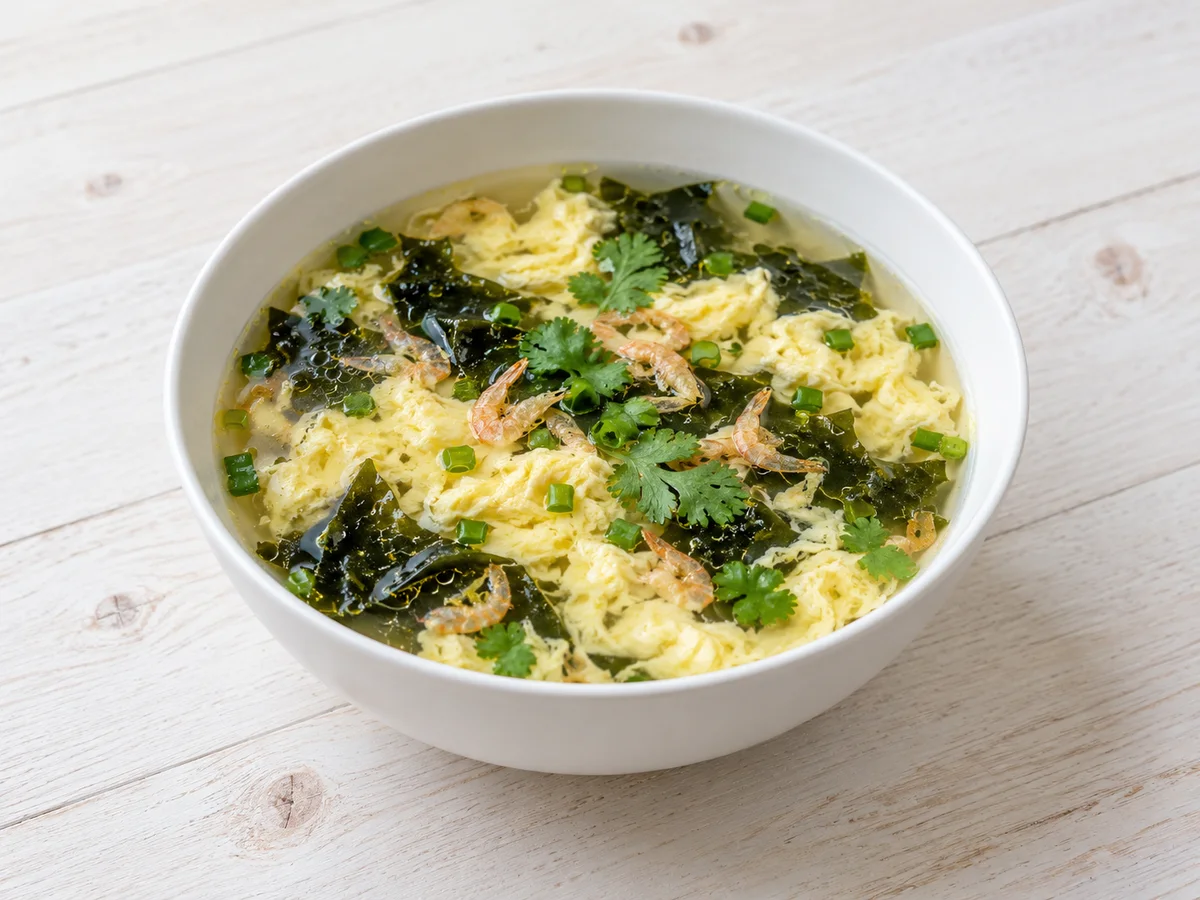
The commonest is seaweed and egg, 紫菜蛋花汤: dried laver, tiny dried shrimp, scallion and coriander, salt, white pepper and sesame oil put into the serving bowl, the egg flowers poured over. Tomato and egg soup is just as universal, the soup counterpart of tomato and egg stir-fry, with the tomato simmered first so the broth turns pink and slightly sweet-sour.
| Soup | Where | What goes in |
|---|---|---|
| 紫菜蛋花汤 seaweed and egg | Everywhere, homes and canteens | Dried laver, dried shrimp, scallion, coriander, white pepper, sesame oil |
| 西红柿鸡蛋汤 tomato and egg | Everywhere | Tomato simmered soft, a little starch, salt and white pepper |
| 番茄榨菜蛋花汤 tomato, pickle and egg | Jiangnan homes | Tomato with salty pickled mustard tuber |
| 甩袖汤 shuaixiu soup | Dongbei | Big, thin sheets of egg, often with tomato |
| 枸杞蛋花汤 goji and egg | Shanghai restaurants | Goji berries, a light soup after rich dishes |
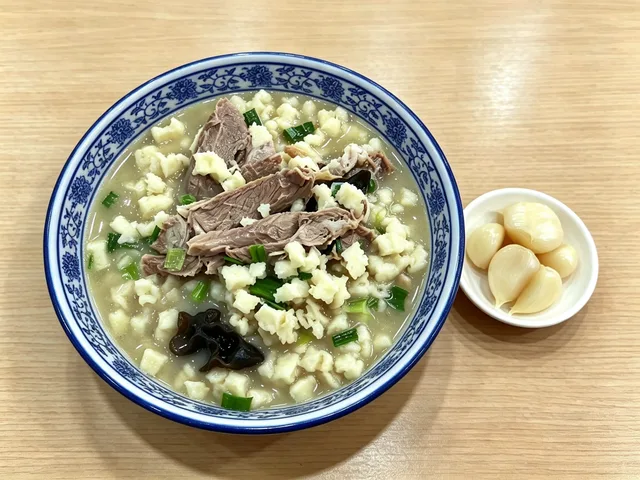
| 片儿汤 pianr tang | Kunming, northern-style noodle shops | Cabbage, egg flowers and torn dough pieces |
| 果儿汤 guo’er tang | Tianjin restaurants | Shredded pork with egg drop soup |
| 酒酿圆子 jiuniang yuanzi | Jiangnan | Sweet: rice wine, small glutinous balls, egg flowers, osmanthus |
05
Egg flowers in older kitchens
Writers who remember Republican-era restaurants mention egg flowers as the light touch at the end of a meal.
Tang Lusun found the soups of Shanghai’s local restaurants either the pork-and-bamboo yanduxian or a shredded-pork broth, both heavy and oily. A diner who knew how to eat, Tang advised, would finish a meal of fish and meat with a goji and egg drop soup, or an amaranth soup with wine lees, “light and refreshing, all the grease gone.” In Beijing, Tang remembered egg flowers in a different role: the meat-slice sauce ladled over breakfast tofu pudding was pork stock with day lilies, wood ear and egg flowers, thickened with starch, and the whole skill was in the thickening, because too thick stuck to the tongue and too thin turned to soup.
Zhou Songfang quotes a Republican-era guide to Shanghai that sent anyone wanting Tianjin food to Qingpingyuan or Liuheju, where the most famous dish was 果儿汤, shredded pork cooked in egg drop soup, “not bad, and cheap, under two jiao.” In Kunming, Wang Zengqi remembered Kuiguangge on Zhengyi Road, which sold no rice dishes, only noodles and pastries: scallion pancakes fried in lard, guotie, and pianr tang of shredded cabbage, egg flowers and torn pieces of dough.
06
An old method, a newly cheap egg
Nobody can date the first egg drop soup, but its logic is easy to see.
Cooking egg in boiling water is very old in China. The sixth-century Qimin Yaoshu’s method for poached egg was to break the egg into boiling water, lift it out as soon as it floated and season it with salt and vinegar. No early text describes egg drop soup by name.
What the soup does is easier to explain. For most of Chinese history, eggs from backyard hens were saved for the sick, the old and children, and only became cheap and plentiful in the 1980s. Beating one or two eggs into a whole pot of soup spreads them across a family: the flowers look generous, every bowl gets some, and the soup still tastes of egg. That thrift is still visible in a recipe that makes a basin from two eggs.
07
Egg drop soup on American menus
In the United States, egg drop soup became a fixture of Chinese restaurant menus early in the twentieth century.
The food etymologist Barry Popik has collected the American record. “Consomme Egg Drop” appears on a Pennsylvania hotel’s dinner menu in 1903, a reminder that Americans dropped egg into soup in their own way too, and a 1914 New York cookbook drops a batter of flour and egg into boiling stock. The Chinese soup is clearly on the menu by the 1930s: a 1934 New York restaurant guide recommends the 65-cent dinner at Hang Far Low, 23 Pell Street, starting with mushroom and chicken soup with egg drop. A 1936 book about New York’s Chinatown lists a tomato soup with eggs as “Fan-kia-don-far-tong,” which is 番茄蛋花汤 in Cantonese. A Reno menu of 1946 offers “Dan Far Tong, egg flower, 15c.”
The thick American version took shape later. A 1961 Dallas newspaper recipe makes “egg flower” soup quickly from a packet of dehydrated chicken noodle soup, a little cornstarch paste and a beaten egg. Popik’s notes add that in China the soup is thinner than its Western counterpart. Today the takeout bowl, glossy with cornstarch, remains one of the main soups on American Chinese menus.
Sources [8]
08
Making seaweed and egg drop soup
This takes five minutes, and most of it is waiting for the water to boil.
The seasonings go into the serving bowl first and the egg flowers are poured over them, so the seaweed stays fresh and nothing overcooks.
For 3 to 4: a sheet or small handful of dried laver (紫菜); a small spoon of tiny dried shrimp (虾皮); scallion and coriander; salt, white pepper, sesame oil, chicken powder if you use it; 2 eggs; 1 teaspoon starch mixed with water; a drop of white vinegar; about 1 liter water or light stock.
- 1. Fill the bowl
Tear the laver into pieces, rinse it and the dried shrimp quickly and squeeze dry. Put them in a large serving bowl with chopped scallion and coriander, salt, white pepper and a few drops of sesame oil.
- 2. Beat the egg
Beat the eggs with the drop of vinegar and the starch slurry until smooth.
- 3. Boil, then calm
Bring the water or stock to a full boil, then turn the heat to the lowest setting or off and wait until the bubbling stops.
- 4. Pour the egg
Pour the egg in a thin stream in a circle over the surface. Wait a few seconds, then push the soup gently in one direction so the flowers lift and spread.
- 5. Do not reboil
If the heat is on, turn it off as soon as small bubbles appear at the edge. Boiling again makes the egg tough.
- 6. Combine
Pour the soup over the bowl of seasonings, stir once and serve.
09
The free soup
For many Chinese students, egg drop soup is the soup that costs nothing.
In school canteens a tub of seaweed and egg soup is often free, and that is how a lot of people remember it: thin, pale and tasting of hot water, with a few freeze-dried blocks stretched across a whole tub. Tomato and egg turned up less often and felt like a small promotion. One nickname for it among students is 国际汤, “international soup,” short for “soup by international convention,” because it was always there.
The same soup now comes in packets. An 8 g freeze-dried cake of egg, laver, starch, salt and chicken seasoning needs only 260 ml of hot water and cost 1.5 yuan online in 2024. It carries more egg than most people’s canteen version did, which is part of the joke when former students taste it again.
Sources [14]
10
What it costs
Egg drop soup has always been the cheapest line on the menu.
Two eggs and a sheet of laver still make a basin of it at home for about two yuan; in 1946 a Chinese restaurant in Reno charged 15 cents a bowl.
| Where | What | Price |
|---|---|---|
| Home kitchen, China, 2022 | A big basin of seaweed and egg drop soup | About 2 yuan in ingredients |
| Tianjin restaurants in Shanghai, Republican era | Guo’er tang, pork and egg drop soup | Under 2 jiao |
| Hang Far Low, New York, 1934 | Set dinner beginning with chicken and mushroom egg drop soup | 65 cents |
| Chinese restaurant, Reno, 1946 | Dan Far Tong, egg flower soup | 15 cents |
11
More on the atlas
Other soups and egg dishes.
Hot and sour soup
The thick, peppery soup that also ends with ribbons of egg.
Read about hot and sour soup →Tomato and egg
The stir-fry that shares its two ingredients with tomato egg soup.
Read about tomato and egg →Wonton
The other standard soup of Chinese menus abroad.
Read about wontons →Food guides
Comparisons and first steps in Chinese food.
Browse the guides →Across China classics
- Hot and Sour Soup
Thickened soup · With dumplings, at banquets
- Jiaozi
Boiled, steamed or pan-fried dumplings · Everyday meals; New Year’s Eve in the north
- Chow Mein
Fried wheat noodles · Lunch, late-night meals, takeaway
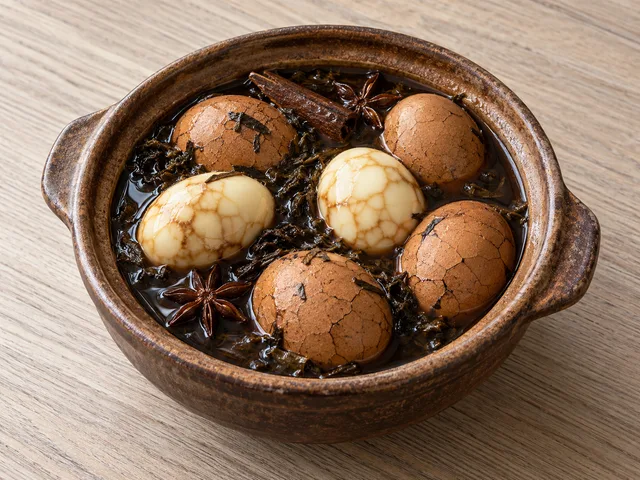
- Tea Eggs
Tea-marbled boiled eggs · Breakfast and snacks
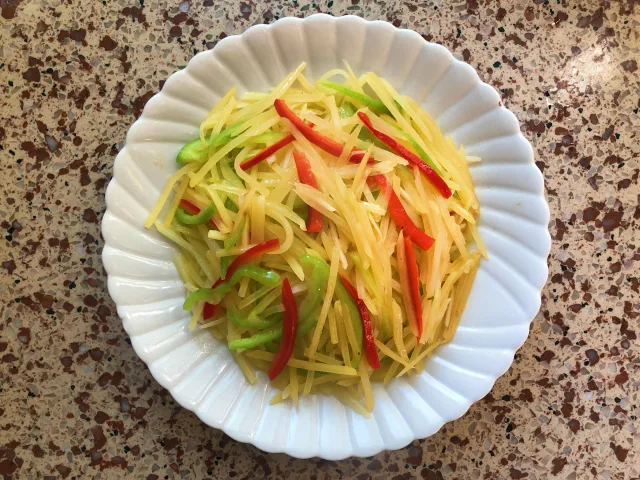
- Stir-Fried Shredded Potatoes
Stir-fried vegetable side dish · Everyday meals with rice
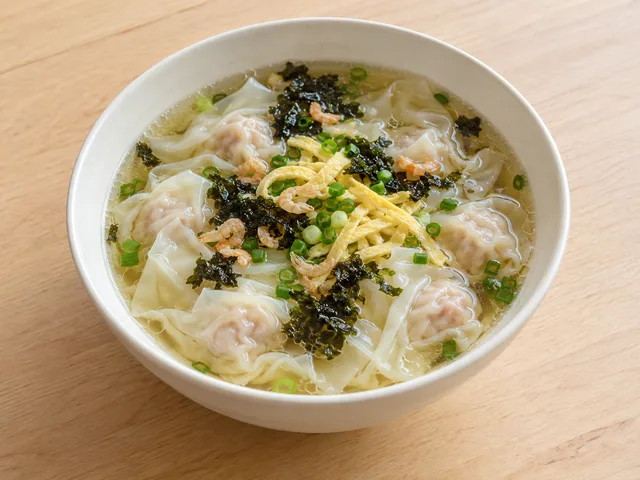
- Wonton
Wontons in broth · Breakfast to late night
Soups and stews from other regions
FAQ
Questions about Egg Drop Soup
What is egg drop soup?
Beaten egg poured into hot broth so it sets into thin petals, usually with seaweed, tomato or greens.
What does 蛋花汤 mean?
“Egg flower soup,” after the shape the egg takes in the broth.
Which region is egg drop soup from?
None; it is an everyday home soup all over China.
How do you get thin, soft egg flowers?
Pour the egg slowly into broth that has just stopped boiling, push gently in one direction and do not reboil.
Why add starch to the egg?
A little starch slurry keeps the flowers tender and stops them sinking.
What is seaweed and egg drop soup?
The commonest version: dried laver, tiny dried shrimp, scallion, coriander, white pepper and sesame oil.
Is American egg drop soup the same?
It is thicker, with more cornstarch; Chinese home versions are usually thin.
How long has egg drop soup been in America?
Egg flower soup is on New York Chinatown menus by the 1930s, and egg drop consommé appears on an American menu in 1903.
What is the difference from hot and sour soup?
Hot and sour soup is thick, sour with vinegar and hot with pepper; egg drop soup is plain and light.
What is shuaixiu soup?
The Dongbei name for egg drop soup, with big thin sheets of egg, often with tomato.
Why did my egg turn into small hard curds?
The broth was boiling hard, or it boiled again after the egg went in. Egg sets at about 65 to 70°C, so take the pot off the boil first.
Can egg drop soup be made ahead?
Not really. Reheating toughens the egg, and starch thickening weakens with long simmering.
Sources
Sources and further reading
- 1 Tang Lusun, Zhongguo Chi (中国吃): “Peiping’s own foods” and “Eating in Shanghai” (in Chinese)Guangxi Normal University Press (2017 edition)
- 2 Wang Zengqi, Renjian Zhiwei (人间至味): “Kunming eating” (in Chinese)China Literature and History Press (2023 edition)
- 3 Zhou Songfang, Yinshi Jianghu (饮食江湖): “Leading the early out-of-town restaurants of Shanghai” (in Chinese)Zhonghua Book Company (2026)
- 4 Zhang Jianping and Gao Feng, Chichi Baixiangxiang (吃吃白相相): “Good vegetables that beat meat” (in Chinese)Sichuan Literature and Art Publishing House (2025)
- 5 Fuchsia Dunlop, Invitation to a Banquet, Chinese edition Jun Xing Shi (君幸食): the chapters on soup and on drunken crab (in Chinese)Shanghai Translation Publishing House (2024)
- 6 Harold McGee, On Food and Cooking, revised edition: the chapter on eggsScribner (2004)
- 7 A History of the Egg in China: More than Just FoodThe World of Chinese (2026) ↗
- 8 Egg Drop Soup (Egg Flower Soup): historical citationsBarry Popik, The Big Apple (2007) ↗
- 9 Egg Drop SoupAmerica’s Test Kitchen ↗
- 10 Seaweed and egg drop soup: starch in the egg, the lowest heat, and egg flowers that float (video, in Chinese)Chao Zi Mei Shi (超子美食), Bilibili (2022) ↗
- 11 Restaurant-style seaweed and egg drop soup: turn off the heat before the egg goes in (video, in Chinese)Jia Yan Mei Shi Chu Fang (家宴美食厨房), Bilibili (2022) ↗
- 12 Tomato and egg drop soup, everyday home cooking (video, in Chinese)Xiao Gao Jie (小高姐的魔法调料), Bilibili (2018) ↗
- 13 Tomato shuaixiu soup: the egg flowers should be big and thin (video, in Chinese)Lao Dongbei Mei Shi (老东北美食), Bilibili (2020) ↗
- 14 Tasting a packet of tomato and egg soup, the other free soup of school canteens (video, in Chinese)Da Zhi Ruo Cai (大智若菜爱测评), Bilibili (2024) ↗
Last updated November 2026