
01
An egg that cooks twice, with its shell cracked
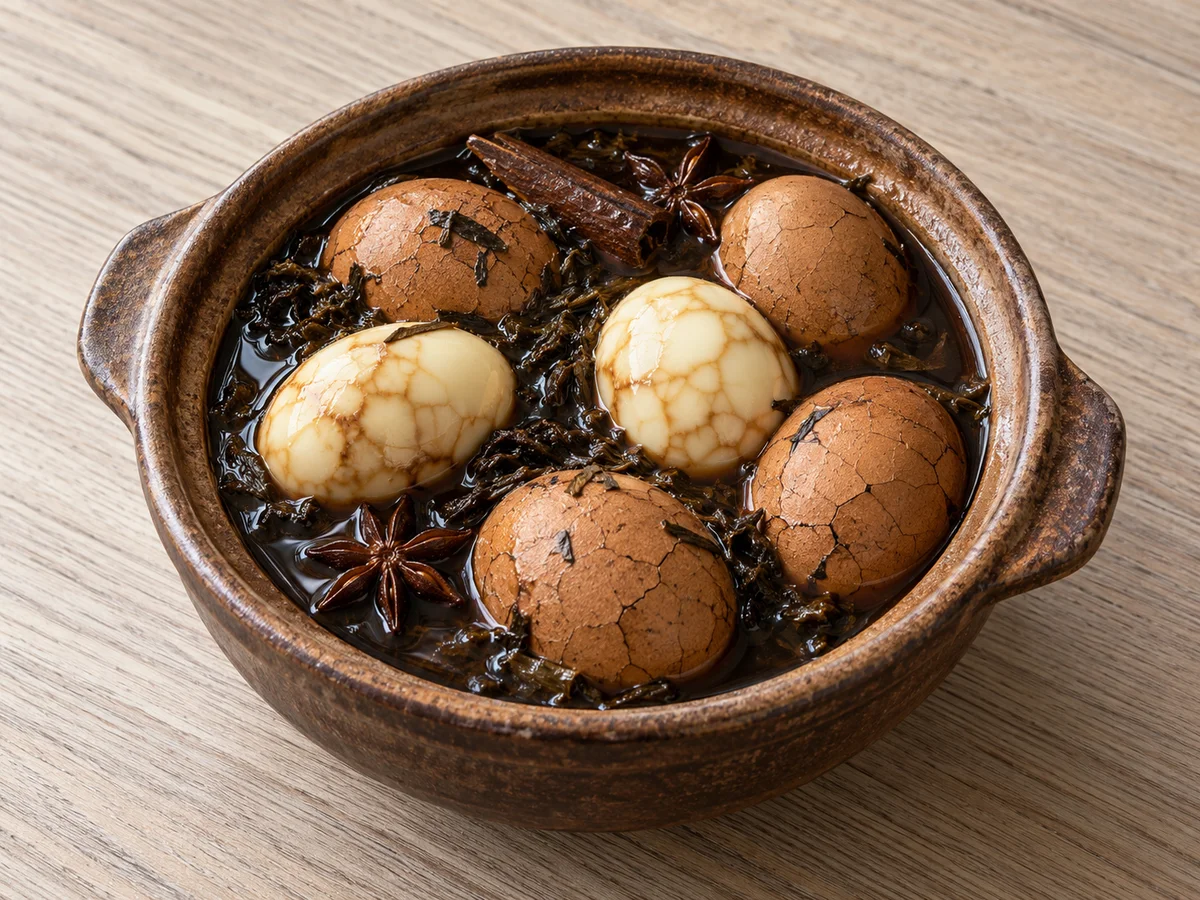
A tea egg is a hard-boiled egg with its shell cracked so the brine can paint the white.
The method has two steps. The eggs are boiled in their shells until firm, then the shells are tapped all over with the back of a spoon or rolled gently on a board until they are covered in fine cracks but still in place. The cracked eggs go back into a pot of tea, salt, soy sauce or caramel and spices, simmer for half an hour or more, and then sit in the liquid for hours, ideally overnight. The brine seeps through the cracks into the white, so when the shell is peeled the egg is marbled with a network of brown lines, darker where the cracks were widest, and the yolk is seasoned all the way through.
It is one of the humblest dishes in Chinese cooking. The writer Wang Zengqi listed tea eggs with fried peanuts, five-spice chestnuts and boiled soybeans as the drinking snacks that anyone can make, and in an essay about tea admitted that the tea leaves too poor to drink were saved for tea eggs. They are eaten for breakfast with congee or soy milk, as a snack on a long train journey, with tea, or bought hot from a convenience-store pot on the way to work.
02
Yuan Mei’s hundred eggs and two sticks of incense
The oldest written tea-egg recipe is three lines long.
Yuan Mei, the Qing poet whose Suiyuan Shidan of 1792 is the most quoted Chinese cookbook, included tea eggs among the small dishes. His recipe is a hundred eggs boiled with one liang of salt and coarse tea leaves, for as long as it takes two sticks of incense to burn; for fifty eggs, use half the salt, and adjust from there. The dish, Yuan Mei added, can be served as a dianxin, a snack between meals. There is no soy sauce, no sugar and no spice in it, only salt and cheap tea, and time measured the way a kitchen without clocks measured it.
Yuan Mei used incense sticks to time several slow dishes, a mushroom chicken stewed in sweet wine and a dry-steamed duck among them, so “two sticks of incense” meant a long, gentle cook rather than a quick boil. Later cooks added soy sauce, star anise and sugar, and the 五香, “five-spice,” tea egg became the usual version.
03
How tea eggs are made: tea, star anise and patience
The brine needs only a few things, and a night to work.
A popular home recipe for twenty eggs uses only one spice, three star anise pods, cracked. Fifty grams of rock sugar is cooked in a little water until it turns into a light caramel, then boiling water goes in with the star anise, and the eggs, washed and gently tapped on the broad end, are boiled for ten minutes. Fifteen grams of black tea and twenty of salt are added; the eggs are lifted out, cracked all over on a cloth, and returned to the brine in a clay pot to simmer for half an hour. Black tea gives the deepest color; the cook warns against soaking eggs overnight in an iron pot, which the brine will spoil. After about three hours they are colored and edible; the next day they are at their best, and they keep several days in the fridge.
The tea is a matter of taste. The Shanghai food writer Shen Jialu notes that most people make five-spice tea eggs with ordinary green tea, and recommends Xiping oolong from Fujian instead, for a lingering orchid fragrance.
04
Tea eggs around China
The same egg turns up at a riverside stall, an old teahouse and a fast-food counter.
Shen Jialu quotes the essayist Shi Kangqiang remembering the five-spice tea egg stalls along the Qinhuai River by Nanjing’s Confucius Temple, and caring less for the eggs than for the squares of pressed tofu simmered in the same pot, which soaked up the brine and chewed better than the eggs. In Shanghai, the Huxinting teahouse in the Yu Garden serves a standard set of four tea snacks: five-spice broad beans, pressed tofu, thumb-sized ham zongzi tied with thirteen turns of red thread, and tea eggs made with quail eggs, because a hen’s egg is too big for a teahouse plate.
Everywhere else, tea eggs are breakfast. In Henan in 2022 a four-yuan breakfast was a bowl of hulatang, a bowl of tofu pudding, pan-fried buns and a tea egg, one yuan each. KFC put tea eggs on its China breakfast menu, at 5.5 yuan in 2022, beside congee, youtiao and hot dry noodles. In Taiwan, convenience stores sell them from steaming pots by the till; when egg prices rose in 2022, FamilyMart raised its tea eggs from NT$10 to NT$13, while OK Mart kept them at NT$10 and 7-Eleven said it had no plans to follow.
05
The companion in the pot: tea-cooked tofu
Where there is a tea-egg pot, there is often tofu in it too.
The brine that colors eggs also makes 茶干, tea-cooked pressed tofu, a snack in its own right in the Yangtze delta. Shen Jialu describes a family habit: supermarket pressed tofu cut in quarters and cooked in the pot with the five-spice tea eggs, the son peeling the eggs while the writer ate the tofu. One Spring Festival Shen found that tofu left in a draft became chewier and more fragrant, and began stringing the cooked squares on thread and hanging them by a north window overnight, then warming them briefly before eating. Wang Zengqi, from Gaoyou in Jiangsu, remembered the tea-dried tofu of Jieshou near Gaoyou, each piece a little smaller than a palm.
06
“Missile builders earn less than tea-egg sellers”
The tea egg is so cheap that Chinese people use it to talk about money.
At one time a saying went around China: 造导弹的不如卖茶叶蛋的, “those who build missiles earn less than those who sell tea eggs.” It was a complaint about the pay of scientists and engineers, and a street vendor with a pot of eggs was the sharpest comparison anyone could think of. Zhong Shan, chief designer of the Hongqi-7 air-defense missile, was asked about it on CCTV in 2018, at the age of 87. His test crews had their own rhyme, “work for Zhong Shan and you’ll be broke.” He did not dispute it: their wages, he said, really were less than what selling tea eggs brought in, and they worked flat out anyway.
The egg came back as a joke in March 2014, when a professor in Taiwan claimed that many people on the mainland could not afford tea eggs. They sold for about 15 to 30 US cents in cities such as Beijing and Shanghai at the time, and the remark became one of the most talked-about subjects on the Chinese internet that week. In Guangzhou a businessman, Yu Ying, went out and handed tea eggs out across town; the iFeng report on it put the number at 100,000.
07
The convenience-store egg
In Taiwan the tea egg became a retail product, and a price worth reporting.
Taiwan’s first 7-Eleven opened in 1980, and the stores struggled to break even at first. Profits rose in the 1990s, when the local operator began selling food for local tastes, tea eggs among them. The American parent company worried that the eggs would smell too strong; they quickly became a bestseller. By 2016 Taiwan’s Central News Agency could call them an item unique to Taiwanese convenience stores, and it ran the news when 7-Eleven, then just over 5,000 stores, raised the price from NT$8 to NT$10 that January, blaming a 25 percent rise in farm egg prices over five years.
08
Why the yolk goes gray-green
A tea egg stays in hot liquid far longer than an ordinary boiled egg, so its yolk often has a dull rim.
The rim is ferrous sulfide. As an egg cooks, sulfur from the white reacts with iron in the yolk at the surface where they meet; the longer and hotter the cooking, the more forms. It is harmless, and a question of looks and a faint sulfur smell. An egg left simmering in a shop pot all day will show it most. At home the fix is the method above: keep the boiling short and let the egg take its color from a long soak off the heat.
Sources [6]
09
Tea eggs, braised eggs and tiger-skin eggs
China has several ways of turning a boiled egg into something else; the tea egg is the one that keeps its shell on.
A tea egg is cooked and soaked in its cracked shell, so it ends up marbled. A braised egg, 卤蛋, is peeled first and simmered in a soy-based braise until the whole surface is evenly brown. A tiger-skin egg, 虎皮蛋, is peeled, deep-fried until the white blisters and wrinkles like a tiger’s hide, and then braised, usually with red-braised pork. In Shanghai the two go together: the restaurant reviewer Huang Qifang, writing about a benbang red-braised pork, noted that the quail eggs beside it had been cooked the tea-egg way and would have been better as tiger-skin eggs, which are the classic partner for the pork. The tea egg is the plainest of the three, and the only one that is a snack on its own, as Yuan Mei already described it.
10
How to buy and eat tea eggs
A tea egg is the simplest thing on any breakfast counter.
Look for dark cracks
A good tea egg has a clear brown web on the white and a seasoned yolk.
Pair it with breakfast
Congee, soy milk, youtiao or a bowl of hulatang.
Try one with tea
In a Shanghai teahouse, quail tea eggs come with five-spice beans and pressed tofu.
Make a batch
At home, cook a dozen or more; they keep several days in the fridge.
11
What a tea egg costs
From one yuan to a little over five.
| Where | Price |
|---|---|
| Beijing and Shanghai, 2014 | US$0.15–0.30 |
| 7-Eleven, Taiwan, until January 2016 | NT$8 |
| 7-Eleven, Taiwan, from January 2016 | NT$10 |
| Henan breakfast stall, 2022 | 1 yuan |
| KFC China breakfast, 2022 | 5.5 yuan |
| OK Mart, Taiwan, 2022 | NT$10 |
| FamilyMart, Taiwan, from December 2022 | NT$13 |
12
More on the atlas
Other preserved eggs and breakfasts.
Century egg
Duck eggs cured in alkaline clay until the white turns to amber jelly.
Read about century eggs →Congee
The rice porridge tea eggs are often eaten with.
Read about congee →Hulatang
The peppery breakfast soup of the Central Plains.
Read about hulatang →Chinese breakfast guide
What China eats in the morning, city by city.
Open the breakfast guide →Across China classics
- Jiaozi
Boiled, steamed or pan-fried dumplings · Everyday meals; New Year’s Eve in the north
- Chow Mein
Fried wheat noodles · Lunch, late-night meals, takeaway
- Hot and Sour Soup
Thickened soup · With dumplings, at banquets
- Stir-Fried Shredded Potatoes
Stir-fried vegetable side dish · Everyday meals with rice
- Wonton
Wontons in broth · Breakfast to late night
- Egg Drop Soup
Light egg soup · With any everyday meal
FAQ
Questions about Tea Eggs
What are tea eggs?
Hard-boiled eggs with cracked shells, simmered and soaked in tea, salt, soy and spices until the white is marbled brown.
Why is the shell cracked?
So the brine seeps through and paints a web of brown lines on the white and seasons the egg.
What tea is used for tea eggs?
Black tea gives the darkest color; many people use ordinary green tea, and some prefer oolong for fragrance.
How long do tea eggs need to soak?
They take color in about three hours and are best the next day.
How old are tea eggs?
Yuan Mei’s Suiyuan Shidan of 1792 has a recipe: a hundred eggs, salt and coarse tea, boiled for two sticks of incense.
Where are tea eggs from?
They belong to no single region; they are sold all over China and in Taiwan.
When do people eat tea eggs?
Mostly for breakfast or as a snack, on journeys and with tea.
Are tea eggs the same as century eggs?
No. Tea eggs are ordinary boiled eggs flavored in tea; century eggs are cured for weeks in alkaline clay.
How much is a tea egg?
About 1 yuan at a Henan breakfast stall and 5.5 yuan at KFC in 2022; NT$10–13 in Taiwan convenience stores.
How long do homemade tea eggs keep?
Several days in the fridge, in their brine.
What does “selling tea eggs” mean in China?
It is shorthand for poorly valued work: an old saying held that people who built missiles earned less than people who sold tea eggs.
Why is the yolk of a tea egg gray-green?
Long cooking forms a thin layer of ferrous sulfide where the white meets the yolk. It is harmless.
Sources
Sources and further reading
- 1 Yuan Mei, Suiyuan Shidan (随园食单, 1792): the entry “Tea eggs” in the list of small dishes (in Chinese)Guwuxuan Publishing House (2021 edition)
- 2 Shen Jialu, Shanghai Lao Weidao (上海老味道), third edition: the chapters on tea-pickled tofu and on the Huxinting teahouse (in Chinese)Shanghai Culture Publishing House (2017)
- 3 Wang Zengqi, Renjian Zhiwei (人间至味): essays on drinking companions and on tea (in Chinese)China Literature and History Press (2023 edition)
- 4 Huang Qifang, Shanghai Zheme Chi (上海这么吃): the reviews of benbang red-braised pork (in Chinese)Publishing House of Electronics Industry (2012)
- 5 Yuan Mei, Suiyuan Shidan (1792): the entry “Tea eggs” (茶葉蛋), full Chinese text (in Chinese)Chinese Wikisource ↗
- 6 Harold McGee, On Food and Cooking, revised edition: the chapter on eggsScribner (2004)
- 7 Taiwan’s FamilyMart to raise price of tea eggsGeorge Liao, Taiwan News (2022) ↗
- 8 How Tea-Boiled Eggs Caused Online Controversy in ChinaEric Jou, Kotaku (2014) ↗
- 9 “Making missiles pays less than selling tea eggs”? The chief designer of the Hongqi-7 responds (in Chinese)CCTV Finance, via rmzxw.com.cn (2018) ↗
- 10 7-Eleven raises price of tea eggs to NT$10Chen Cheng-wei and Kay Liu, Focus Taiwan (2016) ↗
- 11 How Taiwan turned American convenience stores into hub for daily lifeKeoni Everington, Taiwan News (2025) ↗
- 12 Old-style tea eggs at home: star anise, caramel, black tea and an overnight soak (video, in Chinese)Cun Lü (村驴), Bilibili (2024) ↗
- 13 Buying everything on the KFC China breakfast menu, including a 5.5-yuan tea egg (video, in Chinese)Chan Da Xin (馋大鑫), Bilibili (2022) ↗
- 14 A four-yuan Henan breakfast: hulatang, tofu pudding, pan-fried buns and a tea egg, one yuan each (video, in Chinese)You Gu Shi De Qing Mi (有故事的情迷), Bilibili (2022) ↗
Last updated November 2026