
01
Xinjiang’s favorite snack
In Xinjiang people say that if lamb skewers come second, nothing comes first.
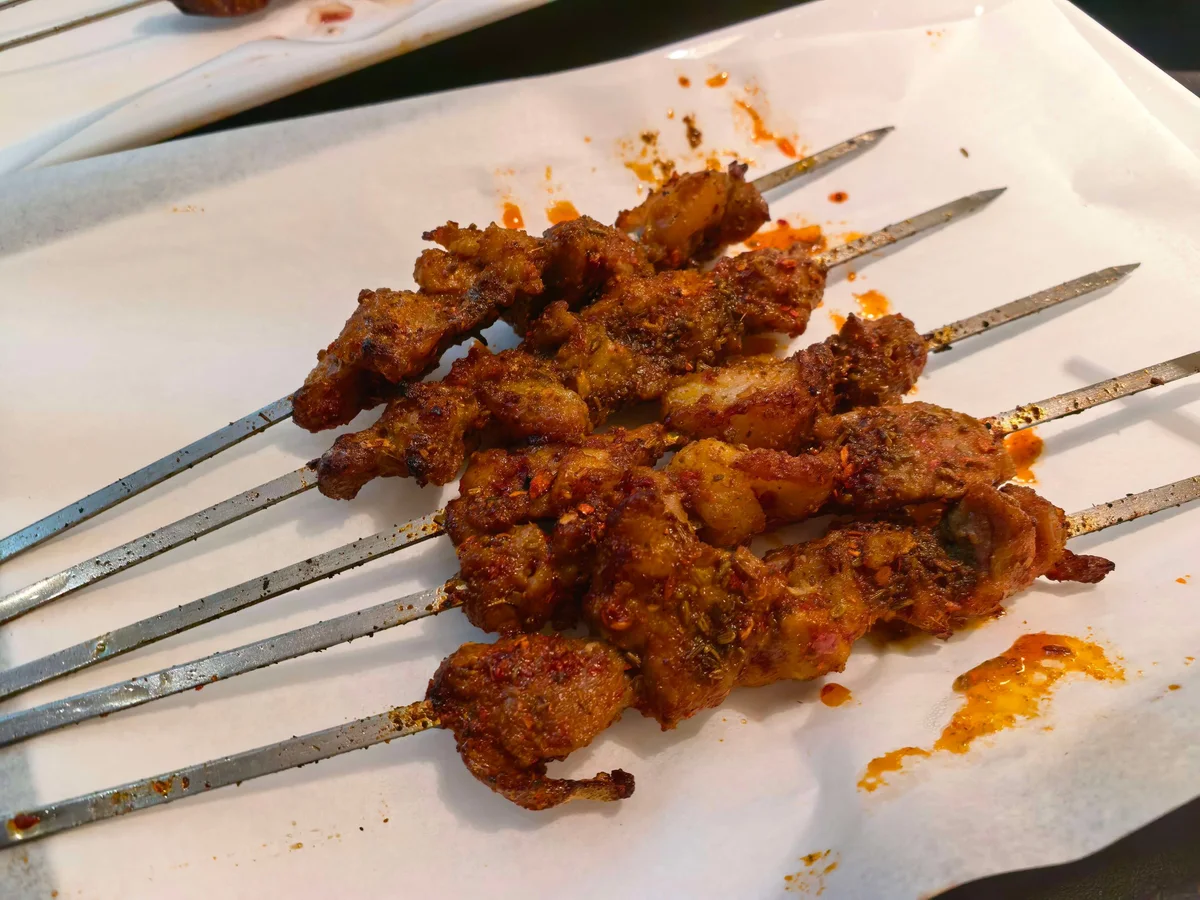
A lamb skewer is a few small pieces of lamb on a thin iron skewer or a peeled red-willow branch, grilled over charcoal and seasoned with salt, chili powder and cumin while it cooks. In Uyghur it is kawap; in Xinjiang Mandarin it is usually just 烤肉, “grilled meat.” The pieces are small, the fire is hot, and a skewer takes two or three minutes, which is why the first one is often gone before anyone can say how it tasted.
The Xinjiang writer Wang Zu notes a distinction locals make: whole roast sheep, hand-held mutton, stewed and braised lamb and the meat baked in a naan oven count as “eating meat,” while skewers are only a snack, eaten often but never as the meal itself. They are what a Xinjiang host buys first for a visitor, to ease them into the place. The flavor is smoky, salty and fragrant with cumin, the chili more aromatic than hot, and the fat is the point.
02
The lamb and the piece of fat
Every skewer has a piece of fat on it, by rule.
Wang Zu divides Xinjiang sheep into two kinds. Those that graze desert, Gobi and saline land give lean, strongly flavored, chewy meat; those raised on grassland pasture and snowmelt give tender, sweet meat, and these are the ones for skewers. Lou Wanghao, who wrote a survey of the foods of Xinjiang’s Muslim peoples, credits the region’s skewers to two things other places lack: its meat breeds, such as the fat-tailed sheep of Altay and Bayanbulak and the Dangbash sheep of Tashkurgan, and cumin. The best meat is from a sheep of about a year old, which a grill owner Wang met in the 1990s advertised as “unmarried lambs.”
A skewer carries four pieces of meat if they are large and five if they are small, and one of them is always fat. Lean and fat alternate so the fat melts and bastes the meat as it grills, and the contrast between soft fat and firm lean is the texture locals want. To take away the smell of mutton, cooks mix the meat with egg white and onion, which Xinjiang calls 皮芽子 (piyazi), and leave it to marinate; cumin and chili do the rest, and some add a few drops of baijiu.
03
The trough grill and the fire
A Xinjiang grill is a long iron trough, three tins of seasoning and a basin of meat.
The grill is a narrow trough of thick iron sheet on four legs, typically about 60 centimeters high and two meters long, 20 centimeters wide and deep, with a perforated grate a hand’s width below the rim for the charcoal. The skewers rest across the top, so the width of the trough is set by the length of the skewers: ordinary ones are about ten centimeters of meat, while a grill for Kuqa’s long skewers needs a trough over 70 centimeters wide. Beside it stand three small tins, of salt, cumin and chili powder, and a basin of threaded skewers.
The best fuel, Wang Zu writes, is red willow and saxaul, the desert shrubs, which give the meat a clean smell and color; in town most grills burn coal, which must be allowed to burn down to glowing embers with no flame or smoke before the meat goes on. Families in Xinjiang often own a small grill and make their own skewers for guests and holidays.
04
How a skewer is grilled
The seasoning goes on halfway, and the grill man pats the skewers together to spread it.
The skewers go on over the embers and are turned so both sides seize. When the fat starts to drip and the surface bubbles, the grill man takes a pinch each of salt, chili powder and cumin from the tins and scatters it over the meat, then picks up four or five skewers in each hand and pats and rubs the two bundles against each other so the seasoning sticks evenly. He watches the heat closely from then on, because burnt cumin turns bitter. Wang Zu says half the pleasure is standing by the grill to watch the fat sizzle, the chili turn from red to glossy and the cumin go from green to crisp gold.
Seasoning during grilling is the Xinjiang way. Wang Renxing, a food historian who studied Han-dynasty images of kebabs, points out that none of them shows anyone sprinkling seasoning on the fire; the old Chinese skewers were marinated before they were grilled.
05
Iron skewers, red willow and the meter-long kawap
The basic skewer is small, but Xinjiang also grills them a meter long.
The ordinary skewer is thin iron wire with a wooden handle. The red-willow skewer is a peeled branch of tamarisk, which grows in the desert and has salty sap; Wang Zu writes that it was first used to give the meat a salty taste when salt was scarce, and kept for its flavor afterwards. Red-willow skewers are longer and carry much bigger pieces, so they are called 红柳大串, “big red-willow skewers.” In recent years Moyu, Kuqa and the Erdaoqiao bazaar in Urumqi have also grilled 40- to 50-centimeter skewers of large chunks, stood upright inside a naan oven ten at a time.
The long skewers also turn up at country fairs. At a fair in Tashkurgan, the food writer Fiona Reilly watched a cook season yard-long kawap with chile, cumin, white pepper and salt over a waist-high charcoal brazier, then fold a round of charred nang in half around three skewers to carry them.
| Kind | What it is | Where |
|---|---|---|
| Iron skewer 铁签 | Four or five small pieces, one of fat, on thin iron wire | Everywhere |
| Red-willow skewer 红柳大串 | Chunks of 3 cm or more on a tamarisk branch about 35 cm long | Everywhere; best known in southern Xinjiang |
| Naan-oven skewer 馕坑大串 | 40–50 cm skewers stood in a naan oven, ten at a time | Moyu, Kuqa, Urumqi’s Erdaoqiao |
| Mitir kawap 米特尔喀瓦甫 | A meter-long skewer of young lamb, about half a kilo of meat | Kuqa |
| Battered skewer 挂糊肉串 | Lamb coated in a thin egg and flour batter before grilling | A common street version |
| Offal skewers | Kidneys, liver wrapped in caul fat, lamb intestine | Most grills |
06
Kebabs in China since the Han dynasty
Chinese cooks were grilling meat on skewers two thousand years ago, and their grills look much like Xinjiang’s.
In 1980 archaeologists excavating the Eastern Han tomb of Sun Cong at Liangtai in Zhucheng, Shandong, found a stone relief of a kitchen. In one corner a man kneels beside a rectangular grill holding five skewers, each with four pieces of meat, turning them with one hand and fanning the fire with the other, while others slaughter a sheep, slice the meat into strips and cubes and thread them. A painted pottery stove from another Eastern Han tomb, found in 1996 in Yu county, Hebei, shows three women cooks at a four-legged charcoal grill, with six pieces on each skewer and five sides of mutton hanging from the beam. Iron skewers 28 to 35 centimeters long, in bundles, came out of the tomb of the King of Nanyue in Guangzhou in 1983.
The sixth-century agricultural manual Qimin Yaoshu gives the recipe: meat marinated briefly with chopped scallion white, salt and fermented-bean juice, then grilled close to a strong fire and turned constantly, and eaten hot when it turns pale, “full of juice and smooth.” Move it on and off the fire, the manual warns, and the fat runs out and the meat dries. The food historian Wang Renxing, who gathered these images, notes that this classic Chinese kebab became rare for more than a thousand years after the sixth century, and sees the spread of Xinjiang-style lamb skewers as a later innovation rather than its continuation. Xinjiang’s own early history is harder to document: scholars have pointed to a wooden-handled fan from the Shanpula cemetery in Lop county, like the fans Uyghur grill men use today, and to a word for grilled meat in the eleventh-century Turkic dictionary of Mahmud al-Kashgari, but Wang found no excavation report or Chinese text that records Xinjiang skewers directly.
Sources [3]
07
Bonus skewers, tickets and wiping the skewer
Skewer grills have their own etiquette, some of it now history.
In the 1980s and 1990s a grill gave 奖金, a “bonus,” of one free skewer for every ten. Wang Zu, then a soldier in southern Xinjiang, remembers tables of a dozen men in Yecheng and Shule ordering a hundred skewers and the owner quietly adding ten. In the 1980s customers also paid first and collected a ticket from a cashier before the grill man would serve them; when the grills went private, the tickets disappeared.
One saying survives. In Xinjiang, “only a good friend wipes your skewer for you.” The tip of an iron skewer collects ash and charred fat on the grill, and anyone who pulls the first piece straight off eats the ash with it; a friend wipes the tip with a napkin before handing it over.
Sources [1]
08
How to order, and what it costs
Tell the grill man how many, and watch.
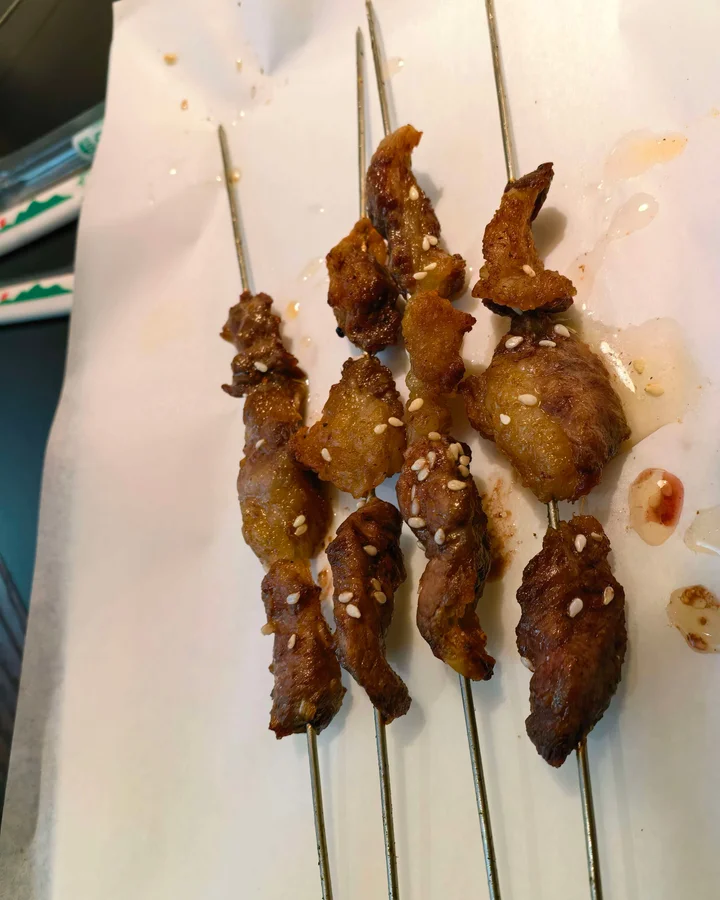
Another plate of skewers
Our own photographs of two plates of lamb skewers. The chili-coated skewers are the photo at the top of this page.
Order by number
Say how many skewers you want; most people order in fives and tens. A grill man can grab the exact number from the basin without counting.
Know the prices
At a Xinjiang neighborhood grill in 2025 a big red-willow skewer was 8 yuan and a small iron one 3; a lamb-rib skewer was 30. Some big grills outside Urumqi sell lamb by weight instead: 98 yuan a kilo in 2024.
Eat it with noodles
Xinjiang grills serve skewers with cold dishes, above all 黄面 (huangmian), yellow alkaline noodles, and the “three cold” of yellow noodles, liangpi and liangfen. Slide the meat onto the noodles.
Add onion and naan
Raw onion and a naan cut the fat; tea or yogurt finish the meal.
Try the offal
Kidneys, liver wrapped in caul fat and lamb intestine are grilled on the same trough.
Mind the tip
Wipe the end of an iron skewer before biting, and eat the first one hot, while the fat is soft.
09
Lamb skewers at home
A charcoal grill and a little sheep fat matter more than the spice mix.
For about 20 skewers: 800 g lamb leg or shoulder, 200 g lamb tail fat or fatty lamb, one egg, half an onion, salt, chili powder and ground and whole cumin.
- 1. Cut the meat
Cut the lamb into pieces about 2 to 3 cm square and the fat into slightly smaller pieces. Keep the lean and fat apart until you thread them.
- 2. Marinate
Grate or finely chop the onion and squeeze its juice over the meat; add the egg and a little salt and mix by hand until the liquid has been absorbed and the meat feels sticky. Refrigerate for one to two hours.
- 3. Thread
Thread four or five pieces of lean on each skewer with one piece of fat in the middle or second from the tip. Soak bamboo skewers first; red-willow branches or metal skewers are better.
- 4. Light the fire
Burn charcoal down to glowing embers with no flame. A home oven grill works, but charcoal is what makes the flavor.
- 5. Grill and season
Grill close to the heat, turning, until the fat drips and the surface bubbles, about two minutes. Scatter salt, chili and cumin over both sides, pat the skewers together, grill another half minute and eat at once.
10
More from Xinjiang
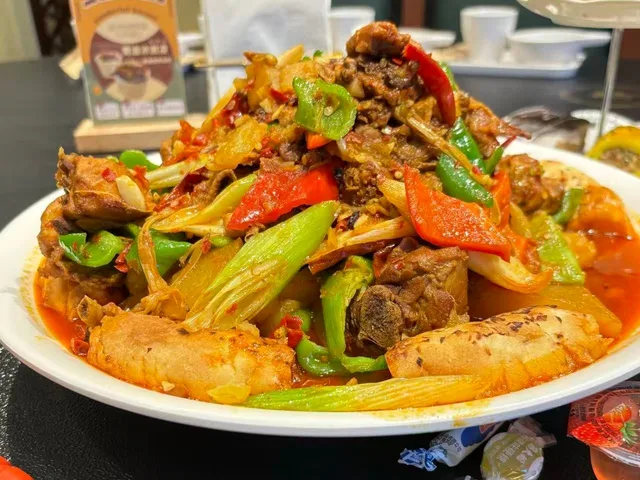
Big plate chicken
A whole chicken with potatoes and belt noodles, born on a Shawan highway.
Read about big plate chicken →Samsa
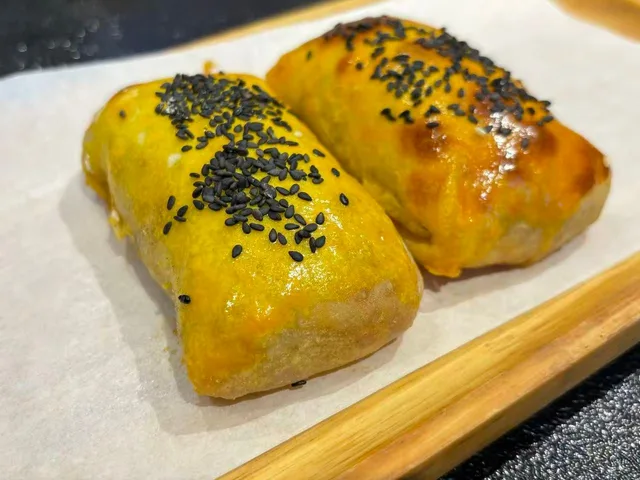
Lamb and onion baked in thin dough on the wall of a naan oven.
Read about samsa →Xinjiang
Naan, polo, laghman and the rest of the region’s table.
Explore Xinjiang food →Xinjiang classics
- Big Plate Chicken
Shared chicken braise with noodles · Lunch and dinner for three or four
- Xinjiang Samsa
Oven-baked lamb pastry · Breakfast, snack, with tea
- Guoyourou Laghman
Hand-pulled noodles with a stir-fried topping · Lunch at a noodle shop
FAQ
Questions about Xinjiang Lamb Skewers
What are Xinjiang lamb skewers?
Small pieces of lamb and sheep fat threaded on iron or red-willow skewers, grilled over charcoal and seasoned with salt, chili powder and cumin.
What are lamb skewers called in Uyghur?
Kawap. In Xinjiang Mandarin they are usually just called 烤肉, grilled meat.
Why is there a piece of fat on every skewer?
The fat melts on the grill and bastes the lean meat, and the soft-and-firm contrast is part of the point. One piece of fat per skewer is the rule.
What are red-willow skewers?
Skewers made from peeled tamarisk branches, a desert shrub with salty sap. They are longer and carry bigger pieces of meat than iron skewers.
What spice is on Xinjiang lamb skewers?
Cumin, chili powder and salt, scattered on halfway through grilling.
Are Xinjiang lamb skewers spicy?
Mildly. The chili is mostly for aroma, and you can ask for less or none.
How much do lamb skewers cost in Xinjiang?
About 3 yuan for a small iron skewer and 8 yuan for a big red-willow skewer at a neighborhood grill in 2025; some big grills sell lamb by the kilo, 98 yuan in 2024.
What do you eat with lamb skewers?
In Xinjiang, cold yellow noodles, liangpi or liangfen, naan, raw onion and tea or yogurt.
Did Xinjiang invent kebabs?
Grilled skewers appear in Han-dynasty tomb reliefs from Shandong and Hebei, and in a sixth-century Chinese recipe; Xinjiang’s cumin-and-chili skewer is the version that spread across modern China.
Are Xinjiang lamb skewers halal?
Kawap is a traditional Uyghur snack, and in Xinjiang many grills are run by Muslim cooks; outside the region, ask.
Sources
Sources and further reading
- 1 Wang Zu, Shi Wei Tian (食为天), chapter “Grilled lamb skewers” (烤羊肉串) (in Chinese)People’s Literature Publishing House (2020; WeChat Read edition)
- 2 Lou Wanghao, Xinjiang Musilin Yinshi Wenhua (新疆穆斯林饮食文化), chapter on Uyghur food: kawap, the skewer grill and Kuqa’s meter-long skewers (in Chinese)Xinjiang Juvenile Publishing House (WeChat Read edition)
- 3 Wang Renxing, “Images of meat skewers from the Han, Jin and Northern dynasties, with the modern world distribution of kebabs,” Journal of Researches on Dietetic Science and Culture 2017 (1): 1–7 (in Chinese)Yangzhou University (2017) ↗
- 4 Eating on the Western Edge of China: kawap, cumin and chile at a fair in TashkurganFiona Reilly, Saveur (2016) ↗
- 5 Two Xinjiang lamb skewers at home: battered skewers and red-willow skewers with an eight-to-two lean-to-fat mix (video, in Chinese)Lai Pi Hou Ai Mei Shi (赖皮猴爱美食), Bilibili (2025) ↗
- 6 Red-willow skewers for 8 yuan and small skewers for 3 at a Xinjiang neighborhood grill (video, in Chinese)Lian Yuan Yuan De Xiao Xiao He (脸圆圆的小小何), Bilibili (2025) ↗
- 7 Lamb grilled and sold by the kilogram, 98 yuan, at a busy grill in Shirengou outside Urumqi (video, in Chinese)Kashi Nong Mei Ge (喀什浓眉哥), Bilibili (2024) ↗
- 8 A thirty-year-old Xinjiang grill: skewers with yellow noodles, liangpi and liangfen, kidneys, lamb intestine and naan (video, in Chinese)Zhang Xixi (张喜喜-), Bilibili (2021) ↗
Last updated November 2026