
01
Two dishes from flour country
Caimang is steamed and geda soup is simmered; both are everyday Henan flour food.
Henan sits in the Central Plains on the lower Yellow River, and, as the writer Li Jing puts it in her book on Henan home food, it is a big farming province with very high wheat output, so its people eat mainly food made from flour. In Zhengzhou the staples are noodles, flatbreads and steamed buns; in Nanyang, dumplings, baozi, thin griddle breads and noodles. Henan people sum up their province with a saying: noodles in the north, stews in the south, soups in the west and braises in the east.
02
Caimang: the vegetable python
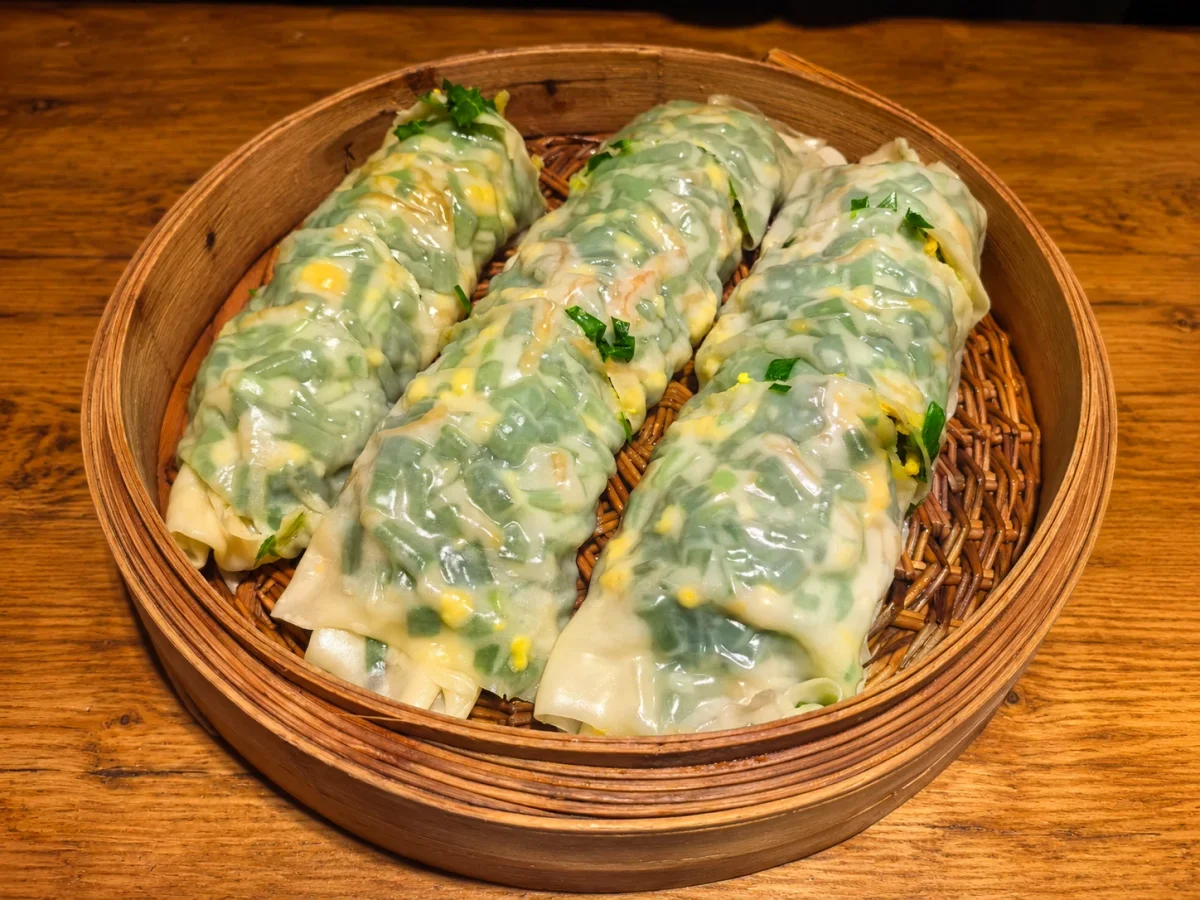
The name comes from its shape: a long, fat roll coiled in the steamer.
A caimang is made by rolling a sheet of thin dough round a filling, pinching the ends and steaming the whole log in a bamboo basket. Out of the steamer it is pale and soft, the dough nearly translucent where the filling shows through in green and yellow streaks, and long enough to look like the snake it is named after. Northern Chinese cooks have a matching pair of names: 肉龙, “meat dragon,” for the pork version, and 菜蟒, “vegetable python,” for this one.
The classic filling is chives, scrambled egg and soaked glass noodles. At a busy neighbourhood breakfast shop in Zhengzhou in 2022, a big caimang cost 5 yuan, with chive and egg and a little fennel inside; customers ate it plain, without a vinegar dip, beside a bowl of doumo, a millet-and-soybean porridge, for 6 yuan, a fried dough twist for 2 and a caijiao for 2. Four items came to 15 yuan, and a Henan breakfast built on wheat like this keeps you full until lunch.
03
Dough, filling and the roll
The skill is in keeping a wet filling from turning the dough soggy.
Most cooks use an unleavened dough, flour and water with a pinch of salt, kneaded fairly firm and rested until smooth. Adding 2 grams of salt to each jin of flour strengthens it; room-temperature water suits summer and warm water winter.
Chives give off water as soon as they meet salt, so every cook has a trick to stop it. One is to coat the chopped chives with oil before anything else goes in and add the salt at the very last moment; another is to stir sesame oil through the chives, for the same reason. The eggs are scrambled in very hot oil so they puff, then broken into pieces the size of corn kernels. The glass noodles do the most important job: soaked, cut short and stir-fried briefly with carrot, green pepper and a splash of soy, they turn translucent and soak up the vegetables’ moisture, so the filling stays loose and the dough stays dry. Some cooks add dried shrimp, a pinch of thirteen-spice powder (shisanxiang) or a little sugar.
The dough is rolled out large and very thin on an oiled board, the filling spread over it with a clear margin round the edge, and the sheet rolled up into a log with the ends pinched and tucked in. It goes onto an oiled cloth in the steamer and needs only about ten minutes once the steam is up.
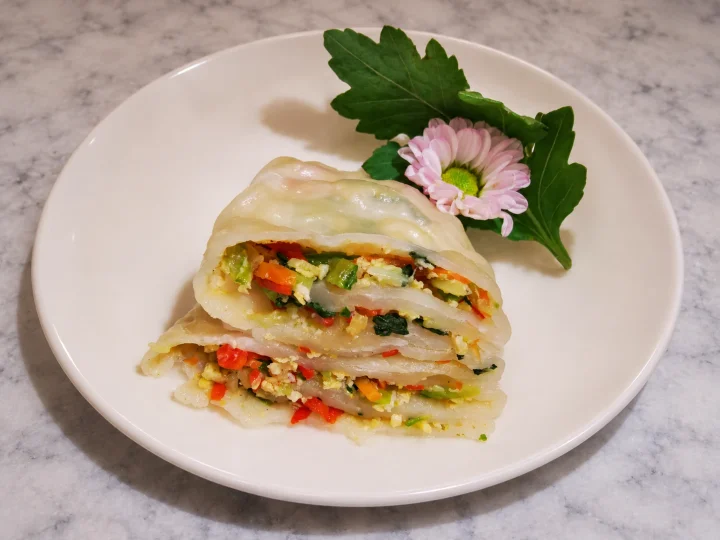
A vegetable roll cut open
Our own photograph of a steamed vegetable roll sliced across, showing the layers of dough and filling.
04
Meat dragons and lazy dragons
Northern cooks call the pork version a meat dragon and the vegetable one a python.
Beijing’s lazy dragon is the meat cousin. Its dough is leavened, with a little baking soda and a spoon of sugar for sweetness, and rolled thin because it will rise; it is spread with minced pork seasoned with soy, wine, thirteen-spice and scallion, rolled up and steamed for about twenty minutes, no longer, so the pork stays tender. Caimang, with its layers of dough wrapped round vegetables, also resembles Shaanxi’s rolled steamed bread, zijuan.
| Name | Dough | Filling | Cooked |
|---|---|---|---|
| Caimang 菜蟒 (Henan) | Usually unleavened, rolled very thin | Chives, egg, glass noodles; carrot, fennel or yellow chives | Steamed about 10 minutes |
| Meat dragon 肉龙 / lazy dragon 懒龙 (Beijing) | Leavened, with a little baking soda | Minced pork with scallion and thirteen-spice | Steamed about 20 minutes |
05
Jingjie: Henan’s summer basil
Henan’s jingjie is a basil, eaten as a summer vegetable.
Henan people call it 荆芥, jingjie, but botanically it is a basil, Ocimum basilicum var. pilosum, in the same genus as the basil of Italian cooking; the plant that the Flora of China calls 荆芥 is actually catmint. Its leaves taste faintly numbing and astringent at first, then cool, a flavour that is hard to describe.
It is a summer food: when jingjie appears on the table, Henan people say, summer has arrived. The most popular dish in a summer Henan restaurant is a big plate of it dressed cold, and it is tossed with cucumber, preserved egg, beef or pig’s head meat. The classic home use is with hand-rolled noodles, rinsed cool and dressed with pounded garlic water, a handful of jingjie on top. It is also steamed with flour, rolled into balls, battered and fried, cooked into egg pancakes and added to geda soup. It is easy to grow, and pinching off the tender tips only makes it bushier.
Henan even has sayings about it. Someone worldly “has eaten the big plate of jingjie”; someone who makes a fuss is “not eating jingjie, just making jingjie,” a pun on 净 and 荆.
Sources [1]
06
Geda soup: lumps of flour in tomato and egg
Geda soup is flour lumps simmered in tomato and egg broth; Henan also makes it with jingjie.
Geda means a small lump, and geda soup is just that: flour stirred with a little liquid into small, irregular lumps and simmered in broth until they are chewy. The usual broth starts with egg and tomato: egg is fried into a foam with scallion, tomato goes in and is fried until it softens and colours the oil, then boiling water is added and the pot is boiled hard for a few minutes until the broth turns cloudy and orange.
The lumps decide whether the soup is good. One good method mixes the flour with egg water, a little beaten egg diluted in cold water, trickled in while stirring, rather than plain water, which gives lumps that are smooth and springy and stay that way after sitting in the soup. The lumps should be no bigger than a fingernail, “wheat-ear lumps,” and pressed flat with chopsticks so no dry flour is left inside. They go into the boiling soup, which is seasoned with salt and white pepper.
In Henan the soup is also made with jingjie: jingjie geda soup, 荆芥疙瘩汤, is one of the province’s standard jingjie dishes, alongside cold-dressed jingjie, jingjie egg pancakes and noodles with jingjie.
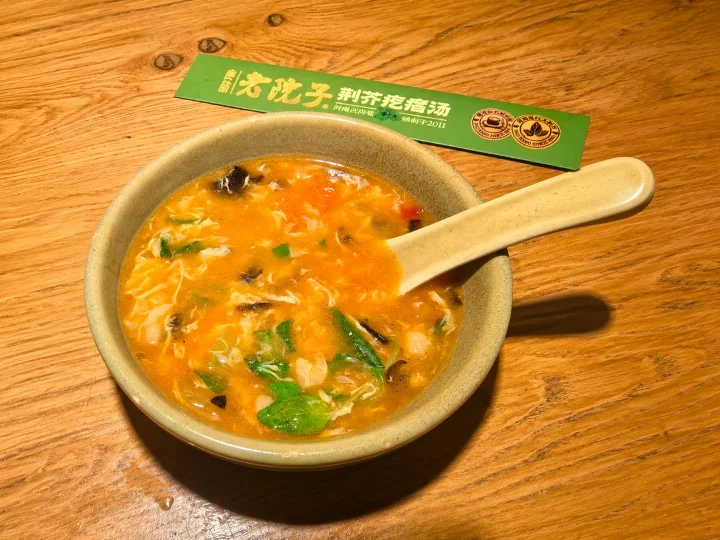
Jingjie geda soup
Our own photograph of a bowl of jingjie geda soup in a restaurant.
07
Both at home
Make the caimang first; the soup cooks while it steams.
Caimang (2 rolls): 300 g plain flour, 2 g salt, about 160 ml water; 200 g chives, 3 eggs, 40 g dried glass noodles soaked and cut short, half a carrot shredded, 1 tablespoon soy sauce, oil, salt. Soup (3 bowls): 2 eggs, 2 tomatoes, 1 scallion, 100 g flour, 1 litre boiling water, salt, white pepper, a handful of jingjie (or Thai or sweet basil).
- 1. Dough
Mix the flour, salt and water into a fairly firm dough, knead until smooth, cover and rest 30 minutes.
- 2. Filling
Scramble 2 eggs in hot oil and break them up. Stir-fry the noodles and carrot with the soy until the noodles turn clear; cool. Coat the chopped chives with a tablespoon of oil, mix in egg and noodles, and salt just before rolling.
- 3. Roll and steam
Roll each half of the dough into a thin rectangle on an oiled board, spread with filling leaving a margin, roll up and pinch the ends. Steam on an oiled cloth for 10 to 12 minutes after the water boils.
- 4. Soup
Meanwhile fry the remaining egg with scallion, add chopped tomato and fry until soft, add the boiling water and boil 5 minutes. Beat the remaining egg with a little cold water, trickle it into the flour while stirring to make small lumps, press them flat and add them to the pot. Simmer 3 minutes, season, and stir in the jingjie off the heat.
Slice the caimang and serve it with the soup, with a dipping sauce on the side if you like.
08
Where and how to eat them
Look for caimang at breakfast shops; jingjie dishes fill summer restaurant menus.
Caimang at breakfast
Henan breakfast shops sell it by the piece, 5 yuan in Zhengzhou in 2022; pair it with doumo and matang.
Dip or not
At a Zhengzhou breakfast shop in 2022 it was eaten plain, with no vinegar dip.
Geda soup
The names to know are 荆芥疙瘩汤, with jingjie, and 西红柿鸡蛋疙瘩汤, with tomato and egg.
Try jingjie
In summer order a plate of 凉拌荆芥, cold-dressed jingjie, the top order in Henan restaurants, or noodles with jingjie.
Abroad
Jingjie is a basil; Thai basil or sweet basil is the nearest substitute.
09
More Henan and northern flour food
Other pages on the atlas.
Wanyue geng
Kaifeng’s moon-viewing soup from the Song dynasty.
Read about wanyue geng →Mantou
The plain steamed bun of the wheat-growing north.
Read about mantou →Jiaozi
The north’s best-known wrapped flour food.
Read about jiaozi →Chinese breakfasts
What people eat in the morning across China.
Explore Chinese breakfasts →Henan classics
FAQ
Questions about Caimang and Jingjie Geda Soup
What is caimang?
A Henan steamed roll: thin dough wrapped round chives, scrambled egg and glass noodles, rolled into a long log and steamed, then sliced. The name means “vegetable python.”
Is caimang dough leavened?
Usually not; most Henan cooks use a firm unleavened dough rolled very thin. Beijing’s meat-filled “lazy dragon” uses a leavened dough.
What is geda soup?
Small lumps of flour simmered in a broth, usually of tomato and egg; a staple of home cooking across northern China.
What is jingjie?
The herb Henan people call 荆芥; botanically a basil (Ocimum basilicum var. pilosum), faintly numbing and then cool, eaten mainly in summer.
Is Henan jingjie the same as the medicinal herb jingjie?
No. The medicinal and botanical 荆芥 is a different plant; the Henan vegetable is a basil.
How much does caimang cost?
About 5 yuan for a large one at a Zhengzhou breakfast shop in 2022.
Can I make jingjie geda soup without jingjie?
Yes; use Thai basil or sweet basil, added off the heat.
Sources
Sources and further reading
- 1 Stranger than fish mint, beloved in Henan: what Henan’s jingjie is and how it is eaten (2023) (in Chinese)Futao Jiufenbao (福桃九分饱), via The Paper (in Chinese) ↗
- 2 Li Jing, Hometown Flavours: Henan (老家味道:河南卷), chapters on Zhengzhou huimian, Nanyang five-spice beef and Xinyang hot dry noodles (in Chinese)Hebei Education Press, read on WeChat Read ↗
- 3 A chef makes caimang after a trip to Henan: dough, scrambled egg, vermicelli and chives (video, in Chinese)Techu Sui Bian (特厨做饭_), Bilibili (June 2024) ↗
- 4 “Today we eat the python”: caimang with chives, yellow chives and egg (video, in Chinese)An Qiujin (安秋金), Bilibili (January 2022) ↗
- 5 Breakfast in Zhengzhou for 15 yuan: doumo, matang, caimang and caijiao (video, in Chinese)Jun zai Xi’an (君在西安), Bilibili (July 2022) ↗
- 6 A Beijing cook’s “big lazy dragon”: leavened dough rolled round a pork filling (video, in Chinese)Yitiao (一条风味地图), Bilibili (April 2019) ↗
- 7 Tomato geda soup: mix the flour with egg water, not plain water, for smooth, springy lumps (video, in Chinese)Lao Dongbei Meishi (老东北美食), Bilibili (October 2023) ↗
Last updated November 2026