
01
A bun with nothing inside
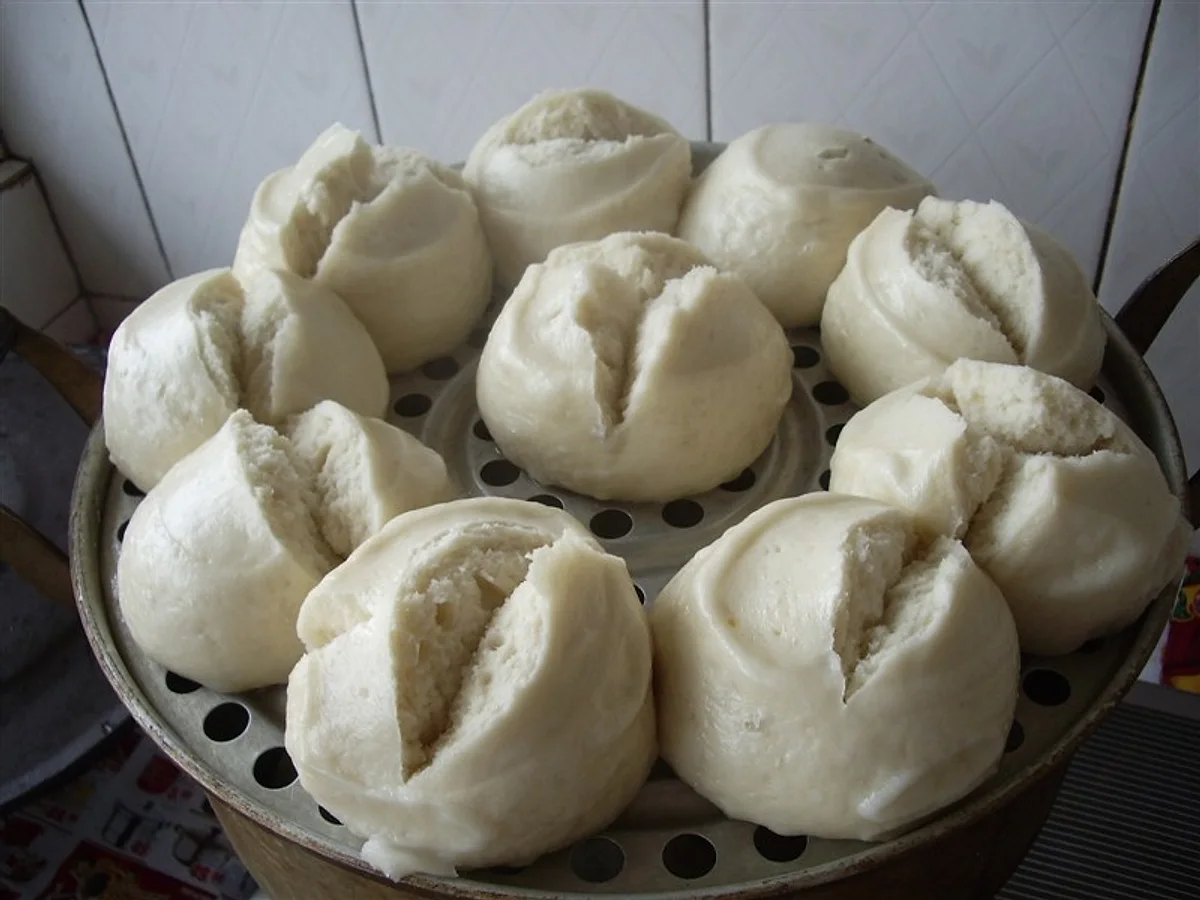
A mantou is leavened wheat dough, steamed, with no filling. Put a filling inside and, in most of northern China, it becomes a baozi.
Liu Changhong’s handbook for mantou makers, now in its second edition, calls the plain bun the “solid mantou,” mantou in the narrow sense: flour, a leaven and water, kneaded, risen and steamed, with little else added. It has many local names. Some people say 馍 mó or 馍馍, others 饽饽 bōbo, 蒸馍, 大馍, 卷糕 or 面头. Older usage did not separate plain buns from filled ones. Liu notes that any steamed bun of risen dough was first called zhengbing, “steamed cake,” and later mantou; only afterwards did some regions keep mantou for the plain bun and give the filled one its own name, baozi. Liang Shiqiu, the essayist, observed that some places still call a baozi a mantou.
Having nothing inside is what makes it plain everyday food. In the second chapter of Wu Jingzi’s eighteenth-century novel The Scholars, villagers entertaining a vegetarian schoolteacher named Zhou Jin bring out a big plate of “solid mantou” and a plate of fried flatbreads, and urge him to eat because these at least are meatless. Zhou Jin, worried that the soup was cooked with something unclean, asks for tea and eats the buns with that.
02
Three kinds of everyday mantou
Mantou makers sort everyday buns by how firm the dough is, and the line runs roughly from north to south.
Liu describes three main kinds. The hard northern mantou of Shandong, Shanxi and Hebei uses strong flour and little water, so the bun is chewy, with a crumb that peels away in layers, and nothing is added for flavor: it should taste of wheat and fermentation. A softer northern mantou is the daily staple further inland, in Henan, Shaanxi, Anhui and Jiangsu, with medium flour and a little more water; it is soft but still has some chew, and a faint sweetness at the end. The southern mantou is made where rice is the staple and buns are a second choice. Its weaker flour takes more water, the dough is proved to about three times its size rather than the north’s one and a half to two and a half, and the bun comes out whiter and softer, often sweetened or flavored with milk.
Shape follows region too. The famous northern names Liu gives are Shandong’s tall gaozhuang mantou, Shaanxi’s guanguan mo and the long, hand-rolled gangzi mantou of Kaifeng in Henan; the south has knife-cut squares and tiny “mahjong” mantou the size of a game tile.
| Kind | Where it is the daily bun | Dough | Texture and shapes |
|---|---|---|---|
| Hard northern mantou | Shandong, Shanxi, Hebei | Strong flour, little water, nothing added | Chewy and layered; tall gaozhuang, long gangzi, knife-cut squares, machine-made rounds |
| Soft northern mantou | Henan, Shaanxi, Anhui, Jiangsu | Medium flour, a little more water | Soft with some chew, faintly sweet; rounds and squares |
| Southern soft mantou | Rice-eating south, as breakfast or a side | Weaker flour, more water, proved longer | White and very soft, often sweet or milky; rounds, knife-cut squares, tiny mahjong mantou |
Sources [1]
03
Shandong, where the buns are big
In Shandong, mantou comes to the table at every meal, and the province is known for buns that are large, dense and firm.
The best-known place to see this is Wanggezhuang, on the coast outside Qingdao, where a whole street of shops sells nothing but big mantou. In 2026 a freshly steamed bun weighing three jin, a kilo and a half, cost 13 yuan there, and a jujube-studded kaihua mantou 5 yuan; decorated showpiece buns ran to 188. A Wanggezhuang bun has a hard base, a close, springy crumb and less sweetness than an ordinary bun, and keeps for days.
Shandong bakers also carried their buns to other cities. Liang Shiqiu remembered that in old Peiping the man selling steamed “triangle buns” was always from Shandong. When he lifted the cloth from his steamer, the choice was sugar triangles, mantou with sugar kneaded into the dough, red bean buns, plain and jujube zhengbing, and tall gaozhuang mantou. Tang Lusun remembered that the Peiping restaurant Tongheju was known for a big sugared mantou weighing half a jin, and that when a batch came out of the steamer at noon, people came from the far ends of the city to buy one.
04
Dough flowers for New Year and birthdays
At festivals the plain northern bun becomes a decoration and a gift.
In many northern households, especially in Shandong, the day before New Year’s Eve is for steaming: enough mantou to last about a week, so nobody has to cook through the first days of the year. On the Jiaodong peninsula the dough is shaped into carp, lions, dragons, phoenixes and peaches, steamed and painted once cool. These Jiaodong huabobo, “flower buns,” are also made for children’s and elders’ birthdays, weddings, exam results and housewarmings.
This kind of dough art is listed as national intangible heritage under the name 面花, “dough flowers,” also called 花馍 huamo. The listing, made in 2008, describes it as made across Shandong, Shanxi, Henan, Shaanxi and Gansu, and points to Tang-dynasty dough figures found in the Astana tombs at Turpan as evidence of its age. In Huangling, Shaanxi, near the tomb of the Yellow Emperor, dough animals stand in for the three sacrificial animals at ceremonies. In Wenxi, Shanxi, the commonest piece is the jujube mountain, a mound of dough set with red dates that is offered to the Kitchen God on the 23rd day of the twelfth lunar month. When an elder has a birthday, Wenxi families shape peaches, some with the character 寿, “long life,” pressed into the dough.
05
Smaller, whiter and sweeter in the south
The south has its own long tradition of fine, soft mantou.
In 1792 the poet and gourmet Yuan Mei praised mantou from Yangzhou, on the lower Yangtze: walnut-sized buns eaten straight from the steamer, small enough to pick up two at a time with chopsticks. “Yangzhou leavening is the best,” he wrote. Pressed flat by hand, a bun was less than half a cun thick, under two centimeters, and when released it rose high again. Yangzhou morning tea still includes kaihua mantou, split open on top, among the buns, shaomai and layered cakes of its teahouses, and Shen Jialu found each of them so substantial that one is enough to fill you.
Liu Changhong’s southern mantou are whiter and softer than northern ones and often taste of sugar or milk; they are eaten at breakfast or alongside rice dishes rather than in place of rice. When mantou appeared at the 2024 Fête du pain in front of Notre-Dame in Paris, its label explained the difference in one line: in the south of China, sugar and fat are added. The word itself also shifts in the south. In Shanghai and the Yangtze delta, filled buns are still mantou: xiaolongbao are xiaolong mantou and pan-fried shengjian are shengjian mantou.
06
Old dough and the alkali test
Before packet yeast, every batch of mantou was raised with a piece of the last one, and many cooks still prefer that.
Chinese cooks have leavened wheat dough in several ways. Liu Changhong’s history begins with dough mixed with the liquid from sweet fermented rice, around the second century, and moves to a sour grain slurry described in the sixth-century Qimin Yaoshu. By the Song dynasty cooks kept back a piece of risen dough to start the next batch; the Song scholar Cheng Dachang explained a word for risen bread as adding leavened dough “to make it loose and soft.” The 1330 court dietary Yinshan Zhengyao raises steamed buns with a dried leaven, salt and alkali, and an early Ming household manual gives a method for raising mantou with leaven liquid.
Old dough, 老面, brings a problem with it: it is sour. Besides yeast it carries many bacteria that make acid, so the risen dough must be neutralized with alkali, 碱, before it is shaped. Too little and the buns taste sour; too much and the alkali reacts with pigments in the flour and turns them yellow. Home cooks use roughly 3 to 4 grams of alkali for each jin, 500 grams, of risen dough, adjusting for how sour it smells, and knead hard, because alkali that is not worked in leaves yellow streaks. The old test is to steam or smell a small piece: a sour smell means it needs more.
Instant dry yeast changed the trade. Machinery for factory mantou was developed from the mid-1980s; by 2000, Liu writes, almost every large and medium city north of the Yangtze had a mantou factory, and some of the bigger ones went through more than ten tonnes of flour a day. China issued a national standard for wheat-flour mantou in October 2007, in force from 1 January 2008.
07
Why kaihua mantou split open
Kaihua mantou, “blooming” buns, are meant to burst.
A kaihua mantou is made from a soft, almost pourable dough, sweetened with white or brown sugar and often enriched with egg, yogurt and a little lard. Besides yeast it gets baking powder, about 8 grams for 500 grams of flour, and a splash of white vinegar to speed the reaction. Spooned into paper cups and steamed over fierce heat for about 15 minutes, the buns fill with gas faster than the dough can stretch, and it escapes through the weakest point, the top, which splits into three or four petals. Cooks give two reasons for buns that do not bloom: the wrong mixture or too little heat.
Liu puts kaihua mantou with the small, rich “dim sum mantou,” alongside cream, chocolate and fruit buns, which are popular with children and served at banquets. Northern bakers make larger kaihua buns too, studded with jujubes.
08
How mantou is eaten
A plain bun goes with almost everything, and leftovers have their own dishes.
Fresh mantou is eaten with stews, stir-fries and pickles, torn and used to mop up sauce. Liang Shiqiu’s breakfasts were always something dry and filling: shaobing, youtiao, mantou or baozi. In the northeast, buns are set on top of the big iron pot in which a stew is simmering, so they warm through and take on its flavor. Leftovers are sliced and pan-fried until golden, diced and stir-fried with egg and scallion, as in Henan, deep-fried in slices to eat with millet congee and pickles, or threaded on skewers and grilled with cumin and chili.
Restaurants serve “golden and silver mantou”: a plate of small buns, half of them steamed white, the other half deep-fried golden, with a dish of sweetened condensed milk for dipping. It is a common choice for the New Year table.
The record for appetite may belong to Xu Qianxue, a seventeenth-century minister. According to Qian Yong’s Lüyuan Conghua, every morning before court Xu ate fifty solid mantou, fifty sparrows and fifty eggs and drank ten pots of wine, and needed nothing more all day; his colleague Zhang Yushu ate two slices of yam and a cup of water.
09
Making old-dough mantou at home
The starter takes two days; after that, a batch takes a morning.
Use loose fermented rice (醪糟) from a market stall: the pasteurized jars sold in supermarkets no longer contain live yeast. With instant yeast instead, skip the starter and the alkali and use about 5 grams of yeast to 500 grams of flour.
Starter: 120 g loose fermented rice, 180 g water, 300 g plain flour. Dough: the starter, about 250 g more flour, and 3–4 g food-grade alkali (碱面) per 500 g of risen dough, dissolved in a spoonful of water.
- 1. Make the starter
Blend the fermented rice with the water, stir in the flour until no dry flour is left, cover and leave about 48 hours, until bubbly, softer and smelling of wine.
- 2. Make the dough
Work in about 250 g more flour and knead until smooth. Cover and leave somewhere warm, ideally 35–40°C, until it has risen to two or three times its size and is full of holes inside.
- 3. Add the alkali
Knead in the dissolved alkali a little at a time until completely even. Pinch off a piece and smell it: if it still smells sour, add a little more; if the dough turns stiff and yellowish, you have added too much and should let it rest longer.
- 4. Shape
Divide into equal pieces and knead each one smooth, turning it against the board until the top is tight and round.
- 5. Rest
Set the buns in the steamer with space between them and leave about 10 minutes, until they spring back slowly when pressed.
- 6. Steam
Steam over boiling water on high heat for 15 minutes. Low heat leaves the buns patchy and heavy.
10
What mantou costs
An ordinary mantou is one of the cheapest things to eat in China; decorated buns are a different matter.
At a Beijing neighborhood mantou shop in 2025, a flower roll large enough to hide a face cost 1.5 yuan, and ten different buns and rolls came to about 34 yuan, enough for a family for several days.
| Where | What | Price |
|---|---|---|
| Neighborhood mantou shop, Beijing, 2025 | Large pepper-salt flower roll | 1.5 yuan |
| Neighborhood mantou shop, Beijing, 2025 | Ten kinds of buns and rolls | About 34 yuan in all |
| Wanggezhuang, Qingdao, 2026 | Fresh mantou, three jin (1.5 kg) | 13 yuan |
| Wanggezhuang, Qingdao, 2026 | Jujube kaihua mantou | 5 yuan |
| Wanggezhuang, Qingdao, 2026 | Decorated showpiece bun | 188 yuan |
11
More on the atlas
Buns with fillings, and dishes to eat mantou with.
Baozi
The filled bun, and how northern and Shanghai usage differ.
Read about baozi →Shengjian
Shanghai’s pan-fried “raw-fried mantou,” filled with pork.
Read about shengjian →Pork and vermicelli stew
A northeastern winter stew eaten with rice or mantou.
Read about pork and vermicelli stew →Jiaozi
The other wheat staple of northern holidays.
Read about jiaozi →Across China classics
- Stir-Fried Shredded Potatoes
Stir-fried vegetable side dish · Everyday meals with rice
- Tomato and Egg
Home stir-fry · Everyday meals, canteens
- Jiaozi
Boiled, steamed or pan-fried dumplings · Everyday meals; New Year’s Eve in the north
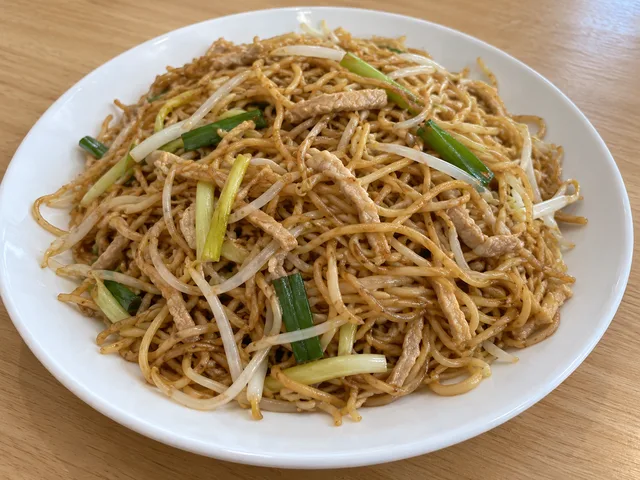
- Chow Mein
Fried wheat noodles · Lunch, late-night meals, takeaway
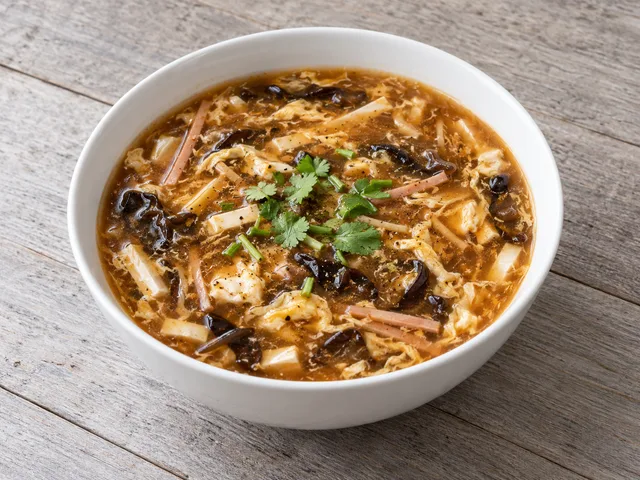
- Hot and Sour Soup
Thickened soup · With dumplings, at banquets
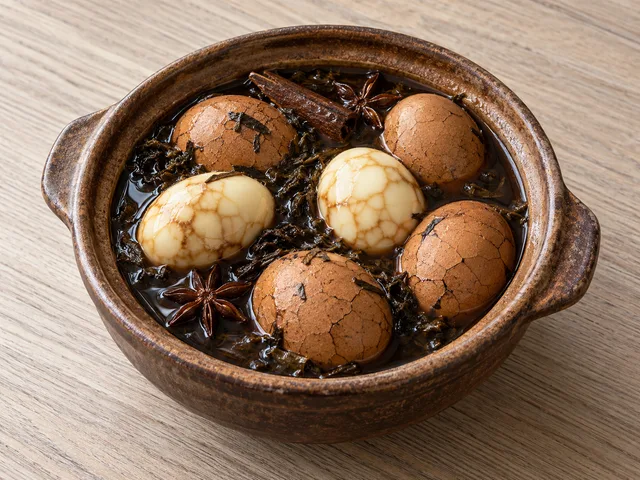
- Tea Eggs
Tea-marbled boiled eggs · Breakfast and snacks
FAQ
Questions about Mantou
What is mantou?
A Chinese steamed bun of leavened wheat dough with no filling, eaten as a staple in northern China.
What is the difference between mantou and baozi?
In northern China a mantou has no filling and a baozi does. In Shanghai and the Yangtze delta, filled buns are also called mantou.
Is mantou northern or southern?
Both, but differently: in the north it replaces rice at meals, while in the south it is a whiter, softer, often sweet bun for breakfast or a side.
Why are Shandong mantou so firm?
They use strong flour and little water, so the dough is stiff and the bun dense, chewy and layered.
What is old dough (laomian)?
A piece of fermented dough kept to raise the next batch, used before packet yeast and still preferred by many cooks.
Why is alkali added to mantou dough?
Old dough turns sour, and alkali neutralizes the acid. Too little leaves the buns sour; too much turns them yellow.
Why did my mantou turn yellow?
Too much alkali, or alkali that was not kneaded in evenly, which leaves yellow streaks.
What is kaihua mantou?
A soft, sweet bun made with yeast and baking powder and steamed over high heat so that the top bursts open like a flower.
What are huamo or huabobo?
Decorated festival buns shaped as flowers, animals, fish or peaches, made in northern China for New Year, weddings and birthdays.
What is golden and silver mantou?
A plate of small buns, half steamed and half deep-fried, served with condensed milk for dipping.
How are leftover mantou eaten?
Sliced and pan-fried, deep-fried with congee and pickles, diced and stir-fried with egg, or grilled on skewers with cumin and chili.
How much does a mantou cost?
Ordinary buns and rolls cost a yuan or two; a three-jin Shandong bun was 13 yuan in Wanggezhuang in 2026.
Sources
Sources and further reading
- 1 Liu Changhong, Mantou Shengchan Jishu (馒头生产技术), 2nd ed.: ch. 1 §2 “Origins and development of mantou”, §3 “Types of mantou”; ch. 4 “Traditional leavens” (in Chinese)Chemical Industry Press (2015)
- 2 Liang Shiqiu, Yashe Tanchi (雅舍谈吃): “Street snack sellers of Peiping”, “Congee” and “Yinshan Zhengyao” (in Chinese)China Women Publishing House (2019 edition)
- 3 Tang Lusun, Zhongguo Chi (中国吃): “Eating in Peiping” (in Chinese)Guangxi Normal University Press (2017 edition)
- 4 Shen Jialu, Shanghai Lao Weidao (上海老味道), 3rd ed.: “Tea snacks, the companions of tea” (in Chinese)Shanghai Culture Publishing House (2017)
- 5 Wu Baiying and Li Li, Wenxi Huamo (闻喜花馍): “Shapes of Wenxi huamo”, “Huamo at festivals and celebrations”, “Cultural meanings” (in Chinese)Beiyue Literature and Art Publishing House (2024)
- 6 Suiyuan Shidan (1792), dim sum list: small mantou and small wontons (in Chinese)Yuan Mei, Wikisource ↗
- 7 Rulin Waishi (The Scholars), chapter 2 (in Chinese)Wu Jingzi, Wikisource ↗
- 8 Lüyuan Conghua (1838), chapter 1: Xu Qianxue’s breakfast (in Chinese)Qian Yong, Wikisource ↗
- 9 Dough flowers (Huangling dough flowers), item Ⅶ-53, second national list (2008) (in Chinese)China Intangible Cultural Heritage Network ↗
- 10 Li Hang, “Exploring versatility and global reach of Chinese steamed buns”Global Times (May 15, 2024) ↗
- 11 Elaine, “Deep Fried Mantou”: golden and silver mantou with condensed milkChina Sichuan Food (2014, updated 2025) ↗
- 12 Traditional old-dough mantou: a starter from rice wine, and how much alkali (video, in Chinese)Pinnuo Meishi (品诺美食开课啦), Bilibili (2022) ↗
- 13 Why kaihua mantou split open: batter, raising agents and a fierce steam (video, in Chinese)Pinnuo Meishi (品诺美食开课啦), Bilibili (2021) ↗
- 14 Big fresh mantou on Wanggezhuang’s mantou street, Qingdao: prices and texture (video, in Chinese)Zhuan Sheng Cheng Wei Mao Mao (转生成为毛毛), Bilibili (2026) ↗
- 15 Ten kinds of buns and rolls for about 34 yuan at a Beijing mantou shop over 40 years old (video, in Chinese)Gou Hui (狗辉er), Bilibili (2025) ↗
Last updated November 2026