
01
A soup for looking at the moon
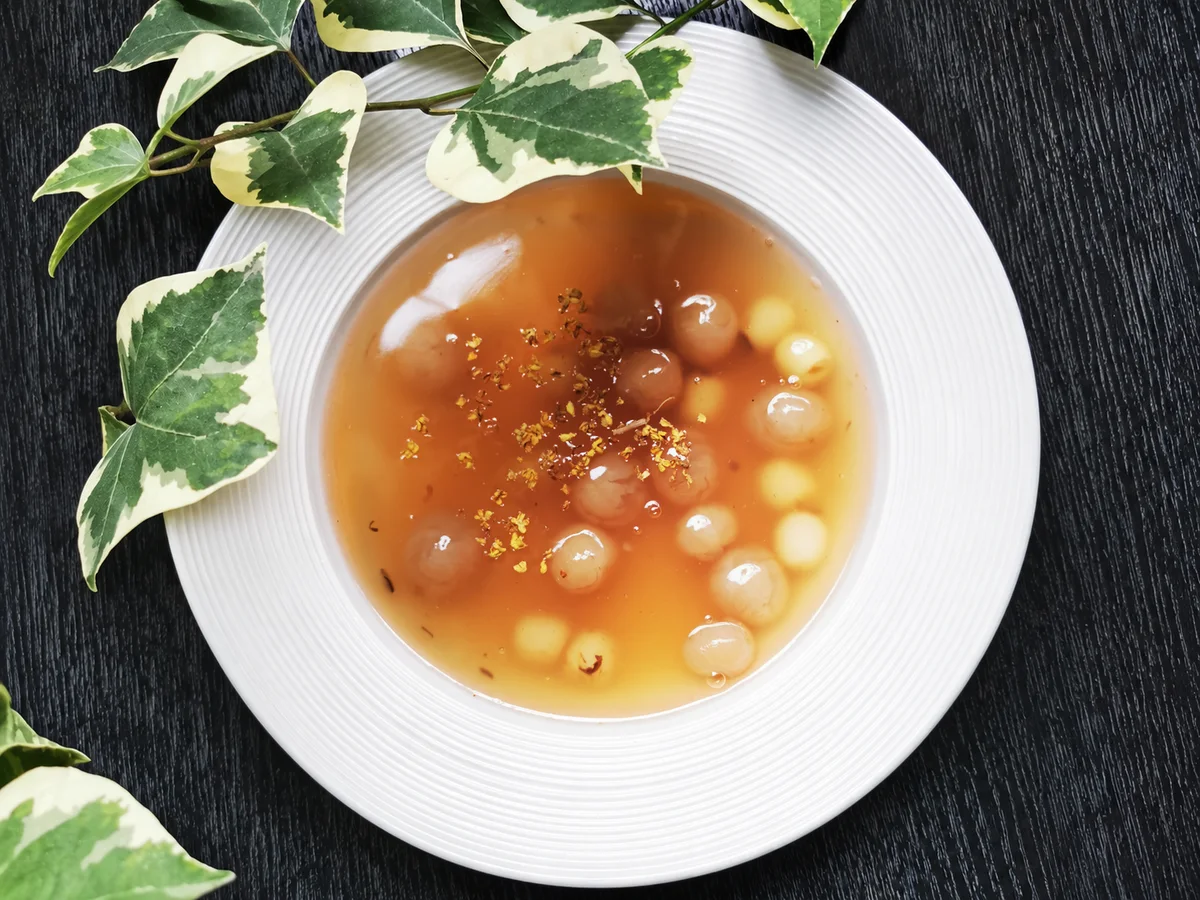
Wanyue geng is a dish known by its name alone: a Mid-Autumn soup sold in Kaifeng about a thousand years ago.
The name is a description of the occasion, not the recipe. 玩月 means to enjoy the moon, the Song phrase for sitting up on the night of the fifteenth day of the eighth month to look at the full moon, and 羹, geng, is the old word for a thick soup or stew, savory or sweet. Put together, it is simply “the soup for moon-viewing night.”
Liu Bo, of the ancient books department at the National Library of China, calls it the Mid-Autumn festival food of the Song dynasty. He also states the problem plainly: how it was made can no longer be determined. Later, as mooncakes became the food of the festival, the moon-viewing soup slipped out of use.
02
Zhang Shoumei’s festival menu
The oldest record is a list of festival dishes from one Kaifeng food shop.
Tao Gu, an official who served the Five Dynasties courts and the early Song in Kaifeng, collected food lore in his notebook Qingyi Lu. One entry describes a shop on a main street outside the Changhe Gate that people called “Zhang Shoumei’s.” It would supply anything from water or land that customers asked for, but at each festival it sold only one thing, and people crowded in from all over the capital to buy it. Tao Gu wrote down the names, he said, so that everyone who cared about food could hear of them. For Mid-Autumn, the dish was wanyue geng.
The names are fanciful, and only two come with a gloss saying what they were: the Lantern Festival’s “painted pearls” were fried dough balls, and the Double Ninth’s “rice brocade” was the festival cake. The rest, the soup included, are names without recipes.
| Festival | Dish | Literally |
|---|---|---|
| New Year’s Day | 元阳脔 | “First-sun slices” |
| Lantern Festival | 油画明珠 | “Oil-painted pearls”: fried dough balls |
| Seventh day of the year | 六一菜 | “Six-and-one greens” |
| Fifteenth day of the second month | 涅槃兜 | “Nirvana pouches” |
| Shangsi, third day of the third month | 手里行厨 | “A kitchen in the hand” |
| Cold Food | 冬凌粥 | “Winter-ice congee” |
| Eighth day of the fourth month | 指天馂馅 | “Pointing-at-heaven fillings” |
| Dragon Boat Festival | 如意圆 | “As-you-wish rounds” |
| Dog days of summer | 绿荷包子 | “Green lotus buns” |
| Spring and autumn earth-god days | 辣鸡脔 | “Spicy chicken slices” |
| Qixi, seventh night of the seventh month | 摩㬋罗饭 | Rice named after the Mohele doll |
| Mid-Autumn | 玩月羹 | “Moon-viewing soup” |
| Zhongyuan, fifteenth of the seventh month | 盂兰饼餤 | “Ullambana cakes” |
| Double Ninth | 米锦 | “Rice brocade”: the festival cake |
| Winter solstice | 宜盘 | “Fitting platter” |
| La day | 萱草面 | “Day-lily noodles” |
| Eighth day of the twelfth month | 法王料斗 | “The Dharma King’s measure” |
Sources [1]
03
Copied for six hundred years
Later writers kept copying the list, and one of them named the city.
A Song-dynasty food book, the Shanfu Lu attributed to Zheng Wangzhi, repeats a shorter version of the same calendar under the heading “Festival foods of Bianzhong,” Bian being the old name of Kaifeng. That heading is what fixes the soup to the city. In the Ming, the scholar Wang Shizhen copied the list again into his collected writings, noting that he recorded the names because they were the festival foods of Bianzhong, and in 1726 the imperial encyclopedia Gujin Tushu Jicheng printed both the Qingyi Lu entry and the Shanfu Lu list side by side in its section on food.
The Shanfu Lu version is not an exact copy. It keeps twelve of Tao Gu’s seventeen festivals and drops New Year’s Day, the fifteenth of the second month, Qixi, the winter solstice and the eighth of the twelfth month; it also gives the seventh day’s greens as “six-up” rather than “six-and-one,” the kind of slip a copyist makes. Mid-Autumn and its soup survive in every version.
Each copy keeps the name and nothing more. Six centuries of scholars found the list worth preserving, but none of them describes the soup.
04
Mid-Autumn night in Kaifeng and Hangzhou
Two memoirs of the Song capitals show the night the soup was made for.
Meng Yuanlao, who lived in Kaifeng before the Jurchen conquest of 1127, wrote down the city’s year from memory twenty years later. Before Mid-Autumn, he says, every wine shop sold new wine and dressed its front with fresh painted poles and brocade flags; people crowded in to drink, and by early afternoon the wine had run out and the shop flags came down. Crabs were just in season, and so were pomegranates, quinces, pears, jujubes, chestnuts, grapes and ripening oranges. On the night itself, wealthy households decorated their terraces and ordinary people fought for tables in the wine towers to look at the moon; children played the whole night through, and the night market went on until dawn.
After the court fled south, Hangzhou kept the same night. Wu Zimu called it “the moon night,” when princes and rich families climbed high towers for banquets with music, shopkeepers built small moon terraces for family dinners, and even the poor pawned clothes to buy wine. Neither writer names a festival soup; the soup is known only from the food lists.
05
What geng meant in Song Kaifeng
In Song Kaifeng, geng was everyday restaurant food, and most of it was savory.
Meng Yuanlao’s chapters on the city’s restaurants show how ordinary a geng was. The wine shops’ cooked dishes began with a run of them: “hundred-flavor” geng, “head” geng, a new-style quail geng, shrimp-and-mushroom and chicken-and-mushroom geng, an “immortals’ gathering” geng, golden-thread tripe geng and stone-tripe geng. Small wine shops sold blood geng and starch geng, no portion costing more than fifteen cash. There were whole shops given over to gourd soup, 瓠羹店, with twenty or thirty sides of pork and mutton hung on decorated frames at the door.
The big food shops, called fencha, were busy and exacting. Customers asked for their geng hot or cold, lean or fatty, and waiters memorized each order, shouted it to the kitchen and came back with three bowls in one hand and some twenty stacked up the other arm. A bowl in a glass dish cost ten cash; noodles and meat in equal parts was a “combined geng,” and half a portion a “single geng.” Meng adds that people used to eat it with a spoon and now used chopsticks, which suggests how much solid food a geng could hold.
None of this says what was in the moon-viewing soup. It does show that a famous Kaifeng shop selling a geng for Mid-Autumn was selling the city’s most familiar kind of dish, and that a geng there was as likely to be meat, offal or mushroom as anything sweet.
Sources [5]
06
How the Song made a geng
A Southern Song cookbook gives real geng recipes, and some of them come close to the modern guess.
Lin Hong’s Shanjia Qinggong, written in the thirteenth century, is the most complete Song recipe book to survive, and it includes a dozen geng. They show the range of the word. Some are clear vegetable soups: celery blanched in water until “clear and fragrant, like a green mountain stream,” or greens and radish boiled soft in well water. Some are thickened: Su Dongpo’s famous “jade grain” geng was radish boiled until soft and thickened with ground rice, and he declared that nothing in the human world tasted like it. Some are rich: “gold and jade” geng is slices of Chinese yam and chestnut simmered in mutton broth.
Two are closer to the modern idea of wanyue geng. For “pomegranate” geng, small pieces of lotus root were dyed pink with plum water and rouge, coated in mung bean starch and cooked in chicken broth until they looked like pomegranate seeds; a companion “silver thread” geng did the same with shredded bamboo shoot. So lotus root and starch, the ingredients of today’s guess, were already in Song soups, though in a savory broth. Lin Hong also records an osmanthus rice cake called guanghan gao, “Moon Palace cake,” given to friends in examination years for luck. Osmanthus and the moon were already linked in the Song kitchen.
| Name | What it was | Sweet or savory |
|---|---|---|
| 金玉羹 gold and jade geng | Chinese yam and chestnut slices in mutton broth | Savory |
| 玉糁羹 jade grain geng | Radish boiled soft, thickened with ground rice | Savory, plain |
| 雪霞羹 snow and sunset geng | Hibiscus flowers with tofu, pepper and ginger optional | Savory |
| 石榴粉 pomegranate geng | Lotus root bits, dyed pink, coated in mung bean starch, in chicken broth | Savory |
| 骊塘羹 Litang geng | Greens and radish boiled soft in well water | Plain |
| 碧涧羹 green stream geng | Celery blanched in clear water | Plain |
Sources [6]
07
What was in it?
Nobody knows, and the honest answer is a guess.
The usual modern description is a soup of longan, lotus seeds and lotus-root starch. Liu Bo reports this as what “some say,” and adds only that such a soup would have been sweet, which suits a festival of reunion. No Song source gives these ingredients. The word geng could cover a thick savory stew as easily as a sweet soup, and none of the dishes on Zhang Shoumei’s list is described in enough detail to judge from its neighbors.
Other guesses circulate, none with a source behind it. A 2023 article in China Food News collected three. One unnamed scholar suggested it might have been an egg dish, a steamed custard perhaps set in the shape of the moon, or an egg pancake with a sauce poured over. Some people see a trace of it in Xi Shi wan yue, “Xi Shi enjoying the moon,” a Jiangsu soup of white balls of chicken and fish paste in clear chicken broth with ham, spring bamboo shoot, mushroom and greens, named after the story of the beauty Xi Shi viewing the moon on Lingyan Hill in Suzhou; beyond the name and the moon, no link between the two is known. The longan, lotus-seed and lotus-root starch version comes from the third claim, that cooking experts found the soup still sold in Lingnan, in the far south, at the end of the Qing. The article does not say who the experts were or what they found, and ends by calling their recipe only a guess at the old soup.
What is certain is how the soup was lost. Mooncakes, Liu writes, only became the food of Mid-Autumn in the Ming, and as they spread, wanyue geng faded. When people speak of a Tang-dynasty moon-viewing soup, they are reaching back further than any surviving text: the earliest records are Tao Gu’s, from the tenth century.
08
A bowl made today
There is no Song recipe to follow, so a bowl today is either the modern sweet guess or a soup in the Song manner.
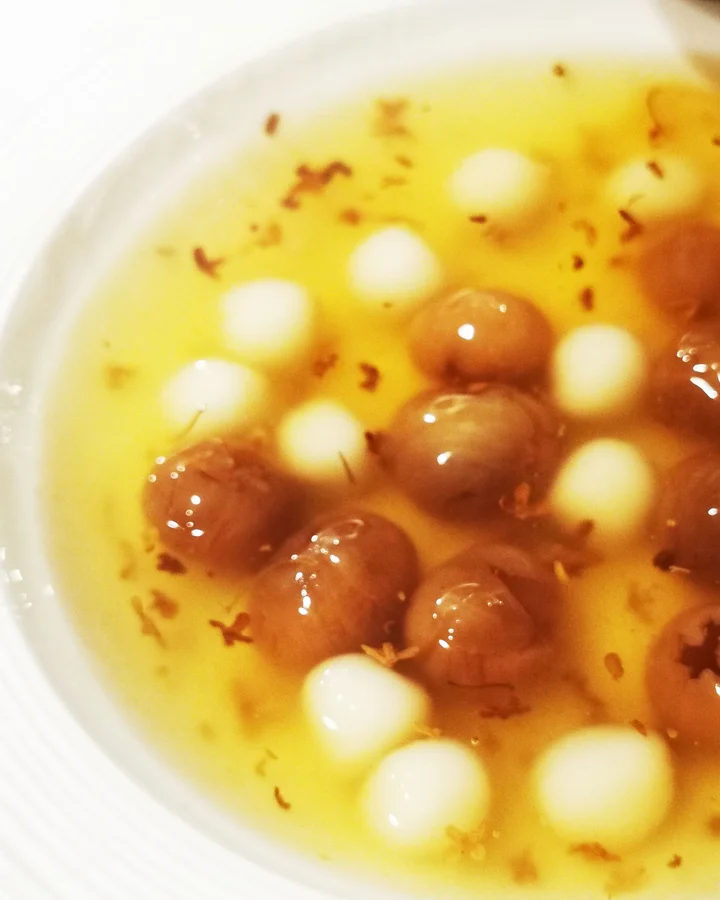
A home-made bowl: peeled dried longans and small white rounds sit in a clear amber syrup, with dried osmanthus scattered over the top. It follows the common reading of the soup, sweet and light, with osmanthus because it flowers at Mid-Autumn. A thicker version stirs in lotus-root starch until the soup turns glossy, and lotus seeds are the other usual addition.
A cook who wants something closer to what a Song shop might have sold can work from Lin Hong instead: yam and chestnut in a clear meat broth, or lotus root bound with starch in chicken stock, both of them dishes that existed. In Kaifeng itself, the Qingming Shanghe Park, a reconstruction of the city in the famous Song scroll, now serves banquets developed from the Dongjing Menghua Lu and the Shanjia Qinggong; over the National Day holiday in 2026 all three daily sittings were full. Whichever bowl you make, it is a modern answer to an old name, not a Song recipe.
Two ways, for four. Sweet: a handful of dried longans, a handful of dried lotus seeds or small glutinous rice balls, rock sugar, lotus-root starch, dried osmanthus. Song-style savory: a piece of Chinese yam, a handful of peeled chestnuts, clear mutton or chicken broth, salt.
- 1. Sweet: soak
Soak the lotus seeds until soft and remove any green cores, which are bitter.
- 2. Sweet: simmer
Simmer the lotus seeds and longans in water with rock sugar until the seeds are tender; add rice balls, if using, and cook until they float.
- 3. Sweet: thicken
Stir in a little lotus-root starch mixed with cold water, until the soup turns clear and glossy, and scatter with dried osmanthus.
- 4. Savory: slice
Peel the yam and cut it and the chestnuts into slices, as the Shanjia Qinggong says.
- 5. Savory: cook
Simmer the chestnuts in the broth until nearly soft, add the yam and cook a few minutes more; season with salt.
Longan and osmanthus up close
An original photograph of the homemade bowl, close enough to see the longans and the osmanthus.
09
More on the atlas
Other festival foods.
Mooncakes
The food that replaced the moon-viewing soup at Mid-Autumn.
Read about mooncakes →Tanghulu
A sweet sold at temple fairs and festivals in the north.
Read about tanghulu →Jiaozi
The dumplings of the New Year and the winter solstice.
Read about jiaozi →Food guides
Comparisons and first steps in Chinese food.
Browse the guides →Soups and stews from other regions
FAQ
Questions about Wanyue Geng
What is wanyue geng?
A Mid-Autumn soup sold by a famous Kaifeng food shop in the tenth and eleventh centuries. Only its name survives.
What does 玩月羹 mean?
“Moon-viewing soup”: 玩月 is enjoying the full moon, 羹 a thick soup.
Which book first mentions it?
Tao Gu’s Qingyi Lu, in the entry on Zhang Shoumei’s food shop; a Song list calls it one of the “festival foods of Bianzhong,” Kaifeng.
What was in the original?
Unknown. Longan, lotus seeds and lotus-root starch is a modern guess. Song geng were often savory, as the Kaifeng restaurant lists and Lin Hong’s recipes show.
Is it sweet?
Modern versions are sweet. Whether the Song soup was sweet or savory is not recorded.
Why did it disappear?
Mooncakes became the Mid-Autumn food in the Ming, and the soup fell out of use.
Can I eat a Song-style meal in Kaifeng?
Yes. The Qingming Shanghe Park serves banquets developed from Song texts, though they are modern adaptations.
Sources
Sources and further reading
- 1 Qingyi Lu (清異錄), “Food” section: “Zhang Shoumei’s house” (in Chinese)Tao Gu, 10th century, Wikisource ↗
- 2 Shanfu Lu (膳夫錄), “Festival foods of Bianzhong,” and Qingyi Lu, as collected in Gujin Tushu Jicheng, Food and Commodities, juan 259 (in Chinese)Zheng Wangzhi (Song); Gujin Tushu Jicheng (1726), Wikisource ↗
- 3 Yanzhou Sibu Gao (弇州四部稿), juan 171: the Bianzhong festival foods copied out (in Chinese)Wang Shizhen (Ming), Siku Quanshu edition, Wikisource ↗
- 4 Mengliang Lu (夢粱錄), juan 4: “Mid-Autumn” (in Chinese)Wu Zimu (1274), Wikisource ↗
- 5 Dongjing Menghua Lu (東京夢華錄), juan 2 “Drinks and snacks” and juan 4 “Food shops” (in Chinese)Meng Yuanlao (1147), Wikisource ↗
- 6 Shanjia Qinggong (山家清供): jinyu geng, yushen geng, xuexia geng, shiliu fen and others (in Chinese)Lin Hong (Southern Song), Ming Yimen Guangdu edition, Wikisource ↗
- 7 “Talking about Mid-Autumn reunion customs” (中秋团圆话习俗) (in Chinese)China Food News, via China National Radio (September 18, 2023) ↗
- 8 Zhao Shuaijie, “Light and shadow: a thousand years of history brought back to life” (光影流转 千年历史复现眼前) (in Chinese)People’s Daily (October 6, 2026) ↗
- 9 Dongjing Menghua Lu (東京夢華錄), juan 8: “Mid-Autumn” (in Chinese)Meng Yuanlao (1147), Project Gutenberg ↗
- 10 Liu Bo, “Mid-Autumn food in old books” (古籍里的中秋饮食漫谈), Wenjin Liushang 2022 no. 3 (in Chinese)Ancient Books Department, National Library of China ↗
Last updated November 2026