
01
Sour fruit in a glass shell
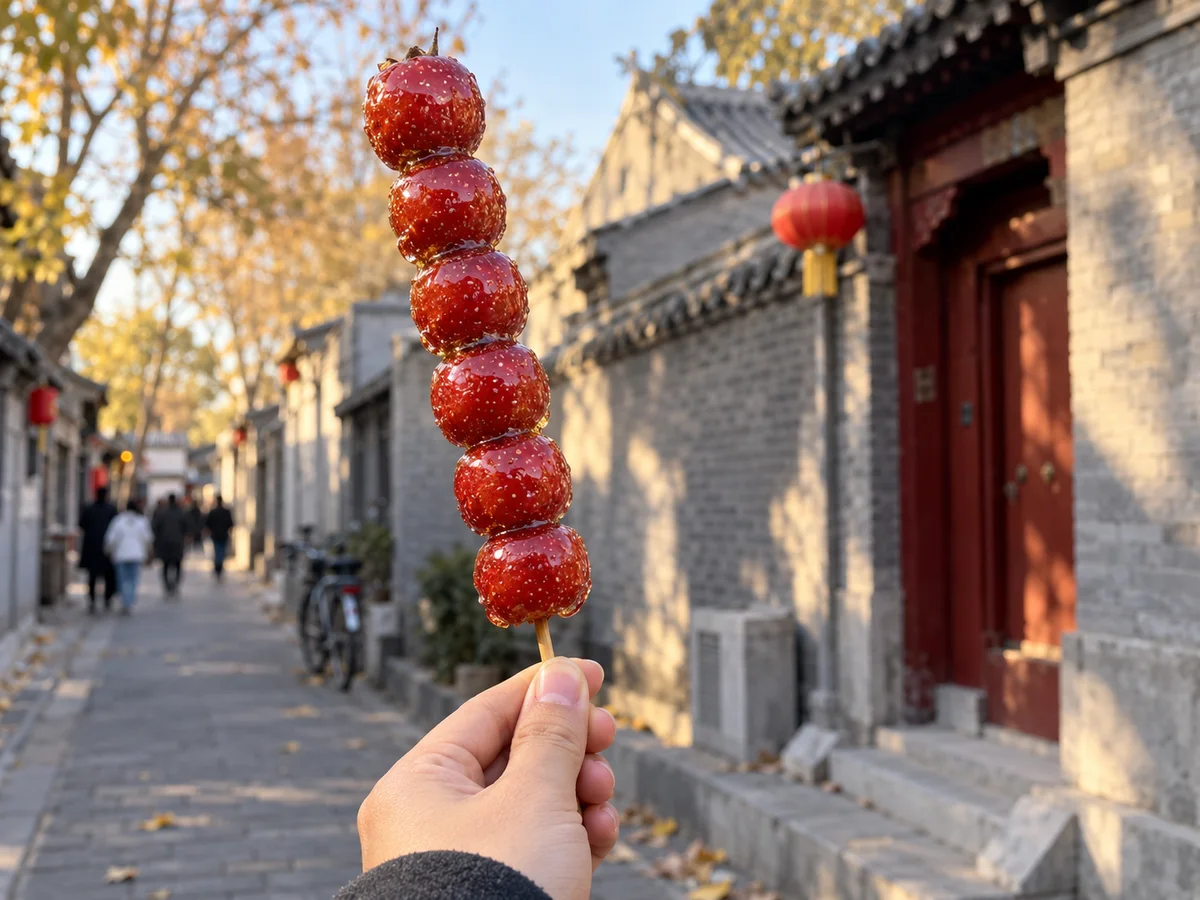
A good tanghulu cracks like thin glass and then goes sour.
The classic tanghulu is a row of hawthorns, the small red fruit Beijing calls shanlihong (山里红) or hongguo (红果), pushed onto a bamboo skewer and rolled through a pot of sugar boiled to the point where it hardens almost instantly. The shell is thin, clear and brittle; the fruit inside is tart, a little dry and full of pips if they have not been removed. The name means “sugar gourd”: a string of round fruit looks like a gourd, and the bingtang, “ice sugar,” in Beijing’s fuller name is rock sugar, the sugar the shell was once made from.
The oldest detailed description comes from Fucha Dunchong’s Yanjing Suishi Ji (燕京岁时记), a calendar of Beijing customs written at the end of the Qing. Under the foods that appear after the tenth lunar month he writes that bingtang hulu, which he spells 壶卢, are made by threading grapes, little yam bulbils, crabapples, hawthorns and the like on bamboo skewers and dipping them in rock sugar: “sweet, crisp and cold.” Eaten on winter nights, he adds, they help clear the coal fumes of a heated room. Beijing writers still list other fruits used in the past, oranges, walnuts and Chinese yam among them, but agree that hawthorn is the best. Tanghulu is a cold-weather food: hawkers started selling it in late autumn, because the sugar stays hard in the cold and goes sticky in a warm room.
02
Hawkers, cries and the temple fair
In old Beijing you heard tanghulu before you saw it.
Hawkers walked the hutongs carrying a straw target shaped like a feather duster, bristling with finished skewers, and sang their wares with one hand cupped over an ear. Wan Jianzhong and Jiang Wenhua record some of the cries: “Hulu… made with rock sugar!”, “Two strings left, big hawthorns!”, “Fresh-dipped tanghulu, sweet and sour, good for the appetite!” A late-Qing record of the street calls of the year, Yi Sui Huo Sheng (一岁货声), lists tanghulu among the things sold on New Year’s Eve and again in the ninth month. Hawkers also carried it into teahouses, where storytelling audiences bought it with melon seeds and chestnuts.
The grandest tanghulu belonged to the Changdian temple fair, held every Spring Festival around three small temples on South Xinhua Street. There the skewers were more than a metre long: big red hawthorns threaded on long vitex twigs and dipped or brushed with malt syrup, so they came out red under a white glaze. An old account quoted by the food historian Wan Jianzhong calls them bawang bian, “the overlord’s whip,” four or five chi of bamboo packed with candied fruit, and Beijing writers say only Changdian sold them. The fair was revived in 2001 and drew more than two million visitors that year; in 2006 the Changdian temple fair was placed on China’s first national list of intangible cultural heritage, and the giant skewers came back with it.
| Cry | Meaning |
|---|---|
| 葫芦……冰糖的! | Hulu… with rock sugar! |
| 冰糖多哎……葫芦来嗷。 | Plenty of rock sugar… here come the hulu. |
| 还有两挂啦哎,大山里红啦! | Two strings left, big hawthorns! |
| 刚蘸得的冰糖葫芦,开胃呀甜酸冰糖葫芦! | Fresh-dipped, sweet-and-sour tanghulu, good for the appetite! |
03
The consort and the hawthorn cure
Every tanghulu seller knows the origin story, and nobody can prove it.
The story goes that an emperor’s favorite, Consort Huang, fell ill and could not eat. The palace doctors failed; a traveling healer told her to simmer hawthorns with rock sugar and eat a few before each meal, and within half a month her appetite was back. The remedy spread outside the palace, where people threaded the fruit on sticks. It is a legend with no record behind it, and different tellings set it in different reigns. What it does capture is how Beijing has always talked about the snack: hawthorn as something sour that “opens the appetite,” and sugar as what makes it a treat. The firm written record begins much later, in the late-Qing descriptions of skewers sold on winter streets.
04
Cooking the shell
The fruit is easy. The sugar is the whole craft.
Street sellers use white sugar and water, about two parts sugar to one part water, enough water to cover the sugar by a centimeter. The order matters: high heat and constant stirring until the sugar dissolves, then a lower flame that stays below the level of the syrup, and no more stirring at all, because stirring cools the surface and makes the sugar crystallize back into sand. The syrup boils down through dense small bubbles; it is ready when the foam turns the color of lager. To test, dip a skewer, plunge it into cold water and bite: it should crack with a slight stickiness. If it is still soft, the shell will be tacky; if it goes amber, it will taste bitter.
Each skewer is rolled once, lightly, through the foam on the surface rather than plunged in, which gives the thinnest shell, and laid on an oiled board to set. Soft fruit such as strawberries and grapes goes in first while the syrup is foamy, because once the bubbles thin out the syrup is hot enough to split their skins and the juice stops the sugar sticking. No tanghulu stays hard forever. Commercial “glass-crisp” powders only slow the melting; a traditional skewer keeps a day or two in a northern winter, while at room temperature in summer it has to go into a fridge almost at once.
| Problem | Cause |
|---|---|
| The shell turns white and sandy | Stirring or splashing after the sugar dissolved; flame licking the sides of the pot |
| Sticky, chewy coating | Syrup taken off too early |
| Dark shell with a bitter taste | Syrup cooked too long |
| Sugar slides off the fruit | Wet fruit, or thin-skinned fruit split by syrup that was too hot |
| Melts within hours | A warm room; tanghulu needs cold air |
05
Hawthorn, filled, flattened and strawberry
A modern tanghulu stall sells a dozen kinds.
Hawthorns are pitted with a small pair of tongs before they are threaded. For filled tanghulu each fruit is cut in half, the halves are threaded at opposite angles and red bean paste is pressed between them, sometimes with a walnut or almond on top; newer versions pipe cream or jam into the hollow fruit and let the skin dry for an hour before dipping. Flattened skewers, pressed into discs, are often made from bruised or blemished fruit. The coating can be rolled in sesame, desiccated coconut or chopped nuts. Fruit skewers, strawberries, grapes and tangerine segments, are the ones that went round the world, though grapes were already on Beijing’s list more than a century ago.
| Kind | What it is |
|---|---|
| Classic hawthorn | Whole pitted hawthorns, plain sugar shell |
| Filled | Halved hawthorns sandwiching red bean paste, often topped with a walnut |
| Cream or jam centred | Hollowed fruit piped with a filling and dried before dipping |
| Flattened | Hawthorns pressed into discs before the sugar goes on |
| Fruit | Strawberry, grape, tangerine and other soft fruit, dipped while the syrup is still foamy |
| Yam and sweet potato | Steamed and dried before threading |
06
Bing Dwen Dwen’s sugar shell
The mascot of the Beijing 2022 Winter Olympics began as a tanghulu.
The mascot, a panda in a clear shell of ice, was designed by a fourteen-person team at the Guangzhou Academy of Fine Arts led by the professor Cao Xue, and chosen from nearly 6,000 entries in 2019. Cao said the shell was inspired by tanghulu, the “ice-sugar gourd,” and also resembles a space suit. The team’s first idea was a tanghulu itself; it was judged not enough to represent the country, so they tried an elk, a tiger and a rabbit inside the shell before settling on a baby panda.
Sources [5]
07
The craze in Korea, and the sugar question
Outside China, tanghulu became a social-media dessert, and then a public-health argument.
In South Korea tanghulu exploded in 2023 on the back of mukbang videos. Searches for it on the delivery app Baemin rose 47.3 times between January and July. The largest chain, Dalkom Wang Ga Tanghulu, had opened its first shop in Ulsan in 2017 and by October 2023 had 420 stores, ten times as many as a year earlier. That autumn the National Assembly’s health committee summoned the chain’s chief executive over teenagers’ sugar intake, citing estimates that one skewer could hold half the recommended daily 50 grams of sugar; the company said the coating on one piece was 35 to 45 calories, about half a teaspoon of sugar. The fashion did not last: a Korean business paper dates the boom to May 2023 and mass closures to about May 2024, after which tanghulu shops survived mainly in tourist areas.
08
Buying and eating it
Buy it cold, eat it outdoors, and eat it soon.
Tanghulu is at its best from late autumn to Spring Festival, from a stall that dips to order, eaten outside where the shell stays hard. Look for a thin, clear, glossy coating without white sandy patches, and for round, full fruit; a seller who makes them once said the flattened ones are where the blemished fruit goes. A street skewer in a Chinese city cost about 5 yuan in 2024; at temple fairs and in tourist streets they cost more, and fruit skewers more again. Bite at an angle from the side so the shell cracks instead of shattering down your coat, and mind the pips if the hawthorns are unpitted.
09
Making it at home
For about 10 skewers: 500 g hawthorns or firm fruit, 300 g white sugar, 150 g water, bamboo skewers, a baking sheet brushed with oil, a bowl of cold water.
- 1. Prepare the fruit
Wash and dry the fruit completely. Cut the stems off hawthorns and push the pips out with tongs or a small tube. Thread four to six on each skewer, stem end up.
- 2. Dissolve the sugar
Put sugar and water in a small, deep pan, so the water just covers the sugar. Stir over high heat only until the sugar dissolves.
- 3. Boil without stirring
Lower the heat so the flame stays under the level of the syrup and leave it alone. It will foam with dense small bubbles.
- 4. Test
When the foam turns pale lager-gold, dip a skewer tip, plunge it into cold water and bite. A clean crack with only slight stickiness means it is ready.
- 5. Dip
Tilt the pan and roll each skewer once through the foam on the surface. Do soft fruit first. Lay the skewers on the oiled sheet.
- 6. Set and eat
They set in a minute. Eat them within a few hours, or keep them somewhere cold.
If the syrup turns white and grainy, add a little water, dissolve it again and start the boil over without stirring.
10
More Beijing snacks
Ludagun
Glutinous rice rolls dusted with soybean flour, another temple-fair sweet.
Read about ludagun →Douzhir and jiaoquan
Fermented mung-bean drink with crisp fried rings, the sour Beijing breakfast.
Read about douzhir →Beijing roast duck
The city’s banquet dish, from two kinds of oven.
Read about roast duck →Beijing classics
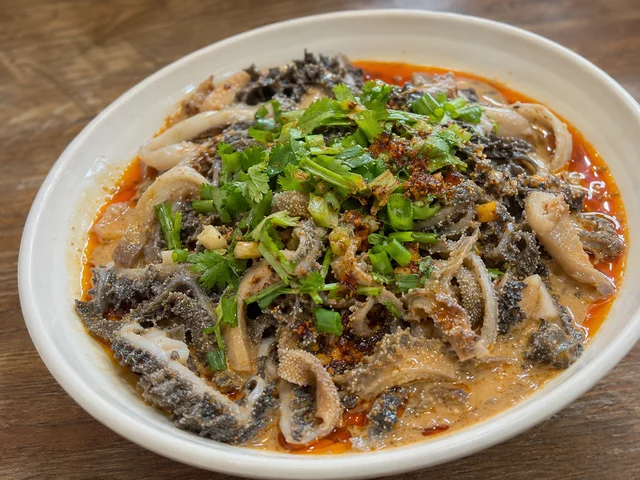
- Beijing Quick-Blanched Tripe
Tripe snack · Snack, one plate at a time
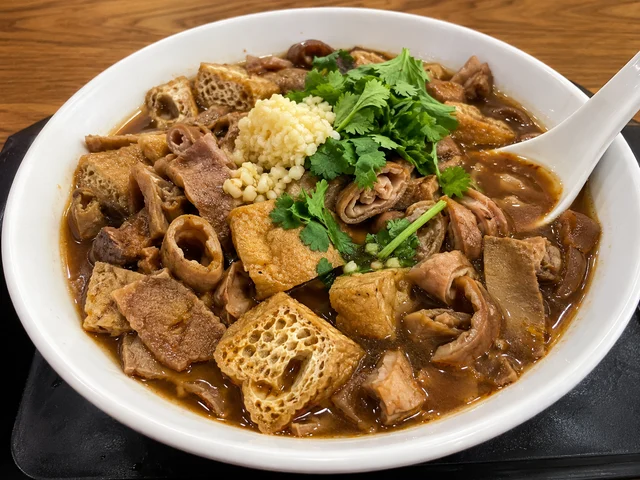
- Luzhu Huoshao
Offal stew · Lunch or dinner
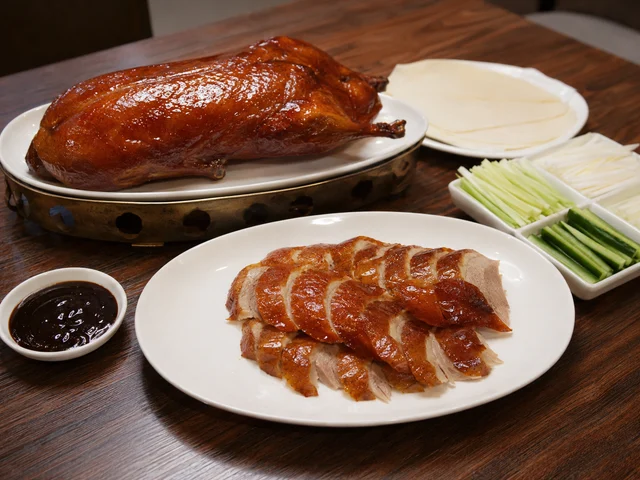
- Beijing Roast Duck
Roast duck · Shared meal
- Beijing Copper-Pot Mutton
Lamb hot pot · Winter, shared
- Beijing Zhajiang Noodles
Home-style noodles · Everyday meal, best in summer
- Baozi
Steamed filled bun · Breakfast
FAQ
Questions about Tanghulu
What is tanghulu?
A Chinese street snack of fruit, traditionally hawthorn berries, on a bamboo skewer, coated in boiled sugar that sets into a thin, glassy shell.
What fruit is used in tanghulu?
Hawthorn is the classic. Late-Qing Beijing also used grapes, crabapples and little yams; today strawberries, grapes and tangerines are common.
Why is it called bingtang hulu?
Bingtang is rock sugar, the old coating, and hulu means gourd, which a string of round fruit resembles.
Where does tanghulu come from?
It is a northern Chinese snack most closely tied to Beijing, recorded there in the late Qing. The story of a consort cured by hawthorn and sugar is a legend.
Why does my tanghulu turn sandy?
The sugar crystallized, usually because it was stirred after it dissolved or splashed up the sides of the pan.
How do you know when the sugar is ready?
Dip a skewer, cool it in cold water and bite. It should crack, with only a little stickiness.
How long does tanghulu last?
A day or two in cold winter air; at room temperature it gets sticky within hours.
How much sugar is in a tanghulu?
Korean lawmakers in 2023 cited estimates of up to half the recommended 50 grams a day in one skewer; a chain said each coated piece was about half a teaspoon of sugar.
Is Bing Dwen Dwen based on tanghulu?
Its designer, Cao Xue, said the mascot’s ice shell was inspired by tanghulu.
Sources
Sources and further reading
- 1 Fucha Dunchong, Yanjing Suishi Ji (燕京岁时记), entry on chestnuts, sweet potatoes, sachima and bingtang hulu (in Chinese)Late Qing (1900); Chinese original on Wikisource ↗
- 2 Wan Jianzhong, Beijing Yinshi Wenhua Fazhan Shi (北京饮食文化发展史), ch. 8 §4 “Popular food customs”: temple fairs, the bawang bian and Yi Sui Huo Sheng (in Chinese)Beijing People’s Publishing House (2025)
- 3 Wan Jianzhong and Jiang Wenhua, Beijingren de Yinshi Shenghuo (北京人的饮食生活), ch. 5 §5, ch. 6 §§2–3 and ch. 8 §2: hutong snacks, temple fairs, teahouses, street cries (in Chinese)Beijing Publishing House (2024)
- 4 Cui Daiyuan, Jingweir Shizu (京味儿食足), expanded ed., essay “Lamb skewers come to Beijing” (in Chinese)SDX Joint Publishing (2019)
- 5 Why is Bing Dwen Dwen so popular? Cao Xue on the tanghulu-inspired shellCGTN, China Daily (2022) ↗
- 6 Tanghulu CEO to testify before lawmakers on account of teen healthSeo Ji-eun, Korea JoongAng Daily (2023) ↗
- 7 Food fads fade faster as tanghulu shops vanishNam Yun-jung, Seoul Economic Daily (2026) ↗
- 8 How far to boil the sugar for tanghulu, and why no tanghulu stays hard (video, in Chinese)Pin Nuo Mei Shi (品诺美食开课啦), Bilibili (2022) ↗
- 9 A complete tanghulu tutorial: pitting, filled and flattened skewers, the sugar test (video, in Chinese)Lai Pi Hou (赖皮猴爱美食), Bilibili (2020) ↗
- 10 Who invented tanghulu? The story of Consort Huang (video, in Chinese)Zheng Jing De Zhi Shi (正经的知识), Bilibili (2021) ↗
- 11 A 5-yuan tanghulu from a street stall, 2024 (video, in Chinese)Nanchang Li Zhi En (南昌李知恩), Bilibili ↗
Last updated November 2026