
01
One dumpling, mostly soup
A crab roe soup dumpling is one huge, paper-thin dumpling filled almost entirely with crab-rich soup.
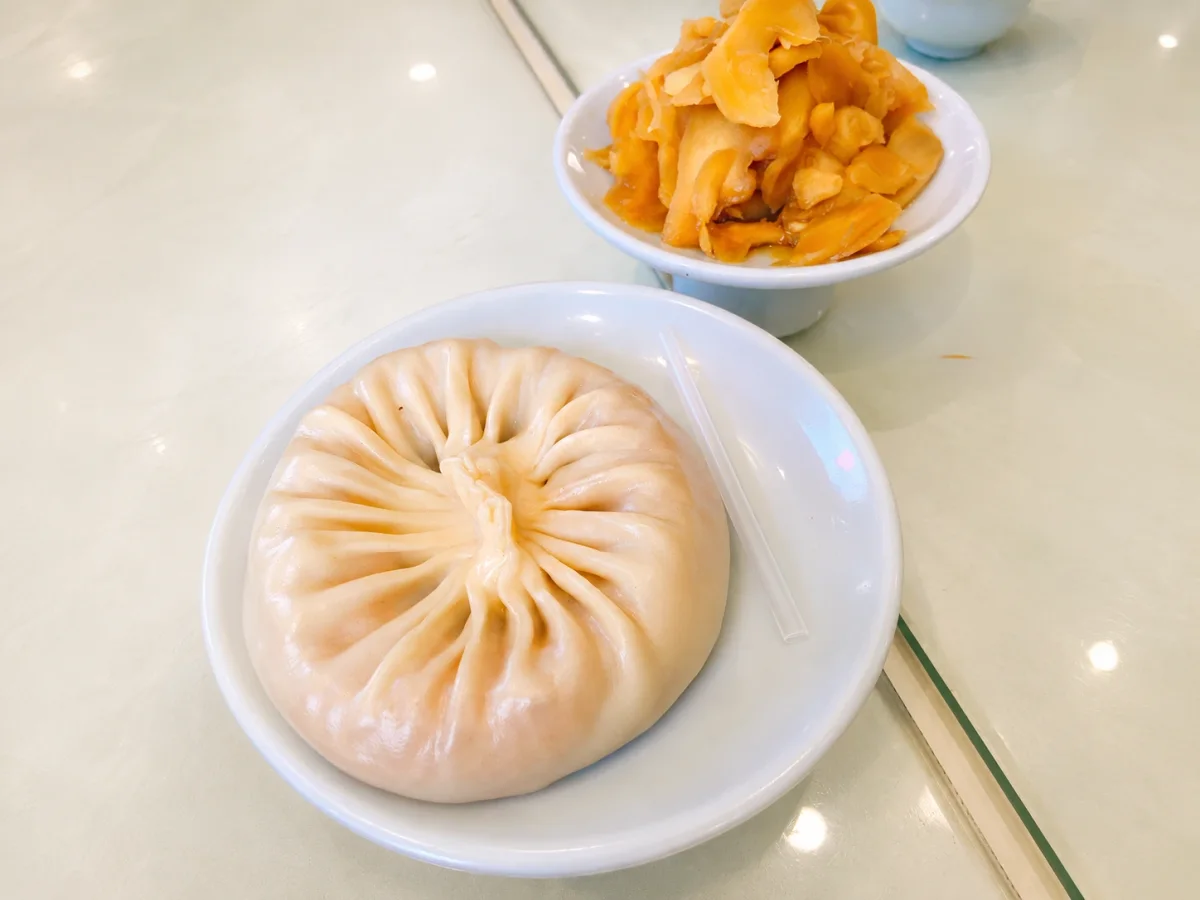
Each one holds about 125 grams of filling, twice the size of an ordinary soup dumpling, under a skin so thin it is nearly transparent. Its gathered top, with thirty or more fine folds, is meant to look like a chrysanthemum. Lift it and the dumpling sags like a water balloon; the filling inside is mostly hot soup, made from pork skin and chicken, with crab roe and crab meat stirred through it. Taizhou’s local standard for the Jingjiang dumpling, first issued in 2018 and revised in 2021, asks for a soup that is rich but not thick, smooth but not greasy, and the crab lends a gentle sweetness.
They are served one to a plate. In Jingjiang a server in disposable gloves lifts each dumpling out of the six-to-a-basket steamer and settles it on its own dish. Then comes the rule every local repeats: 先开窗,后喝汤, “open the window first, then drink the soup.” Let it rest a moment, bite a hole the size of a grain of rice, sip the soup slowly, then eat the skin with ginger and vinegar.
It comes alone on a plate, with a straw laid beside it for the soup.
02
Aspic, crab and a very thin skin
The soup goes in solid and comes out liquid.
The trick is aspic. Old hens and pork bones are simmered for hours, pork skin is added until the stock turns sticky, and the stock is left to set into a jelly. That jelly is chopped and mixed with picked crab roe and crab meat; in steaming it melts back into soup. The standard sets the proportions for a batch of 600: 60 kilograms of aspic to 15 kilograms of crab, the crab being local mitten crabs of 125 to 150 grams each, steamed and picked by hand.
The skin must hold all that liquid and still be almost transparent. Each 26-gram piece of dough is rolled out to 13.5 centimeters, thin at the edges and slightly thicker in the middle where the weight sits, then pleated shut with thirty to thirty-two folds and steamed for six minutes without lifting the lid. Counting the crab picking, the work runs to more than sixty steps. The Nanyuan Hotel in Jingjiang once tried a crab-picking machine, which turned the meat to mush, and the most precise Japanese-made dumpling machine, which managed only twelve folds; it gave up on both.
03
Jingjiang, Huai’an and Yangzhou
Three places claim the dish, and each does it a little differently.
Jingjiang, on the north bank of the Yangtze, has written its version into a local standard, down to the weight of each piece of dough. Huai’an’s famous name is the Wenlou restaurant in the old canal town of Hexia, where the skins are rolled out to as much as 18 centimeters, bits of chicken float in the soup with crab oil stirred through, and diners poke two or three holes with chopsticks, pour vinegar with ginger and coriander over, and suck out the soup. In Yangzhou, Fuchsia Dunlop describes the big soup dumpling as a local dim sum of its own, one to a basket, its soup sipped through a straw before anyone tries to lift it.
One thing to keep apart: the crab roe buns of Xinghua, nearby, are a different food, buns of pork mixed with crab meat, eaten for the filling rather than the soup.
| Jingjiang | Huai’an (Wenlou) | Yangzhou | |
|---|---|---|---|
| Size | About 125 g of filling; finished 12–13 cm across | Finished bun 10 cm across, 3 cm high; skin up to 18 cm | One big dumpling to a basket |
| Folds | 30–32 | Gathered like a chrysanthemum | — |
| Filling | Aspic with crab roe and meat | Soup with diced chicken and crab oil | Plenty of aspic |
| How to drink the soup | Bite a small hole and sip | Poke holes with chopsticks, add vinegar, suck | Often with a straw |
| Recognition | Provincial heritage 2009; local standard 2018, revised 2021 | Jiangsu quality food 1983; “famous Chinese snack” 1997 | — |
04
To straw or not to straw
The straw is the dish’s great argument.
In Yangzhou the straw is almost standard; Dunlop’s book and a 2018 China Daily report both describe sipping the big dumpling’s soup through one. In Jingjiang, cooks disagree. A chef there told Goldthread that despite what Instagram shows, the dumpling should not be eaten through a straw, because you suck the soup straight down and scald your throat; a small bite lets you control the heat. Jingjiang people add that fine crab meat clogs a straw anyway. Jingjiang and Huai’an share a twelve-character rule: 轻轻提,慢慢移,先开窗,后喝汤, lift it gently, move it slowly, open a window, then drink the soup.
Whichever you choose, rest it, but not for long. A local friend told a Jiangnan Times reporter that a soup dumpling is at its best for three minutes; after that the skin softens and the soup cools.
05
From pork soup buns to crab
The soup bun is old; the crab version is younger and harder to date.
The technique is documented in Qing-dynasty Yangzhou. Lin Sumen’s Hanjiang Sanbai Yin describes soup-filled pork buns: in the cool seasons, meat stock sets easily, so it is filled into buns of fine flour that melt back into soup when steamed, and the city’s teahouses were known for them. That was pork, not crab. In Huai’an, local historians date Wenlou to 1817 and describe its dumpling evolving over two generations, from crab-and-pork dumplings to a leavened crab bun and finally to the thin-skinned soup dumpling. It won a provincial quality award in 1983 and the China Cuisine Association’s “famous Chinese snack” title in 1997.
Jingjiang’s modern dumpling owes much to Tao Jinliang, who learned pastry at the Jingjiang Hotel at nineteen and, after becoming head chef in 1987, took the gamey taste and grease out of the stock and made the skin stronger and better-looking; in 2014 he became the technique’s provincial heritage bearer. According to the Taizhou city government, Jingjiang was named China’s “hometown of soup dumplings” in 2007, and its technique entered Jiangsu’s intangible heritage list in 2009. Other stories are legends. One says that Sun Shangxiang, the Three Kingdoms princess married to Liu Bei, threw herself into the Yangtze, and Jingjiang people honored her with a crab-filled soup dumpling still nicknamed the “Shangxiang tangbao.” Another has the Qianlong Emperor biting in too fast and scalding his back with the soup.
06
Crab season and the rest of the year
They used to be an autumn food.
Until the late 1990s, Jingjiang made crab roe soup dumplings only from September to December, when the crabs came to market, and Wenlou in Huai’an began serving them around the Double Ninth festival in autumn. Better cold storage for crab meat then made them a year-round dish. Crab season still brings the crowds: the Nanyuan Hotel sold 2,000 baskets in a day over the 2026 National Day holiday, and at Spring Festival it makes more than 3,000 a day.
07
Where to eat them and what they cost
Go early, expect to queue, and expect to wait for the steamer.
In Jingjiang, one of the best-known places is the Nanyuan Hotel’s Nanzhiyuan restaurant, whose cooks start at half past four in the morning and steam every basket to order; at Spring Festival the wait for a table is at least an hour. A couplet in the restaurant sums up the rule: the dumplings do not wait for the guests; the guests wait for the dumplings. In October 2026 its premium dumplings sold in boxes at 185 yuan for five or 382 for ten, about 37 or 38 yuan a dumpling, and its everyday ones at 17 or 23 yuan each. In Huai’an, go to Wenlou in Hexia, where the dumplings are worth the wait; in Yangzhou, China Daily’s 2018 breakfast tour went to Ye Chun Teahouse.
Share a basket
In Jingjiang a basket holds six, so it suits a group.
Go in the morning
It is a morning-tea food; in Jingjiang the cooks start before dawn.
Rest it, briefly
Let it sit a moment and open a window to let the steam out, then eat within about three minutes.
08
Making them at home
It is a two-day project, and a test of patience.
The standard is written for batches of 600 dumplings and gives no home recipe. The amounts below are that recipe divided by a hundred, our own scaling for one basket of six. A small pot loses far more water over six hours, so keep it covered at a bare simmer and top up with water, aiming for about 600 g of liquid before it sets. Make the aspic the day before.
For 6 dumplings: 110 g high-gluten flour, about 50 ml water, a pinch of food-grade alkali (about 0.3 g) and about 2 g salt for the dough; for the aspic, 100 g chicken (preferably an old hen), 50 g pork leg bone, 150 g pork skin, 1 liter water, 11 g scallion, 2.5 g ginger, 15 ml cooking (Shaoxing) wine, 4–5 g salt; 150 g crab roe and crab meat, picked from steamed mitten crabs; ginger and vinegar to serve.
- 1. Make the stock
Simmer the chicken and pork bone with the water, scallion, ginger and wine for about 5 hours. Lift them out, add the cleaned pork skin and simmer about an hour more, until sticky.
- 2. Set the aspic
Skim, season with salt, strain and chill until firm. You need about 600 g of aspic.
- 3. Make the filling
Chop the aspic finely and mix it with the crab roe and meat.
- 4. Make the dough
Mix the flour, water, alkali and salt, knead well and rest for 45 minutes. Divide into six pieces of about 26 g and roll each into a 13.5 cm round, thin at the edge and a little thicker in the middle.
- 5. Fill and fold
Put about 125 g of filling on each skin and pleat it shut with 30 or so small, even folds, closing the top small and tight.
- 6. Steam
Set the dumplings on a greased mat and steam over boiling water for 6 minutes without lifting the lid. Lift each one gently onto its own plate and serve with ginger and vinegar.
Sources [8]
09
More from Jiangsu and the Yangtze delta
Other dishes on the atlas.
Xiaolongbao
Shanghai’s small soup dumplings, eaten by the basket.
Read about xiaolongbao →Lion’s head meatballs
Yangzhou’s giant pork meatballs, with a crab-meat version in autumn.
Read about lion’s head →Squirrel fish
Suzhou’s showpiece sweet-and-sour fish.
Read about squirrel fish →Jiangsu classics
FAQ
Questions about Crab Roe Soup Dumplings
How is it different from xiaolongbao?
Size and soup. A crab roe soup dumpling holds about 125 grams of filling, mostly soup, in one paper-thin skin served one to a plate; xiaolongbao are bite-sized and eaten several at a time straight from the basket.
Should I use the straw?
Yangzhou often serves one; Jingjiang cooks prefer you bite a small hole and sip, which lets you control the heat. Either way, go slowly: the soup is scalding.
Is there really crab inside?
Yes: crab roe and crab meat mixed through the soup. The Jingjiang standard works out to about 25 grams of crab per dumpling.
When is the best season?
Autumn, when the crabs are in. Since the late 1990s refrigerated crab has made them available all year.
How much does one cost?
In Jingjiang in October 2026, 17 to 23 yuan each for the everyday version and about 37 yuan each for premium ones sold by the box.
How do I eat it without burning myself?
Let it rest a moment, open a small hole to let the steam out, and sip slowly.
Sources
Sources and further reading
- 1 Fuchsia Dunlop, Land of Fish and Rice, Chinese edition Yu Mi Zhi Xiang (鱼米之乡): “Dim sum” (in Chinese)CITIC Press (2021)
- 2 Lin Sumen, Hanjiang Sanbai Yin (邗江三百吟): “Soup-filled pork buns” (灌汤肉包) (in Chinese)Qing dynasty, Shidian Guji edition ↗
- 3 “A Huai’an specialty: Wenlou soup dumplings” (淮点一绝——文楼汤包) (in Chinese)Huai’an CPPCC culture and history website (October 25, 2024) ↗
- 4 “Jingjiang crab roe soup dumpling technique enters the first provincial traditional crafts revival list” (in Chinese)Taizhou Agriculture and Rural Affairs Bureau (June 28, 2024) ↗
- 5 “Inheritors: what goes into a Jingjiang crab roe soup dumpling” (传承人|靖江蟹黄汤包的“内涵”原来这么丰富) (in Chinese)Lingdu Jiangsu, Jiangsu Department of Culture and Tourism and Jiangsu Broadcasting, via The Paper (February 20, 2022) ↗
- 6 Owen Fishwick, “Breakfast in Yangzhou is something to wake up for”China Daily (March 20, 2018) ↗
- 7 “On the sands of Jingjiang, a basket of soup dumplings” (马驮沙上,一笼汤包阅江鲜) (in Chinese)Jiangnan Times (November 5, 2026) ↗
- 8 DB3212/T 1059—2021, “Taizhou morning tea: Jingjiang crab roe soup dumpling technique” (泰州早茶 靖江蟹黄汤包制作技艺) (in Chinese)Taizhou Administration for Market Regulation, local standard (October 12, 2021) ↗
- 9 Lu Yue, “Open the window first, then drink the soup: Jingjiang at Spring Festival” (先开窗,后喝汤,一口滚烫鲜满堂) (in Chinese)Yangtse Evening Post (February 22, 2026) ↗
- 10 Gu Weizhong, “Why a 68-yuan Xinghua crab roe bun sells out” (深读|68元一只的兴化蟹黄包,凭什么卖爆) (in Chinese)Xinhua Daily (October 28, 2026), via Yangzhou News ↗
- 11 Clarissa Wei, “How to eat tangbao, China’s biggest soup dumpling”Goldthread, South China Morning Post (March 19, 2021) ↗
Last updated November 2026