
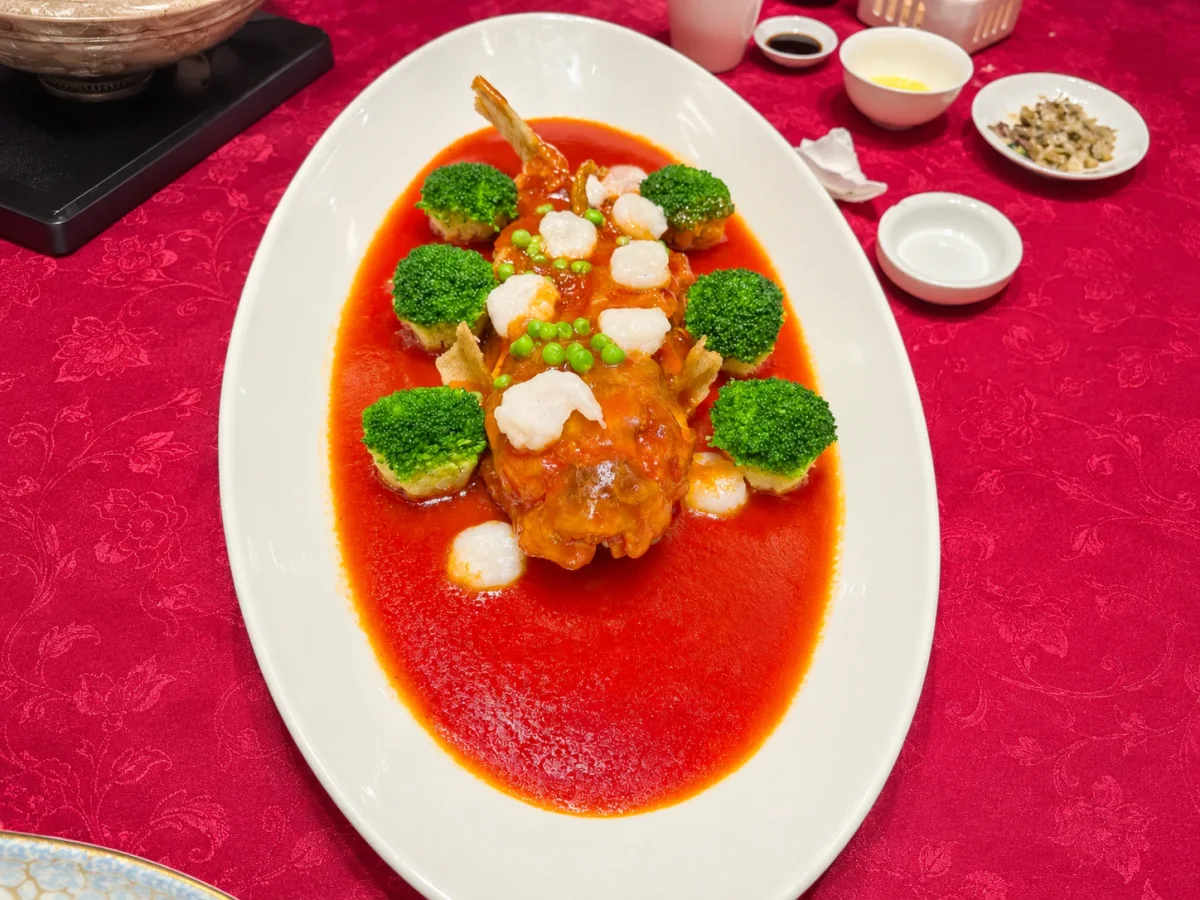
01
A fish cut to look like a squirrel
Squirrel fish is a whole mandarin fish, boned and scored so deeply that, fried, its flesh bristles like a squirrel’s tail.
The fish is mandarin fish (鳜鱼, guiyu), a freshwater fish; the name is also written 松鼠桂鱼, with 桂 standing in for its homophone 鳜. It arrives with head and tail raised and the flesh between them standing up in golden spikes. Then the hot red sauce goes on, and the fish sizzles with a crisp, chirping sound that China Daily likens to a squirrel’s call. The name comes from that shape.
What makes it worth ordering is the contrast. The spikes are brittle, the flesh underneath stays moist, and there are no bones to pick out. The sauce is glossy and leans sweet, as Suzhou cooking does: the people of Suzhou and Wuxi have a particular taste for sweet food, and squirrel fish is one of the city’s famous examples. Anyone who knows sweet-and-sour from Chinese restaurants abroad will recognize the family resemblance; this is a more elaborate relative, built on a whole boned fish.
It ranks near the top of Jiangsu’s famous dishes. The first edition of the province’s famous dishes cookbook, published in 1979, lists squirrel mandarin fish first among its fish and seafood, and it is counted among Jiangsu’s ten classic dishes.
It is also a good way into Suzhou cooking as a whole. The city’s heritage network says Suzhou cuisine first made its name on river fish and fresh vegetables, and sums up its style as rich but not greasy, light but not bland. With its sweet-sour flavor and elegant presentation, squirrel fish is typical of Suzhou cooking, and extremely complicated to make.
02
Old records and an emperor’s visit
Squirrel fish has a written history and a famous story, and they are not the same thing.
Suzhou’s intangible heritage network traces the dish a long way back. The Wu Yue Chunqiu, a chronicle of the ancient kingdoms of Wu and Yue, mentions a “roast fish,” 炙鱼, and the network says the famous squirrel fish evolved from it through many changes. It gives no steps in between, so this is best read as the city’s own account of its dish.
The firmer evidence is a Qing-dynasty recipe collection, the Tiaoding Ji (调鼎集). Its entry reads: “Take a mandarin fish, bone it from the belly, coat it in egg yolk, fry it golden and shape it like a squirrel; cook it with oil and soy sauce” (取鯚鱼,肚皮去骨,拖蛋黄,炸黄,作松鼠式。油、酱油烧; 鯚 is an old name for the mandarin fish). That puts the dish in the Qing at the latest, and today’s squirrel fish is said to descend from it. Note what is missing: no sugar, no vinegar, no tomato.
Then there is the emperor. The story is usually told as a legend: the Qianlong Emperor, traveling through the south in disguise, ate at Songhelou in Suzhou and was delighted with a fish the cook had boned, carved, coated in egg-yolk batter, fried and dressed with hot sweet-and-sour sauce. In one telling the fish was a carp and the dish became the talk of Suzhou; in another, it became famous across the country. The legend’s sweet-and-sour sauce does not match the oil and soy of the Tiaoding Ji, one more reason to keep story and record apart.
03
The knife work
Everything depends on the cuts, made before the fish goes anywhere near the oil.
The classic preparation goes like this. The fish is scaled, gilled and trimmed, and the head is cut off and pressed flat. The backbone is cut away along the back, carefully, so that the belly is not split, leaving about a centimeter of spine at the tail. The boned fish is laid skin down and scored with the knife held at a slant, cut after cut, to four-fifths of the depth of the flesh. The skin must stay whole: in the oil the scored flesh opens and stands up, and the uncut skin holds every strip in place.
The knife work is what makes the dish. At the restaurants of Jin Hongnan, president of the Suzhou Culinary Association, a fish of about a kilogram gets exactly 108 crisscross cuts. Only a highly skilled chef can work that precisely, which is why squirrel fish is rarely cooked at home.
The coating has moved on since the Tiaoding Ji’s egg yolk. Today the scored flesh is rubbed with salt, pepper, cooking wine and a little wet starch, dusted with dry starch and fried in very hot oil, what Chinese cooks call “seventy percent hot,” until the outside is golden and the flesh cooked. The head is dusted and fried separately, and the body goes on the platter cut side up so the spikes show. Dunlop works a starch paste into every cut and then adds a thick coat of dry starch, so that each strip fries on its own instead of sticking to its neighbors.
| The fish | The cuts | |
|---|---|---|
| Restaurant, whole fish | Mandarin fish, boned, head fried separately | Slanting cuts to four-fifths of the depth, skin left whole |
| Jin Hongnan’s kitchens | A fish of about 1 kg | 108 crisscross cuts |
| Dunlop’s home version | Two thick sea bass fillets, skin on | Straight cuts 1 cm apart, then cuts at 30° across them |
04
From soy sauce to tomato
The red sauce is the newest part of the dish.
The Qing recipe finished the fish with oil and soy sauce. Jin Hongnan says the original sauce was vinegar, soy sauce and sugar, already a step away from the Tiaoding Ji’s oil and soy, and that in the early 20th century, when Western-style restaurants were fashionable in Shanghai, cooks began adding tomato ketchup, which made the flavor mellower and more appealing to foreign diners. The restaurant sauce today is clear stock with salt, sugar, ketchup and vinegar, boiled and thickened with starch.
The last step has a name. A spoonful of hot oil, 明油, “bright oil,” is stirred into the sauce just before it goes over the fish, and gives it its gloss. Home cooks hardly ever bother with it; squirrel fish, where the shine is part of the look, is the exception.
What goes on top varies. Restaurants scatter it with tiny river shrimp and peas; other cooks use fried pine nuts and peas, or small dice of fruit. One Suzhou restaurant tops the fish with shelled shrimp and peas and rings the plate with broccoli. Whatever the garnish, the sauce should be thick enough to cling to the spikes rather than run off them.
05
Songhelou and the dish abroad
In Suzhou the name goes with one restaurant.
Songhelou, 松鹤楼, was founded in 1757, the 22nd year of Qianlong’s reign. It is the oldest surviving restaurant brand of Suzhou cooking and was among the first to be certified by the Ministry of Commerce as a “time-honored brand,” 中华老字号. Squirrel mandarin fish is its signature, alongside stir-fried shelled shrimp and eel in sauce, 鳝糊, and it is still the place to go in Suzhou for the real thing.
In 2025 Songhelou opened its first branch abroad, a three-story flagship in London’s Chinatown, with cooks from the Suzhou kitchen on hand to keep the technique right. The squirrel fish there keeps the Suzhou cuts and flavor, but the mandarin fish is replaced with British sea bass. Jin Hongnan’s own chain, Jiangnan Delicacy, with 30 restaurants in Suzhou, opened in San Francisco the same year; the fish sells there for nearly 1,000 yuan, about 140 US dollars, and more than half of all diners order it. Children, Jin says, love it most.
Chen Ye, who works at a foreign bank in Shanghai, told China Daily that her foreign friends always ask first whether there is a real squirrel inside. However many dishes are on the table, the fish is the first to go, head and tail included, though Chinese diners usually leave those. Astrid Poghosyan, an Armenian musician with the Shanghai Symphony Orchestra, explained the appeal: for many foreigners, sweet and sour is the first taste they connect with Chinese food.
06
Ordering squirrel fish
Order it for the table, and eat it as soon as it arrives.
Squirrel fish is a whole fish for sharing, a must-order at many Suzhou restaurants and a banquet dish: it is a common sight at New Year’s Eve dinners in hotels and restaurants. Because the bones are out, it suits children and anyone wary of fish bones. The crust starts to soften once the sauce is on, which is why cooks fry the fish at the last moment; eat it while it still crackles.
On the menu
Look for 松鼠鳜鱼 or 松鼠桂鱼; English menus say squirrel fish or squirrel-shaped mandarin fish.
Outside China
Songhelou’s London branch uses sea bass, so the menu may say 松鼠鲈鱼, squirrel sea bass.
Eat it fast
Start on it as soon as it lands, and do not skip the crisp head and tail.
07
Squirrel fish at home
Fillets make it manageable at home; the cuts still need patience.
Dunlop simplifies the restaurant method by using two thick sea bass fillets instead of a whole boned fish. Even so, she says the preparation needs great care. Work with a very sharp knife and handle the scored fish gently.
For one fish (2 fillets): 1 sea bass (about 500 g, boned into 2 thick skin-on fillets); 1½ tablespoons double-concentrate tomato paste; 1 tablespoon potato starch mixed with 2 tablespoons cold water; at least 500 ml oil for deep-frying. Marinade: 10 g unpeeled ginger; 1 scallion; ¼ teaspoon salt; ½ tablespoon Shaoxing or other cooking wine. Coating: 2 tablespoons potato starch mixed with 2 tablespoons cold water; 100 g dry potato starch. Sauce: 1½ tablespoons Chinese red vinegar; 2 tablespoons sugar; ½ teaspoon salt; 100 ml stock or water. Garnish: 1 tablespoon pine nuts; 1 tablespoon frozen peas.
- 1. Score the fillets
Lay a fillet skin side down. With the knife upright, cut across it at 1 cm intervals, right down to the skin but not through it. Then hold the knife at 30° to the board and cut across those lines, again about 1 cm apart and not through the skin. Repeat with the other fillet.
- 2. Marinate
Lightly crush the ginger and scallion and mix them into the fish with the salt and wine. Mix the sauce ingredients in a bowl.
- 3. Prepare the garnish
Cover the pine nuts with oil, heat gently to 100–120°C and fry until just golden; drain. Blanch the peas.
- 4. Coat
Just before serving, discard the ginger and scallion and pat the fish dry. Smear on the starch paste, working it gently into every cut.
- 5. Fry
Heat the oil to 180°C. Holding the fillets by the tail, coat them all over in dry starch, getting it into every cut so the strips stay separate. Hold each fillet by both ends so the cuts open, slide it into the oil and fry for 3–4 minutes, spooning oil over, until cooked, golden and crisp. Put the fillets on a serving dish.
- 6. Make the sauce
Pour off the oil. Heat 1 tablespoon oil over medium heat and stir-fry the tomato paste briefly. Add the sauce mixture, boil and stir to dissolve the sugar, then add starch mixture a little at a time until the sauce is thick enough to cling to the fish. Stir in 2 tablespoons of the frying oil.
- 7. Serve
Pour the sauce over the fish, scatter with pine nuts and peas and serve at once. For a simpler version, Dunlop pan-fries a whole scored sea bream for 3 minutes a side and pours the same sauce over it.
Sources [1]
08
More from Jiangsu and beyond
Other dishes on the atlas.
Lion’s head meatballs
Yangzhou’s giant pork meatballs, simmered for two hours in clear broth.
Read about lion’s head →Sweet and sour pork
Cantonese gulou rou, the sweet-and-sour dish most of the world knows.
Read about sweet and sour pork →Wuchang fish
Wuhan’s steamed bream, another freshwater fish with a famous name.
Read about Wuchang fish →Jiangsu classics
FAQ
Questions about Squirrel Mandarin Fish
Is there a squirrel in squirrel fish?
No. The name comes from the shape: the scored, fried fish, with its head and tail raised and its flesh standing up in spikes, is meant to look like a squirrel, and it sizzles when the sauce goes on.
Is it very sweet?
It leans sweet, as Suzhou cooking does, balanced by vinegar. If you know sweet-and-sour dishes from Chinese restaurants abroad, it is in the same family, with a crisp, boneless fish underneath.
Can I eat it outside Suzhou?
Yes. It is ordered in Shanghai and appears on Chinese restaurant menus around the world; Songhelou has a branch in London, made with sea bass, and a Suzhou chain serves it in San Francisco.
Why is there ketchup in the sauce?
According to Jin Hongnan of the Suzhou Culinary Association, ketchup came in during the early 20th century, when Western-style restaurants were fashionable in Shanghai. Before that the sauce was vinegar, soy sauce and sugar.
Did Emperor Qianlong really eat it?
That is a legend. The oldest known recipe, in the Qing-dynasty collection Tiaoding Ji, cooks the fish with oil and soy sauce, not sweet-and-sour.
Sources
Sources and further reading
- 1 Fuchsia Dunlop, Land of Fish and Rice, Chinese edition Yu Mi Zhi Xiang (鱼米之乡), translated by He Yujia: “The Jiangnan way of cooking,” “Techniques” and “Fish and seafood” (“squirrel” fish in sweet-and-sour sauce, with a simplified variation) (in Chinese)CITIC Press (2021)
- 2 Deng Zhangyu, “A twist in the tail: Squirrel fish reels in global foodies”China Daily (June 10, 2026) ↗
- 3 “Tastes of Jiangsu: squirrel mandarin fish, crisp outside and tender inside” (味蕾上的江苏·本土美食志|松鼠鳜鱼:外酥里嫩,酸甜碰撞) (in Chinese)Xinhua Daily, Jiaohuidian (November 27, 2023) ↗
- 4 Suzhou-style cooking techniques (苏帮菜烹制技艺) (in Chinese)Suzhou Intangible Cultural Heritage Information Network ↗
- 5 Lu Yanting, “Songhelou, a time-honored Suzhou brand, opens abroad” (用非遗文化对话国际味蕾,老字号松鹤楼开启出海新探索) (in Chinese)Laodong Bao (April 5, 2025) ↗
Last updated November 2026