
01
Crisp pork, a thin glaze and pineapple
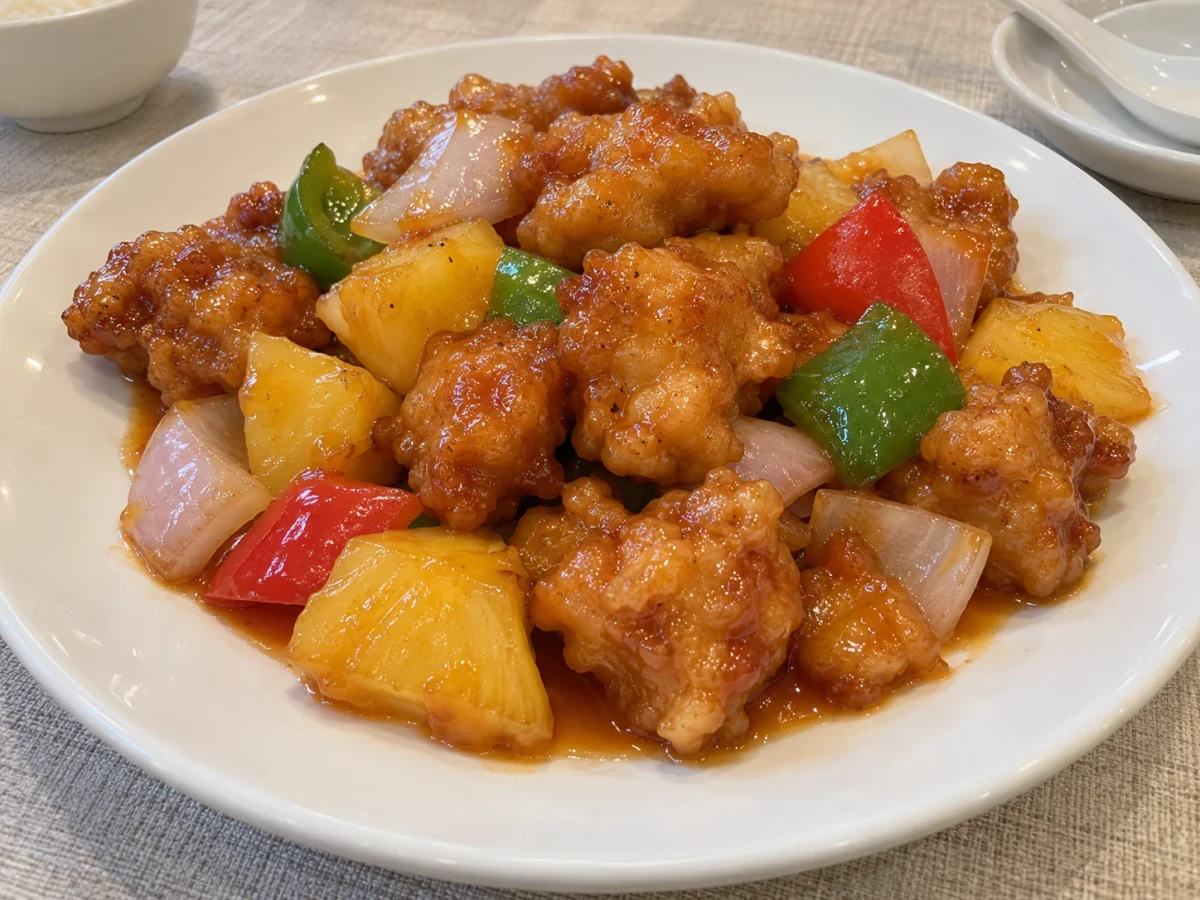
Good gulou pork is crisp outside, tender inside and coated in just enough sauce to cling: none should pool on the plate.
Cantonese cooks cut pork, usually a cut with some fat, into bite-size pieces, marinate them lightly, dip them in a batter of egg yolk and starch and roll them in dry starch, then fry them twice so the coating turns hard and crunchy. The sauce is made separately from sugar, vinegar and usually ketchup, brought to a simmer with garlic and peppers and thickened into a clear glaze. The fried pork, pineapple and peppers go in at the very end and are tossed for seconds. Cantonese cooks call the ideal 挂汁, “hanging sauce”: the glaze wraps each piece and the plate stays almost dry.
The flavor should be sweet and sour in balance, with a little salt underneath, so that the vinegar wakes the appetite rather than making you cough. Pineapple adds fruit and more acid; green and red peppers and onion add crunch. It is a dish for the table, eaten with rice, and like any fried dish it is best in the first few minutes.
02
Gulou, gulao or “old meat”: what the name means
The dish is written 咕噜肉, 咕咾肉 or 古老肉, and nobody agrees why.
The plainest early name was 甜酸猪肉, simply “sweet and sour pork.” The rest are stories. One says foreign diners in Guangzhou loved the dish so much that Cantonese cooks joked about “gweilo meat” (鬼佬肉, meat for foreigners), which softened into gulou. A patriotic version links it to “barbarian meat” (胡虏肉) from a line in the Song general Yue Fei’s poem. Others say foreigners mispronounced 古老, “old,” or that the name imitates the gurgle of a hungry stomach, the sound of swallowing, or the way foreigners pointing at the dish would say “good.” The Michelin Guide’s Hong Kong food writer Meng Huiliang lists most of these and settles on none.
The Cantonese chef and author Pan Yingjun offers the most practical explanation. Battered and fried, the pieces become round, and Cantonese calls a round thing 圆轱辘 (round-wheel shaped). The dish would have been 轱辘肉, and a waiter writing the menu who could not remember the characters wrote the homophone 咕噜, which cooks kept because it stuck in customers’ minds. Pan dismisses 古老肉, “old meat,” which appeared in old newspapers, as a far-fetched invention. In English the dish is almost always sweet and sour pork.
| Name | Meaning | Story |
|---|---|---|
| 甜酸猪肉 | Sweet and sour pork | The plain older name of a Cantonese summer dish |
| 咕噜肉 / 咕咾肉 | Gulou, gulao | From 轱辘, “round,” or from 鬼佬, “foreigner,” or a stomach rumbling |
| 古老肉 | “Old meat” | A mishearing; Pan Yingjun calls it far-fetched |
| 生炒骨 | Sang chau gwat, “raw-fried bones” | The spare-rib version, renamed in the 1940s |
03
Qing-dynasty Chen Village or the early Republic?
Two accounts of where gulou pork came from are in circulation, and neither cites a document.
The Guangdong vocational teaching office’s collection of Cantonese food stories places it in the Qing dynasty in Chen Village (陈村), one of the four great market towns of Shunde. There, it says, it grew out of a dish of pineapple and spare ribs fried “raw”; because foreign merchants did not like spitting out bones, Chen Village cooks swapped the ribs for boneless pork belly. Meng Huiliang tells a similar story set in Guangzhou’s Xiguan district at the end of the Qing, where foreign traders gathered: a plain summer dish of sweet and sour pork suited them because it was fried, had no bones and tasted unusual.
Pan Yingjun is more cautious and dates the dish to the first years of the Republic, after 1911. What all three agree on is that gulou pork was shaped by Guangzhou’s trade with foreigners and was boneless because foreign diners preferred it that way. The rib version is not a later spin-off in this telling but the older dish, and its name has its own story.
04
Sang chau gwat and the soup-bone scandal
The rib version is called 生炒骨, “raw-fried bones,” although nothing about it is raw-fried.
Pan Yingjun tells the story behind the name. In 1921 the restaurateur Chen Fuchou opened Xiyuan in Guangzhou, and Chen’s restaurants, with the chef Wu Luan, were built on a stock “clear as water and very savory,” first for Buddhist-style vegetarian dishes and then for shark’s fin and abalone. After the war, other Guangzhou restaurants copied Chen’s system, and making such stock left kitchens with piles of boiled pork ribs. Some unscrupulous restaurants battered and fried those spent bones and sold them, glazed in sweet-sour sauce, as 咕噜骨, “gulou ribs”; under the coating nobody could tell.
Around 1946, an old Cantonese cook recalled, a chef who knew the trick told a newspaper, and the public was outraged. Honest restaurants hurried to prove they used fresh ribs, and in the end renamed the dish 生炒骨, “raw-fried bones,” meaning the ribs went into the pan raw. The method is the same as for gulou pork: Pan gives identical recipes for the two, except that the ribs are cut in 2.5-centimeter pieces and fried for about eight minutes.
05
How a Cantonese kitchen makes it
The dish passes through three stations in a Cantonese kitchen, and every step is about keeping the crust crisp.
Pan Yingjun’s restaurant formula starts with a kilo of lean-and-fat pork from the loin area, cut into 0.8-centimeter slabs, scored on both sides so the batter grips, then cut into diamonds about 3 centimeters long. The cutting-board cook marinates them for about 30 minutes with salt, sugar and Fenjiu, a Shanxi sorghum spirit whose lingering aroma, Pan says, flatters pork fat as no other liquor does. The pieces are tossed in egg-yolk batter and then in dry starch, and pass to the wok cook.
Frying happens twice. The pork goes into peanut oil at about 150 to 180°C for three minutes, the wok is pulled off the flame for two more, and the pieces are lifted out; this half-fried stage can be held ready. To order, they go back into hot oil for two minutes to harden the shell. Pineapple and bamboo shoot are passed through the oil too. Then the wok is scrubbed, heated until smoking, and garlic and peppers are fried; the sweet-sour sauce goes in and is thickened into a clear “glass” glaze the moment it simmers. Pork, pineapple and bamboo shoot are tossed in it for a few seconds, finished with sesame oil, and the dish may be served in a hollowed-out pineapple.
The last toss must be fast: the longer crisp pork sits in hot sauce, the softer it gets. One Cantonese chef with 27 years at the stove fries at 120°C until the pork is cooked through and then at 150°C to drive out oil and color it, and folds the meat into the sauce off high heat so it coats without soaking in. Pan contrasts this with the northern technique of 熘, in which battered meat stays longer in its sauce until the coating turns silky; gulou pork wants crunch, so its contact with the sauce is brief.
06
The sauce: hawthorn, slab sugar, ketchup and Worcestershire
The sauce decides whether gulou pork is a classic or a cough.
Pan Yingjun prefers slab sugar (片糖), Cantonese brown cane sugar, for its fragrance and color, and allows vinegar to be replaced partly by acidic fruit: tomato, pineapple or hawthorn. Sourness, Pan writes, is the one taste that can sting, so the sauce should be just sour enough to notice and never so sharp it reaches the eyes and nose. The Hong Kong writer Ouyang Yingji grew up eating gulou pork almost daily and came to hate cheap versions made with vinegar essence and water, which made diners cough before they tasted anything sweet. Once Ouyang tried a sauce cooked with dried hawthorn and hawthorn cakes, nothing else would do.
Mixing Chinese and Western condiments is old. According to the Hong Kong food writer Wei Ling, quoted by Ouyang, the chef at Luk Yu Tea House in its Wing Kut Street days made the sauce from 600 grams of white vinegar, 400 grams of slab sugar, 200 grams of ketchup, 40 grams of Worcestershire sauce, two teaspoons of salt and two of dark soy sauce. Meng Huiliang lists rice vinegar, slab sugar, ketchup and Worcestershire as the usual base, with hawthorn or salted plum to round off the vinegar. Hong Kong kitchens still compete on it: one old Kowloon restaurant simmers fresh hawthorn, dried hawthorn and hawthorn cakes into its sauce, and another adds red yeast rice, plums and beetroot so the dish is not the usual fire-engine red.
The same mix is still at work in Hong Kong kitchens. In 2024 the food writer J.M. Hirsch watched the sauce being made at Brother Seafood Restaurant, opened decades ago by the father and uncles of Eddy Au Man Kit: ketchup poured from a seven-pound can, with vinegar, Worcestershire sauce, soy sauce and sugar, and dried hawthorn steeped in it and strained out. The pork was dusted in a thin potato-starch slurry, fried briefly in the wok and lifted out, and met the vegetables and the sauce only at the very end. “We don’t like to have too much sauce,” Au told him.
| Ingredient | What it does |
|---|---|
| Slab sugar 片糖 or white sugar | Sweetness, and with heat a little caramel color and aroma |
| Rice vinegar or white vinegar | The sourness; rice vinegar is milder |
| Ketchup 茄汁 | Color, body and fruit acidity; standard in Hong Kong and abroad |
| Hawthorn, dried or as hawthorn cake | The older fruity sourness, gentler than vinegar |
| Worcestershire sauce 喼汁 | Depth and spice; in Hong Kong recipes since at least the 20th century |
| Salted plum, lemon juice | Round off or brighten the vinegar |
07
Young ginger, strawberries and iced gulou pork
Because the sauce carries the dish, Cantonese cooks have put almost anything under it.
In Hong Kong the summer version uses 子姜, young pink ginger, instead of or alongside pineapple; Ouyang Yingji saves gulou pork for the young-ginger season. There are gulou prawns, chicken, fish and tofu, and a strawberry version of the rib dish called 士多啤梨骨, from the Cantonese for strawberry. The Michelin Guide’s writer notes newer habits that Meng regrets: sliced instead of cubed pork, all-lean meat for health, and coatings either too thick or fried too dry.
The most striking modern version is 冰镇咕噜肉, iced gulou pork, created in the late 1990s from the technique of spun sugar. Pan Yingjun describes it: pure back fat is boiled, sprinkled with Fenjiu and buried in sugar until it turns translucent “ice pork,” cut into cubes, battered and fried, then tossed in melted rock sugar and sweet-sour sauce and tipped onto a bowl of ice cubes, so the sugar shell sets hard and glassy. Crystal-sugar and sugar-sand versions use the same idea.
08
Gulou pork, tangcu liji and guo bao rou
Every Chinese region has a sweet-sour fried pork, and they are not the same dish.
Northern tangcu liji (糖醋里脊) is strips of tenderloin in batter, finished in a sweet-sour sauce more in the northern liu manner, so the coating softens. Northeastern guo bao rou is big thin slices of pork in potato-starch batter, fried twice and tossed in a pale sauce of sugar and vinegar without ketchup. Gulou pork is Cantonese: cubes, a hard crust, fruit and a glossy red glaze.
| Dish | Where | Cut | Sauce |
|---|---|---|---|
| Gulou pork 咕噜肉 | Guangdong, Hong Kong | Cubes or diamonds, often with fat | Glossy, with ketchup or hawthorn; pineapple and peppers |
| Sang chau gwat 生炒骨 | Guangdong, Hong Kong | Spare ribs in short pieces | The same as gulou pork |
| Tangcu liji 糖醋里脊 | Northern China | Tenderloin strips | Sugar and vinegar, held longer in the sauce |
| Guo bao rou 锅包肉 | Northeast China | Large thin slices | Pale sugar-vinegar, traditionally no ketchup |
| Sweet and sour pork balls | British takeaways | Battered balls | Red sauce in a separate pot |
09
From the Gold Rush to the takeaway
Sweet and sour pork was on Chinese menus abroad long before most other Chinese dishes.
Cantonese migrants carried it to California in the Gold Rush. The historian Haiming Liu dates the first recorded Chinese restaurant in America to 1849 in San Francisco, a place called the Canton Restaurant, and by the end of the 19th century, according to the historian Benjamin Shearer, American Chinese menus routinely offered sweet and sour pork, wonton soup and chop suey. In America the recipe changed to suit what was in the shops: ketchup replaced hawthorn, canned pineapple replaced fresh, and sharper white vinegar replaced rice vinegar, with much more starch in the sauce and several coats of flour on the pork. In 1983 McDonald’s launched a sweet and sour dipping sauce for its Chicken McNuggets, which the Guangdong account credits to the same dish.
In Britain the dish became sweet-and-sour pork balls. Fuchsia Dunlop remembers them from a 1970s childhood: golden battered balls in a rustling paper bag, with a plastic pot of translucent red sauce. In 1951 Britain had only 36 Chinese restaurant owners and managers; after the war, migrants from Hong Kong’s New Territories took over fish-and-chip shops, first in Liverpool and then Manchester and beyond, and by the early 1970s there were an estimated 12,000 Chinese takeaways and 3,000 restaurants. Dunlop points out that most of those cooks were farmers, not trained chefs, and that the simplified Cantonese menu they spread around the world hid the rest of Chinese cooking for decades.
10
How to order and eat gulou pork
A good plate stays crisp at the table, and a bad one tells you at the first bite.
Look for a dry plate
The glaze should cling to every piece with little or no sauce pooled underneath. A plate swimming in red sauce has been thickened too heavily or left too long.
Test the crunch
Ouyang Yingji’s standard is that it should still be crisp half an hour after reaching the table. Pork that is hard, chewy and salty was fried hours earlier.
Ask about the fruit
Pineapple is standard; in summer Hong Kong restaurants may offer young ginger instead.
Order it with something plain
It is rich and sweet, so share it with steamed greens, a soup and rice. It is cheap everyday food too: a lunch box with sweet and sour pork sold for 10 yuan at a building site in 2023.
11
Gulou pork at home
For 3 to 4 people with rice: 500 g pork shoulder or belly with some fat; ½ teaspoon salt, 2 teaspoons sugar and 1 tablespoon baijiu or Shaoxing wine for the marinade; 1 egg yolk; about 100 g cornstarch or potato starch; 150 g pineapple; ½ green and ½ red pepper; 1 small onion; 2 cloves garlic; oil for frying. Sauce: 4 tablespoons ketchup, 3 tablespoons rice vinegar, 3 tablespoons sugar, ¼ teaspoon salt, 1 teaspoon Worcestershire sauce, 4 tablespoons water; 1 teaspoon starch in 1 tablespoon water.
- 1. Cut and marinate
Cut the pork into slabs about 1 cm thick, score them lightly on both sides, and cut into 3 cm pieces. Mix with the salt, sugar and liquor and leave for 20 to 30 minutes.
- 2. Coat
Stir in the egg yolk, then roll each piece in dry starch and press it on firmly so it does not fall off in the oil.
- 3. Fry twice
Fry in oil at about 150°C for 3 to 4 minutes until cooked through and pale gold, and lift out. Heat the oil to about 180°C and fry again for a minute or two until hard and golden. Drain.
- 4. Make the glaze
In a clean wok with a spoonful of oil, fry the garlic, onion and peppers for a minute. Add the sauce ingredients, bring to a simmer and stir in the starch water until it turns clear and glossy.
- 5. Toss and serve
Turn off the heat, add the pineapple and the fried pork and toss quickly until every piece is coated. Serve at once.
Taste the sauce before the pork goes in: it should be clearly sweet and sour but never sting. For spare ribs, cut them into short pieces, fry them for longer at the first stage and finish the same way.
12
More Cantonese and sweet-sour dishes
Guo bao rou
Northeast China’s twice-fried sweet and sour pork in a pale glaze.
Read about guo bao rou →Char siu
The Cantonese roast pork that shares gulou pork’s sweetness.
Read about char siu →Egg fried rice
The other Cantonese dish that travelled the world with migrants.
Read about egg fried rice →Guangdong classics
- Char Siu
Roast pork · Lunch or dinner, with rice
- White Cut Chicken
Poached chicken · Lunch or dinner
- Cantonese Yum Cha
Yum cha · Morning tea, weekends with family
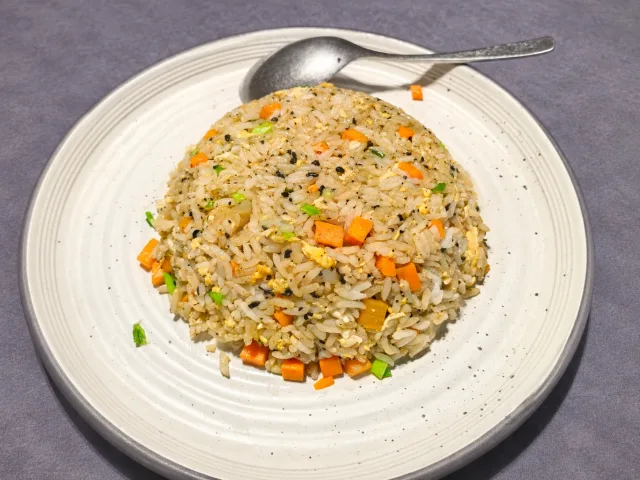
- Egg Fried Rice
Fried rice · Lunch, dinner, end of a meal
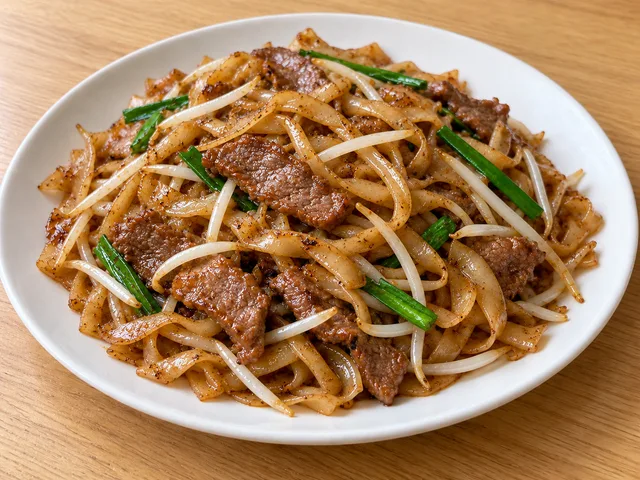
- Beef Chow Fun
Fried rice noodles · Lunch, dinner or late-night supper
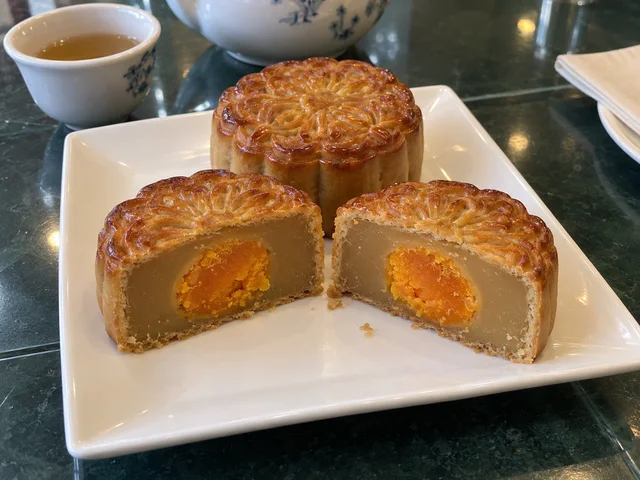
- Mooncake
Festival pastry · Mid-Autumn Festival
FAQ
Questions about Sweet and Sour Pork
What is sweet and sour pork in Chinese?
In Cantonese restaurants it is 咕噜肉 (gū lū ròu, gu lou yuk), also written 咕咾肉 or 古老肉. The plain name is 甜酸猪肉.
Is sweet and sour pork really Chinese?
Yes. It is a Cantonese dish from Guangdong, made in Guangzhou since at least the early 20th century. The thickly battered, bright red takeaway versions abroad are adaptations of it.
Why is it called gulou pork?
Nobody knows for sure. Explanations include 轱辘, “round,” for the shape; a pun on 鬼佬, “foreigner”; or the rumble of a hungry stomach.
What cut of pork is used for sweet and sour pork?
Cantonese cooks prefer pork with some fat, such as shoulder or a lean-and-fat loin cut, cut into cubes or diamonds. All-lean pork is drier.
What is the difference between gulou pork and guo bao rou?
Gulou pork is Cantonese: cubes, a hard crust and a red glaze with pineapple. Guo bao rou is from the northeast: large thin slices in potato-starch batter with a pale sugar-vinegar sauce.
What is sang chau gwat?
The spare-rib version of gulou pork. It was once called gulou ribs and was renamed “raw-fried bones” in the 1940s, after restaurants were caught using spent stock bones.
Did traditional sweet and sour pork use ketchup?
Older Cantonese recipes used hawthorn for fruity sourness, and some Hong Kong restaurants still do. Ketchup and Worcestershire sauce have been used in Hong Kong for many decades and became standard abroad.
How do you keep sweet and sour pork crispy?
Coat it in yolk and starch, fry it twice, thicken the sauce before the pork goes in, and toss for only a few seconds off high heat. Serve at once.
What is iced gulou pork?
A Cantonese variation from the late 1990s: sugar-cured pork fat, battered and fried, glazed with rock sugar and sauce and tossed over ice so the shell sets glassy.
Why is sweet and sour pork so popular abroad?
It was carried by the Cantonese migrants who opened the first Chinese restaurants in America and Britain, and its boneless, fried, sweet-sour pieces suited diners new to Chinese food.
Sources
Sources and further reading
- 1 Pan Yingjun, Yuechu Baodian: Caiyao Pian 1 (粤厨宝典·菜肴篇1), chapters “Gulou pork” (咕噜肉), “Sang chau gwat” (生炒骨) and “Gulou pork and sang chau gwat” (咕噜肉与生炒骨) (in Chinese)Guangdong Science and Technology Press (2020)
- 2 Guangdong Vocational and Technical Teaching Research Office, Zhongguo Yuecai Gushi (中国粤菜故事), chapter “The sweet and sour pork Americans dream of” (让“老美”魂牵梦绕的甜酸咕噜肉) (in Chinese)Guangdong Science and Technology Press (2022)
- 3 Ouyang Yingji, Xianggang Weidao 1 (香港味道1), revised ed., chapter “Gulou pork, past and present” (咕噜一番 咕噜肉的前世今生) (in Chinese)SDX Joint Publishing Company, Beijing (2018)
- 4 Fuchsia Dunlop, Junxingshi (君幸食), Chinese edition of Invitation to a Banquet, chapter “Sweet-and-sour pork balls” (似是而非的中国菜:糖醋肉球) (in Chinese)Shanghai Translation Publishing House (2024)
- 5 Tracing the roots of gulou pork, the Cantonese dish foreigners love: the name stories, hawthorn and salted plum, and the coated finish (Chinese) (in Chinese)Meng Huiliang (孟惠良), The MICHELIN Guide (2019) ↗
- 6 The Search for the Original Sweet-and-Sour PorkJ.M. Hirsch, Milk Street (2024) ↗
- 7 A Cantonese chef of 27 years on gulou pork: belly pork, egg yolk and starch, frying at 120 and 150°C, and a tomato-based sauce (video, in Chinese)Da Shi De Cai (大师的菜), Bilibili (2019) ↗
- 8 A 10-yuan lunch box of pineapple sweet and sour pork for construction workers (video, in Chinese)Wan Lin Ma Ma (晚霖妈妈), Bilibili (2023) ↗
Last updated October 2026