
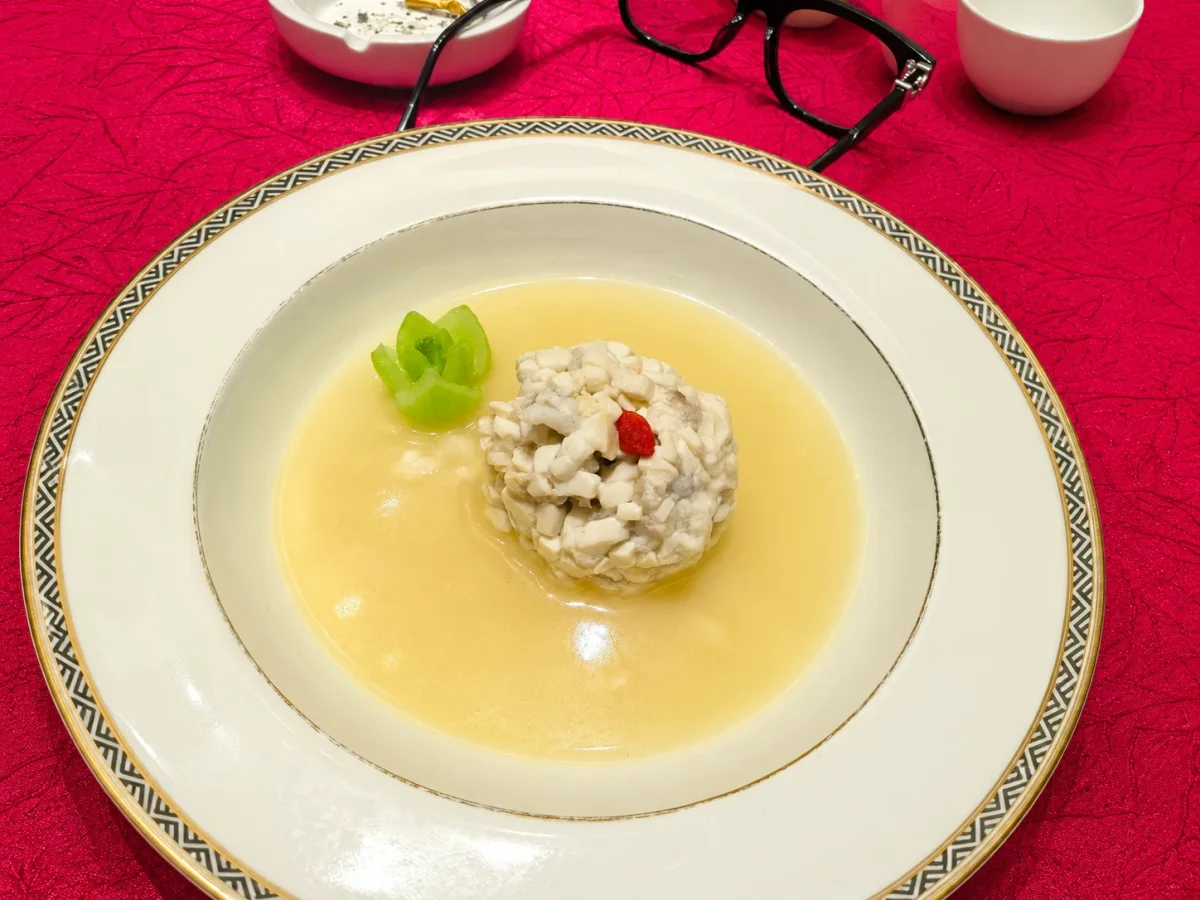
01
A meatball you eat with a spoon
Lion’s head is a very large pork meatball, so soft that it falls apart under a spoon.
The name sounds grand, but the dish is a meatball. Xu Ke’s 1917 compendium of Qing life explains it in one line: lion’s head is named for its shape, and it is a pork meatball. Fuchsia Dunlop, whose Land of Fish and Rice is a cookbook of the lower Yangtze, admits she has never seen the resemblance to a lion, and loves the dish anyway. Liang Shiqiu, the essayist, guessed it was named both for its shape and for its size.
What makes it famous is the texture. A good lion’s head is made from fatty pork, cut by hand, and cooked so slowly that it ends up, in Dunlop’s words, as tender and light as a cloud. It breaks the moment a spoon goes in. Dunlop says it shows better than any other dish what Chinese cooks mean by 肥而不腻, rich but not greasy. Even the broth it was cooked in, poured over plain rice, is worth eating.
In Yangzhou it is one of the “three heads” of the city’s best-known banquet, the 三头宴. The other two are a whole pig’s head, cooked slowly and served with soft white buns and sweet-sour garlic, and a fish head.
02
Fat, lean and the knife
Two things decide a lion’s head: how much fat goes in, and how the meat is cut.
There is no single fat ratio, but there is always a lot of fat. The 1917 recipe in Qingbai Leichao uses half fat and half lean. Liang Shiqiu’s recipe went the other way, seven parts lean to three of fat. Wang Zengqi, who grew up in Gaoyou, north of Yangzhou, wrote half and half, or seven fat to three lean for anyone who likes it fatter. In December 2025, at an event where Yangzhou’s districts showed off their landmark dishes, the lion’s head on show was made in what the city’s own news account called “the precise ratio” of seven fat to three lean, and the Woks of Life, eating it in Yangzhou, reported 60 percent fat. Dunlop uses skinless pork belly and warns against lean meat: the Yangzhou chef who taught her the dish told her a good lion’s head must melt in the mouth and be as soft as tofu, while one made from lean meat is as tough as steak.
The meat is cut, not minced. The old phrase is 细切粗斩, “finely cut, roughly chopped,” and Liang Shiqiu put the same rule as 多切少斩, “more cutting, less chopping”: the meat must be neither cut unevenly nor chopped to a paste, so dice it as small as you can with the knife, then chop it only briefly. Wang Zengqi wanted pieces the size of pomegranate seeds and said machine-minced pork will not do. The reason is texture: minced meat makes a mealy, pasty ball, while hand-cut dice give a soft, slightly rough meatball that still tastes of meat. She cuts the belly into 4–5 mm slices, then strips, then dice, cutting the leaner parts smaller, about 3–4 mm, as tradition asks, and suggests chilling the pork in the freezer for an hour or so first, because soft fat is hard to cut neatly. Wang Hongbo, a chef at Yangzhou’s Fuchun Teahouse, describes the result: meat that stays in separate grains and is as soft as tofu in the mouth.
| Source | Fat : lean | Cut |
|---|---|---|
| Qingbai Leichao, 1917 | 1 : 1 | Finely cut, roughly chopped |
| Liang Shiqiu’s Yangzhou classmate | 3 : 7 | More cutting, less chopping |
| Wang Zengqi | 1 : 1, or 7 : 3 | Pomegranate-seed dice, never machine-minced |
| Yangzhou landmark-food event, 2025 | 7 : 3 | Not stated |
| Dunlop, from a Yangzhou chef | Pork belly | 4–5 mm dice, lean parts 3–4 mm |
03
Clear-simmered in a clay pot
The Yangzhou way is to cook it slowly in broth, with nothing fried and no soy sauce.
The method has hardly changed in a century. Qingbai Leichao, in 1917, binds the chopped pork with egg white, lines a yellow-sand clay pot with napa cabbage or bamboo shoot, adds a little water and salt, sets very large meatballs on top, covers them with leaves, puts the lid on and cooks the pot over a gentle fire, resting it after every few bundles of firewood. That is 清炖, clear-simmering: no frying first, no soy sauce, nothing to cover up the pork.
Dunlop’s version, taught to her by a Yangzhou chef, adds the steps that make the meatball hold together. The diced meat is seasoned with ginger, scallion, Shaoxing wine and salt, then stirred hard in one direction and thrown against the bowl for a few minutes, until it turns sticky and springy. Stock or cold water is worked in a little at a time, then egg white and a thin starch slurry. Each meatball is shaped between wet palms and coated with more slurry, which gives it a faint sheen. Then it goes into barely simmering stock on a bed of blanched cabbage leaves, another layer of leaves goes on top, and the pot cooks covered on the lowest heat for two hours.
What comes with it changes with the season. Yangzhou restaurants usually lift the meatball out of its cooking broth and serve it in fresh clear broth, with blanched bok choy or small cabbage in winter, bamboo shoots in spring, freshwater shellfish in summer and crab in autumn.
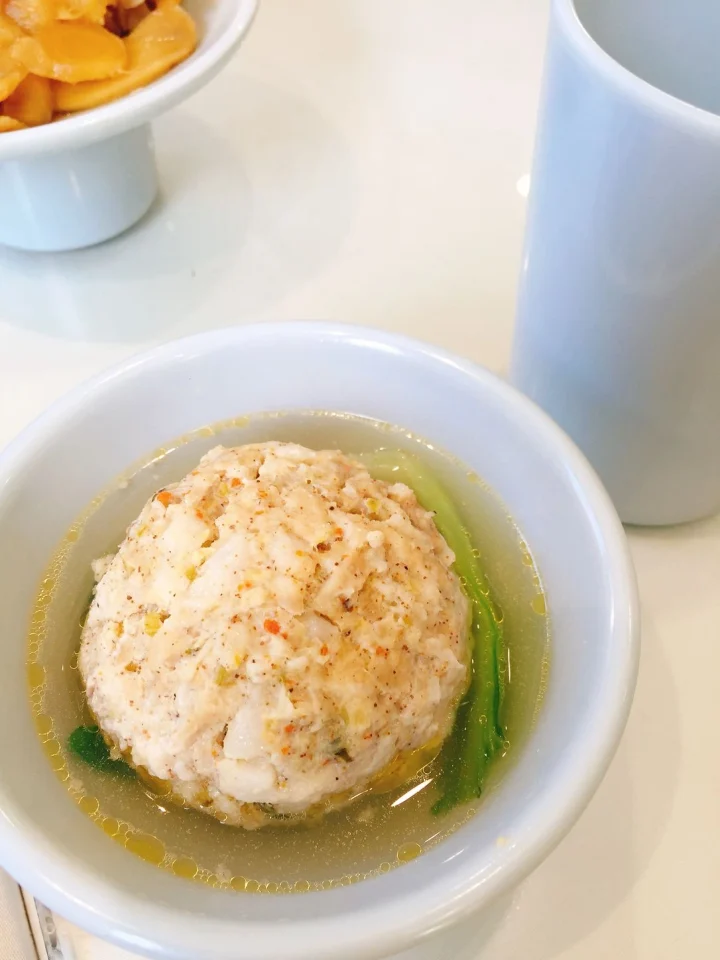
Lion’s head in clear broth
A close look at the surface of the meatball and the broth around it.
04
Crab meat in autumn
In autumn the best-known lion’s head is the crab-meat version, 蟹粉狮子头.
Crab meat in lion’s head is not a modern luxury. The 1917 recipe already says shrimp or crab meat may be added to the pork. Gao Xiaosheng, a Yangzhou-born chef who trained under a Yangzhou master from 1986 and later ran the Chinese kitchen of a Shanghai hotel, wrote that crab-meat lion’s head often appears at state banquets and belongs to early autumn, when hairy crabs are at their fattest. He uses hairy-crab meat and a stock simmered for more than two hours.
In Dunlop’s version, crab meat and a little white pepper go into the pork, and a small dimple pressed into each meatball holds a spoonful of crab roe, which she compares to a pearl set in a crown. She tried it with sea crab and found it good but different; the Yangzhou dish is made with freshwater hairy crab.
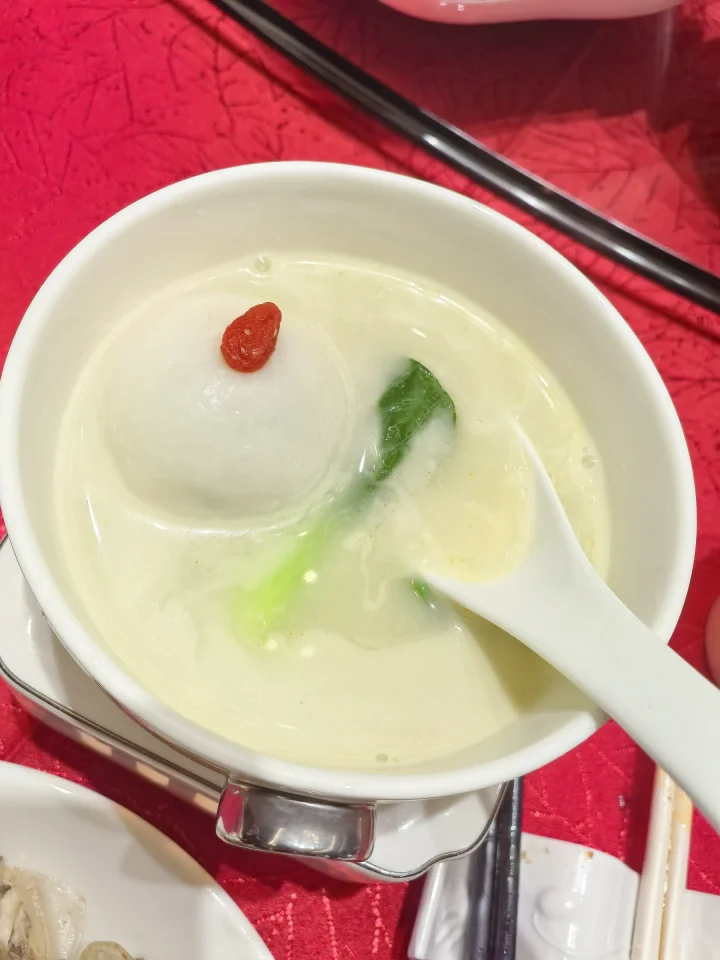
Crab-meat lion’s head
Our own photograph of the crab-meat version, served in clear broth.
05
Yuan Mei’s meatball, and a name recorded in 1917
The giant pork meatball is documented from the eighteenth century; the lion is a later name.
The earliest clear description is in Yuan Mei’s Suiyuan Shidan of 1792. Under “Magistrate Yang’s meatballs,” 杨公圆, he describes meatballs as big as teacups, incomparably fine, in a broth especially clear and fresh, that crumble in the mouth: sinew and gristle removed, the pork chopped very fine, half fat and half lean, bound with starch. An earlier entry in the same list, eight-treasure meatballs, records the opposite view that later became the rule for lion’s head: one Jia Zhihua said meatballs should be cut, not chopped.
The name lion’s head appears in print in Xu Ke’s Qingbai Leichao of 1917, with the recipe described above. Yangzhou also tells an older story: that a cook made giant meatballs for Emperor Yang of the Sui dynasty, who came to Yangzhou in the early seventh century, and called them 葵花斩肉, “sunflower chopped meat,” after a local beauty spot called Kuihua Gang; and that in the Tang dynasty a nobleman’s cook served them again, and his guests said they looked like lions’ heads. Gao Xiaosheng also dates the dish to the Sui dynasty under the name sunflower chopped meat. No Sui or Tang text records the dish. It is a legend, and the documented history begins with Yuan Mei.
06
Two writers’ lion’s heads
Two of China’s best-known food writers left their own recipes, and neither is clear-simmered.
Liang Shiqiu’s lion’s head is the recipe of a classmate, Wang Huacheng, a Yangzhou man who lost his mother young and was raised by an aunt who was a fine cook, who later served for years as China’s minister to Portugal and cooked for his guests himself. Wang’s method, as Liang wrote it down, solves a real problem. Starch in the meat makes it pasty, but without starch the meatball falls apart. So he spread the starch slurry on his palms and rolled the meat into four balls, which leaves a coat on the outside and none inside. The balls were pressed slightly flat and fried until the surface was taut and pale gold, then set in a bowl on chunks of winter bamboo shoot or napa cabbage and steamed hard for more than an hour. All the fat that rose to the top was skimmed off. The result, Liang wrote, could not be picked up with chopsticks, only scooped with a spoon, and was as tender as tofu. Scallion juice, ginger juice and salt went into the meat, and sea cucumber, shrimp, water chestnut or mushrooms if you liked, all finely chopped.
Wang Zengqi’s version adds chopped water chestnut, shapes balls the size of a mandarin orange, fries them just long enough to form a thin shell, then simmers them slowly with soy sauce and sugar until the flavor goes right through. That is a red-cooked lion’s head. Both insist on cutting by hand rather than chopping the meat to a paste.
07
Red-braised lion’s head
Red-braised lion’s head, 红烧狮子头, is fried golden first and then braised in soy sauce, sugar and wine, so it comes to the table brown and glossy, sitting in a thick sauce.
The pork is the same as for the clear-simmered kind, fatty and cut by hand; the difference is the cooking. A clear-simmered lion’s head goes into the pot raw and stays pale; a red-braised one is fried first, but only briefly. Wang Zengqi fried his until the outside formed a thin shell, and Liang Shiqiu stopped when the surface was taut and pale gold. That shell holds a very soft, fatty meatball together through the braise and takes on the colour of the sauce: soy sauce, sugar, Shaoxing wine, scallion and ginger, with stock or water to cover. Dunlop makes them about the size of a small mandarin, braises them like red-braised pork until the sauce is thick, and serves them on blanched bok choy with the sauce poured over. Some braise them on napa cabbage instead, or add coarsely chopped water chestnut for crunch, as Wang Zengqi did. A good one is deep reddish brown, shiny with sauce, and still breaks under a spoon.
Common in Shanghai, the red-braised kind has also been served at the top table. The 1949 banquet at the Beijing Hotel for the founding of the People’s Republic, for more than 600 guests, was Huaiyang food, cooked with chefs brought in from Beijing restaurants such as Yuhuatai (玉华台), and red-braised lion’s head, “clear but not bland, rich but not greasy,” was among the hot dishes. In 1958 Wang Zaifu and Zhang Fushe, former head cooks of Yuhuatai, a well-known Jiangsu restaurant, published their clay-pot version in a collection of famous Beijing dishes. They cut the pork to the size of sorghum grains, made four slightly flattened balls from a jin, 500 g, and browned them in lard for a minute or two. The balls then simmered in a clay pot with water, soy sauce, Shaoxing wine, scallion and ginger over the smallest flame for about 40 minutes, then a quarter of an hour more on stir-fried bok choy. They described it as deep red and so tender that it melts in the mouth.
It is also a family dish. Round meatballs stand for 圆满, completeness, and a big round lion’s head is meant to be shared when the family is together; on New Year’s Eve, a lion’s head on braised cabbage is one of the hot dishes of a Shanghai reunion dinner. Recipes usually make four from 300 to 500 g of pork, served together on one plate.
Yangzhou’s culture and tourism bureau gives this recipe for four meatballs: 300 g pork belly with fat and lean; 20 g white radish, shredded; 15 g scallion, some shredded and some sliced; 10 g ginger; 3 tablespoons Shaoxing wine; 4 g salt; 10 g sugar; 6 g chicken bouillon powder; 15 g cornstarch; 1 egg; about 450 ml oil for frying; 3 star anise; 2 tablespoons soy sauce; 4 small heads of bok choy.
- 1. Mix and shape
Cut the pork into small dice, then chop it briefly into a coarse mince, not a paste. Add the radish, shredded scallion, egg, half the wine, three-quarters of the salt and some of the sugar and bouillon powder; stir until sticky. Stir in most of the cornstarch and shape four balls, each about a handful.
- 2. Fry
Heat the oil and fry the meatballs over medium heat, turning them, until golden all over.
- 3. Braise
In a clean wok, put the sliced scallion, ginger, star anise, remaining wine and soy sauce. Add the meatballs and water to cover, season with the rest of the salt, sugar and bouillon powder, and boil over medium heat for 15 minutes. Lift the meatballs onto a plate.
- 4. Thicken and serve
Mix the remaining cornstarch with a little water, stir it into the wok until the sauce thickens, and pour it over the meatballs. Dip the bok choy in boiling water for five seconds and set it around them.
For softer, darker meatballs, braise longer over low heat: Yuhuatai’s recipe takes nearly an hour, and in 2020 Senlong, a Beijing Jiangsu restaurant first opened in 1924, braised its eight-treasure lion’s heads for four hours.
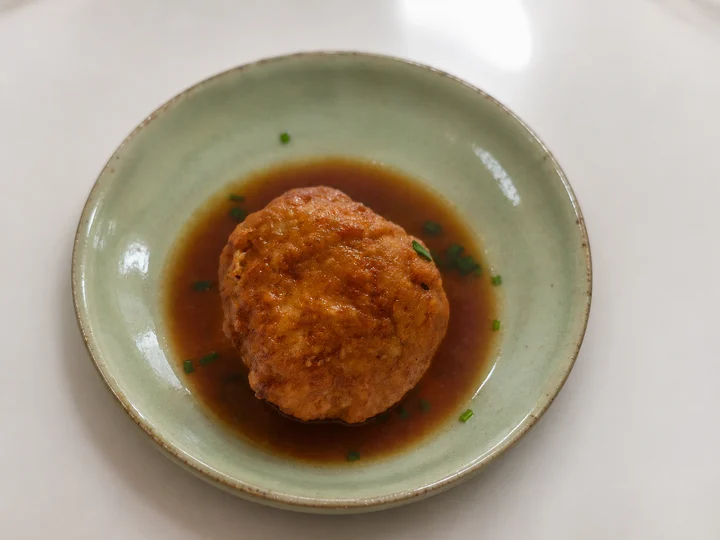
Red-braised lion’s head
The fried and soy-braised version, served in its own sauce.
08
Four-joy meatballs in the north
In northern China the giant meatball comes four to a plate as 四喜丸子, four-joy meatballs.
Liang Shiqiu says northern restaurants named them for the four on the plate, and that the northern way falls far short of Yangzhou’s lion’s head. The four meatballs stand for the four joys, 福禄寿喜: good fortune, prosperity, long life and happiness. That makes them a dish for celebrations, common at weddings, birthdays and reunion meals. In Shandong they are often the big closing dish of a wedding or birthday banquet, and a traditional dish of the New Year’s Eve dinner. In early February 2026, before the Spring Festival, Jiuling (九龄四喜丸子), a meatball shop in Shenyang’s Dadong food market, sold more than 2,000 in a day; customers bought four for peace through the four seasons, or eight for wealth from all eight directions.
The northern meatball is firmer than a lion’s head. In the Shandong recipe in Famous Chinese Dishes (1990), 400 g of lean pork is chopped to a fine paste, which lion’s head cooks avoid, and 100 g of fat is cut into 3 mm dice. Bound with egg and starch, the mixture makes four equal balls. They are fried golden, steamed for 30 minutes with Sichuan pepper, star anise and soy sauce, and plated; the juices are then thickened with sliced bamboo shoot and mushroom and poured over. The result is dense and coated in a thick sauce, where a lion’s head is loose and soft.
| Version | Method | Where |
|---|---|---|
| 清炖 clear-simmered | Raw meatballs simmered about two hours on greens in a clay pot | Yangzhou, the classic |
| 蟹粉 crab-meat | Clear-simmered, with crab meat in the pork and roe on top | Yangzhou and Shanghai, autumn |
| 红烧 red-braised | Fried golden, then braised with soy, sugar and wine; sauce reduced or thickened | Shanghai and Jiangsu, at home and in restaurants |
| 四喜丸子 four-joy meatballs | Four firmer meatballs, fried, then steamed; thick sauce poured over | Shandong and the north, at banquets and New Year |
09
Ordering lion’s head
On a Yangzhou menu, the name tells you how the lion’s head is cooked.
When Yangzhou’s districts put their landmark dishes on show in December 2025, clear-simmered lion’s head stood alongside Wensi tofu soup, blanched tofu shreds and Yangzhou fried rice. On menus, 清炖狮子头 is the plain version, 蟹粉狮子头 the crab-meat one, in season from early autumn, and 红烧狮子头 the soy-braised one. In restaurants it usually comes one meatball to a bowl, in broth. Gao Xiaosheng wrote that many of his guests ordered one the moment they sat down.
Eat it with the porcelain spoon, not chopsticks: a good one breaks apart as soon as you press it, and the broth is part of the dish. If it holds firm under chopsticks, the pork was probably too lean or minced by machine, which makes it mealy.
Plain or crab
Order 清炖狮子头 for the plain version. 蟹粉狮子头 is the crab-meat version, at its best in early autumn with hairy crab.
Red or four to a plate
红烧狮子头 is the fried and soy-braised version; in northern restaurants, 四喜丸子 come four to a plate.
Spoon, then rice
Break it with the spoon and drink the broth. If it comes with rice, pour a little of the juices over it.
10
Clear-simmered lion’s head at home
The work is in the knife; the stove does the rest.
This is Dunlop’s method from a Yangzhou chef, for four large meatballs. You need a clay pot or a heavy lidded pan and a sharp cleaver. Do not use ready-minced pork.
For 4 meatballs: 500 g skinless boneless pork belly; 2 teaspoons finely chopped ginger and 2 teaspoons chopped scallion white; 1½ tablespoons Shaoxing wine; 1½ teaspoons salt; 75 ml cold stock or water; 1 egg white; 1½ tablespoons potato starch mixed with 1 tablespoon cold water. For the pot: 8 napa cabbage leaves; a 10 g piece of unpeeled ginger; 1 scallion white; 500 ml chicken or chicken-and-pork stock; 1 tablespoon Shaoxing wine; ½ teaspoon salt; 3 tablespoons potato starch mixed with 3 tablespoons cold water.
- 1. Chill the pork
Put the pork belly in the freezer for 1 to 2 hours, until firm but not frozen. Meanwhile blanch the cabbage leaves in boiling water until soft, refresh them in cold water and drain.
- 2. Dice by hand
Cut the pork into 4–5 mm slices, then strips, then dice the size of pomegranate seeds, cutting the leaner parts a little smaller.
- 3. Work the meat
In a large bowl, add the chopped ginger and scallion, wine and salt, and stir hard in one direction. Pick up the meat and throw it back into the bowl for a few minutes, until sticky and springy. Stir in the stock a little at a time, then the egg white and the small starch mixture, still stirring in one direction.
- 4. Prepare the pot
Warm the clay pot with hot water and pour it out. Lay half the cabbage leaves in the bottom, add the stock and 250 ml water and bring to the boil. Add the wine, salt and the lightly crushed ginger and scallion, and turn the heat down.
- 5. Shape and coat
Divide the meat into four and shape each into a large ball with your hands. Stir the larger starch mixture and smear a little over each ball, then slide them gently into the barely simmering stock.
- 6. Simmer
Cover with the remaining cabbage leaves, adding hot stock or water so the meatballs are just covered. Bring back to a bubble at the edges, put on the lid and simmer on the lowest heat for 2 hours.
- 7. Serve
Lift off the top leaves, lift out the meatballs and plate them. For crab meat, mix 100 g crab meat and a little white pepper into the pork, and press a small dimple into each ball for a spoonful of crab roe.
Sources [1]
11
More from the lower Yangtze
Other slow-cooked pork and Jiangnan dishes on the atlas.
Dongpo pork
Hangzhou’s squares of pork belly braised in Shaoxing wine, the other great Jiangnan pork dish.
Read about Dongpo pork →Xiaolongbao
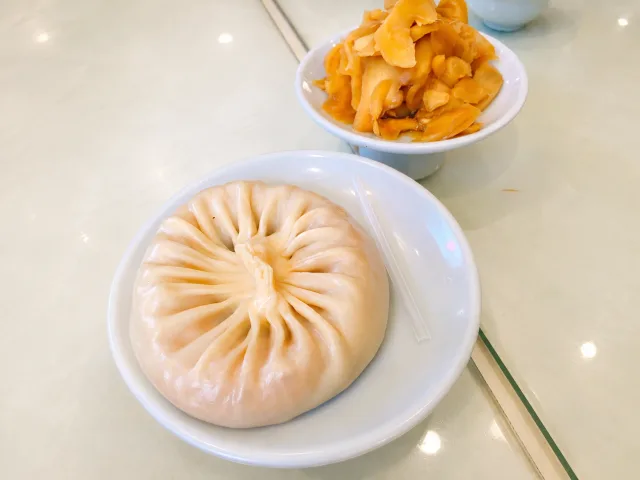
Shanghai’s soup dumplings, another dish where the pork filling is everything.
Read about xiaolongbao →Egg fried rice and Yangzhou fried rice
Yangzhou’s other famous dish, and how it traveled the world through Cantonese restaurants.
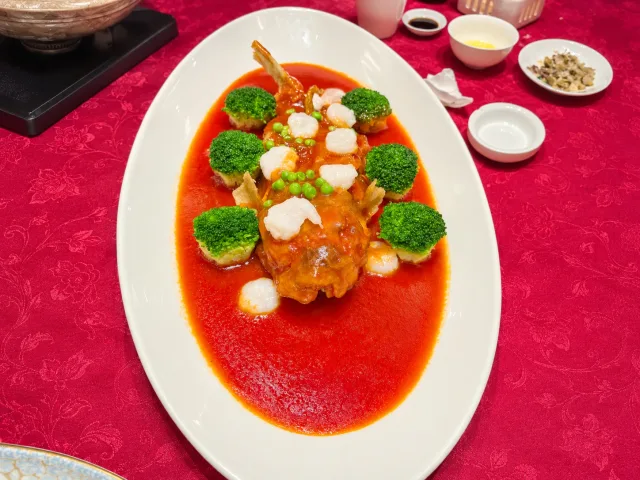
Read about Yangzhou fried rice →Jiangsu classics
FAQ
Questions about Lion’s Head Meatballs
Why is it called lion’s head?
The 1917 Qingbai Leichao says simply that it is named for its shape. A Yangzhou legend says Tang-dynasty guests thought the giant meatballs looked like lions’ heads; no Tang text records it.
Is lion’s head the same as four-joy meatballs?
They are relatives. Northern restaurants serve four large meatballs to a plate as 四喜丸子. Liang Shiqiu thought the northern version fell far short of Yangzhou’s.
Can I use ground pork?
You can make meatballs with it, but not a classic lion’s head. Hand-diced pork gives a soft, slightly rough meatball; machine-minced pork turns mealy.
How much fat should the pork have?
Recipes range from about 30 to 70 percent fat. Recent Yangzhou examples use more fat than lean, and Dunlop simply uses skinless pork belly. Lean meat alone makes it tough.
What is the difference between clear-simmered and red-braised lion’s head?
Clear-simmered lion’s head goes into the broth raw and cooks slowly for about two hours, with no soy sauce. Red-braised lion’s head is fried golden first and braised in soy and sugar.
When is crab-meat lion’s head in season?
Early autumn, when hairy crabs are at their best. Dunlop tried it with sea crab and found it good but different.
Why is it eaten with a spoon?
A properly made lion’s head is too soft to pick up with chopsticks. Liang Shiqiu wrote that it has to be scooped with a spoon and is as tender as tofu.
Sources
Sources and further reading
- 1 Fuchsia Dunlop, Land of Fish and Rice, Chinese edition Yu Mi Zhi Xiang (鱼米之乡), translated by He Yujia: “Introduction: Jiangnan” and “Meat” (clear-simmered lion’s head meatballs, with crab-meat and red-braised variations) (in Chinese)CITIC Press (2021)
- 2 Liang Shiqiu, Yashe Tan Chi Quanji (雅舍谈吃全集): “Lion’s head” (狮子头) (in Chinese)Tianjin People’s Publishing House (2018)
- 3 Qingbai Leichao (清稗類鈔), “Food”: “Lion’s head” (獅子頭) (in Chinese)Xu Ke (1917), Wikisource ↗
- 4 Suiyuan Shidan (1792), pork list: “Magistrate Yang’s meatballs” (楊公圓) and “Eight-treasure meatballs” (in Chinese)Yuan Mei, Wikisource ↗
- 5 Famous Chinese Dishes, vol. 3: Famous Beijing Dishes and Snacks, part 2 (中国名菜谱·第三辑:北京名菜名点之二), p. 77: clay-pot lion’s head (砂锅狮子头), by Wang Zaifu and Zhang Fushe, formerly head cooks at Yuhuatai (in Chinese)Light Industry Press (1958)
- 6 Famous Chinese Dishes, new series: Shandong Flavors (中国名菜谱·山东风味), p. 62: four-joy meatballs (四喜丸子) (in Chinese)China Financial and Economic Publishing House (1990)
- 7 Gao Xiaosheng, “Appreciating Huaiyang cuisine” (食趣見聞:欣賞淮揚菜) (in Chinese)MICHELIN Guide Hong Kong Macau (2018) ↗
- 8 “From home cooking to state banquets: how Huaiyang cuisine spread” (从家常菜到国宴,淮扬菜何以香飘四海?) (in Chinese)China News Service, via ifeng.com (May 25, 2024) ↗
- 9 “Yangzhou: unlocking the taste codes of a world capital of gastronomy” (江苏扬州:解锁“世界美食之都”舌尖密码) (in Chinese)Yangzhou Fabu (扬州发布), via The Paper (December 3, 2025) ↗
- 10 “Food in writers’ hands” (文人笔下的“吃”), quoting Wang Zengqi on lion’s head (in Chinese)The Paper (October 5, 2018) ↗
- 11 “The menu of the founding state banquet” (“开国第一宴”菜单解密), recollections of a former Foreign Ministry protocol officer (in Chinese)Xiangchao, via People’s Daily Online and ifeng.com (March 8, 2011) ↗
- 12 “Chefs’ New Year’s Eve dishes: eight-treasure lion’s head” (名厨料理年夜饭——八宝狮子头), with Wang Peixin of Senlong (in Chinese)Wang Ping, The Beijing News (January 18, 2020) ↗
- 13 CNY Dinner: The Meaning Behind China’s Most Important MealCindy Kuan, City News Service (February 12, 2026) ↗
- 14 “Close-up: everyday life in four-joy meatballs” (新春走基层丨特写:四喜丸子里的人间烟火) (in Chinese)Yu Yetong, Xinhua (February 5, 2026) ↗
- 15 Where excellence is made: Chinese New Year’s Eve dinner, braised pork balls in brown sauceChina Daily Shandong, from Iqilu News (February 3, 2022) ↗
- 16 Exploring Huaiyang Cuisine: Our Culinary Journey to YangzhouJudy Leung, The Woks of Life (2024) ↗
- 17 Lion’s head meatball, with a red-braised recipeSee Yangzhou, Yangzhou Municipal Bureau of Culture, Radio, TV and Tourism, presented by China Daily (December 24, 2020) ↗
Last updated November 2026