
01
A sheep’s stomach full of lamb
Lamb, salt and a sheep’s stomach, tied and simmered.
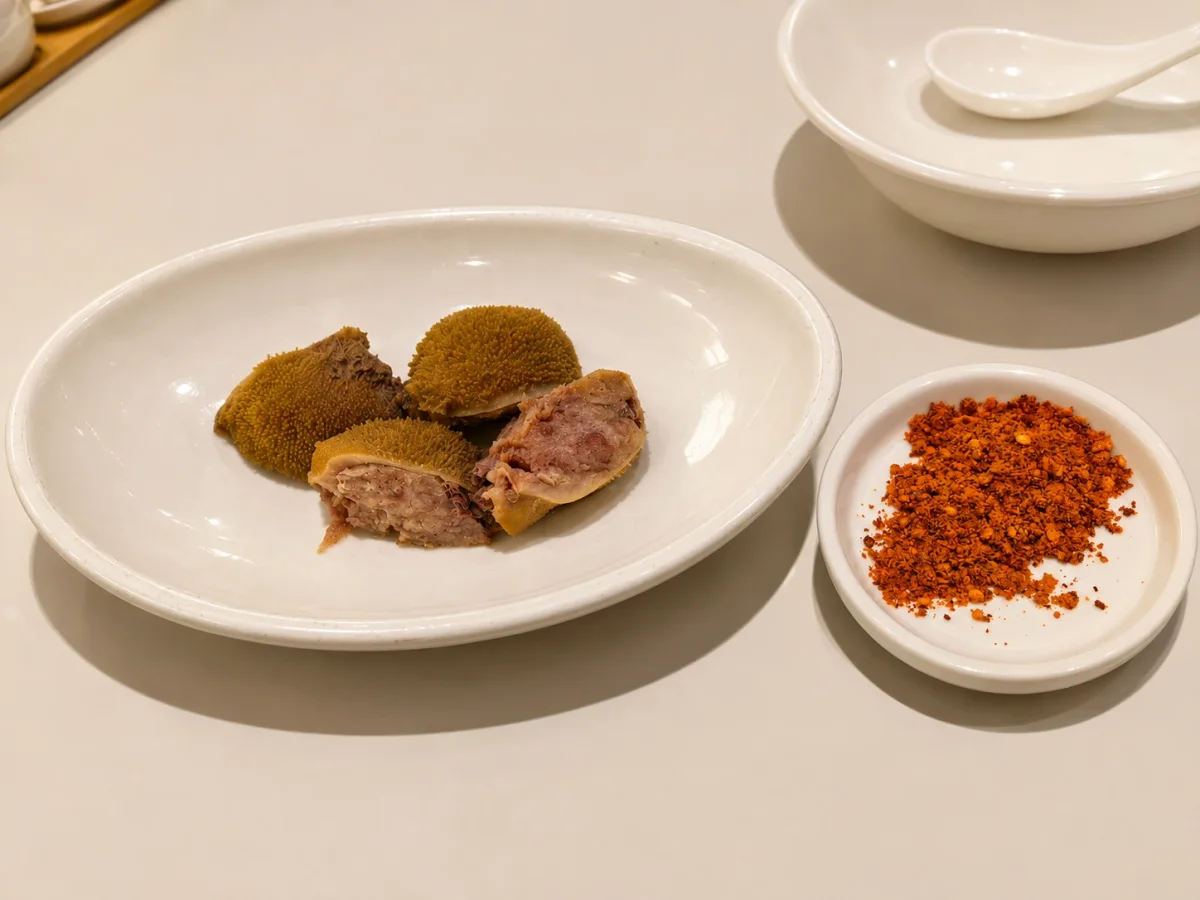
On an oval plate at a restaurant in Inner Mongolia sit two dubaorou, each cut in half and each about the size of a fist. The outside is the sheep’s stomach, olive-brown and covered all over in short, soft, velvety bristles, the papillae that line a sheep’s first stomach. Inside, the lamb is packed tight, pale pink and grey, in coarse pieces pressed together into a solid filling. Beside the plate is a saucer of coarse, dry red chilli powder for dipping. The restaurant charged 28 yuan for one in 2026.
Fresh lamb is chopped, seasoned and sealed inside a cleaned sheep’s stomach, which is tied tight and cooked slowly in water. The stomach does two jobs: it is the pot, holding the meat together and keeping all its juices in, and it is part of the meal. After hours in the pot it becomes soft yet still springy to the bite, while the lamb inside stays moist and fragrant, sitting in its own hot broth.
Northern Chinese who love lamb tend to love its offal too, and of all the offal, the stomach is the most widely liked. In Inner Mongolia there are many ways to cook sheep’s stomach, and dubaorou is the favourite. On the grasslands it was a dish herders made for honoured guests and for festivals.
02
The herders’ way
The traditional method needs a fresh stomach, sand onion, twine and hours of slow heat.
The book Inner Mongolian Folk Customs describes how it was done. An experienced herder chose the freshest stomach and the freshest lamb from a newly slaughtered sheep. The lamb was chopped fine and seasoned, above all with sand onion, the thin wild onion that grows on the steppe. The stomach was packed full and wrapped tight around the meat, then tied firmly with string twisted from sheep intestine or horsehair.
It went into a big pot of water over a fire of dried cow dung or firewood and simmered slowly for several hours. Someone had to tend it all that time, feeding the fire and topping up the water, until the stomach was soft and the meat had taken in the seasoning.
Today’s cooks often keep the lamb on the bone. They chop it into small chunks with the bone in, marinate it with salt, cooking wine and pepper, then pack it into the stomach and tie it with thin string.
03
Cutting one open
The broth inside is the point, and it is very hot.
A whole dubaorou comes out of the pot taut and round, the stomach stretched tight by the steam and juices inside. In 2025, at an army cooks’ contest on the Xilingol grassland, it was called a “food grenade” in the pot. Cooks prick the stomach with a toothpick or skewer before cooking so that it does not burst.
At the table it is cut open with a knife, and the broth that pours out is part of the dish. The stomach is springy and chewy, a little like beef omasum, maodu; the lamb is moist and tastes clean, without the strong smell that badly handled mutton can have. Eat it hot: as it cools the broth soaks into the meat or runs out on to the plate, and in our photograph the halves have already given up their juice.
04
Haggis, boodog and the sand-baked version
Cooking meat inside an animal is an old idea across the grasslands and beyond.
English readers will think of haggis. Scotland’s national dish is also traditionally cooked in a sheep’s stomach, but what goes inside is different: haggis is the heart, liver and lungs, minced and mixed with onion, oatmeal, suet and stock, while dubaorou is plain lamb, often on the bone, with little more than salt.
Across the border in Mongolia, where cooked mutton is the everyday food of the countryside and spices are used sparingly, herders have other ways of cooking meat in a sealed container. Khorkhog is chunks of mutton cooked with stones heated in a fire inside a sealed milk can. Boodog goes further: a goat or marmot is boned and cooked inside its own body cavity, again with hot stones.
In Xinjiang, on the edge of the Taklamakan desert, lamb is packed into a sheep’s stomach in the same way and buried in sand under a fire until it cooks in the heat.
05
From the grassland to the internet
A herders’ dish became one of Inner Mongolia’s best-known foods online.
Enke, an Inner Mongolian internet personality, won millions of followers with videos of himself eating it in huge, cheerful mouthfuls. Dubaorou became a trending food, Inner Mongolian restaurants made it a signature dish, and in some of them diners queue for it.
It also became a parcel. E-commerce platforms sell it in many brands and sizes, raw and frozen or vacuum-packed and ready to heat. In 2021 a pack of eight, weighing two jin (one kilogram), cost 130 yuan with express delivery, and cheaper packs went for 70 to 80 yuan.
06
What to eat it with
A dip, the broth, and more lamb.
The classic dip is chive flower sauce, 韭菜花酱, made from the salted, ground flowers of garlic chives, sometimes with chilli. It is the same sauce Inner Mongolians eat with boiled lamb, 手把肉, and it is salty, so dip lightly. Our restaurant served coarse dry chilli powder instead; garlic chilli sauce is another choice.
If dubaorou is cooked at home, the broth it was boiled in, lightly flavoured with lamb, is drunk as soup. At the Grassland Nadam in Xilingol in 2025, the tasting tables for visitors offered hand-held boiled lamb, dubaorou and roast lamb ribs together.
| With it | What it is | Note |
|---|---|---|
| 韭菜花酱 chive flower sauce | Salted, ground garlic-chive flowers | Salty; dip lightly |
| 辣椒面 dry chilli powder | Coarse ground dried chilli | Served with ours |
| 蒜蓉辣酱 garlic chilli sauce | Garlic and chilli paste | Another dip |
| 羊肉汤 lamb broth | The cooking liquid | Drunk as soup |
| 手把肉 boiled lamb | Lamb on the bone, boiled plain | Served beside it at the 2025 Nadam |
07
Cooking bought dubaorou at home
Most people outside Inner Mongolia meet it as a frozen or vacuum-packed parcel.
For 2 to 4 people: 4 raw frozen dubaorou, about 1 jin (500 g) in all, thawed; 3 slices ginger; 2 scallions; a pinch of salt; chive flower sauce or dry chilli powder to serve.
- 1. Rinse and blanch
Rinse the dubaorou, put them in a pot of cold water, bring to the boil and boil for 5 minutes. Drain and discard the water.
- 2. Prick
Prick each one in a few places with a toothpick or skewer so that it will not burst under pressure.
- 3. Cook
Put them in a pressure cooker with the ginger, scallions, a pinch of salt and water to cover. Cook for 30 minutes at pressure. In an ordinary pot, simmer gently for a few hours, topping up with water, until the stomach is tender.
- 4. Serve
Lift them out, cut each in half at the table so that the juices are not lost, and eat at once with the dip. Drink the broth as soup.
Ready-cooked vacuum packs only need heating through: follow the pack, and still cut them open at the table.
08
Ordering it
Restaurants sell it by the piece or by weight.
Find it on the menu
Look for 肚包肉, sometimes 羊肚包肉, in Inner Mongolian and northwestern restaurants.
Our plate
We paid 28 yuan for one in 2026. Restaurants charge by the piece or by the jin, so check before ordering several.
Eat it hot
Ask for it to be cut at the table and eat it while the broth is still inside.
With it
Boiled lamb, Hohhot shaomai or a bowl of noodles, and salty milk tea or plain tea.
09
More northern lamb
Other pages on the atlas.
Shaomai
Hohhot’s lamb shaomai, ordered by the liang for breakfast.
Read about shaomai →Lanzhou hand-grabbed mutton
Lamb boiled on the bone and eaten with the hands.
Read about hand-grabbed mutton →Beijing copper-pot mutton
Thin lamb slices dipped in boiling water at the table.
Read about copper-pot mutton →Sand onion scrambled eggs
The wild steppe onion that once seasoned dubaorou.
Read about sand onion →FAQ
Questions about Dubaorou
What is dubaorou?
Inner Mongolian lamb, chopped and seasoned, tied up inside a sheep’s stomach and simmered for hours; you eat both the stomach and the lamb.
Is it the same as haggis?
Both use a sheep’s stomach, but haggis is minced heart, liver and lungs with oatmeal, while dubaorou is plain lamb, often on the bone.
What does it taste like?
The stomach is springy and chewy; the lamb is moist and lightly salted, in its own hot broth.
What do you dip it in?
Chive flower sauce is the classic; dry chilli powder or garlic chilli sauce also work.
How long does it take to cook?
Traditionally several hours over a slow fire; about half an hour in a pressure cooker.
Sources
Sources and further reading
- 1 Wang Feng, “Dubaorou: the name alone is enough to tempt you” (2025) (in Chinese)Inner Mongolia Economic Net ↗
- 2 “Nadam flavours: the many ways to eat Xilingol lamb” (2025) (in Chinese)Wuhai Daily ↗
- 3 Mongolian cuisineWikipedia ↗
- 4 HaggisWikipedia ↗
- 5 Dubaorou: lamb and sheep’s stomach, a perfect match (video, in Chinese)Li Lihong (配音解说李立宏), Bilibili (May 2023) ↗
- 6 Two jin of Inner Mongolian dubaorou for 130 yuan, with chive flower sauce (video, in Chinese)Li Yisheng (李一生L), Bilibili (September 2021) ↗
- 7 Careful, there’s a “food grenade” in the pot (video, in Chinese)CCTV Military (央视军事), Bilibili (August 2025) ↗
- 8 Lamb in a sheep’s stomach, buried in the sand to cook (video, in Chinese)Pinwei Xinjiang (品味新疆), Bilibili (March 2022) ↗
- 9 A Mongolian-style breakfast in Hohhot: boiled lamb, salty milk tea and chive flower sauce (video, in Chinese)Dage zai Shanghai (达哥在上海), Bilibili (May 2024) ↗
Last updated November 2026