
01
A plate of green and yellow
Two ingredients: a thin desert onion and eggs.
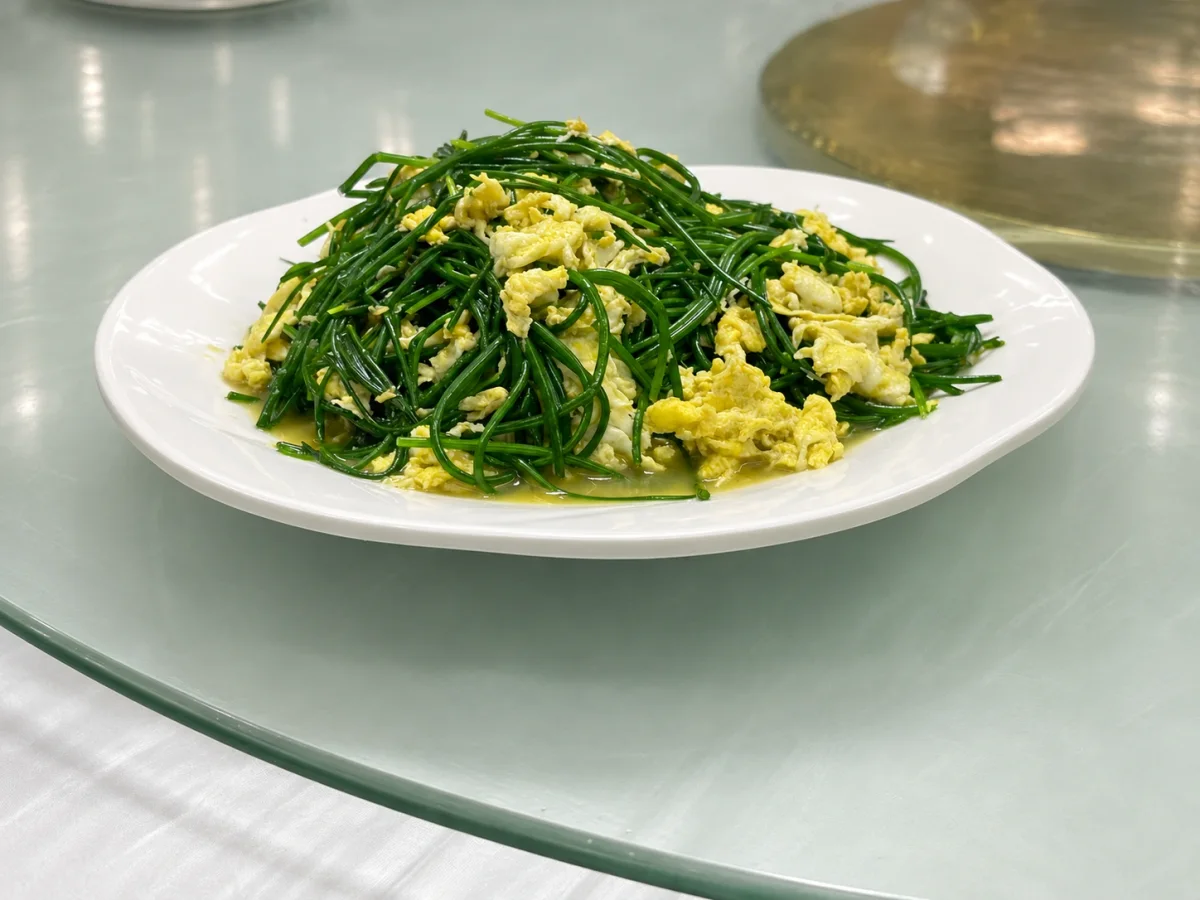
The plate at the top of this page was served in a restaurant, on the glass turntable of a round banquet table. It is a tall, loose heap of long, dark-green stems, each about as thick as a knitting needle, tangled with soft curds of scrambled egg in pale and bright yellow. The stems have been left long rather than chopped, and they are still glossy and springy; a little yellow, egg-tinted liquid has gathered on the plate underneath.
Apart from oil and salt, the dish needs only sand onion and eggs. It is ordinary food across the northwest, cooked at home and served in restaurants. In Xinjiang it comes to the table beside hand-grabbed lamb. In Altay, in the far north of Xinjiang, it is one of the local specialities, along with black mushrooms and lamb baked in the naan oven.
The dish is just as common in Gansu, Ningxia and Inner Mongolia, where the plant grows wild. For a long time it was a seasonal treat, because wild sand onion appears with the summer rains and toughens by autumn. Greenhouses have changed that, and fresh and pickled sand onion now reach supermarkets as far away as Shanghai and Shenzhen.
02
What sand onion is
A wild onion of the desert, with leaves as thin as needles.
Sand onion is Allium mongolicum, sometimes sold in English as Mongolian onion or desert onion; in Chinese it is also called 蒙古韭, Mongolian chive, and Mongolian speakers call it by a name written 乎木勒 in Chinese characters. It is native to Mongolia, Inner Mongolia, Tuva and Kazakhstan, and to Gansu, Ningxia, Qinghai, Shaanxi, Xinjiang and Liaoning in China. The plant forms clumps of thin bulbs and very thin, hollow, tubular leaves; in flower it carries dense round heads of red or purple-red blossom on stalks up to 30 cm tall.
It grows on desert, sandy ground and dry hillsides between 800 and 2,800 metres above sea level, and it tolerates wind, drought, cold and poor soil, surviving temperatures from 10 to 40 °C. Its roots reach down more than a metre and a half, and a single plant holds 0.5 to 1 square metre of sand in place, which is why desert-control scientists took an interest in it. After rain, its underground stems sprout within two or three days, and fifteen to twenty days later the plant has reached flowering height. In Alxa, camels graze on it.
Chinese writers noticed it long ago. The sixteenth-century pharmacopoeia Bencao Gangmu, in its entry on wild onions, says they grow in the mountains and on the plains, and that those growing on sandy ground are called sand onion.
03
Wild in summer, farmed all year
The wild plant comes up with the first rain; greenhouses supply the rest of the year.
Wild sand onion is a summer vegetable. In the Tengger desert, in Alxa in western Inner Mongolia, it springs up after the first rain at the end of May. By September its fibres have turned woody and it is at its most pungent. For most of history that was the only time to eat it.
The change began in Minqin county, Gansu, an oasis squeezed between the Badain Jaran and Tengger deserts. From 1999 a team at the Gansu Desert Control Research Institute led by Yan Zizhu worked out how to propagate the plant by division and from seed, and a Minqin farmer, Ye Changlian, found that a spell of cold broke its dormancy and grew it in a solar greenhouse with sprinklers. With greenhouses, plastic tunnels and open fields together, Minqin now harvests sand onion all year. It is planted on 15,000 mu, about 1,000 hectares, by more than 3,000 households in all fourteen of the county’s towns; one sowing can be cut for ten years, five or six times a year. The county ships more than two tonnes a day to over twenty cities, to Xinjiang, Ningxia and Inner Mongolia among others, and is now China’s largest base for farmed sand onion.
In Alxa, growers raise it in heated sheds between the Tengger desert and the Helan mountains, feed it composted sheep manure and cut it young, after 26 days of growth. In Jiuquan, in western Gansu, growers fill their greenhouses with fine sand mixed with a little manure to imitate the Gobi, and the leaves still taste slightly gentler than those picked wild.
04
Between scallion and chives
It looks like a very thin scallion and tastes more like garlic chives.
Sand onion is much thinner than an ordinary scallion, and it smells more of garlic chives than of onion. Raw, the chive flavour is strongest, and the leaves are crisp, juicy and slightly hot; in the northwest it is known for a strong onion fragrance with a little bite. Cooking reverses the balance: the chive note fades and the onion flavour comes forward, but the leaves stay crisper than chives would. Scallion is mostly a seasoning; sand onion is substantial enough to be the vegetable in a dish.
With eggs, the heat largely disappears. What remains is a faint chive flavour without the harshness of chives, a clean crunch and a sweet aftertaste once it is chewed. A quick blanch in hot water takes the bite out too, which is why most cold sand onion dishes begin with a dip in boiling water.
05
Two ways with eggs
Cooks either scramble the eggs first or fry everything as an omelette.
The usual method scrambles the eggs first. Beaten egg goes into hot oil and is stirred into large, soft curds, then lifted out; the sand onion, cut into lengths, is stir-fried over high heat with a little salt, and the egg goes back in to be tossed through. Restaurants, like the one in our photograph, often leave the stems long, so that the plate arrives as a tangle of green with yellow egg caught in it.
The other method chops the sand onion finely and stirs it into the beaten egg with salt, then fries the mixture as a flat omelette, rather like the chive omelettes made elsewhere in China. It suits a small amount of sand onion.
Either way the cooking is short. Sand onion is juicy, and the longer it sits in the pan the more water it gives off; in our photograph, some of that liquid has already gathered under the egg.
06
Cold, pickled and with lamb
Sand onion is also dressed cold, pickled and cooked with lamb.
For a cold dish, sand onion is blanched in boiling water, often with a few drops of oil added, for thirty or forty seconds until it turns bright green, then drained and dressed. One popular dressing pours hot oil over chopped scallion, garlic, Sichuan pepper and dried chilli; an older, plainer one uses salt, vinegar, garlic and chilli oil. Dressed, the long green strands look like a bowl of noodles.
To pickle it, sand onion is blanched in salted water, drained and packed into a sealed jar with salt and vinegar, sometimes with chopped chilli, and left for three days. Pickled sand onion is also a business. In the Luanjingtan resettlement area of Alxa, a herder named Menkebayar began pickling it the traditional herders’ way in 2011 and selling it to local shops; the cooperative that grew from his workshop extended its shelf life from one month to twelve, and in 2025 sold more than 200,000 jin, about 100 tonnes, including to supermarkets in Beijing and Shanghai. Minqin also makes sand onion sauce and sand onion powder.
Sand onion is also stewed with lamb in the northwest, to take away the gamy smell. In Hohhot, Inner Mongolia’s capital, lamb and sand onion buns belong to the hearty breakfast of boiled lamb and salty milk tea; the filling is packed with sand onion and lamb and tastes a little like a chive filling, without any mutton smell.
| Dish | How | Where |
|---|---|---|
| 沙葱炒鸡蛋 scrambled with eggs | Eggs scrambled, sand onion stir-fried briefly, tossed together | Xinjiang, Gansu, Ningxia, Inner Mongolia |
| 凉拌沙葱 cold sand onion | Blanched 30–40 seconds, dressed with garlic, chilli and vinegar | Across the northwest |
| 腌沙葱 pickled sand onion | Blanched in salt water, jarred with salt and vinegar for three days | Alxa, Minqin, Jiuquan |
| 沙葱羊肉包子 lamb and sand onion buns | Steamed buns filled with lamb and sand onion | Hohhot breakfast |
| 沙葱炖羊肉 lamb stewed with sand onion | Stewed together to temper the mutton smell | The northwest |
07
Buying it outside the northwest
Most of the price is the journey.
Fresh sand onion does not travel well. In 2021 a supermarket outside the northwest was selling wild sand onion at 50 yuan a jin, half a kilo, and still running out. The food-science writer Yun Wuxin explained that the price at source is low; cold-chain transport and the share that spoils on the way make it expensive.
Shipping has improved since then. A decade ago Alxa growers sent sand onion in foam boxes with ice; now it is pre-cooled, held at 3 °C and flown, and reaches Guangdong, more than 2,000 km away, within 24 hours. Sales of Minqin sand onion in China’s big cities have been growing by more than 30 per cent a year.
A Shenzhen supermarket buyer checks each delivery six ways: temperature, colour, roots, smell, breaking a stem open and testing for pesticide residue. The visible checks work for anyone buying it: good sand onion is a bright, fresh green, with clean roots and no mud. Minqin growers who sort to a stricter standard get more than one yuan a jin above the rest.
08
Sand onion scrambled eggs at home
Five minutes at the stove.
For 2 to 3 people: 200 g sand onion; 4 eggs; 3 tablespoons neutral oil; ½ teaspoon salt, divided.
- 1. Clean
Pick off any yellowed tips, rinse well and drain. Cut into 5 cm lengths, or leave the stems long as restaurants do.
- 2. Eggs
Beat the eggs with a pinch of the salt. Heat 2 tablespoons oil until hot, pour in the eggs, let them puff and set at the edges, then push them into large soft curds and lift out while still slightly wet.
- 3. Sand onion
Add the remaining oil, turn the heat to high and stir-fry the sand onion for a minute or two, until bright green and just softened. Season with the rest of the salt.
- 4. Together
Return the eggs, toss for a few seconds and serve at once, before the sand onion gives off its water.
If your sand onion is strong, blanch it in boiling water for a few seconds and drain it well before frying; it will lose most of its bite.
09
Ordering it
It is the vegetable to order with a table full of lamb.
Find it on the menu
Look for 沙葱炒鸡蛋 or 沙葱炒蛋.
With what
Hand-grabbed lamb, lamb skewers or big plate chicken; the crisp, green plate balances the meat.
Season
Wild sand onion comes in from late May; greenhouse sand onion is on menus all year.
Vegetarian?
It has eggs but no meat.
Elsewhere in China
Xinjiang and northwestern restaurants are the place to look; some supermarkets sell fresh and pickled sand onion.
10
More from Xinjiang
Other pages on the atlas.
Big plate chicken
Chicken, potatoes and chilli with belt noodles, for the whole table.
Read about big plate chicken →Xinjiang lamb skewers
Lamb and fat over charcoal with cumin and chilli.
Read about Xinjiang lamb skewers →Tomato and egg
China’s other everyday egg stir-fry.
Read about tomato and egg →Xinjiang food
Naan, lamb and noodles on both sides of the Tian Shan.
Explore Xinjiang →Xinjiang classics
- Xinjiang Lamb Skewers
Charcoal-grilled skewers · Snack, street food, before a meal
- Big Plate Chicken
Shared chicken braise with noodles · Lunch and dinner for three or four
- Xinjiang Samsa
Oven-baked lamb pastry · Breakfast, snack, with tea
- Guoyourou Laghman
Hand-pulled noodles with a stir-fried topping · Lunch at a noodle shop
FAQ
Questions about Sand Onion Scrambled Eggs
What is sand onion?
Allium mongolicum, a wild onion of the deserts and dry hillsides of northwest China and Mongolia, with very thin, crisp green leaves.
What does it taste like?
Between scallion and garlic chives: raw it is crisp and slightly hot; cooked with eggs it turns mild and a little sweet.
When is it in season?
Wild sand onion comes up after the first rain at the end of May and toughens by September; greenhouse sand onion is sold all year.
Can I use chives instead?
Garlic chives make a similar dish but are softer and stronger; sand onion is crisper and milder once cooked.
Is it only a Xinjiang dish?
No. It is eaten across the northwest, in Gansu, Ningxia and Inner Mongolia as well as Xinjiang.
Sources
Sources and further reading
- 1 Ma Aibin, “Minqin: a small desert onion holds a big future” (2025) (in Chinese)China Daily (Chinese edition), from Gansu China Net ↗
- 2 Lu Yu’an, “Alxa sand onion goes from desert to table in 24 hours” (2026) (in Chinese)Xinhua, from Economic Information Daily ↗
- 3 Zhang Chen, “A desert weed turns into a golden crop” (2026) (in Chinese)People’s Daily ↗
- 4 Liu Huan, “Still sold out at 50 yuan a jin: want to try sand onion?” (2021) (in Chinese)The Beijing News ↗
- 5 Wild onion industry yields ecological, economic benefits in NW China’s Gansu (2025)People’s Daily Online, via the Belt and Road News Network ↗
- 6 Allium mongolicumWikipedia ↗
- 7 Sand onion from the Gobi: looks like scallion, tastes like chives (video, in Chinese)Jiuquan Juanjie (酒泉娟姐戈壁良种直供), Bilibili (November 2022) ↗
- 8 Xinjiang people really know their vegetables: sand onion scrambled eggs (video, in Chinese)Baozi zai Xinjiang (包子在新疆), Bilibili (June 2024) ↗
- 9 A northeasterner tries sand onion for the first time, dressed cold (video, in Chinese)Telangsu (特狼苏_祛魅版), Bilibili (March 2026) ↗
- 10 A Mongolian-style breakfast in Hohhot, with lamb and sand onion buns (video, in Chinese)Dage zai Shanghai (达哥在上海), Bilibili (May 2024) ↗
- 11 Altay in the snow: black mushrooms, sand onion scrambled eggs and naan-oven lamb (video, in Chinese)A Xing Tandian (阿星探店), Bilibili (March 2023) ↗
Last updated November 2026