
01
Boiled lamb, weighed at the door
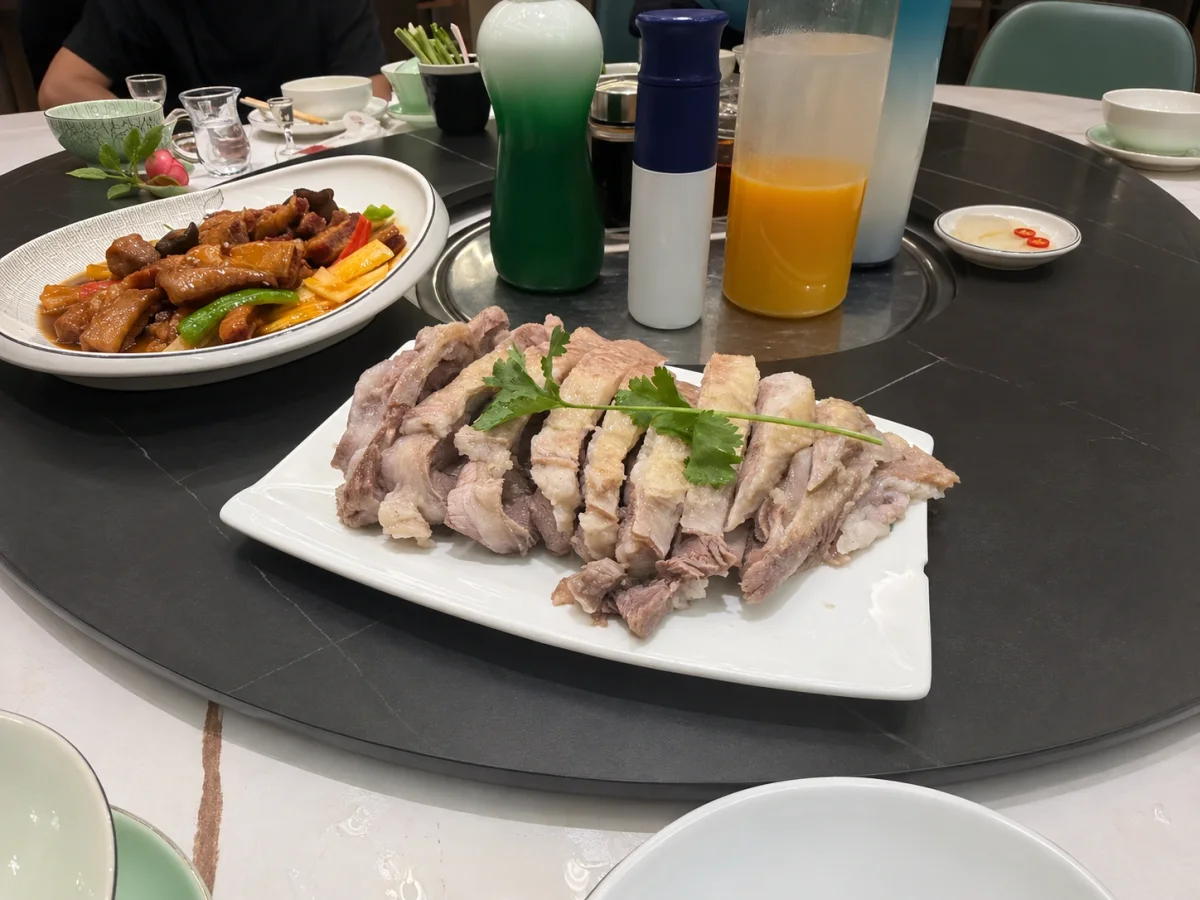
Shouzhua means “grabbed by hand,” and the name tells you how the dish arrives: as strips of lamb still on the rib or neck bone, with nothing to eat them with except your fingers and perhaps a disposable glove. In Lanzhou the cooking is deliberately plain. It is simmered slowly in clear water with only three seasonings, salt, Sichuan pepper and tsaoko, the smoky black cardamom used across northwest China. One busy shop adds ginger; the principle stays the same. The lamb is supposed to taste of lamb.
Most hand-grabbed mutton shops in Lanzhou cook in large pots near the entrance and sell by the jin (500 g). You choose the cut, the cook lifts it out, weighs it and chops it into pieces on a board, and it comes to the table steaming on a plate. At one street shop that charged ¥46 a jin in 2024, the meat was cooked only until it was done, so the fat still had a slight spring and the lean had some chew rather than falling off the bone. That is the texture Lanzhou cooks aim for. A shoulder that collapses at a touch would be better suited to a stew.
The dish is eaten hot in Lanzhou. In Ningxia it is often served cold. In Lanzhou the point is to eat it straight from the pot, while the fat is soft and the meat still smells of pepper and broth.
02
Ribs, neck and the parts you won’t be offered
The usual first order is ribs, 肋条. A strip of rib carries a layer of fat under the skin and a band of lean between the bones, and the meat comes away cleanly when you pull. Ribs are the most popular choice in Lanzhou, ahead of the neck (羊脖子), the back (羊背子) and the foreshoulder (羊前夹). Neck has more connective tissue running through it. Locals like it for the alternating chew of meat and tendon, and at the shops visited here it cost the same per jin as ribs.
What you will rarely see is the hind leg. One cook explained that the leg does not take up flavor well in this kind of boiling, and Lanzhou shops mostly cook the front half of the carcass for shouzhua. Legs go to roasting or to other dishes. When you order, ask for 肋条 if you want fat and tenderness, 脖子 if you like gnawing, and mix them if two or three people are sharing. A jin is enough for two people as part of a meal with noodles or bread; a jin and a half feeds two hungry people with nothing else.
Because the price is per jin with the bone, the amount of bone matters. A rib strip is mostly meat with a thin bone. The neck has more bone by weight but more flavor close to it. Shops that let you pick the cut at a flat price give you a better deal if you choose ribs.
| Order | Cut | What to expect |
|---|---|---|
| 肋条 · ribs | Rib strips with skin and fat | Tender, fatty, little bone; the most popular order |
| 脖子 · neck | Neck on the bone | Meat and tendon in layers; more chewing, more bone |
| 背子 · back | Upper back | Leaner, with a cap of fat |
| 前夹 · foreshoulder | Front shoulder and upper leg | Larger pieces of lean meat |
03
Fresh sheep from Dongxiang and a short list of spices
Lanzhou shops talk first about where the sheep came from. Many buy from Dongxiang, the Dongxiang Autonomous County in Linxia Prefecture south of the city, and others from Minqin in the Hexi Corridor. These are sheep, not goats, and cooks credit their mild taste to grazing on dry hillsides. Freshness matters as much as breed: shops on the main mutton street receive carcasses several times a day and put them straight into the pot. A frozen lamb boiled this way tastes noticeably flatter, which is one reason the dish is better near where the sheep are raised.
Most Lanzhou cooks describe the same method. The meat is soaked for several hours in clean water to draw out blood, then started in cold water and brought up slowly. Scum is skimmed as it rises. Salt, Sichuan pepper and tsaoko go in, and the pot simmers until done. China News Service, describing the Dongxiang version, gives the same sequence for a whole sheep: boil hard, skim, turn the heat down, add salt, Sichuan pepper, ginger and tsaoko, and lift the meat out when a chopstick slides in without resistance. One street shop cooks seven sheep at a time and needs a little over an hour.
Since the meat is seasoned in the pot, it arrives tasting lightly salted. Some shops season more heavily than others, so try a plain bite before you reach for the salt dish. The price gap between raw and cooked meat is narrow: on Lanzhou’s busiest mutton street in 2025, raw mutton cost about ¥27–28 a jin and cooked shouzhua ¥39–48, after bone, water loss and cooking time.
04
Garlic in one hand, lamb in the other
The writer Ye Zi, who grew up in Gansu, describes the proper way as one hand holding the meat and the other a slice of freshly cut garlic, and quotes the local saying that eating meat without garlic loses half the goodness. The standard accompaniment in Lanzhou is raw garlic. In late spring and summer it is new purple garlic, juicy and sharp enough to clear the fat from your mouth between bites. A dish of spiced salt (椒盐) sits on the table for dipping, and many shops have a pot of chili oil with toasted flakes, more fragrant than hot, and a bottle of vinegar for those who want to mix a dip. Take the first piece plain, then try salt, then chili. A bowl of the cooking broth may come with the meat or be offered on request.
Eat with your hands. Pull the meat off along the bone; the fat under the rib skin is the best part, and neck pieces reward the patience of working around the vertebrae. Shops put out plastic gloves and rolls of paper, and staff refill your tea glass to the brim, the local way of making guests welcome. Hand-grabbed mutton is usually eaten as meat alone. Order a bowl of noodles, flatbread or a few skewers if you want something starchy alongside. Ye Zi recalls a family reunion in Lanzhou where, after a big plate of shouzhua, his brother called for bowls of huidouzi (灰豆子), the city’s sweet, thick pea soup.
In Dongxiang, a plate of shouzhua is what makes a meal a banquet. China News Service quotes the local saying: no household without sheep, no banquet without shouzhua. There it comes with a vinegar dip or a dry seasoning and onion. At Hui weddings, the World Federation of Chinese Catering Industry notes, the lamb is set out with a small dish of salt.
05
Where to eat it in Lanzhou and what it costs
Hand-grabbed mutton shops cluster around Xiaoxihu in Qilihe District, where a row of shops compete with pots at the door and staff calling to passersby. Prices there in 2024–25 sat mostly at ¥46–48 a jin, with one shop dropping to ¥39 during a promotion. Elsewhere prices vary: one shop charged ¥75 a jin in 2021. A sit-down meal for two with a jin and a half of meat and a few sides came to about ¥130 in 2024.
Look for a shop where the pots are full and the turnover is fast. The meat should look moist and pale, not grey or dried at the edges. If you want a cut that is sold out, the cook may tell you to wait for the next pot.
Hand-grabbed mutton is also sold in Lanzhou noodle restaurants elsewhere in China, usually as a half-jin plate alongside a bowl of beef noodles.
| Order | Price | Setting |
|---|---|---|
| Hand-grabbed mutton, per jin | ¥75 | Lanzhou, 2021 |
| Hand-grabbed mutton, per jin | ¥46 | Street shops, 2024 |
| Ribs or neck, per jin | ¥39–48 | Xiaoxihu shops, 2025 |
| Raw mutton, per jin | ¥27–28 | Xiaoxihu, 2025 |
Gansu classics
- Lanzhou Beef Noodles
Hand-pulled noodle soup · Breakfast and lunch
- Tianshui Malatang
Boiled skewers tossed in chili oil · Lunch, dinner, street food
- Lanzhou Niangpi
Cold steamed wheat sheets · Snack or light meal, summer, festival tables
FAQ
Questions about Lanzhou Hand-Grabbed Mutton
What is hand-grabbed mutton?
Lamb boiled on the bone with salt and a few whole spices such as Sichuan pepper and tsaoko, cut into strips and eaten with your hands. In Lanzhou it is sold by the jin and served hot.
Which cut should I order?
Ribs (肋条) are the most popular: tender and fatty with little bone. Neck (脖子) has more tendon and bone and more chewing. Many shops charge the same per jin for both.
How much does it cost in Lanzhou?
Around ¥46–48 a jin at the street shops around Xiaoxihu in 2024–25, with promotions as low as ¥39. A jin is enough for two people as part of a meal.
What do you eat it with?
Raw garlic, spiced salt and chili oil, with tea. Taste a piece plain first, since the meat is already salted in the pot.
Is it the same as Xinjiang hand-grabbed rice?
No. Xinjiang’s polo (手抓饭) is rice cooked with lamb and carrots. Hand-grabbed mutton is boiled lamb alone.
Is it halal?
Shouzhua shops in Lanzhou are typically run by Hui or Dongxiang Muslims and are halal. Check for the halal sign if it matters to you.
Sources
Sources and further reading
- 1 Dongxiang hand-grabbed mutton: whole lambs, a few spices and a dish that makes the banquet (in Chinese)Feng Zhijun, China News Service (September 20, 2022) ↗
- 2 The plain flavor of Lanzhou mutton dishes: soaking, three seasonings, and spiced salt with raw garlic (in Chinese)Hua Jing and Wei Jiabei, Lanzhou Daily, via ZAKER (2026) ↗
- 3 Halal Cuisine in China: Dongxiang hand-held lamb at Hui weddings, served with saltWorld Federation of Chinese Catering Industry, Google Arts & Culture ↗
- 4 Ye Zi, Long Weir (The Taste of Gansu), chapters “Summer snacks” and “Rolled lamb at the foot of the Qilian Mountains” (in Chinese)SDX Joint Publishing, 2020; WeRead edition ↗
- 5 Lanzhou street hand-grabbed mutton at ¥46 a jin: seven Dongxiang sheep to a pot, ribs and neck (video, in Chinese)Danniu Shi Zouqi (丹牛食走起), Bilibili (2024) ↗
- 6 A Lanzhou hand-grabbed mutton shop at ¥46 a jin: Sichuan pepper, tsaoko and ginger in the pot (video, in Chinese)Techu Sui Bian (特厨隋卞), Bilibili (2024) ↗
- 7 Xiaoxihu, Lanzhou’s hand-grabbed mutton street: prices from ¥39 to ¥48 a jin and raw mutton at ¥27–28 (video, in Chinese)Yewen Bu Dong Chi (野文不懂吃), Bilibili (2025) ↗
- 8 Hand-grabbed ribs and neck at ¥46 a jin in Lanzhou, with fresh garlic and fragrant chili (video, in Chinese)Da Ge zai Shanghai (达哥在上海), Bilibili (2024) ↗
- 9 Lanzhou hand-grabbed mutton at ¥75 a jin with two big spoons of chili (video, in Chinese)Daoyueshe (盗月社食遇记), Bilibili (2021) ↗
Last updated November 2026