
01
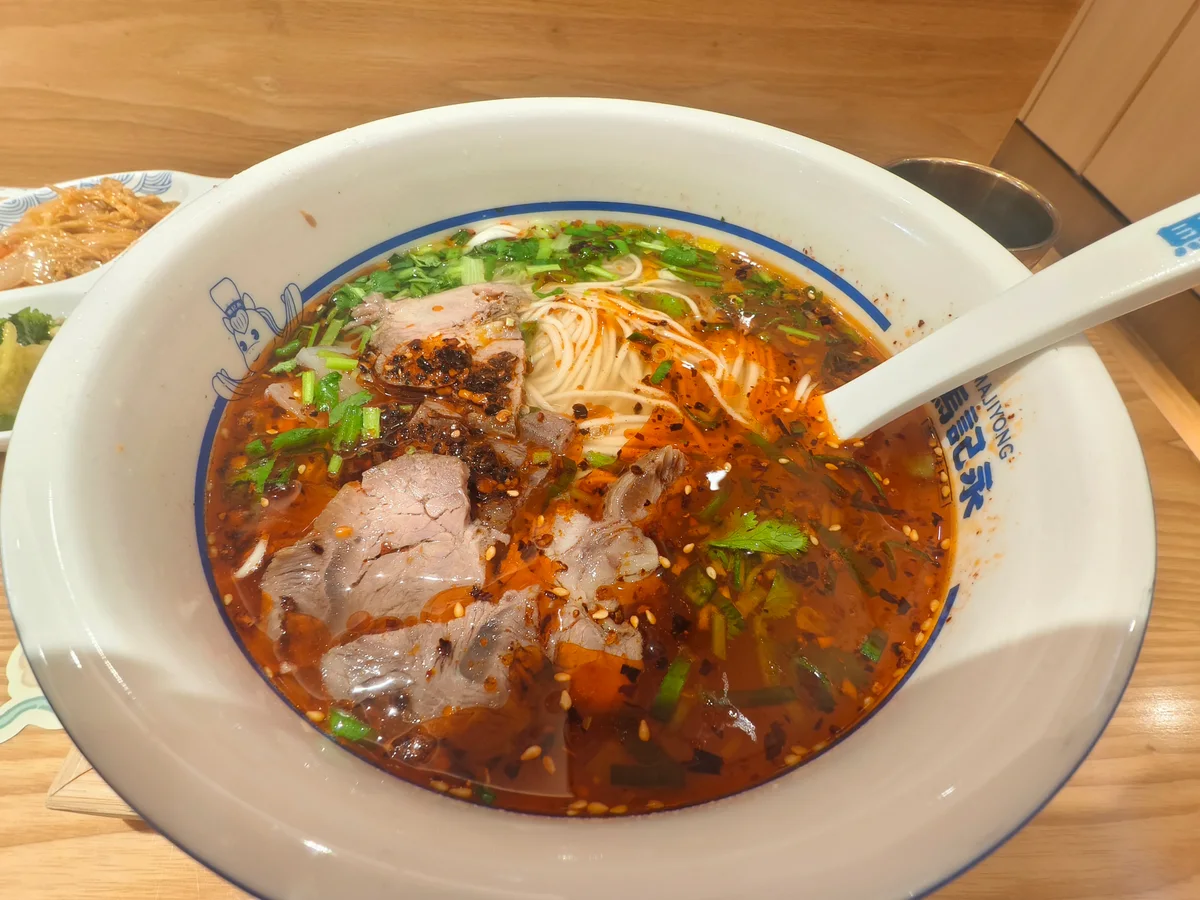
Clear broth, white radish, red oil, green garlic, yellow noodles
Lanzhou describes a correct bowl in five colors: one clear, two white, three red, four green, five yellow.
Clear is the broth, beef stock simmered with spices and thinned until it is transparent. White is the slices of white radish cooked in it. Red is the chili oil, made by pouring hot oil over chili flakes. Green is the chopped garlic shoots and coriander. Yellow is the noodles themselves, which turn a pale yellow from the alkaline ash in the dough. On top sits a spoon of diced beef. The noodles are pulled for each bowl in the shape the customer orders, from hair-thin to belt-wide, and the bowl is assembled in seconds at a counter.
It is breakfast. Lanzhou people eat a bowl on the way to work, summer and winter, and many traditional shops open at dawn and close in the afternoon. The color formula was in popular use by the early 1980s and was adopted by city officials around 1983 as the official description; “five yellow” was added later. Ma Jiesan, son of the dish’s founder, put the standard more simply: the broth must be clear, the beef tender and the radish full of flavor.
02
Lanzhou beef noodles and “Lanzhou lamian”
Most “Lanzhou lamian” shops in China are not from Lanzhou, and Lanzhou people do not call their own dish lamian.
In September 1990 a 34-year-old farmer from Hualong County in Qinghai, Han Lu, took 7,000 yuan to Xiamen and opened a northwestern noodle shop selling hand-pulled noodles. Over the next twenty years families from Hualong and neighboring Qinghai counties followed, opening shops across southern and eastern China under the name “Lanzhou beef lamian,” because Lanzhou was the name customers knew. In Lanzhou the dish is simply 牛肉面, beef noodles; locals reserve “lamian” for the shops opened by Qinghai people elsewhere.
The two are related but not the same. The Qinghai shops usually serve a broader menu of fried noodles, rice dishes and lamb skewers, and the Lanzhou noodle historian Sai Bingwen notes that many early ones leaned heavily on MSG and seasoning packets. A bowl in Lanzhou is about the broth and the pull.
| In Lanzhou | “Lanzhou lamian” elsewhere | |
|---|---|---|
| Name locals use | 牛肉面, beef noodles | 兰州拉面, Lanzhou lamian |
| Who runs it | Lanzhou Hui and Han noodle makers | Mostly families from Hualong and other Qinghai counties |
| When | Breakfast and lunch; many shops close mid-afternoon | All day |
| Menu | Beef noodles, extra beef, eggs, cold dishes | Beef noodles plus fried noodles, rice dishes, lamb skewers |
03
From a carrying pole to a national heritage item
The founder’s name is not in doubt; the year is.
The story starts with Ma Baozi, a Hui Muslim from Nantan Street in Lanzhou’s southern Muslim quarter, who sold noodles from two baskets on a carrying pole: cold noodles in summer, and in winter 热锅子面, “hot-pot noodles,” kept hot in broth over a little stove hung from the pole. Official accounts date his beef noodles to 1915, and add that he gave every customer a free bowl of broth on entering. Sai Bingwen, who wrote a book-length history of the dish, reconstructs from oral accounts that Ma, aged 49 and tired of the pole, rented a shop in the Dongchenghao market outside the east gate in 1919 and began selling beef noodles there, a first for a Lanzhou Muslim street vendor. At first, Sai writes, ordinary laborers found a bowl of clear soup and a few noodles too dainty, while clerks and merchants loved it.
His son Ma Jiesan, who took over around 1925, defined the bowl: the clear broth, the radish, the chili oil and coriander, and the names of the noodle shapes. A rhyme listed Ma Baozi’s noodles among the four wonders of the city, and in 1946 the Nationalist elder Yu Youren, passing through Lanzhou on his way to and from Xinjiang, ate them and is said to have left a piece of calligraphy. After 1956, when private businesses became joint state-private enterprises, Ma Jiesan was moved to a state canteen on Central Square, where queues stretched from dawn to noon. Noodle makers trained in that kitchen became the officially recognized third and fourth generations of a craft that was added to China’s national list of intangible cultural heritage in May 2021 and is now in its sixth.
04
The broth: yellow cattle, spices and radish
The broth decides a shop’s reputation, and it is clear rather than rich.
Beef and bones are simmered for five to seven hours with a bag of more than a dozen spices, among them black cardamom, ginger peel, Sichuan pepper, nutmeg, cloves, white pepper and angelica root, then the stock is skimmed and thinned with water until it is transparent. Slices of white radish simmer in it. A popular legend says the secret is yak meat from the Tibetan plateau; Sai Bingwen points out that yak was rare in Lanzhou a century ago and that an old noodle maker found yak stock turns reddish-black, while yellow cattle give the clear, beer-colored broth the dish is named for. The heritage description lists both.
At the counter the bowl is built in a fixed order. At one old shop the server puts in half a ladle of broth, then diced beef and garlic shoots, then as much chili as the customer wants, and finally fills the bowl with boiling broth, which scalds the chili and garlic and releases their smell.
05
The noodles: penghui and the pull
What makes the dough stretch without breaking is ash.
The dough is wheat flour and salted water, kneaded and beaten for a long time, with alkaline water worked in three times. In Lanzhou that alkali traditionally came from 蓬灰, penghui, an alkaline ash extracted from the penghao plant, which was cheaper than soda; it makes the dough elastic and turns the noodles faintly yellow. Ma Baozi’s refinement, Sai writes, was a second dose before service: a hollow punched in the rested dough, penghui water poured in with a little dry flour, then pounded, stretched and folded again and again. The dough is rolled into short logs, oiled and rested; for each order the cook takes a log, swings and stretches it, folds it, and doubles the strands with each pull. At a national competition one Lanzhou cook pulled maoxi eight times, into 256 strands with a total length of 384 meters.
| Name | What it is | Notes |
|---|---|---|
| Maoxi 毛细 | Hair-thin round noodles | Cooks in seconds; soft |
| Xi 细 | Thin round | A common choice |
| Sanxi 三细 | Between thin and erxi | Appeared after the 1980s |
| Erxi 二细 | Medium round | The most common order; springy |
| Erzhuzi 二柱子 | Thick round | Chewy |
| Jiuyezi 韭叶子 | Flat, as wide as a chive leaf | Holds the broth |
| Kuan 宽 and dakuan 大宽 | Flat, a finger wide to belt wide | Very chewy |
| Qiaomaileng 荞麦棱 | Triangular in section, like a buckwheat grain | A connoisseur’s choice |
06
How to order in Lanzhou
You pay first, say a noodle shape, and collect your bowl at the counter.
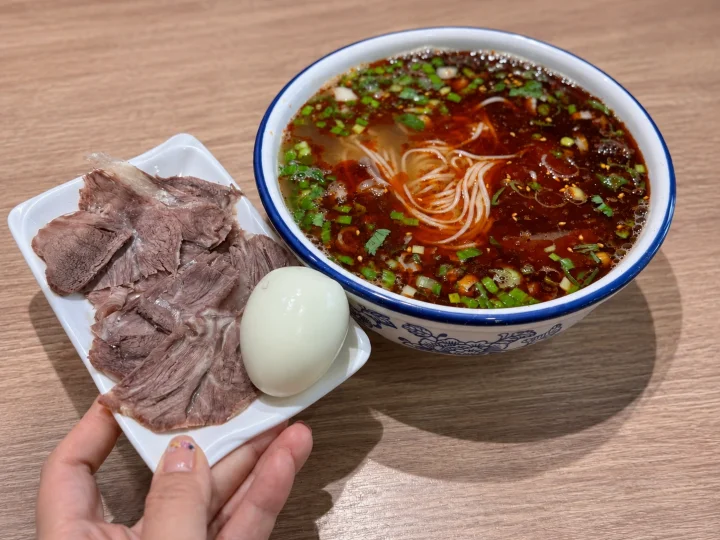
Extra beef and an egg
Our own photograph of a bowl ordered with the extras.
Pay and name the shape
Buy a ticket at the till and call your shape at the pulling counter: erxi (二细) is the usual choice, maoxi for something soft, jiuyezi or kuan for bite.
Add meat and egg
The basic bowl has a spoon of diced beef. Extra sliced beef and a boiled egg are sold separately; a bowl with both is called 牛大 (niuda).
Choose your chili
Tell the server how much chili oil you want; some shops are known for their chili dregs. Garlic shoots and coriander can be left off.
Go early
Old shops open around six and many close by mid-afternoon; queues are longest at breakfast.
Finish with vinegar
Locals add vinegar to the last of the broth, and it is said to cure a hangover.
07
The politics of a bowl’s price
In Lanzhou the price of beef noodles was, for decades, a matter for the city government.
Lanzhou treated beef noodles as a staple whose price affected everyone. The city set the price itself until 1997, when its last official price was 1.70 yuan a bowl. In 2000 a provincial standard fixed the shapes and said a large bowl must hold at least 275 grams of cooked noodles and a small one 175. When shops raised the price from 2.20 to 2.50 yuan in 2006, and again in June 2007, the city’s price bureau issued an emergency cap, grading shops into four classes with a maximum of 2.50 yuan for a large bowl at an ordinary shop, which set off a national debate about price controls. Today a bowl costs about 8 yuan in Lanzhou: in 2025 a street shop charged 8 for noodles, 9 for a plate of extra beef and 2 for an egg, 19 yuan in all.
08
Where to eat beef noodles in Lanzhou
Every Lanzhou family has its own shop, but a handful of names carry the city’s noodle history.
Ma Zilu (马子禄) is the name most visitors look for, and its founder’s life tracks the noodle’s politics. Sai Bingwen’s history says Ma Zilu’s father died in the 1930s, when Ma was 13 and began learning halal cooking and noodle making; Ma had a restaurant before turning thirty, saw it absorbed in the 1950s, and spent years pulling handcarts for a street transport team. After 1978 Ma returned to run a state canteen, then quit to rent a small kiosk and sell beef noodles independently, one of Gansu’s 13,000 licensed private businesses in 1980. The shop on Dazhong Lane, a food street between Nanbinhe Road and the Zhangye Road pedestrian street, gives its founding date as 1954. It still serves noodles in thick coarse bowls printed with its mark, long after most shops moved to finer ones, and in 2022 a bowl with diced beef cost 8 yuan, with free refills of broth. An older local saying gives the beef to another shop, Wumule (吾穆勒), and the broth to Ma Zilu.
Other names trace other chapters. In August 1979 a teenager’s first job was pulling noodles at the Mogouyan (磨沟沿) canteen, a tent run by the Hualinping street office, one of eight such street canteens in the district; after a flood it moved to the riverside and back again. In 1991 Zhou Fuyuan and Ma Wenbin of the Lanqingge canteen carried Gaolan’s heshangtou flour to a national snack contest in Zhengzhou and won the Ministry of Commerce’s Golden Tripod award; in 1993 the city merged Lanqingge, Hongbinlou and other old canteens into the Lanzhou Jinding (金鼎) Beef Noodle Company. In 2009 the government chose Dongfanggong (东方宫), a large halal restaurant group, to carry the “Lanzhou beef lamian” brand into other cities.
Whichever shop you choose, go early. Most traditional shops open at dawn and close by mid-afternoon. Buy a ticket at the counter, collect the bowl at the noodle window, and add vinegar and extra chili yourself.
| Name | History | Note |
|---|---|---|
| Ma Zilu 马子禄 | Founder sold noodles before 1949 and again from a kiosk after 1978 | Dazhong Lane; coarse marked bowls; 8 yuan in 2022 |
| Mogouyan 磨沟沿 | Street-office canteen in a tent, 1979 | Moved after a flood and came back |
| Jinding 金鼎 | Golden Tripod award 1991; company from old state canteens, 1993 | Lanqingge, Hongbinlou and others |
| Dongfanggong 东方宫 | Chosen in 2009 to carry the Lanzhou brand nationwide | Halal restaurant group, many branches |
09
A Lanzhou industry worth 80 billion yuan
Lanzhou has spent the last two decades trying to reclaim its noodle from the imitators.
Gansu reports that the beef noodle industry chain earned 80 billion yuan in 2025, with more than 600 Lanzhou beef noodle outlets in over 60 countries and regions and most of the core ingredients now processed by machine. In July 2025 China added “beef lamian maker” to its official list of occupations, and a Lanzhou training school founded in 2012 has taught nearly ten thousand people, some of whom have opened shops in the United States, France and Britain. Away from home the bowl bends to local taste: the first Lanzhou-run shop in Guangzhou swapped garlic shoots for yellow chives because Cantonese customers would not eat them.
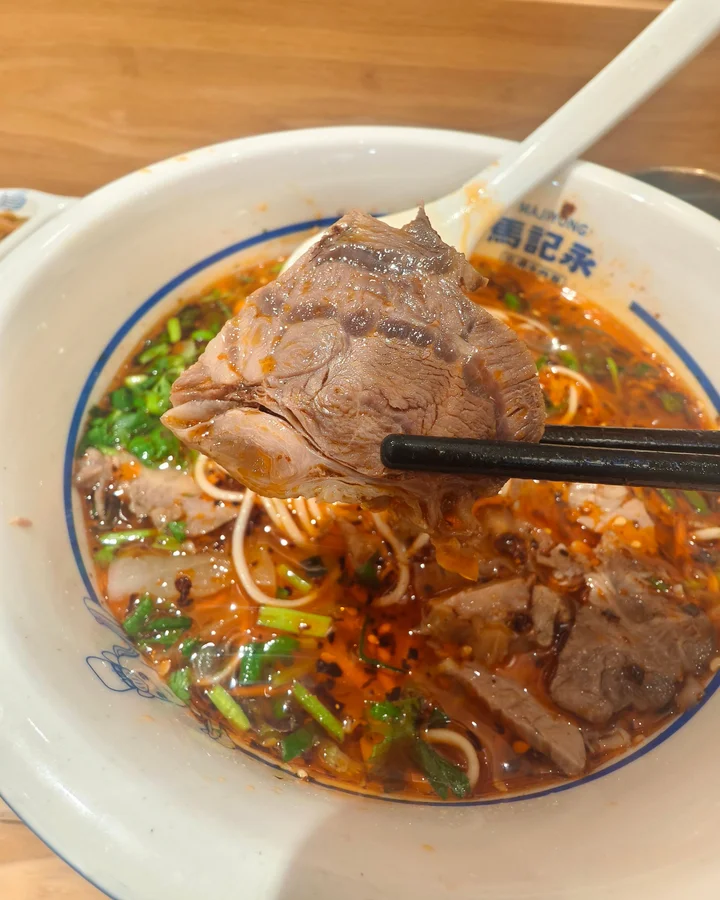
A bowl at Majiyong, October 2026
Our own photographs of one bowl of beef noodles at Majiyong (马记永), a beef noodle chain, in October 2026. The whole bowl is the photo at the top of this page.
10
What else Lanzhou eats
A beef noodle breakfast is only the start of a day in Lanzhou.
Niangpizi 酿皮子
Lanzhou’s cold wheat-starch sheets, steamed or poured, cut into strips with chili, vinegar and garlic. Lanzhou people judge them on chewiness.
Huidouzi 灰豆子
A sweet, dark purple soup of peas and jujubes, eaten in summer.
Tianpeizi 甜醅子
Fermented whole oats or barley, sweet and faintly boozy, sold in summer from small shops and thinned with warm water.
Cold noodles and skewers
In summer Lanzhou eats cold pulled noodles with vinegar, garlic and mustard, often mixed with grilled lamb skewers.
Shouzhua mutton 手抓羊肉
Boiled mutton on the bone, eaten by hand with salt and garlic.
11
More northwestern noodles
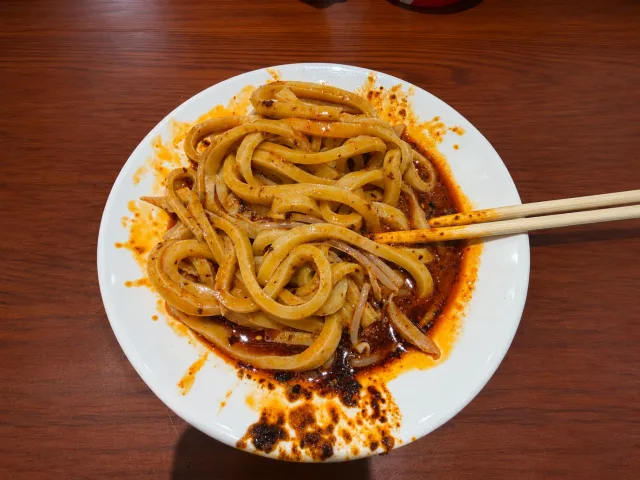
Youpo noodles
Xi’an’s wide noodles with hot oil poured over chili.
Read about youpo noodles →Biang biang noodles
Shaanxi’s belt-wide noodles.
Read about biang biang noodles →Liangpi
Shaanxi’s cold noodle sheets, cousins of Lanzhou’s niangpizi.
Read about liangpi →Gansu classics
- Tianshui Malatang
Boiled skewers tossed in chili oil · Lunch, dinner, street food
- Lanzhou Niangpi
Cold steamed wheat sheets · Snack or light meal, summer, festival tables
- Lanzhou Hand-Grabbed Mutton
Boiled lamb on the bone · Lunch or dinner, banquets and weddings
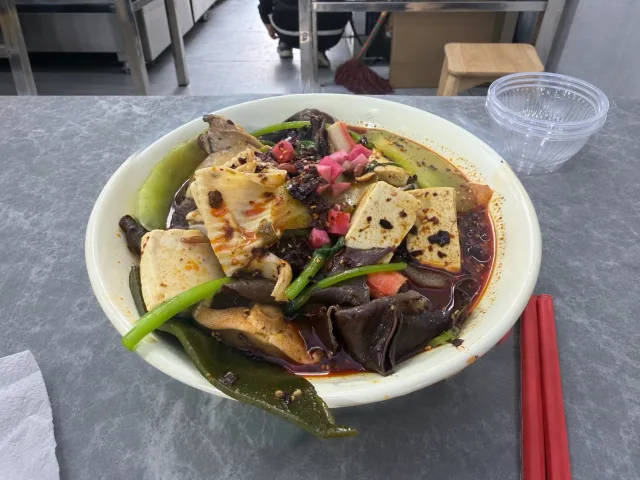
Noodles from other regions
FAQ
Questions about Lanzhou Beef Noodles
What are Lanzhou beef noodles?
Hand-pulled wheat noodles in a clear, spiced beef broth with white radish, chili oil, garlic shoots, coriander and diced beef, from Lanzhou in Gansu.
Is Lanzhou lamian the same as Lanzhou beef noodles?
Not quite. Lanzhou lamian is the name used by shops across China, mostly run by families from Qinghai; in Lanzhou the dish is called beef noodles and is made in its own way.
What does “one clear, two white, three red, four green, five yellow” mean?
Clear broth, white radish, red chili oil, green garlic shoots and coriander, and yellow noodles.
Who invented Lanzhou beef noodles?
Ma Baozi, a Hui noodle seller from Lanzhou, around 1915 to 1919; his son Ma Jiesan shaped the modern bowl.
What is penghui?
An alkaline ash from a desert plant, traditionally used in the dough to make it stretch and turn faintly yellow.
Which noodle shape should I order?
Erxi, medium round, is the usual choice. Maoxi is hair-thin; jiuyezi and kuan are flat and chewier.
How much do beef noodles cost in Lanzhou?
About 8 yuan a bowl in 2023–2025; extra beef and an egg bring it to about 19 yuan.
When do people eat Lanzhou beef noodles?
Mostly for breakfast; many old shops open at dawn and close by mid-afternoon.
Is the beef yak?
Usually yellow cattle, which gives a clear broth; the yak story is mostly legend.
Is Lanzhou beef noodle making intangible heritage?
Yes, it was added to China’s national list in May 2021.
Sources
Sources and further reading
- 1 Sai Bingwen, Dawan Chuanqi: Niuroumian Zhuan (大碗传奇:牛肉面传), chapters on Ma Baozi and Nantan Street, the beef noodle system, Ma Jiesan, the 1956 transformation, the Hualong noodle makers, the 2000 standard and the 2007 price cap (in Chinese)Qinghai People’s Publishing House (2020)
- 2 Ye Zi, Long Wei’er (陇味儿), chapters “Lanzhou,” “Niangpizi” and “Huidouzi” (in Chinese)SDX Joint Publishing (2020)
- 3 Technology, innovation deliver China’s beef noodles to global marketsXinhua, on China Daily’s Gansu pages (2026) ↗
- 4 Lanzhou beef noodle making, a national intangible heritage item: “clear, white, red, green and yellow” (in Chinese)Zhang Heng, China Culture and Tourism News, via The Paper (2021) ↗
- 5 New occupations: the beef lamian maker, and a Lanzhou noodle school (in Chinese)Xinhua (2025) ↗
- 6 Beef noodles at 7 a.m. in the snow at an old Lanzhou shop: 8 yuan, chili dregs and how the bowl is assembled (video, in Chinese)Lao Yang Liu Yao Su (老杨六要素), Bilibili (2023) ↗
- 7 A Lanzhou street bowl: 8 yuan of noodles, 9 of beef and 2 for an egg, then cold noodles with lamb skewers (video, in Chinese)Ye Wen Bu Dong Chi (野文不懂吃), Bilibili (2025) ↗
- 8 Every noodle shape in one sitting, from maoxi to dakuan, at a Lanzhou beef noodle chain in Beijing (video, in Chinese)Rui Ge You Dian Xiao Shi Li (睿哥有点小食力), Bilibili (2023) ↗
- 9 What a bowl of beef noodles costs in Lanzhou, and why locals do not call it lamian (video, in Chinese)Xiao Cao He Hui Ge (小曹和辉哥-逛吃), Bilibili (2024) ↗
- 10 Ma Zilu on Dazhong Lane: an 8-yuan bowl with diced beef, free broth refills and the saying about Wumule’s beef (video, in Chinese)Lao Yang Liu Yao Su (老杨六要素), Bilibili (2022) ↗
Last updated November 2026