
01
Malatang on a plate, under a blanket of chili
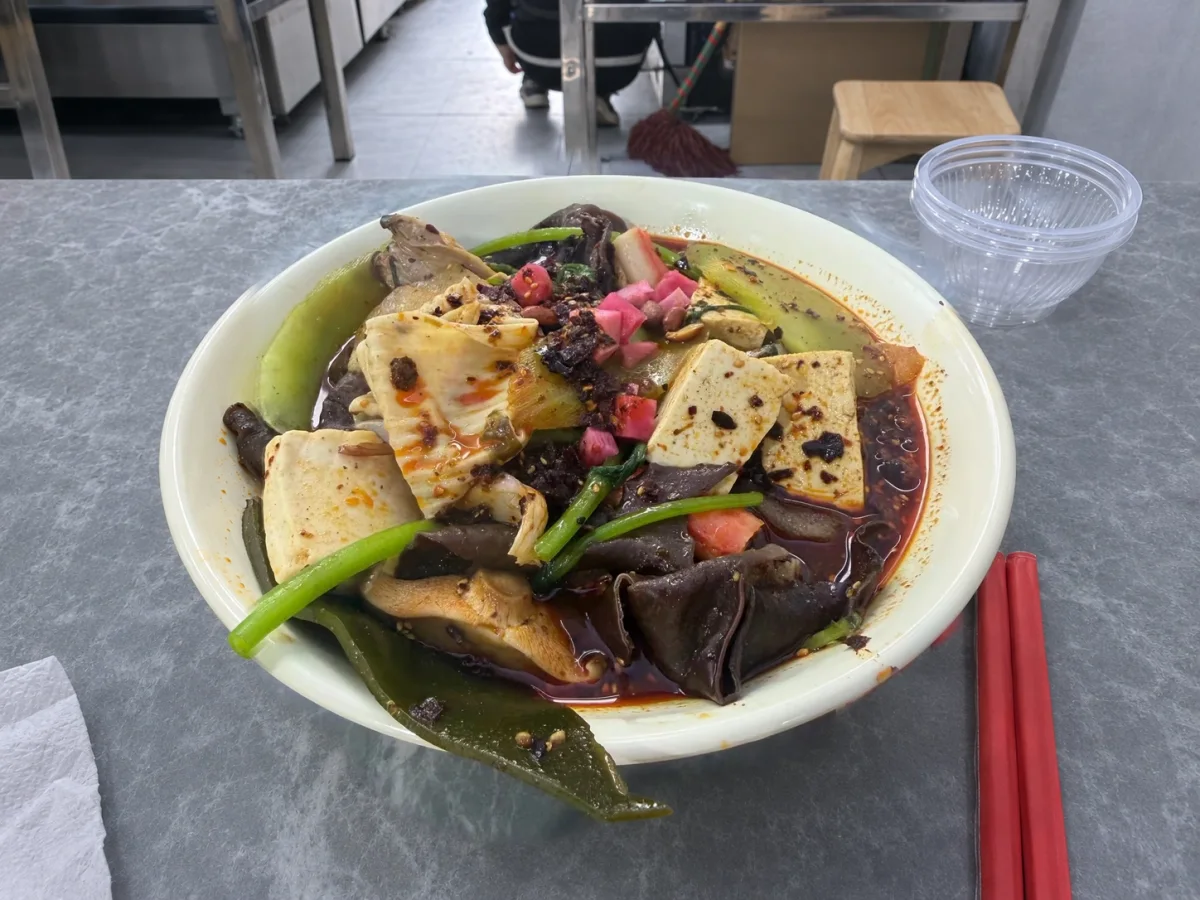
Tianshui malatang is boiled skewers tossed on a big plate with oil-poured chili and Sichuan pepper, eaten with potato noodles and flatbread.
Ordinary malatang is a bowl: you pick vegetables, tofu, meatballs and noodles from a fridge, and the shop boils them in a spicy or bone broth and serves them in it. Tianshui’s version starts the same way, with skewers of greens, tofu skin, kelp, lotus root, potato and quail eggs picked from the shelf, so many that diners carry them to the counter in their fist like a bunch of flowers. They are boiled briefly and then, in the classic Tianshui style, slid off the sticks onto a big porcelain or aluminum plate and tossed with crushed peanuts, diced pickled mustard stem, salt, a pinch of ground Sichuan pepper and several spoons of 油泼辣子, chili flakes scalded with hot oil, until everything is coated red.
The writer Wang Xuan lists three marks of the local style in a 2024 essay in People’s Daily: it is tossed dry, without soup; it comes on a big plate rather than in a bowl; and it is eaten with 白饼, plain white flatbread. A bowl of chewy potato noodles completes it. Many shops will also serve it in broth if you ask, and a skewer cost one or two yuan in 2024.
02
Gangu chilies and Maiji Sichuan pepper
The dish is about the chili, and Tianshui cooks will only use their own.
Gangu, a county west of Tianshui, is called the home of chili, and Gansu’s official accounts date its chilies to a county gazetteer of 1627, when Gangu was called Fuqiang (the history of that date is below). Today it grows about 30,000 mu of them and has more than a hundred chili processors. Gangu chilies are deep red and rich in oil, and they are prized more for fragrance and color than for heat. The Gansu writer Ye Zi notes that local cooks will not make the city’s other famous snack, guagua, with anything but top-grade Gangu chili powder.
The making is seasonal. In September the chilies are picked and strung on cotton thread in strands a meter long to dry under the eaves; in winter the dried pods are cut, roasted in a dry pan and pounded to flakes in a stone mortar. Hot oil poured over the flakes, with sesame and other seasonings, makes the 油泼辣子 that covers every plate. The numbing half of the name comes from Sichuan pepper grown in the same hills: Tianshui has cultivated it for a thousand years, mostly the deep-red Dahongpao variety, and Wudu in neighboring Longnan leads China in pepper output. Visitors keep saying the same thing: the plate looks fiery, but the chili oil is more aromatic than hot.
03
Hand-rolled potato noodles and white flatbread
The noodles are made from Gansu potatoes, and for many visitors they were the real discovery.
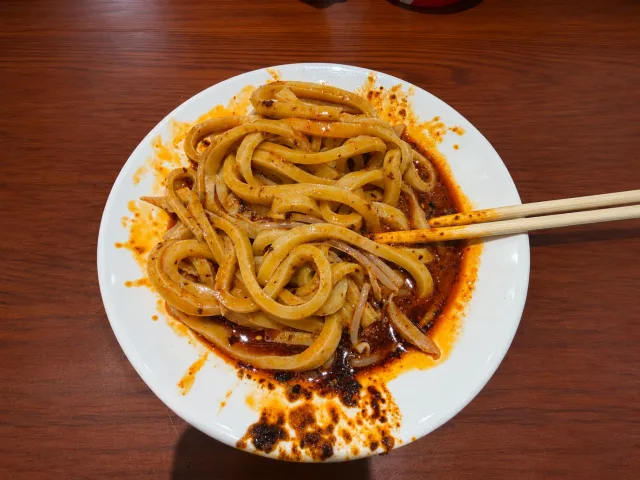
Gansu is one of China’s great potato provinces, and the noodles that come with Tianshui malatang are made from potato starch. In the hill villages potatoes are dug in August, crushed and pressed, and the juice is left in big vats, the water changed again and again until the starch settles clean, then dried. The starch is made into wide, translucent noodles: Dingxi, Gansu’s “potato capital,” has 120 noodle makers selling over three billion yuan a year under a registered geographical-indication name, and Tianshui shops make their own 手擀粉, hand-rolled potato noodles, which are thicker and much chewier than the machine-made kind. A portion cost 6 yuan in 2024 and, coated in chili oil, chews almost like rice cake.
The other starch is 白饼, a plain round flatbread, torn and dragged through the chili oil left on the plate. Shops also sell deep-fried potato balls, another Gansu potato snack, as one of the skewers.
04
Dry or in soup: malatang across Gansu
Malatang changes across Gansu, and Tianshui’s is the oiliest.
Gansu’s malatang is not one recipe. In the southeast, around Tianshui, the chili oil is heaviest and diners choose between a soupy bowl and the dry-tossed plate. Further northwest along the Hexi Corridor, in Zhangye and Jiuquan, there is less soup and the skewers are coated in thick sweet-and-salty sauces of each shop’s own making. In Tianshui many shops now weigh the skewers and mix each plate in a big ladle with a dozen sauces before pouring the chili over, a method that reminded one visitor of Sichuan’s maocai.
| Tianshui | Typical chain malatang | |
|---|---|---|
| Served | On a big plate, usually dry; soup on request | In a bowl of broth |
| Seasoning | Oil-poured Gangu chili, Sichuan pepper, peanuts, zhacai | Bone broth (Yang Guofu adds milk); sesame paste or chili oil |
| Starch | Hand-rolled potato noodles, white flatbread | Noodles picked from the fridge with everything else |
| Priced by | Skewer or weight | Weight |
05
Before 2024: a Sichuan dish and a Gansu chili
Tianshui’s malatang is a local version of a Sichuan dish, and its famous chili has a shorter written history than the publicity says.
Malatang itself came from Sichuan. It is generally traced to Niuhua in Leshan, where Yangtze boatmen and trackers are said to have boiled cheap food in a spicy pot in the 1940s, and until the 1980s it was eaten mainly in southern cities such as Chengdu, Chongqing, Wuhan and Guiyang before it spread north. Tianshui’s own histories do not mention it: neither the 1985 Tianshui Shihua by Ma Tiancai nor the 2007 edition edited by Liu Mali has an entry for malatang. What the city had were the ingredients and the habit. Small shops were making their own version long before the videos: Wu Hongfang, who runs a malatang shop of seven or eight tables in Qin’an county, began working on her seasoning at sixteen and had kept the shop for twenty-four years when the boom came, taking nearly 10,000 yuan a day even before it.
The numbing half is ancient. The early pharmacopoeia Shennong Bencao Jing mentions 秦椒, qinjiao, and the sixth-century Qimin Yaoshu says that one kind of Sichuan pepper “comes from Wudu, qinjiao from Tianshui,” so Sichuan pepper has been a Tianshui product for at least fifteen centuries. The chili is far younger, because chilies only reached China from the Americas in the late Ming. Gansu’s publicity dates Gangu chilies to a gazetteer of 1627, but the historian Brian Dott, surveying local gazetteers for his history of the chili in China, finds Gansu’s first mention in 1737, in a gazetteer of Suzhou, today’s Jiuquan, and notes that the old Gansu name for chili was also qinjiao, which had first meant Sichuan pepper. The food historian Cao Yu finds chilies entering the gazetteers of Baoji, Tianshui and Lanzhou only in the second half of the nineteenth century, spreading west from Shaanxi and passing into Hui Muslim cooking on the way. Whichever date is right, by the twentieth century Gangu’s chilies were the region’s best, and in 2024 Gangu chili powder sold for 20 to 30 yuan a jin against about 10 for ordinary powder.
06
Spring 2024: the bowl that filled a city
A seven-second video in February 2024 sent millions of people to a city most Chinese had never visited.
Just after the 2024 Spring Festival, a user posted a seven-second video of a red, glistening plate of Gansu malatang with the caption “Gansu malatang should be popularized nationwide.” It collected more than a million likes, and by mid-March videos of Tianshui’s malatang were at the top of China’s social media. Tianshui, Gansu’s second city, known until then for the Buddhist caves of Maijishan and the temple of the mythical emperor Fuxi, was overrun. Searches for it on travel platforms rose 186 percent in one week; by 28 March related videos had been viewed 16.77 billion times, and from 1 to 28 March the city received 3.89 million tourists and 2.25 billion yuan in tourism income.
The city responded in the way Zibo had for its barbecue the year before. On 16 March it held an official meeting on “service guarantees” for malatang; it ran free bus lines from the railway station to the malatang streets, staged a malatang festival, cut ticket prices at sights and put volunteers on the streets, and residents pressed gifts on visitors. Queues ran to two hours and more; at the most famous shop, Haiying, people lined up from half past two in the morning, eight hours before it opened, and nearly a million visitors came over the three-day Qingming holiday in April.
07
Why the copycats closed
The dish traveled badly, and the lesson was that people had come for Tianshui.
Within weeks, “Tianshui malatang” shops opened all over China, some after a three-day course in Tianshui, some through franchises asking 100,000 to 200,000 yuan, others with seasoning packs sold online. By the May Day holiday the first of them, in cities such as Jinan, Rizhao, Guilin and Suqian, were already up for transfer; one owner who had spent 300,000 yuan closed after eighteen days. The copies charged city prices by weight, while in Tianshui a skewer cost between half a yuan and two, two people ate well for 30 to 40 yuan, and many small shops did not raise their prices at all.
They also lacked the ingredients: the Gangu chili, the local pepper and oil, and the hand-rolled potato noodles. Not everyone was converted even in Tianshui; one Beijing diner found the plate red and fragrant but neither as hot nor as good as hoped. One widely shared analysis concluded that what went viral was not a recipe but Tianshui itself: its prices and its hospitality.
08
How to order in Tianshui, and what it costs
Pick your skewers, say dry or soup, and add noodles.
Pick skewers
Take a basket and choose from the shelves: greens, tofu skin, kelp, lotus root, potato slices, fried potato balls, quail eggs and gluten. A skewer was one or two yuan in 2024; some shops weigh instead.
Expect about 30 yuan for two
A big shared plate cost 28 yuan at a 28-year-old shop and 32 yuan at a small street shop in 2024.
Say dry or soup
Dry-tossed on a plate is the Tianshui classic; most shops will add broth if you prefer.
Order noodles and bread
Add a portion of hand-rolled potato noodles, 6 yuan in 2024, and a white flatbread for the chili oil.
Choose the heat
Even “extra hot” is medium by Sichuan standards, and the chili is more fragrant than fierce.
Go off-peak
Famous shops still draw queues at weekends and holidays; old neighborhood shops are quicker and often just as good.
09
Tianshui malatang at home
The skewers are easy; make the chili oil properly.
For two: 600 to 800 g of mixed vegetables and tofu products (greens, lotus root, kelp, potato, tofu skin, mushrooms, quail eggs), 200 g wide potato-starch noodles, a handful of roasted peanuts, a little pickled mustard stem (zhacai), and for the chili oil 4 tablespoons of coarse chili flakes, 1 teaspoon ground Sichuan pepper, a spoon of sesame seeds and 150 ml oil.
- 1. Make the chili oil
Put the chili flakes, sesame and a pinch of salt in a heatproof bowl. Heat the oil until it shimmers, let it cool a moment, and pour it over in two goes, stirring. It should sizzle and turn bright red, not black. Leave it 10 minutes.
- 2. Cook the noodles
Soak dried potato noodles in warm water, then boil until chewy and translucent; drain.
- 3. Boil the skewers
Boil the vegetables and tofu in salted water or light stock, the firm ones first, until just done. Drain well.
- 4. Toss on a plate
Tip everything onto a big plate with crushed peanuts, diced zhacai, salt and the Sichuan pepper. Spoon over plenty of chili oil and toss until everything is red and coated.
- 5. Serve
Eat with the noodles and some plain flatbread to wipe up the oil. Add a ladle of the cooking broth if you want it soupy.
10
More from Gansu
Malatang
The pick-your-own boiled bowl from Sichuan and the national chains.
Read about malatang →Lanzhou beef noodles
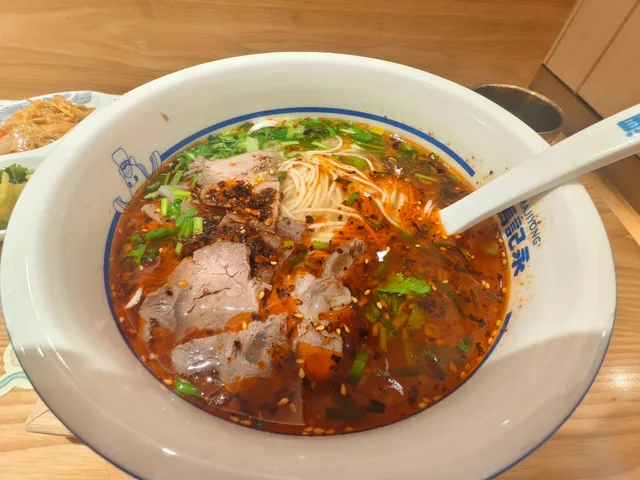
Gansu’s other famous bowl, pulled to order in a clear broth.
Read about Lanzhou beef noodles →Gansu
Tianshui’s guagua and jiangshui noodles, mutton and the Hexi Corridor.
Explore Gansu food →Gansu classics
- Lanzhou Beef Noodles
Hand-pulled noodle soup · Breakfast and lunch
- Lanzhou Hand-Grabbed Mutton
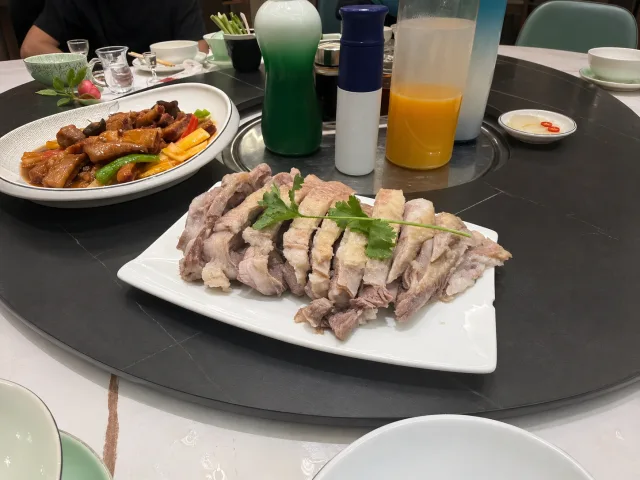
Boiled lamb on the bone · Lunch or dinner, banquets and weddings
- Lanzhou Niangpi
Cold steamed wheat sheets · Snack or light meal, summer, festival tables
FAQ
Questions about Tianshui Malatang
What is Tianshui malatang?
Gansu-style malatang from Tianshui: skewers of vegetables and tofu boiled and tossed on a plate with oil-poured Gangu chili and Sichuan pepper, eaten with potato noodles and flatbread.
How is Tianshui malatang different from ordinary malatang?
It is usually served dry on a big plate rather than in broth, under much more chili oil made from local Gangu chilies, and comes with hand-rolled potato noodles and white flatbread.
Why did Tianshui malatang go viral?
A seven-second video posted after the 2024 Spring Festival spread across Chinese social media; by March millions of visitors were traveling to Tianshui to eat it, helped by cheap prices and an energetic city response.
What chili is used in Tianshui malatang?
Chili from Gangu county, dried, roasted, pounded and scalded with hot oil, plus Sichuan pepper from the Tianshui hills, which has been grown there for well over a thousand years.
Is Tianshui malatang very spicy?
Not very. It looks fiery, but Gangu chili is more fragrant than hot, and even extra-hot plates are medium.
How much does Tianshui malatang cost?
One or two yuan a skewer in 2024; a shared plate for two about 28 to 32 yuan, with noodles 6 yuan extra.
What noodles come with Tianshui malatang?
Hand-rolled wide noodles of potato starch, thick and very chewy.
Does Tianshui malatang have soup?
The classic is dry-tossed without soup, but most shops will serve it with broth.
Where is Tianshui?
In southeastern Gansu, on the high-speed railway between Xi’an and Lanzhou; it is known for the Maijishan grottoes and the Fuxi temple.
Is Tianshui malatang still popular?
The peak of spring 2024 passed and many copycat shops elsewhere closed, but it remains Tianshui’s best-known street food.
Sources
Sources and further reading
- 1 Xinhua News Agency, Dongjian Huoli Zhongguo (洞见活力中国), vol. 1, “A bowl of Tianshui malatang serves up a cultural phenomenon” (in Chinese)Xinhua Publishing House (WeChat Read edition)
- 2 Ye Zi, Long Wei’er (陇味儿), chapter “Guagua”: Tianshui’s insistence on Gangu chili (in Chinese)SDX Joint Publishing (2020; WeChat Read edition)
- 3 Cao Yu, Zhongguo Shi La Shi (中国食辣史), “North and south” and “Chilies on the frontier”: chilies reaching Tianshui and Gansu in the late nineteenth century (in Chinese)Beijing United Publishing (2019; WeChat Read edition)
- 4 Brian R. Dott, Chi La: Lajiao de Zhongguo Shi (吃辣:辣椒的中国史; The Chile Pepper in China), “Chilies enter China”: Gansu’s first record in 1737 and the name qinjiao (in Chinese)Beijing United Publishing (2023; WeChat Read edition)
- 5 The heady smell of Sichuan pepper: Tianshui’s pepper, chilies and potatoes, and the three marks of Tianshui malatang (in Chinese)Wang Xuan, People’s Daily (2024) ↗
- 6 Gansu malatang takes the internet by storm: skewers, chili oil, and how the bowl changes from Tianshui to Zhangyegogansu.com, on China Daily’s Gansu pages (2024) ↗
- 7 Tianshui’s malatang ignites tourism boomgogansu.com, on China Daily’s Gansu pages (2024) ↗
- 8 The Gansu produce behind Tianshui malatang: Dingxi potato noodles, Gangu chilies and Wudu Sichuan pepper (in Chinese)Xin Gansu, on China Daily’s Chinese site (2024) ↗
- 9 An ancient Silk Road city is now China’s latest hotpot hubHe Qitong, Sixth Tone (2024) ↗
- 10 Hot and spicy: how malatang conquered ChinaTan Yunfei, The World of Chinese (2024) ↗
- 11 Tianshui beyond malatang: the dish’s Leshan origins and its absence from the 1985 and 2007 histories of Tianshui (in Chinese)Beijing Daily app, via Tencent News (2024) ↗
- 12 Behind the malatang, this is Tianshui: Qinjiao in the Qimin Yaoshu, Gangu chili powder and a Qin’an malatang shop of 24 years (in Chinese)Chen Faming, Economic Daily, via Guangming Online (2024) ↗
- 13 A 32-yuan plate of Tianshui malatang sold by weight, with 6-yuan wide potato noodles (video, in Chinese)Rou Rou Da Sou Suo (肉肉大搜索), Bilibili (2024) ↗
- 14 Eighteen meals of Tianshui malatang in two days: a 28-year-old shop and a 28-yuan plate (video, in Chinese)Ju Zi Gong Zhu (-橘子公主), Bilibili (2024) ↗
- 15 Tianshui malatang copycats elsewhere: franchise costs and shops closing within weeks (video, in Chinese)Cai Jing Bu Mian Jie (财经不眠姐), Bilibili (2024) ↗
Last updated November 2026