
01
The crepe and the fried dough in its name
In Tianjin, the word guozi in jianbing guozi means a fried dough stick.
Jianbing is the thin pancake on the griddle; guozi is what goes inside, the long, hollow strip of fried wheat dough sold elsewhere as youtiao (油条). The proper character, 馃, carries the food radical, but signs use the homophone 果 just as often, so 煎饼馃子 and 煎饼果子 are the same thing.
Despite the name, Tianjin stalls also fill it with guobir (馃箅儿), a sheet of fried dough that breaks like a cracker, and at the griddle the filling stands for the whole order: guobir de is the one with the crisp, guozi de the one with the stick. Both are counted in tao (套), sets. A guozi on its own is just the dough stick, for dipping in soy milk.
02
Choose a fried dough stick or a thin crisp
The stick gives a thick, chewy middle; the sheet cracks all the way across.
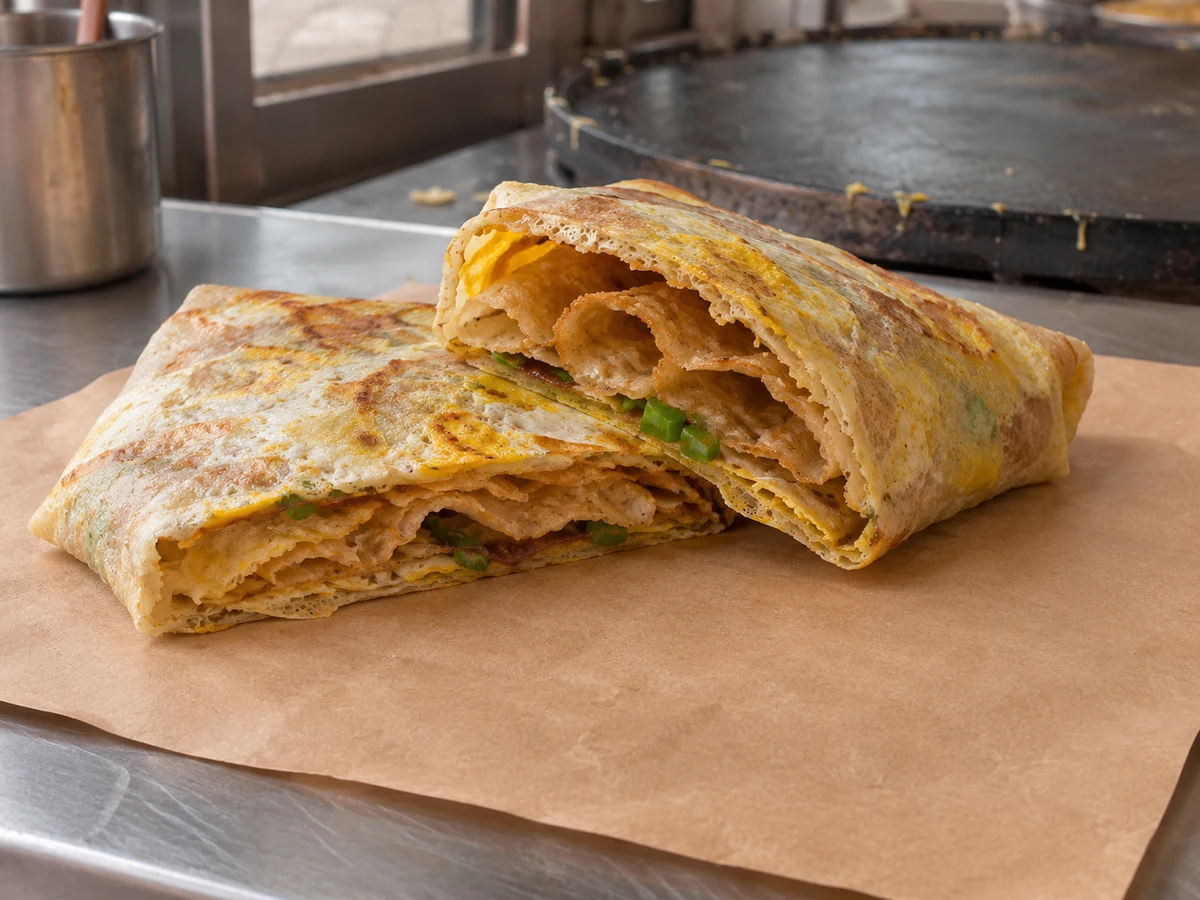
To make a guozi, the fryer stacks two narrow pieces of dough and stretches them into a strip about 31–33 centimeters long before frying. The two halves puff up together into a crisp shell around an open, chewy center. A guobir starts as a small square rolled and pulled out by the corners into a broad sheet. The cook briefly dips one end in the oil before letting the whole sheet go in, then flips it once it floats. A well-fried sheet feels light for its size.
At Ersaozi, near Minyuan Square in the Five Great Avenues district, both fillings are fried in-house. The shop looks for a deep golden color on the stick and a sheet brittle enough to shed crumbs when it snaps. A large sheet can look too big for the pancake before folding. Once the sides are tucked in and the parcel is folded in half, there is a layer of crisp in almost every bite. The stick is the better pick if you like the pull of a fresh youtiao. Pick the sheet if you are eating immediately and want to hear the crunch.
03
Mung bean batter, the bamboo spreader and the egg
The egg is cracked onto the crepe and spread over it while the batter sets.
The 2022 Tianjin trade standard allows two batters. For the wet-milled one, the beans are soaked, ground to a paste and thinned with water until it spreads; the loose skins can be skimmed off first, or milled in if the grind is fine enough. For the other, dry mung bean flour is mixed with water and left to hydrate. Either way the base is mung bean, and millet is optional.
At Ersaozi, the fourth-generation cook Sun Zhiqiang picks medium-sized beans, soaks them and stone-grinds them for a batter of mung bean alone. At a cart in Hongqiao, Cui Genrong soaked the beans overnight and mixed the ground paste with millet flour, other flours and water steeped with spices. If a stall has its own small stone mill, ask whether the batter is pure mung bean.
A ladle of batter lands on a lightly oiled round iron griddle. The cook circles a bamboo spreader outward to make a thin, even round. The trade standard calls for a diameter of 38–45 centimeters. An egg goes straight onto the wet side, where the spreader takes it to the edge in another pass. When the egg sets, a spatula goes around the rim, the crepe flips and the filling goes on. The last fold makes a broad breakfast fit in one hand.
04
Sweet wheat paste, red fermented tofu and scallions
Sweet wheat paste is the main seasoning. A good brushing reaches the edges without soaking the pancake.
The brown sauce is tianmianjiang (甜面酱), a sweet-savory fermented wheat paste. Shops can use it as it comes, or cook it with their own seasonings. Red fermented bean curd can be mashed and thinned to a brushable paste for a salty second layer. Chili paste or chili oil is usually a separate choice. Sesame, when used, goes in as a scattering, while a generous pinch of scallions gives the hot crepe a fresh bite.
The timing of the scallions matters. Scatter them onto the egg before flipping and they cook into the surface. Add them with the sauce near the end and they stay sharper. Some old-style cooks dab a little sauce at the open ends after folding, so the first bite is seasoned as well as the middle. If you prefer a lighter sauce, ask before the brush goes on. If you avoid shellfish, ask before the batter goes down: older recipes ground dried shrimp into it, and one of the trade standard’s sample methods still does.
05
When it was a midnight snack
Early vendors sold jianbing guozi at night outside Tianjin’s theaters and bathhouses.
Tianjin’s Grand Canal trade brought merchants and foods from across northern and eastern China. One local account links the pancake technique to Shandong traders and the fried dough to traders from Anhui. Historian Wan Lujian places the combination among the port’s paper-held foods, easy for laborers to eat without a table. A 1942 account in Jinjin Yuekan describes it as a late-night favorite, made from ground mung beans with small dried shrimp and scallions, wrapped around a fried stick.
Old vendors could make the rolls in advance, carry a small stove and reheat each sale on a greased griddle. Lu Wenyu, born in 1887, recalled seeing an egg-topped version in childhood at the New Year market near Tianhou Palace. The egg was once an extra, even though it feels basic to the dish today. Wan dates its wider use to the 1950s and 1960s, when some state-run breakfast shops began to sell the dish and offered guobir as a filling. Cui’s family remembers the egg becoming more common as its own stall shifted to cooking each crepe to order.
In You Guoqing’s book on food, Wang Wenhan remembers the stand at Xuanjia ferry in Xigu in the mid-1950s. An eggless set cost three fen and came with one short, thick fried stick split in two. Wang recalled paying eight fen by the mid-1970s.
The 1979 manual Tianjin Miandian Xiaochi, quoted in Jinwan Bao, describes reheating a wrapped stick with a little oil until both sides turn golden, then brushing on sweet wheat paste and adding scallions. That last griddle turn survives in the industry method today. In 2017 the city listed three named jianbing-making traditions as municipal intangible cultural heritage, including Ersaozi’s. The local restaurant association published its first processing standard the following year.
06
Ordering a set at the griddle
Choose the fried filling first, then the number of eggs and how much chili you want.
One egg is enough to coat the pancake; two make it softer and richer. Some Tianjin regulars still bring eggs from home and hand them to the cook, but ask the stall first, or simply buy them there. The cook will ask làzi gē bu ge, “chili or not?”; bù gē làzi gets you the sweet wheat paste on its own. If you want less sauce, say so while the batter is still being spread.
| What you want | What to say |
|---|---|
| One set with fried dough | 来一套馃子的 (lái yí tào guǒzi de) |
| One crisp-filled set with two eggs | 来一套馃箅儿的,俩鸡蛋 (lái yí tào guǒbìr de, liǎ jīdàn) |
| Less paste, more scallions | 少搁面酱,多搁葱 (shǎo gē miànjiàng, duō gē cōng) |
| No chili | 不搁辣子 (bù gē làzi) |
A set cost ¥7–8 at Xibeijiao stalls in 2023, and a double-egg set with a crisp ¥7.50 at a neighborhood stall the same year; a metro-station kiosk charged ¥9.90 in August 2026. At a busy stall, have your order ready when your turn comes, and eat it while the paper bag is still warm.
07
Tianjin jianbing, Beijing jianbing and Shandong pancakes
Jianbing is a whole family of griddled pancakes, and Tianjin’s is only one of them.
In Shandong a jianbing can be a sheet as thin as paper, eaten as a staple with other dishes the way bread is, or a stuffed pancake such as the vegetable jianbing of Zibo and Zaozhuang. Tianjin’s is a whole breakfast made on the griddle: mung bean crepe, egg, fried dough and sauce.
In Beijing the street jianbing visitors know is usually built around a thin fried cracker called baocui (薄脆), much like Tianjin’s guobir, and a Beijing batter may contain mung bean too. What marks the Tianjin version is the choice of a hollow guozi and a batter based on mung bean, as the local standard sets out. Abroad the frame takes other fillings: in 2024 a Chicago shop sold one with bacon, avocado and cheddar, still with a crisp layer inside.
09
What translates to a home frying pan
At home, a flat frying pan makes a smaller crepe and a more manageable flip.
Use mung bean flour, which gives the crepe its earthy taste; mung bean starch is sold next to it in some shops, so check that the label lists ground beans. Have the egg, chopped scallions, sweet wheat paste and fried filling within reach, make the round only as wide as the flat part of your pan, and spread it thin enough to set before the egg goes on.
Spread the beaten egg over the surface as it sets, sprinkle on scallions and flip when the edges lift cleanly. Brush the cooked side with a little sweet wheat paste. A ready-made youtiao is the closest match for the stick version. A crisp-fried wonton wrapper gives a smaller crackly center if guobir is unavailable. Fold the sides over the filling and fold the parcel once more so it can be held in one hand.
FAQ
Questions about Tianjin Jianbing
What is jianbing guozi?
It is Tianjin’s savory mung bean crepe, usually cooked with an egg and folded around a fried dough stick or a thin fried crisp, with sweet wheat paste and scallions.
What does guozi mean in Tianjin?
In jianbing guozi it means youtiao, a long, hollow stick of fried wheat dough. It is written 馃子 or 果子 in the dish name.
What is the crunchy filling in jianbing?
The flat one is guobir in Tianjin, a thin sheet of fried dough. Beijing vendors often call their thin fried cracker baocui. For a puffed, chewy middle, ask for a guozi, or youtiao.
Is Tianjin jianbing the same as Beijing jianbing?
They share a thin griddled pancake, usually an egg, and a fried filling. Tianjin’s named style uses a mung bean base and gives a choice of a fried stick or a crisp. A Beijing street stall commonly uses a cracker.
Can you bring your own eggs?
Some Tianjin regulars do. Ask the vendor first. You can also order one or two eggs from the stall.
Does the batter have to be pure mung bean?
Mung beans are the main ingredient in the Tianjin trade standard. Some shops use pure mung bean and others add millet. The standard describes both a wet-milled batter and one made from dry flour.
Do you eat jianbing hot?
Yes. Eat it straight from the griddle while the fried center is crisp. In Tianjin, hot soy milk is a common accompaniment.
Is Tianjin jianbing vegetarian?
It can be. Ask whether the batter contains dried shrimp or stock, and check the sauce and fillings at the stall. The usual egg topping also matters if you avoid eggs.
Sources
Sources and further reading
- 1 T/TJCY 002–2022, Tianjin jianbing guozi: definitions, ingredients and griddle technique (in Chinese)Tianjin Catering Industry Association (2022) ↗
- 2 Beijing street food: jianbing with an egg and fried crackerVisit Beijing (2016) ↗
- 3 A ¥9.90 jianbing at a Tianjin metro station (in Chinese)Jinwan Bao, via Tianjin Municipal Government (2026) ↗
- 4 Making Tianjin jianbing: the port, a fourth-generation cook and a coffee-shop version (in Chinese)Wu Shaomin, People’s Daily Overseas Edition (2025) ↗
- 5 A morning at Cui Genrong’s jianbing cart in Hongqiao (in Chinese)Wang Chongpengcheng, The Beijing News (2020) ↗
- 6 Three Tianjin jianbing-making traditions enter the municipal heritage list (in Chinese)Xinhua (2017) ↗
- 7 Xibeijiao’s breakfast stalls and what people paid in 2023 (in Chinese)Tianjin Radio, via The Paper (2023) ↗
- 8 Shandong jianbing across Tai’an, Yimeng, Zibo and Zaozhuang (in Chinese)People’s Daily Online, Shandong (2025) ↗
- 9 From night snack to breakfast: Lu Wenyu, a 1942 account and the 1979 Tianjin snack manual (in Chinese)Jinwan Bao (2026) ↗
- 10 Tianjin breakfast, with newspaper archive references (in Chinese)Tianjin Library (2023) ↗
- 11 Jianbing Chicago and its bacon, avocado and cheddar versionMonica Eng, Axios Chicago (2024) ↗
- 12 A Beijing-born cook’s home-pan jianbing methodThe Kitchn (2026) ↗
- 13 “Jianbing guozi: two spellings,” including Wang Wenhan’s Xigu ferry memories (in Chinese)You Guoqing, Sifang Shishi, Buguo Yi Wan Renjian Yanhuo, China Literature and History Press (2024) ↗
- 14 Neighborhood breakfast in Tianjin: double-egg jianbing with two fried crisps (video, in Chinese)A Xing Tan Dian (阿星探店), Bilibili (2025) ↗
- 15 Breakfast near home: freshly milled mung beans and a ¥7.50 double-egg jianbing (video, in Chinese)Meishi Xiaopang Dai Ni Lang (美食小胖带你浪), Bilibili (2023) ↗
Last updated November 2026