
01
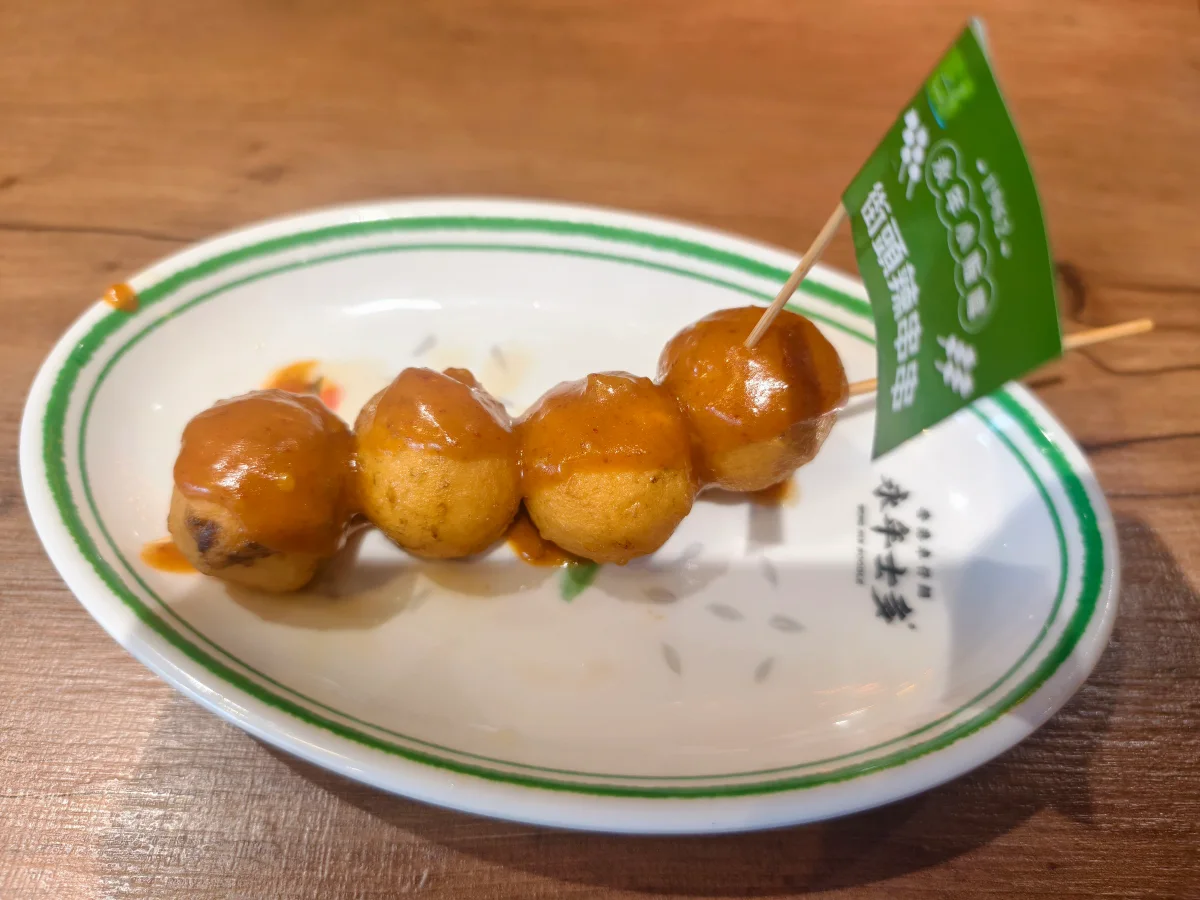
A skewer of golden fish balls in curry
Curry fish balls are fried fish balls on a bamboo skewer, soaked in a thick, sweet-spicy curry sauce.
Walk through any busy Hong Kong street and you will smell them before you see them: a warm, sweet curry scent drifting out of snack stalls, cart noodle shops and convenience stores. A skewer usually holds four or five, golden outside from the fryer and white inside, with the springy, bouncy bite Hong Kong calls 彈牙, dan ah. The sauce is not an Indian or Thai curry. Most stalls build it on curry powder with sha cha sauce, ground bean paste, garlic and ginger, so it tastes savory and a little sweet first, then warm with spice.
In Cantonese the fish ball is 魚蛋, jyu daan, literally “fish egg,” and the snack and it is eaten on the spot: you take the skewer, pull each ball off with your teeth, let the sauce drip on the pavement, and throw the stick away a few minutes later. Some stalls add a squirt of soy sauce or chili sauce; others serve the balls in a foam bowl.
At Wing Nin (永年士多), a shop that itself began by selling fish balls, a skewer holds four large fish balls glazed in a thick orange curry sauce, with a small flag reading 咖喱魚蛋串串, “curry fish ball skewer.” In the 1960s its founder, 劉永年, whose given name the shop still carries, ran a snack stall in Ping Shan, then moved into Yuen Long town and opened a small store selling fish balls and rice noodle rolls; it switched to cart noodles in 1988. A grandson, Dennis, renovated the old shop and in 2017 opened a branch in Tsim Sha Tsui, and the Hong Kong Tourism Board’s 2025 food guide lists a shop in Tuen Mun for cart noodles with fish balls and spicy sauce.
02
What goes into a fish ball
Cheap fish, a lot of beating, and a fryer.
The fish ball began as thrift. In poor Chaozhou, fish too small or bony to eat whole were scraped of every scrap of flesh, and the paste was mixed with rice flour or starch and rolled into balls. Street-stall fish balls in Hong Kong are still made from inexpensive fish, traditionally shark and lizardfish among them, mixed with starch. Kau Kee, a local maker, adds golden threadfin bream, bigeye snapper, yellowtail scad and hairtail to the list, and some versions include a little dried tangerine peel, chenpi.
The bounce comes from work. The fish paste is stirred and beaten hard until its proteins bind into a springy gel, and good makers keep it ice-cold while they do it, because warm paste will not hold together. Lam Lo-ping of Tak Hing in Kowloon City pours ice onto his paste as he mixes and uses no flour at all; his balls are 90 percent fish. Hand-kneaded paste has a firmer bite than machine-molded balls, but many stalls now buy theirs in bulk from suppliers who make them by machine.
Then comes the fryer. The white, boiled Chiu Chow fish ball is the one that goes into noodle soup; the street-stall ball is deep-fried until golden. Because it is already cooked, the stall only needs to heat it through in the curry.
03
From Chaozhou to the Hong Kong curb
A Chaozhou fish ball, an Indian spice and a post-war street cart.
Fish balls belong to the cooking of Chaozhou and Fujian, and in Hong Kong they were at first eaten the Chiu Chow way, white and boiled, in noodle soup. The snack as Hong Kong knows it took shape in the 1950s and 60s, when the city was crowded with new arrivals and hawkers pushed wooden carts through the streets. Hawkers began frying the fish balls and serving them in a spicy curry sauce. Curry itself had arrived with Indian traders in the colonial period, but the hawkers’ sauce became a local thing of its own. Cart noodles grew up at the same time and from the same kind of mobile cart, which is why fish balls are still a standard cart noodle topping.
Making the balls was hard, cheap labor. Factories grew up in time: Four Seas Fish Balls received the first fish ball manufacturing license in 1977 and moved from family workshops to machines. But for decades much of the work happened in Kowloon Walled City, a Chiu Chow stronghold outside the reach of licensing and tax. Lam Lo-ping, who came from Chaozhou as a child, helped his brother scrape fish by hand in a tiny Walled City workshop after school, and in 1983, at 24, opened his own wholesale business there with 6,000 dollars. When the Walled City was demolished in 1994, he kept making fish balls in Kowloon City and began selling direct to customers.
The fish ball has stayed cheap and everywhere, and it travels. A skewer is one of the first things Hong Kong emigrants seek out on visits home, and by 2007 popular fish ball outlets had opened branches from Sydney to Vancouver.
04
Every stall’s secret sauce
The fish balls are often bought in; the sauce is where stalls compete.
Few local makers still produce their own fish balls, so stalls compete on sauce, and recipes are guarded. The usual base is curry powder fried with sha cha sauce, ground bean paste, garlic and ginger, but the balance runs from sweet and nutty to properly hot. Some lean toward satay: Yu Dan Lo in Sai Wan Ho, the “Fish Ball Guy,” makes a sauce of more than twenty ingredients every day that tastes rich and sweet with only a little heat. Others pride themselves on fire, and some add chenpi, dried tangerine peel, to the fish balls, or a numbing mala heat to the sauce.
| Style | Where | What it tastes like |
|---|---|---|
| Sweet curry-satay | 魚蛋佬 Yu Dan Lo, Tai On Building, Sai Wan Ho; 6 pm to midnight | Thick, rich and sweet, slightly spicy |
| Classic curry | 通達食店 Tung Tat, 48 Pitt Street, Yau Ma Tei, and 172 Fa Yuen Street, Mong Kok | Golden, glossy, warm with spice; spicy or mild |
| Extra hot | 輝記小食 Fai Kee, Wan Chai (2018) | Ultra-spicy curry, or chili oil instead |
| Chenpi and numbing spice | 旦王, Mong Kok | Tangerine peel aroma, a burn that hits the throat |
05
Where to eat them
Snack stalls, cart noodle shops and old neighborhoods.
You can buy curry fish balls almost anywhere, including convenience stores, but the snack stalls of the older neighborhoods are the place to start. In Sham Shui Po, Hop Yik Tai on Kweilin Street sells traditional curry fish balls alongside its famous steamed rice rolls; a short walk away Kung Wo Beancurd Factory sells them too, along with jumbo fish balls, golf-ball-sized and softer than the usual kind; and Man Kee Cart Noodle is known for its curry quartet of radish, pork rind, pig’s blood curd and fish balls. Tung Tat, with shops in Yau Ma Tei and Mong Kok, is the stall the Hong Kong Tourism Board sends visitors to. In Sai Wan Ho, Yu Dan Lo opens in the evening and draws long queues. In Kowloon City, Tak Hing on Fuk Lo Tsun Road has long sold its hand-made fish balls fresh, along with curry fish balls and its own curry sauce to take home.
Cheung Chau is known for giant, golf-ball-sized fish balls; in 2018 Welcome Food Court (時來食坊) there served them in curry or barbecue sauce, or deep-fried. Prices have crept up but stay low: in 2016 Yu Dan Lo charged five Hong Kong dollars for five fish balls; in 2026 its skewers start at about seven.
06
How to order
Point, say how hot, and eat it standing up.
Ask for 一串咖喱魚蛋, jat cyun gaa lei jyu daan, “one skewer of curry fish balls.” Some stalls have a spicy and a milder sauce, so say which you want. Eat it while it is hot, holding the skewer away from your clothes.
How hot
Say 辣 (laat) for spicy or 唔辣 (m laat) for not spicy; some stalls have only one sauce, so ask before you pay.
Extras
Some stalls add soy sauce or chili sauce on top, and some serve the balls in a bowl instead of on a stick.
Mind the salt
A skewer is light, at about 76 calories, but salty: HK01 puts it at about a third of a day’s sodium.
07
Curry fish balls at home
Buy fried fish balls, make a ten-minute sauce, then let them soak for an hour.
Asian supermarkets sell the golden, fried fish balls in packs, and they are already cooked. This version follows HK01’s home recipe, which uses curry powder and lets the fish balls soak in the sauce off the heat, so they take on flavor without swelling. The Woks of Life makes a thicker, richer sauce with Thai yellow curry paste, a little flour, chicken stock and coconut milk, closer to a curry you could spoon over rice.
About 450 g (1 lb) fried fish balls; 2 tablespoons curry powder; a little onion and garlic, finely chopped; 1 tablespoon sugar; 1 tablespoon oyster sauce; 200 ml water; a little oil; bamboo skewers.
- 1. Blanch
Drop the fish balls into boiling water for a moment and drain.
- 2. Aromatics
Warm a little oil over low heat and fry the onion and garlic until fragrant.
- 3. Curry
Add the curry powder and stir until it smells toasty, then pour in the water and bring to the boil over medium heat.
- 4. Season
Stir in the sugar and oyster sauce, taste, and adjust; curry powders differ a lot in flavor and heat.
- 5. Soak
Add the fish balls and bring back to the boil, then turn off the heat, cover and leave for about an hour.
- 6. Serve
Reheat gently, thread four or five onto each skewer and spoon over more sauce.
08
More Hong Kong food
Other dishes on the atlas.
Satay beef noodles
The cha chaan teng breakfast bowl, with a peanut-rich satay soup.
Read about satay beef noodles →Rice noodle rolls
A common street-stall partner, with sweet soy and sesame.
Read about rice noodle rolls →Egg tarts
Hong Kong’s bakery classic.
Read about egg tarts →Hong Kong classics
FAQ
Questions about Hong Kong Curry Fish Balls
What are Hong Kong fish balls made of?
Fish paste, traditionally from inexpensive fish such as shark and lizardfish, mixed with starch, beaten until springy, rolled and deep-fried. Some makers, such as Tak Hing in Kowloon City, use no flour at all.
Are curry fish balls spicy?
Usually mildly. The sauce is sweet and savory with gentle heat, and some stalls offer a spicy and a mild version.
Is the curry Indian?
Curry came to Hong Kong with Indian traders, but the street-stall sauce is local: curry powder with sha cha sauce, bean paste, garlic and ginger, and it tastes like neither Indian nor Thai curry.
How much do they cost?
About 7 to 10 Hong Kong dollars a skewer in 2026; a well-known stall in Sai Wan Ho starts at about seven.
What is the difference between white and golden fish balls?
White fish balls are boiled, Chiu Chow style, and go into noodle soup. Golden ones are deep-fried and are the kind sold with curry on the street.
Where did curry fish balls come from?
Hong Kong street hawkers of the 1950s and 60s, who fried Chaozhou-style fish balls and served them in curry sauce from their carts.
Sources
Sources and further reading
- 1 “Must-Try Street Food in Hong Kong”Hong Kong Tourism Board ↗
- 2 “Wing Nin Noodles” (永年士多), Taste Hong Kong guideHong Kong Tourism Board, produced by the South China Morning Post (information as of December 2025) ↗
- 3 “Bouncing Through Time: The Journey of Hong Kong’s Iconic Fish Ball”MICHELIN Guide Hong Kong (October 15, 2025) ↗
- 4 “Sex, Money, Food, Politics: How Hong Kong’s Humble Fishball Defines Us”HK Magazine, South China Morning Post (March 11, 2016) ↗
- 5 Jason Wordie, “Fishy goings-on”South China Morning Post (April 15, 2007) ↗
- 6 吳美松, “Kowloon Walled City: the Tak Hing fish ball boss who started in the Walled City” (九龍城寨︱德興魚蛋老闆城寨起家躍升行業龍頭) (in Chinese)HK01 (July 20, 2024) ↗
- 7 鄒家鳳, “Curry fish ball recipe: an easy method in 15 minutes” (咖喱魚蛋食譜|簡易做法15分鐘完成) (in Chinese)HK01 (August 23, 2026) ↗
- 8 Andrea Lo, “Hong Kong Bites: Fishballs 魚蛋”Zolima CityMag (September 5, 2018) ↗
- 9 “Curry fish ball picks: five must-try curry fish balls” (咖喱魚蛋推介|5間必食咖喱魚蛋推薦) (in Chinese)U Food (November 4, 2026) ↗
- 10 “Yuen Long cart noodle shop renovates and opens a branch, selling 1,500 bowls a day” (元朗車仔麵老舖翻新 開埋分店日賣千五碗) (in Chinese)Apple Daily, via Franchise Hub (November 27, 2017) ↗
- 11 Kaitlin Leung, “Hong Kong Curry Fish Balls”The Woks of Life (February 26, 2017) ↗
Last updated November 2026