
01
Beef, noodles and a peanut soup
Satay beef noodles are a bowl of noodles in a peanut-rich satay soup, topped with tender beef.
In a Hong Kong cha chaan teng, the satay beef is cooked to order: thin slices of marinated beef are stir-fried with satay sauce, spooned onto noodles in chicken broth, and the two slowly run together into an orange-red, peanut-scented soup. HK01 calls it one of the cha chaan teng’s main dishes, and Chau Tsz Yan, a scholar of Hong Kong literature at the Hang Seng University of Hong Kong, calls it, simply, the pillar of the cha chaan teng noodle menu.
The taste is savory first and peanutty second, with a mild sweetness and only a little heat. Besides peanuts, local sauces get their savor from fish sauce, dried flatfish and dried shrimp, which puts them closer to Chaozhou cooking than to the lemongrass and tamarind of Malaysian satay. Shop descriptions in a 2026 Hong Kong round-up run from “slightly sweet and savory” to “rich with peanut,” and no two kitchens taste the same, because most build their sauce from one or more bottled sauces and finish it with their own aromatics.
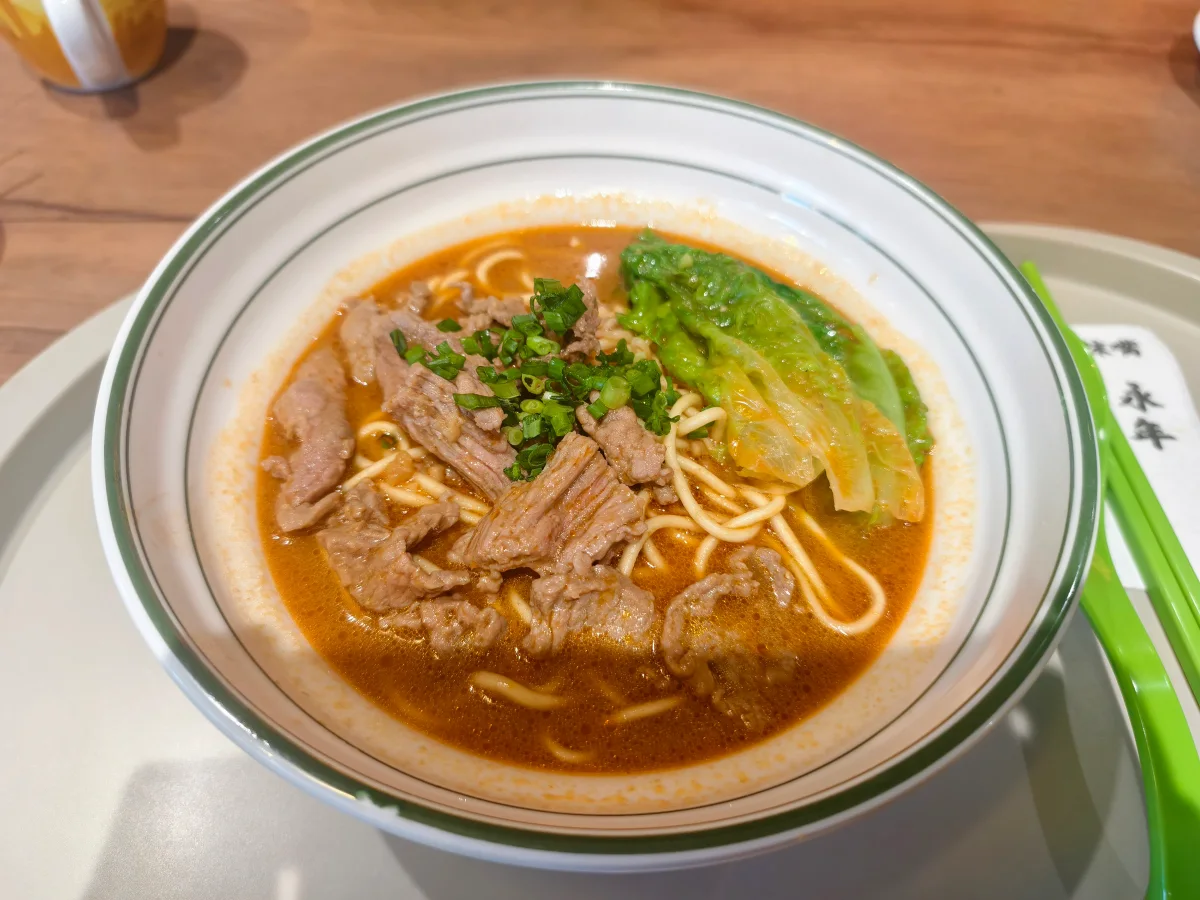
At Wing Nin (永年) noodle shops the bowl has fresh noodles rather than instant ones, sliced beef, scallions and a few leaves of lettuce in an orange-red satay soup. Lettuce is a common partner.
02
What is in Hong Kong satay sauce
The sauce is bought, then finished in the kitchen.
Hong Kong satay sauce is a jarred local product, and a cha chaan teng kitchen usually starts from one or two brands, fries them with its own aromatics and seasonings, thickens the result and loosens it with water. The labels Chau Tsz Yan copied from market shelves show what goes in: peanuts and oil, garlic and scallion, then a savory layer of fish sauce, dried flatfish and dried shrimp in one brand, soy sauce and curry powder in another, bean paste, coconut and rice vinegar in a third. The two names she hears most often as favorites are 綿香 and Jimmy’s, the first mild and nutty, the second hotter and saltier.
Hong Kong cooks distinguish this sauce from Chaozhou sha cha (沙茶), its close relative. A 2026 Ta Kung Pao column puts it in one line: satay is about peanut, sha cha about dried shrimp. Sha cha is the nearest substitute abroad; to push it toward the Hong Kong taste, add peanut. Even in Hong Kong the color drifts: Chau noticed that some shops now make their satay beef so pale that it looks just like curry beef.
| Brand | What stands out |
|---|---|
| 綿香 (a local brand) | Peanut, garlic, fish sauce, dried flatfish, dried shrimp; mostly peanut, not hot or salty |
| Jimmy’s | Peanut, soy sauce, curry powder, chili powder, shrimp; hotter and saltier |
| Amoy 淘大 | Peanut butter, shallot, bean paste, coconut, rice vinegar, dried shrimp |
03
From Southeast Asian satay to a Hong Kong breakfast
The word came from Southeast Asia; the flavor came by way of Chaozhou.
Satay began in Southeast Asia as skewers of marinated meat grilled over charcoal and dipped in a peanut sauce. In the 19th century, the historian Lin-Yi Tseng writes, Fujianese and Cantonese workers in Southeast Asia brought the sauce home, and in Chaoshan it was remade: less peanut, no chili heat, and in its place dried flatfish, dried shrimp and a cabinet of spices from Sichuan pepper to cloves. That sauce became sha cha, 沙茶; one theory is that the name stuck because the Teochew reading of 茶 sounds close to the last syllable of satay.
Hong Kong had both strands. In the 1950s and 60s, Chau Tsz Yan found, the city’s newspapers used “satay” mostly for Malaysian skewers, served in the Malaysian and Hainanese restaurants that opened after the war, while the Chaozhou version appeared as 沙嗲牛肉, satay beef. In 1964 the sauce maker Amoy put a household “Real Taste” satay sauce (真味沙爹醬) on the shelves. When the cha chaan teng took up satay, though, it chose the Chaozhou beef: poured over instant noodles in the morning, and used for fried rice noodles and vermicelli pots later in the day. Why that version won, she suggests, is probably a matter of which social class’s taste the diners served.
Hong Kong satay and Chaozhou sha cha still share an ancestor, but they no longer taste alike. And of everything that carries the satay name, the one Hong Kong people long for most, a Wen Wei Po columnist wrote in 2026, is a bowl of satay beef noodles in a cha chaan teng in the morning.
04
A cha chaan teng breakfast
Satay beef noodles are breakfast food first.
The classic way to eat them is in the 常餐, sheung chaan, the “regular set” that cha chaan tengs serve all day: buttered toast, an egg, a bowl of noodles and a drink, usually milk tea or coffee. The noodles in that set are either macaroni with ham or satay beef noodles, 沙嗲牛麵, saa de ngau min in Cantonese.
The default noodle is instant. Hong Kong still calls instant noodles 公仔麵, after the local brand that made them famous, which Nissin bought in 1989. Rice noodles and other noodles usually cost the same, but switching to Demae Iccho, the Japanese brand, costs extra; in 2016 Demae Iccho alone came in 21 flavors in Hong Kong, more than anywhere else in Asia. Some shops use fresh dai gwong noodles (大光麵) or rice noodles instead, a few serve it in a claypot, and some, like Wing Shun in Yuen Long, will make it 走湯, without soup, as a tossed bowl.
05
Where to eat it in Hong Kong
Every old cha chaan teng has its own version.
A 2026 round-up of eighteen Hong Kong shops shows how wide the range is. Wah Lok Ice Room (華樂冰室) in Sheung Wan has been open since the 1940s, and satay beef noodles are what most customers order. Wing Shun (永順) in Yuen Long, open since 1982, lets you pick the noodle. Sun Wah (新華茶餐廳) in Cheung Sha Wan, 57 years old, marinates fresh beef and fries it in its own satay sauce to order, and Fong Wing Kee (方榮記) in Kowloon City puts its satay beef on dai gwong noodles with lettuce. Some shops change the base entirely: 陳通記 on Cheung Chau serves it on 米通 rice noodles, and 榮記 in Tsz Wan Shan makes it as a claypot noodle. Prices run from 18 Hong Kong dollars for a dine-in bowl between 11 am and noon at 小城大廚 in Kwun Tong to 80 dollars for a deluxe set at 好好運 in Lai Chi Kok.
| Shop | Detail | Price |
|---|---|---|
| Fong Wing Kee 方榮記, Kowloon City | Dai gwong noodles, lettuce | $38 at lunch |
| 康樂茶冰廳, Tsuen Wan | Breakfast set | From $35 |
| 小城大廚, Kwun Tong | Dine-in, 11 am to noon ($20 otherwise) | $18 |
| 好好運, Lai Chi Kok | Deluxe set, black garlic Demae Iccho | $80 |
Sources [1]
06
How to order
A few words go a long way.
On a cha chaan teng menu look for 沙嗲牛麵 or 沙嗲牛肉麵, or find it inside the 常餐 set. Say which noodle you want, and whether you want soup.
Saa de ngau min
The Cantonese name, 沙嗲牛麵, “satay beef noodles.” Also written 沙爹牛肉麵.
Switch the noodle
Instant is standard. Other noodles usually cost the same; Demae Iccho costs extra.
Soup or not
Some shops will make it 走湯, “no soup,” as a tossed bowl.
07
Satay beef noodles at home
The beef takes ten minutes; the marinade takes thirty.
This follows the recipe in ArChan Chan’s Hong Kong cookbook, which tosses the noodles with the sauce; its tablespoons are Australian, 20 ml each. For the cha chaan teng soup version, make the broth in the last step and pour the beef over noodles in soup. Chau Tsz Yan’s home version skips baking soda and uses naturally tender cuts, ribeye or short rib, sliced thick against the grain.
For 4: 300 g beef fillet or another quick-cooking cut, sliced into thin strips; 1 tablespoon light soy sauce, 1 teaspoon sugar, 2 teaspoons cornflour, 1 tablespoon oil and 2 tablespoons water for the marinade; 100 g sa cha or Hong Kong satay sauce; 1 teaspoon sugar; 125 ml water; 3 tablespoons oil; 1 garlic clove and 1 shallot, finely chopped; 340 g instant noodles; scallions and toasted sesame seeds.
- 1. Marinate
Mix the beef with the soy sauce, sugar, cornflour, oil and water and leave for 30 minutes.
- 2. Mix the sauce
Stir the satay sauce with the sugar and 125 ml water.
- 3. Sear the beef
Heat 1 tablespoon oil over high heat and fry the beef for about 2 minutes, until almost cooked. Lift it out.
- 4. Finish the sauce
Fry the garlic and shallot in the remaining oil for 30 seconds, return the beef, add the sauce and simmer gently for about 2 minutes.
- 5. Noodles
Cook the noodles according to the packet and drain. Top with the beef and sauce, scallions and sesame.
- 6. Soup version
For one bowl in soup, bring about 150 ml chicken stock and 150 ml water to the boil, stir in 2 tablespoons canned cream of chicken soup, pour over the noodles, then add the satay beef.
08
More Hong Kong and Cantonese food
Other dishes on the atlas.
Hong Kong curry fish balls
Hong Kong’s street-snack counterpart: fish balls on a stick in curry sauce.
Read about curry fish balls →Wonton noodles
Hong Kong’s other great noodle bowl, thin egg noodles with shrimp wontons.
Read about wonton noodles →Egg tarts
A cha chaan teng sweet with a short or flaky crust.
Read about egg tarts →Hong Kong classics
FAQ
Questions about Hong Kong Satay Beef Noodles
Are satay beef noodles spicy?
Not very. Hong Kong satay sauce is savory and peanutty, with a little sweetness; some brands add chili, but it is a mild dish.
Is Hong Kong satay sauce the same as sha cha?
They are relatives with the same Southeast Asian ancestor. Hong Kong satay sauce tastes more of peanut; Chaozhou sha cha tastes more of dried shrimp and fish.
Is it the same as Malaysian or Indonesian satay?
No. Southeast Asian satay is grilled skewered meat with peanut sauce. Hong Kong satay beef is stir-fried beef in a local sauce, served on noodles.
Which noodles are used?
Instant noodles by default; switching to Demae Iccho costs extra. Some shops use dai gwong noodles or rice noodles.
When do people eat it?
Mostly at breakfast, in the cha chaan teng set with toast, an egg and a drink, but it is served all day.
Can I make it without satay sauce?
Use sha cha sauce and push it toward peanut: Chau Tsz Yan seasons her satay sauce with peanut butter, fish sauce and sugar.
Sources
Sources and further reading
- 1 Ellen, “18 satay beef noodle picks” (沙嗲牛肉麵18大推介) (in Chinese)HK01 (July 23, 2026) ↗
- 2 Law Po-hei, “Instant noodles in Hong Kong for half a century” (「公仔麵」扎根香港半世紀) (in Chinese)HK01 (June 6, 2016) ↗
- 3 Joanne Yau, “How beef satay noodles, comfort food with Southeast Asian roots, became a Hong Kong fave”South China Morning Post (September 14, 2024) ↗
- 4 Chau Tsz Yan, “The many universes of satay beef” (讀食時光:沙爹牛肉的多重宇宙) (in Chinese)Ming Pao (February 18, 2024) ↗
- 5 Lin-Yi Tseng, “From a foreign land to a homeland: the story of sha cha you didn’t know” (從他鄉到故鄉:你所不知道的沙茶故事) (in Chinese)Geographical Society of the Republic of China (Taiwan), blog (January 29, 2021) ↗
- 6 Ip Tak-ping, “Indonesian satay comes to Chaoshan: less heat, more savor, and it becomes sha cha” (印尼沙嗲入潮汕 減辣增鮮成沙茶) (in Chinese)Wen Wei Po (September 3, 2026) ↗
- 7 “Satay and sha cha” (食色/沙嗲與沙茶) (in Chinese)Ta Kung Pao (September 1, 2026) ↗
- 8 Hiufu Wong, “Cha Chaan Teng: A Survival Guide to Hong Kong’s Local Diners”Hong Kong Cheapo (updated August 6, 2021) ↗
- 9 ArChan Chan, “Sa cha beef noodles,” from Hong Kong Local (Smith Street Books)SBS Food (December 12, 2022) ↗
Last updated November 2026