
01
What one stroke does to a noodle
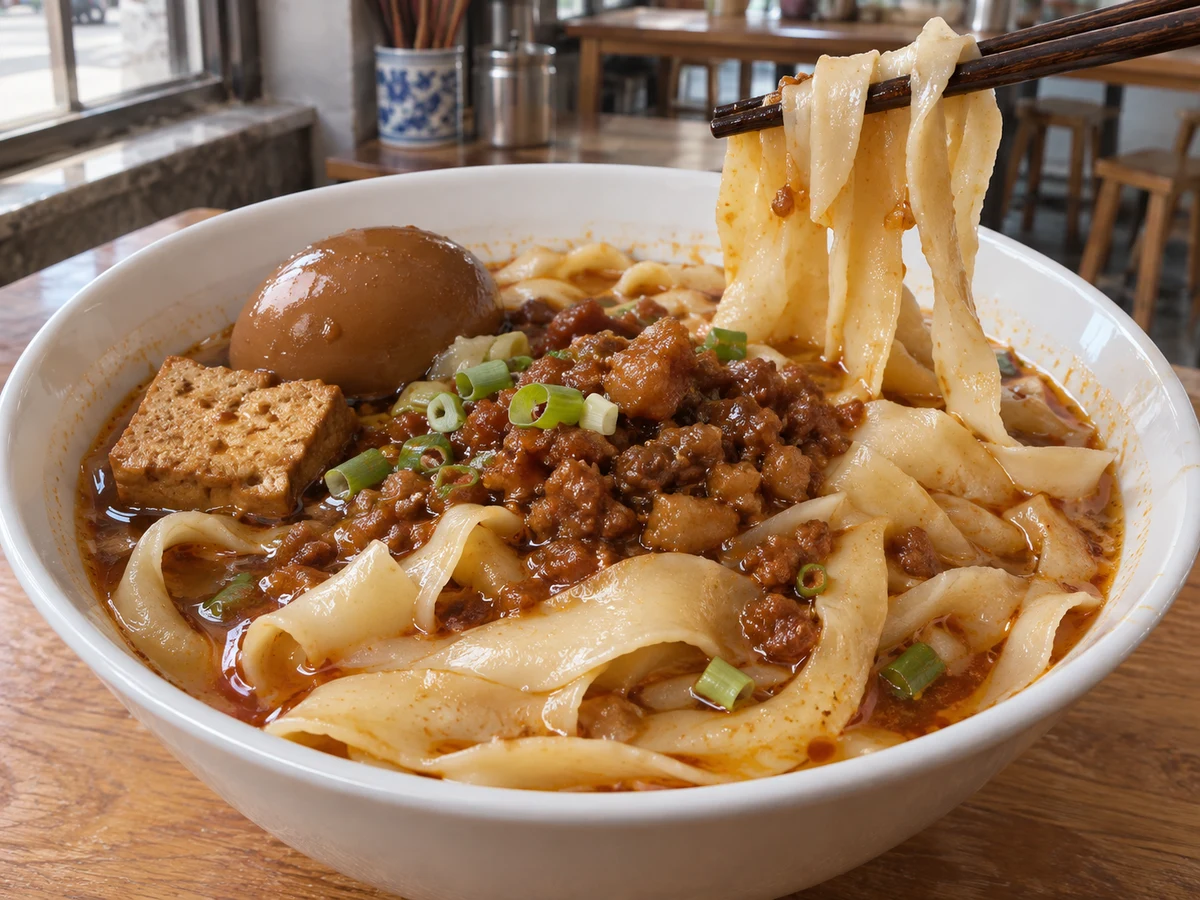
One hand holds the dough beside the pot. The other runs a short blade over it. A strip lifts from the surface, sails forward and drops into the water. In a shop with an open counter you can follow this straight through to the bowl. Once the strips are cooked, the cook lifts them with a strainer and dresses them with a ladle of the topping you ordered.
Pick up a single noodle and look along its edge. The thin sides feel slippery, and the ridge down the middle gives your teeth something to work on. Shanxi cooks liken the outline to a willow leaf. The strip can broaden around the middle and taper at the ends, with its shape changing according to the blade and the angle of the stroke. A strong bowl feels tender at the edges while the thicker part stays springy.
Daoxiao mian is also written 刀削麵 on menus using traditional characters. In English, knife-cut, knife-shaved and knife-sliced noodles can all mean the same thing. The word that matters is 削, xiao, to shave something off a solid surface: each stroke takes one strip from the outside of the block.
02
The dough has to hold its shape
Shaving starts with a stiff wheat dough. A piece that slumps in the hand makes the thickness difficult to control. A rough dough is liable to snag on the blade and tear into pieces. Zhao Xiping, a Datong-trained noodle maker who took the family business to Taiyuan, describes starting early enough for the dough to rest properly. First the water turns the flour into small clumps. Repeated kneading brings them into a smoother mass, and a damp cover keeps the outside supple between rounds.
The amount of water depends on the flour and the cook’s method. Zhao teaches a very stiff starting mix of three liang of water per jin of flour, or about 150 grams per 500 grams of flour. Wang Mei’s culinary training manual uses 400 grams of water and 10 grams of salt per kilogram of flour for its practice batch. It adds the water in stages, works the dough again after a short rest, then shapes it into a long, rounded block. Yu Xin and Liu Wenduo give another example in their handbook on Shanxi flour products, with about 500 grams of water per kilogram of flour and a block shaped thicker at the rear. Whatever the ratio, the test is at the blade: the dough should be smooth and let go of each strip in one piece.
A professional cook may rest a long slab on a board and work through it fast enough to feed several customers from the same batch. A learner can start with a much smaller block and take a few trial strokes. Each stroke takes a layer off the block, and keeping what is left even matters as much as pressing hard.
03
The old sheet blade and the Datong hook
The cook can change the shape of the noodle by changing the blade or the angle at which it meets the dough.
The sheet blade, piandao (片刀), is a small curved piece of steel. Gao Yan, who has trained noodle cooks at Xijindao in Datong, uses a shallow angle and steady pressure to shave a strip off the block. He describes a smooth leaf with a broader middle and tapered ends. His shop aims for strips of about 20–25 centimeters and a center around two millimeters thick. Other cooks cut theirs longer, or with a sharper ridge.
Dongguan Xiaomianwang (东关削面王) developed a hooked-edge blade in the 1990s, according to cooks interviewed by Lifeweek. The bent tip gave the cook a more repeatable cutting profile and made longer strands easier. Square, round and triangular hook profiles followed. Some Datong shops came to rest a long board on the shoulder and shave several bowls’ worth in quick succession. Gao describes his sheet-cut noodles as smoother and the hook-cut version as more angular and firmer.
The board itself has an older story. At Fenglingdu, on Shanxi’s border with Shaanxi and Henan, cook Li Ziyuan switched from holding dough directly against the hand and arm to supporting it on a wooden board. The board let him work farther from the steam and splashing water. He also used a stand to free both hands for cutting. In a 1964 trade competition at Houma, he sent the noodles across the gap in an arc and took first place. People’s Daily recorded the competition and the tool changes in 1980.
04
Datong builds the bowl around pork saozi
In Datong, a good first order is pork saozi over fresh knife-cut noodles, with one braised extra from the counter.
Saozi (臊子) is what the shop ladles over the noodles. In the Datong pork version, a cook browns the pork to develop the flavor, then lets it cook down slowly. At Zhao Laoqi a large batch takes two to three hours, according to Zhao. The meat, fat and cooking liquid end up in the same spoonful. A little of the savory liquid falls to the bottom of the bowl, and the pieces of pork catch among the strips. The size of those pieces can be a shop’s signature. Erban became known for yielding chunks of belly, while Laochai made its topping with finer pieces.
Aged vinegar can appear twice. At Xijindao, the chef adds it while cooking the pork, just after the lean meat changes color. At the table you can add a few more drops. Taste the topping as it comes first, then lift a few noodles through the vinegar. A little sharpness makes the pork fat feel lighter and leaves the aroma of the cooked topping intact. Chili oil and cilantro are other possible table additions.
Look at the braising trays before ordering. A dark-skinned egg, a firm piece of tofu or dried tofu, a meatball and a slab of braised pork are the usual choices. Pickled vegetables make a cool, salty bite between hot mouthfuls. One old Datong pickle is lan yancai (烂腌菜), made with kohlrabi, which locals call songgen (松根). When noodle water is offered, try a little in the bowl at the end. It loosens what is left of the sauce and turns the last spoonful into something to drink.
05
In Taiyuan, pick a topping and a shape
Taiyuan had knife-cut noodle shops of its own long before Datong chains moved in. Around the old South Gate, small family shops sold knife-cut, hand-pulled and flicked noodles. Some were merged in 1956 to form the Yingze Street restaurant, which moved and took the name Taiyuan Noodle Shop in 1976. Its noodle banquet serves a series of shapes with a series of toppings, including a mixed-ingredient gravy, a fried bean sauce and steamed lamb.
Zhao Xiping learned the trade in his family’s Datong shop, Zhao Laoqi, and moved to Taiyuan in 2004. In Taiyuan he offers a Datong pork bowl alongside tomato, zhajiang (fried bean sauce), dalu (a cooked gravy) and, in winter, lamb. Tomato and egg is a useful name to know when you want something lighter and tangier. For a meat-free order, ask whether the shop cooks the sauce in meat stock or adds pork. Even an apparently vegetable-based gravy can contain a little meat, as the pickled greens and tofu version in Wang Mei’s training book does.
At a shop that offers two shapes with the same sauce, compare the shaved strips with tijian (剔尖). The cook flicks softer dough from the edge of a plate with a chopstick. Both go straight into the pot. The flicked noodle is generally shorter and more rounded, with a different bite even under exactly the same tomato topping.
06
A Yuan story and the records that came later
The story often told about the Yuan dynasty begins with several households made to share a kitchen knife. When a family goes to fetch it and finds it in use, a thin scrap of iron does the job. The storyteller’s good detail is that the metal is too flimsy to cut a rolled sheet, so the cook shaves little strips off the block and drops them into the pot. China’s heritage listing gives the Yuan date only as tradition; the first written description of shaved noodles is much later.
In the late-Qing author Xue Baochen’s Sushi Shuolüe (素食说略), the entry on shaved noodles calls for firm dough worked thoroughly, a block held in the palm, and a sharp knife to slice off thin strips. Xue finishes them with soup or gravy. A Datong cook, Zhao Fuping, recalled watching a cook near the Drum Tower hold dough much the same way in the 1960s. By 1979, the cookbook Shanxi Shipu could point to signs for Shanxi knife-cut noodles on busy streets in Beijing, Tianjin, Shanghai and Xi’an.
Datong researcher He Feng traces the growth of its specialized noodle shops to the later twentieth century. In 2008 the national heritage list named the paired dragon-beard and knife-cut noodle techniques submitted by Shanxi’s Quanjin Huiguan. Datong’s knife-cut noodles entered its municipal list in 2020, and the hook-blade method entered the provincial list in 2023. In 2024 the city’s catering association issued a processing standard for Datong’s wheat-flour version.
07
At the counter, in the bowl and from the wok
At a Datong shop, ask for a small or large bowl, then name the topping. Zhūròu sàozi means the usual pork topping. A bowl can be breakfast in Datong, especially when there is a pot of pork ready and the noodle pot is already boiling. The old city’s best-known shops also draw queues around lunch. A neighborhood counter can give you the same sequence of dough, pot and ladle in a simpler setting. In January 2025 a long-running Datong shop was serving a bowl for ¥9.
For a second bowl on a different day, look for chǎo dāoxiāo (炒刀削). The cut noodles are boiled, drained and finished in a hot wok, which coats the strips and can toast the spots that meet the pan. Yu and Liu record a version with shredded pork and green beans. The firm ridge is handy here because it keeps its bite through both the boil and the stir-fry. In April 2026, Datong’s Xinyuan stir-fried noodle shop served its pork-and-chili version for ¥18.
| On the menu | What to expect |
|---|---|
| 猪肉臊子 zhūròu sàozi | Slow-cooked pork and its savory cooking liquid |
| 西红柿鸡蛋 xīhóngshì jīdàn | Tomato and egg, when listed as a topping |
| 卤蛋 lǔdàn / 豆干 dòugān | A braised egg / firm pressed tofu, ordered separately at many shops |
| 炒刀削 chǎo dāoxiāo | Boiled knife-cut noodles finished in a wok |
Noodles from other regions
FAQ
Questions about Shanxi Knife-Cut Noodles
What are knife-cut noodles made of?
Shanxi cooks shave them from a firm wheat flour and water dough. Some formulas add a little salt.
What makes daoxiao mian chewy?
Firm kneaded dough and the shape of the cut. Each strip has a thicker center that stays springy after the edges soften in boiling water.
What is the classic Datong topping?
Pork saozi, a cooked pork topping with its savory juices. A braised egg, pressed tofu or a meatball can be added.
Is every bowl served in soup?
The same noodles can be dressed with a thick topping, served in a bowl with more cooking liquid, or finished in a wok as chao daoxiao.
Can I order vegetarian knife-cut noodles?
Some shops have vegetable toppings. Ask about meat stock, pork fat and minced meat in the sauce before ordering.
What is the difference between knife-cut and hand-pulled noodles?
One stroke shaves one strip from a block of dough. Hand-pulled noodles are stretched into strands, with different shapes and thicknesses depending on the style.
Sources
Sources and further reading
- 1 Traditional noodle-making techniques: dragon-beard noodles and knife-cut noodles, item VIII-160 (in Chinese)China Intangible Cultural Heritage Network (2008 listing) ↗
- 2 Li Ziyuan, a knife-cut noodle master: the wooden board and the 1964 Houma competition (in Chinese)Zhang Bingjun, Liu Juesheng and Liu Genwang, People’s Daily, p. 2 (23 October 1980) ↗
- 3 Datong knife-cut noodles: the curved blade, pickles, braised extras and the folktale (in Chinese)Datong Yunzhou District Culture and Tourism Bureau (2025) ↗
- 4 Datong noodles travel: the 2020 municipal listing and a Hong Kong noodle shop (in Chinese)Datong Daily, via Datong Municipal Government (2023) ↗
- 5 Datong’s hooked-blade noodle technique enters the sixth provincial heritage list (in Chinese)Datong Daily, via Datong Municipal Government (2023) ↗
- 6 A Datong noodle-shop order with braised sides and noodle water, and the summer restaurant queues (in Chinese)Datong Daily, via Datong Municipal Government (2026) ↗
- 7 Zhao Xiping on shaving a noodle, slow-cooking pork saozi and bringing his family’s noodles to Taiyuan (video and transcript, in Chinese)Qu Lixia and Xiang Shang, China News Service (2022) ↗
- 8 Taiyuan Noodle Shop: the South Gate stores, the 1956 merger and the noodle banquet (in Chinese)Li Junhua, Taiyuan Evening News, via Taiyuan Fabu (2021) ↗
- 9 Shanxi’s noodle shapes: dough flicked from a plate and toppings shared between styles (in Chinese)The Paper (2022) ↗
- 10 A cut above: the Datong family noodle shop in Paris and Zhao Xiping on dough and hand cuttingLi Yingxue and Zhu Xingxin, China Daily (2026) ↗
- 11 How a Datong family took knife-cut noodles from a French market to a Paris shop in 2023 (in Chinese)Global People (2024) ↗
- 12 How Shanxi knife-cut noodles became famous, with Xue Baochen’s old method and interviews with Datong cooks (in Chinese)Wu Liwei, Lifeweek (2024) ↗
- 13 Practical Training in Chinese Pastry and Dough, chapter 1: knife-cut noodles with pickled greens and tofu gravy (in Chinese)Wang Mei, Tsinghua University Press (2011) ↗
- 14 T/DTCY 002–2024, Datong knife-cut noodles: processing standard and scope (in Chinese)Datong Catering and Hotel Industry Association (2024) ↗
- 15 Shanxi Shipu, pp. 3–4: Shanxi knife-cut noodle signs in four cities (in Chinese)Li Yingjun and others, Shanxi People’s Publishing House (1979) ↗
- 16 Datong knife-cut noodles at breakfast: pork and vegetable toppings (video, in Chinese)Tencent Video and Haixia TV, Breakfast in China, season 3, episode 18 (2020) ↗
- 17 Shanxi Flour Products, chapter 4: examples of shaved, stir-fried and soup knife-cut noodles (in Chinese)Yu Xin and Liu Wenduo, China Textile & Apparel Press (2014) ↗
- 18 A ¥9 bowl of knife-cut noodles at a long-running Datong shop (video, in Chinese)Jiumen’r Tandian (九门儿探店), Bilibili (2025) ↗
- 19 Datong stir-fried knife-cut noodles: the ¥18 pork and chili plate at Xinyuan (video, in Chinese)Guangchi Xiaozhuzhu (逛吃小猪猪), Bilibili (2026) ↗
Last updated November 2026