
01
A whole carp, fried in a leap
It is a traditional Jinan dish, made with a Yellow River carp of about 1.5 jin, three-quarters of a kilogram.
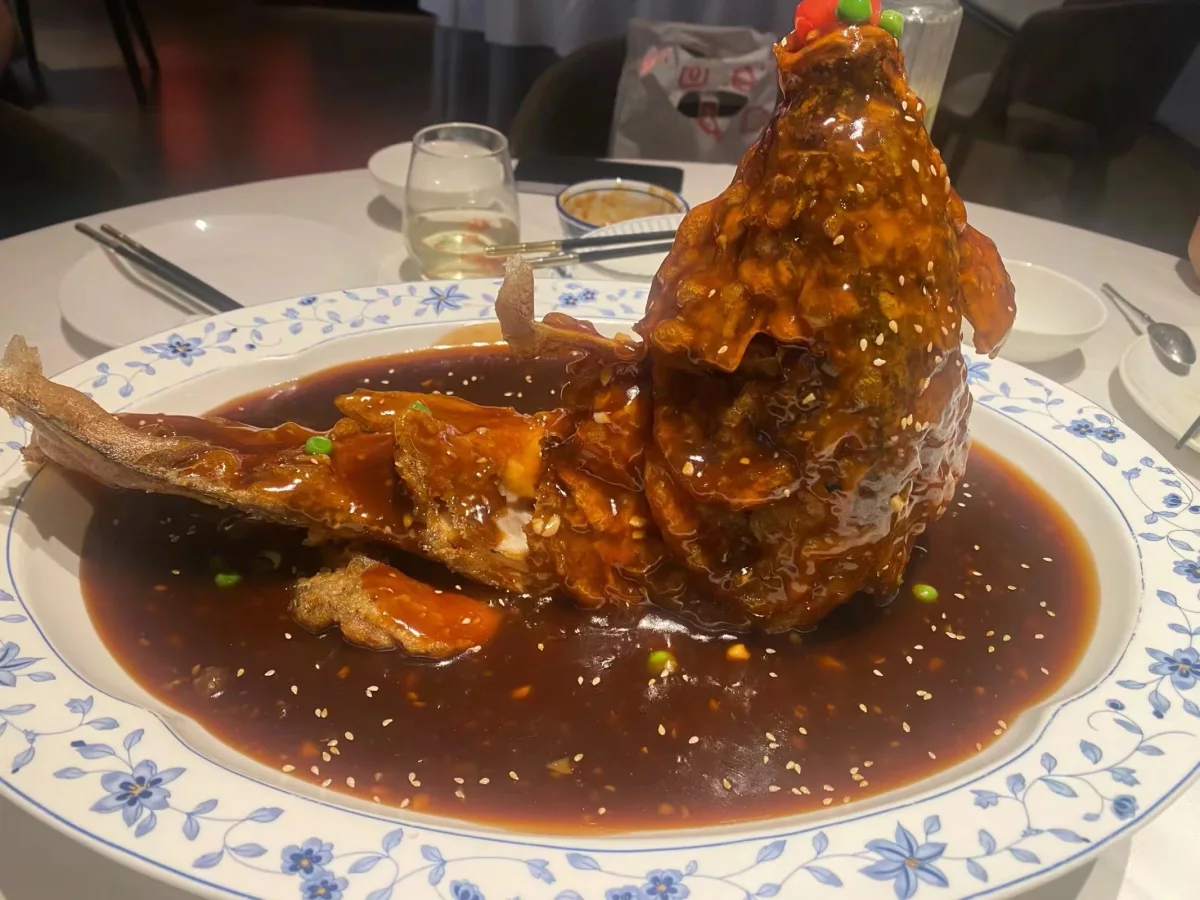
It arrives as a single fish on a long platter, head raised, tail flicked up, the sides opened out in ridges where the knife went in, all of it glazed in an amber sauce scattered with garlic. The scoring is what makes it work. Deep cuts on both flanks let the hot oil reach the middle of a thick fish, so it cooks through in about eight minutes, and they open as it fries into crisp ridges that are easy to pull off with chopsticks. The batter, starch or flour, gives a shell that stays crunchy under the sauce for the first few minutes at the table.
The sauce is simple and strong. Garlic, scallion and ginger are fried in a little oil, then vinegar, sugar, a dash of soy sauce and clear stock go in and are thickened with starch into a heavy glaze, poured over while still bubbling so that it hisses on the fish. The taste is 香酥酸甜: fragrant, crisp, sour, sweet, with a little salt underneath. The colour is amber, and the shape is “like a carp leaping the Dragon Gate.”
The dish belongs to Lu, Shandong cooking, which shaped the restaurant food of Beijing and the north. Kitchens from Tianjin to Kaifeng have their own versions, but in Jinan it is the fish everyone expects at a wedding or a celebration.
02
The fish for weddings and exam results
It is served at weddings and birthdays, at a baby’s first-month banquet and at banquets for university admission.
In the old story, carp swimming up the Yellow River try to leap the rapids at the Dragon Gate, and the few that make it turn into dragons. The phrase became the standard wish for a child sitting the imperial examinations, and today for anyone passing an exam or starting out in life. A fish fried in that leap is therefore the obvious dish for a celebration. In Shandong the dragon-gate carp is the must-order head dish of a banquet for a wedding or exam success.
A whole fish also carries the New Year pun 年年有余, “a surplus every year,” since 鱼, fish, sounds like 余, surplus, so the dish suits the Spring Festival table too.
Because it carries so much meaning, the shape is judged closely. Yanxitang, one of Jinan’s old Lu restaurants, uses a rule of four: 口开、腮开、鳍开、肚开, mouth open, gills open, fins spread, belly open. A fish that comes out flat or limp is left on the table untouched.
03
Luokou, the Yellow River and a vinegar that won a medal
The dish was born at a river port, from local fish and local vinegar.
Luokou, just north of Jinan, was where the city met the Yellow River: a crossing, a dock and, in the late Qing, a busy market town full of restaurants. Two things made its carp famous. One was the fish. The Yellow River carp has a golden head and tail and gleaming scales, and Chinese writing has praised it since the Book of Songs, whose line “if you eat fish, why must it be the carp of the River?” became a proverb; a Jinan gazetteer lists it beside the crabs of Nanyang as food worth recording. The other was vinegar. Luokou’s vinegar, brewed from sorghum and yellow millet and sunned through three summers, won a gold medal at the 1915 Panama-Pacific Exposition and is now on Shandong’s list of intangible heritage.
A 1959 national cookbook records the recipe of Peng Ke, who had cooked at the Jizhenyuan restaurant in Luokou for more than fifty years and specialised in Yellow River carp; seven of the book’s Jinan dishes are his. When the dish moved into Jinan itself, cooks began coating the fish in batter before frying and left the wood ear, bamboo shoot and water chestnut out of the sauce. Huiquanlou, beside the Jiangjia Spring, kept its carp alive in spring water and became the most famous place to eat it, and in Jinan’s old quarter Yanxitang, founded in 1932 and now a China Time-Honored Brand, still makes it one of its classics.
Its fame was established early. The writer Wang Tongzhao remembered the poet Xu Zhimo visiting Jinan in the summer of 1923 and insisting, at nine at night, on being taken out for Yellow River carp. From Jinan the dish spread to Shanxi, Henan and beyond.
04
How Luokou made it: Peng Ke’s 1959 recipe
A 1959 cookbook records the Luokou chef Peng Ke’s method, which fries the fish in four positions.
One live Yellow River carp of about 750 g. For frying: about 1.5 kg of vegetable oil and 200 g of flour. For the sauce: 50 g Luokou vinegar, 200 g sugar, 50 g soy sauce, 25 g Shaoxing wine, 100 g wet starch, 300 g clear stock, a little scallion, ginger and garlic, and a few slices of soaked wood ear, bamboo tip and water chestnut.
- 1. Score
Scale and clean the fish and remove the gills. Every 8 fen, about 2.7 cm, cut straight in 5 fen deep, then turn the knife and slant it in a further 6 fen, so each cut opens into a flap. Lift the tail to open the cuts, sprinkle salt inside and dust the whole fish, cuts and all, with dry flour.
- 2. Into the oil
Holding the tail, lower the fish into very hot oil. The cuts spring open at once. Support it with a spatula so it does not stick or break.
- 3. Fry in four positions
After two minutes push the fish against the side of the wok so the body bends into an arch, back down, for two minutes; turn it belly down for two more; then lay it flat, push the head under the oil with the tail raised, and fry two minutes more: about eight minutes in all, until golden.
- 4. Sauce
Fry the aromatics in a little oil, pour in the vinegar, then the mixed sauce, the wood ear, bamboo and water chestnut, stock, wine and sugar, and thicken with starch. Pour it over the fish so that it bubbles and hisses.
The 1959 cookbook adds a Jinan custom: when the meat is eaten, the head and tail go back to the kitchen, are smashed with an iron ladle in the leftover sauce and boiled with clear stock, then poured over vinegar, coriander, green garlic and pepper to make 砸鱼汤, smashed-fish soup, sour, sweet, hot and salty at once.
Sources [4]
05
In a Jinan kitchen today
Modern chefs keep the shape and the sauce but change the fish and the cuts.
Yellow River carp is now scarce, and most kitchens use ordinary farmed carp. Yanxitang still buys red-tailed Yellow River carp and keeps each fish for about a week in a pool fed by one of Jinan’s springs, to clean out the muddy taste before it is killed. Other cooks deal with the taste in the kitchen: they pull out the fish’s “fishy line,” dig out the pharyngeal teeth behind the gills, which otherwise turn black and bitter in the oil, and soak the scored fish in water with salt, scallion, ginger and a splash of beer.
The cuts vary by chef. Yanxitang makes seven on one side and eight on the other, 七上八下, each down to the backbone. Other cooks use a “wheat-ear” cut, slanting in at 45 degrees to the bone and then along the spine, spaced 2.5 to 3 centimeters apart, with the number of cuts set by the length of the fish; Huiquanlou used a ridged “tile” cut. Before frying, the backbone is bent by hand into the curve, and at Yanxitang the chef holds the battered fish by tail and belly in oil at about 70 percent heat until the shape sets, spattered hands and all, before propping it with iron chopsticks.
The sauce has shed Peng Ke’s vegetables and uses plenty of garlic.
06
Kaifeng, Tianjin and Beijing versions
The dish travelled along the Yellow River and north to the capital.
Kaifeng’s version grew out of thrift. Diners there once reheated the leftover sauce with noodles; later cooks fried hair-fine hand-pulled noodles separately and laid them over the fish, a dish locals call “carp under a quilt.”
| Version | Where | What is different |
|---|---|---|
| Sweet and sour carp 糖醋鲤鱼 | Jinan, Shandong | Deep scoring, fried in a leaping curve, vinegar-sugar-garlic glaze; head and tail made into smashed-fish soup |
| Carp with fried noodles 鲤鱼焙面 | Kaifeng, Henan | Sweet-sour glazed carp covered with a nest of hair-fine fried noodles that soak up the sauce |
| Tianjin sweet and sour carp | Tianjin | Egg-and-flour batter, fried twice, sauce finished with Sichuan pepper oil |
| Everyday sweet and sour carp | Beijing | A smaller fish with a few straight cuts and a plain sugar, vinegar and soy sauce |
07
Sweet and sour carp at home
This follows the 1978 Shandong cookbook, for one fish.
One carp of about 750 g, scaled and cleaned; 2.5 g salt; about 150 g potato or corn starch mixed with water to a thick batter; peanut oil for deep-frying, at least 1.5 litres in a large wok. Sauce: 100 g Chinese vinegar (Shandong or Shanxi rice or sorghum vinegar), 200 g sugar, 10 g soy sauce, 300 ml clear stock or water, 2 tablespoons cornstarch slurry, and 2 cloves garlic, a little scallion and ginger, all finely chopped.
- 1. Score
Make cuts about 2.7 cm apart along both sides: first straight down about 1.5 cm, then turn the blade and slant it in toward the head about 2 cm more, down to the bone. Lift the tail so the cuts open, sprinkle salt into them and coat the whole fish in batter.
- 2. Fry
Heat the oil to about 190°C. Holding the tail, lower the fish in carefully, supporting it with a large spatula. Fry about two minutes, push it against the side so the body arches back-down for two minutes, turn it belly-down for two, then lay it flat and spoon oil over the head for two more, about eight minutes in all, until deep golden. Lift onto a warm platter, curved.
- 3. Sauce
Pour off all but about 3 tablespoons of oil. Fry the garlic, scallion and ginger, add the vinegar and soy, then the stock and sugar, bring to a boil and thicken with the slurry to a glossy, heavy sauce.
- 4. Pour
Pour the sauce over the fish at once, so it sizzles, and serve.
A whole fish in hot oil is hard to handle at home: use a wide, deep wok, keep the oil no more than half full, and lower the fish away from you. A smaller fish, or the fish cut in half, is easier the first time.
08
How to order it
It is a dish for a table, not for one.
Order it for a group
One fish is meant to be shared; a fish of the usual size serves a table of about ten along with other dishes.
In Jinan
Old Lu restaurants such as Yanxitang in the Qushuiting quarter keep it as a classic; ask whether they use Yellow River carp.
Eat it quickly
The crust is crispest in the first minutes after the sauce goes on.
Ask for the soup
In old Jinan custom the head and tail can go back to the kitchen for 砸鱼汤, smashed-fish soup.
In Kaifeng
Order 鲤鱼焙面 for the version covered in crisp fried noodles.
09
More sweet-sour and fish dishes
Other pages on the atlas.
Squirrel mandarin fish
Suzhou’s fried fish, cut to fan out like a squirrel’s tail.
Read about squirrel mandarin fish →Sweet and sour pork
The Cantonese sweet-sour classic.
Read about sweet and sour pork →Guo bao rou
The northeast’s crisp, sour-sweet pork.
Read about guo bao rou →Chinese New Year food
Why a whole fish goes on the New Year’s Eve table.
Read the New Year food guide →FAQ
Questions about Sweet and Sour Carp
What is sweet and sour carp?
A whole carp, scored to the bone, battered and fried in a curved, leaping shape, then covered in a hot sauce of vinegar, sugar, garlic and a little soy. It is the signature fish of Shandong cooking.
Why is the fish shaped like it is jumping?
It stands for 鲤鱼跳龙门, the carp that leaps the Dragon Gate and becomes a dragon, a wish for success, so it is served at weddings and celebrations for passing exams.
Where does sweet and sour carp come from?
From Luokou, the old Yellow River port north of Jinan, where restaurants made it with river carp and local vinegar in the late Qing; it then spread through Jinan and north China.
Does it have to be Yellow River carp?
That is the tradition, but Yellow River carp is now scarce, and most restaurants use ordinary carp, cleaned carefully of its muddy taste.
What is 砸鱼汤?
Smashed-fish soup: in old Jinan custom, the leftover head and tail are smashed in the sauce, boiled with clear stock and finished with vinegar, coriander and pepper.
How many people does one fish serve?
It is a shared banquet dish; a fish of the usual size is meant for a whole table eating several other dishes.
Sources
Sources and further reading
- 1 Li Xin, sweet and sour carp leaps the dragon gate: Yanxitang’s chef Deng Junqiu (2022) (in Chinese)China News Service (in Chinese) ↗
- 2 Sun Yiwei, “The taste of Luokou”: Luokou vinegar, the Jizhenyuan carp and Xu Zhimo’s night out (2025) (in Chinese)Qilu Evening News, via Sina (in Chinese) ↗
- 3 Sun Xuefei, Jinan Yanxitang: a century-old restaurant and its banquet customs (2026) (in Chinese)China City News, People’s Daily (in Chinese) ↗
- 4 Famous Chinese Dishes, vol. 6: Shandong (中国名菜谱·第六辑), p. 70: sweet and sour carp, from the Luokou chef Peng Ke (in Chinese)Light Industry Press (1959), indexed by laocp.tech ↗
- 5 Chinese Cookbook: Shandong (中国菜谱·山东), p. 55: sweet and sour carp (in Chinese)China Financial and Economic Publishing House (1978), indexed by laocp.tech ↗
- 6 Famous Dishes of North and South China (中国南北名菜谱), p. 371: sweet and sour carp and smashed-fish soup (in Chinese)Jindun Press (1990), indexed by laocp.tech ↗
- 7 Everyday Recipes (大众菜谱), p. 157: sweet and sour carp, Beijing (in Chinese)Light Industry Press (1966), indexed by laocp.tech ↗
- 8 Kaifeng Recipes (开封食谱), p. 71: carp with fried noodles (鲤鱼焙面) (in Chinese)Kaifeng Catering Company (1973), indexed by laocp.tech ↗
- 9 Tianjin Recipes, vol. 3 (天津菜谱 第三册), p. 9: sweet and sour carp in egg batter (in Chinese)Tianjin Catering School and Tianjin Catering Company, indexed by laocp.tech ↗
- 10 Classic Shandong dishes no. 10: sweet and sour carp, cut, cured and fried by a Lu chef (video, in Chinese)Lucai Xingzhe (鲁菜行者), Bilibili (September 2021) ↗
Last updated November 2026