
Three to start with
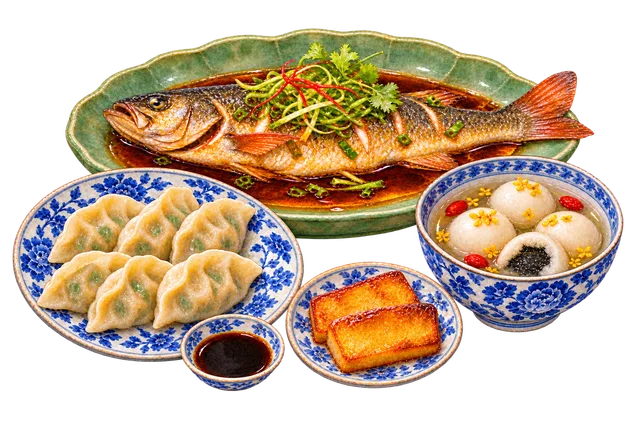
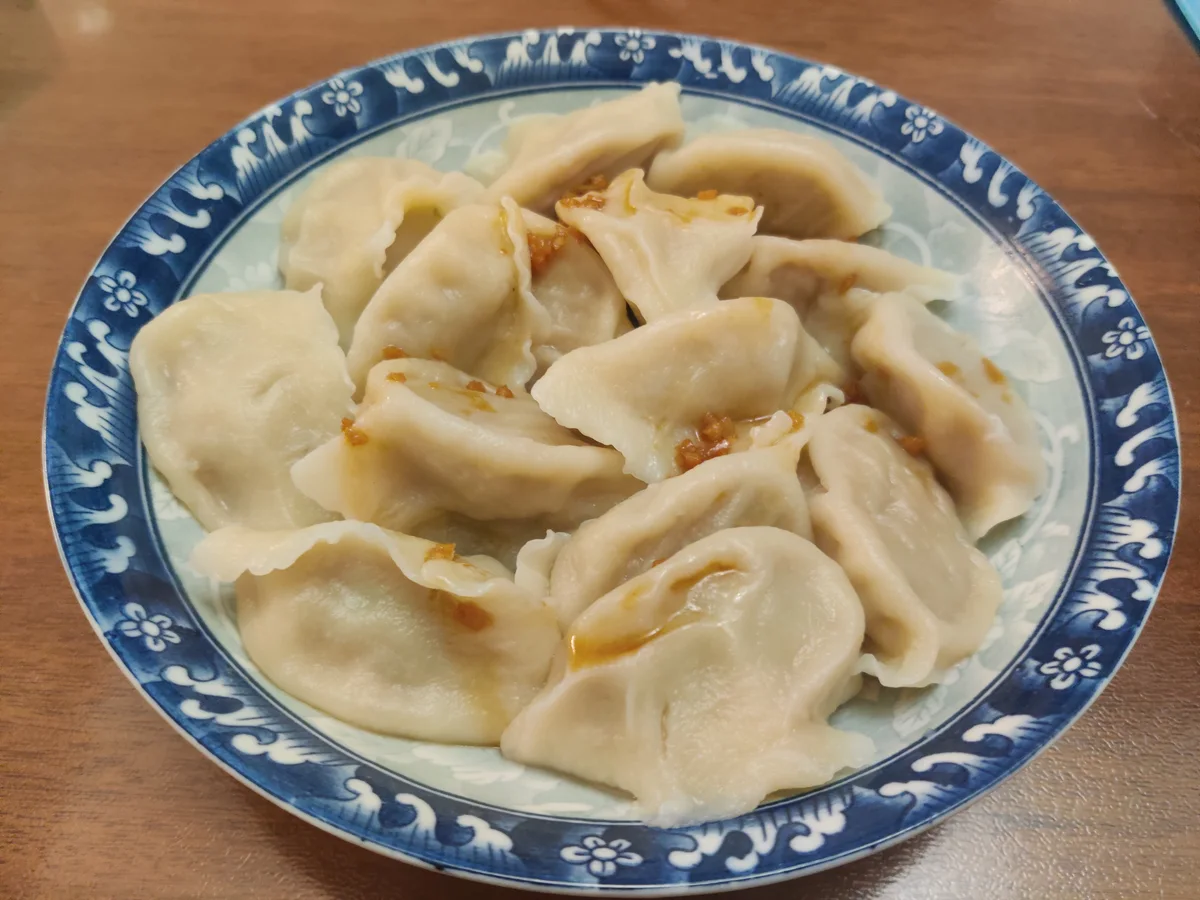
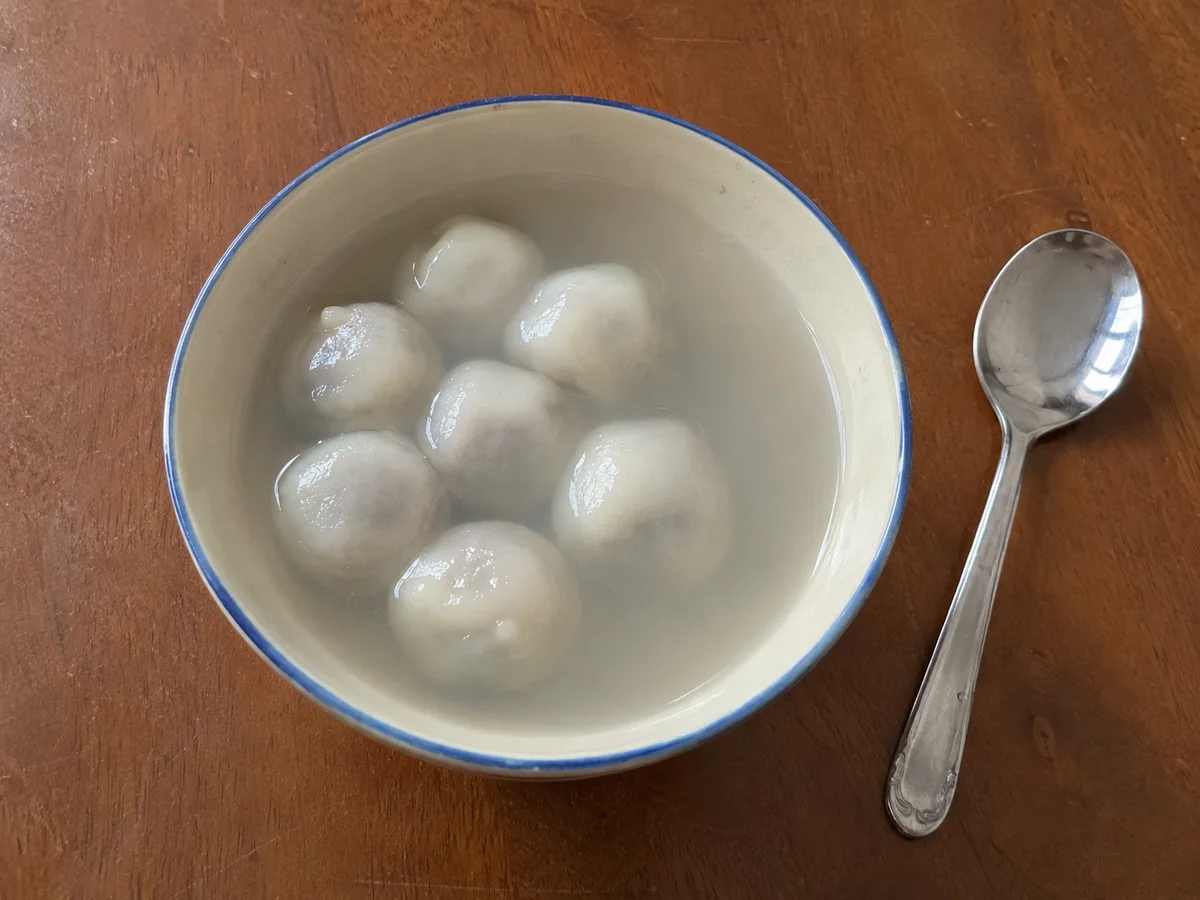
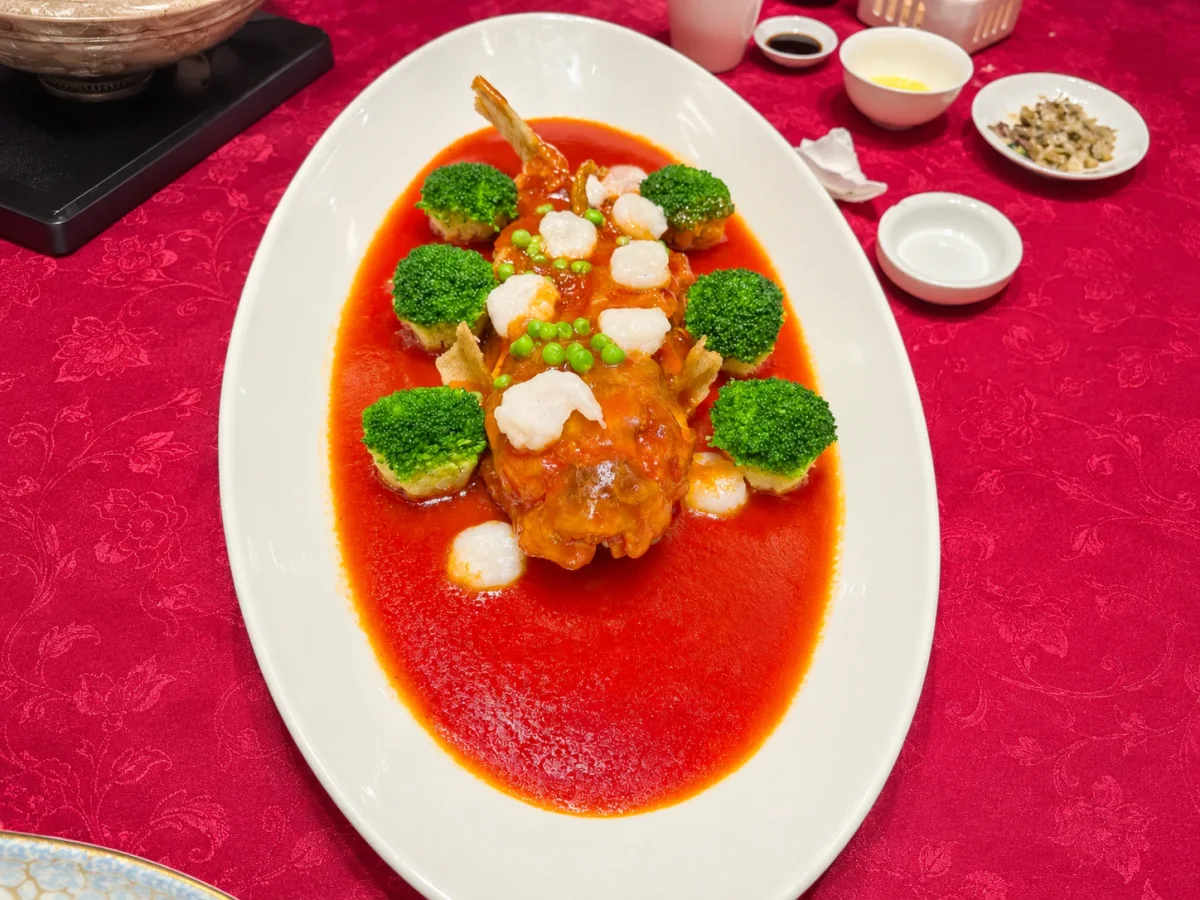
Midnight jiaozi, a morning bowl of tangyuan and the New Year’s Eve fish
Jiaozi are the north’s New Year’s Eve food, tangyuan open New Year’s morning in much of the south and close the season at the Lantern Festival, and Suzhou’s squirrel mandarin fish is the fish that a famous old restaurant sells by the thousand over the holiday.
01
Fifteen New Year foods and what they stand for
Most of the meanings are puns, so the Chinese name matters more than the recipe. Where a food belongs to one region, the table says where.
| Food | Chinese | Where | What it stands for | Note |
|---|---|---|---|---|
| Fish | 鱼 yú | Almost everywhere | 余, “surplus”: 年年有余, “a surplus every year” | Some is left uneaten on New Year’s Eve |
| Jiaozi | 饺子 | The north | Shaped like silver ingots; 交子, the midnight hour when the years change | Wrapped by the family, eaten at midnight |
| Nian gao | 年糕 | The south | 年年高, “higher every year” | Steamed, or sliced and fried |
| Tangyuan, yuanxiao | 汤圆、元宵 | South from New Year’s morning; north at the Lantern Festival | Round, for reunion (团圆) | Wrapped in the south, rolled in the north |
| Whole chicken | 鸡 jī | Almost everywhere | 万事大吉, “good luck in everything” | Served whole, head and tail |
| Fat choy and dried oysters | 发菜蚝豉 | Guangdong, Hong Kong | 发财好市, “get rich, good business” | Often braised with pig’s trotters |
| Lettuce | 生菜 | Guangdong | 生财, “making money” | Added to festive dishes |
| Jian dui and you gok | 煎堆、油角 | Guangdong | “煎堆碌碌,金银满屋”: a house full of gold and silver | Fried at home from the 24th of the twelfth month |
| Kumquat tree | 年桔 | Guangzhou | 桔 sounds like 吉, luck, in Cantonese | Bought for the house, not eaten |
| Poon choi | 盆菜 | Hong Kong’s New Territories | One basin shared by the whole clan | Best ingredients on top |
| Egg dumplings | 蛋饺 | Shanghai, Jiangnan | Golden ingots | Simmered in the reunion hot pot |
| Four-joy kaofu | 四喜烤麸 | Shanghai | 四喜, the four joys | A cold dish of wheat gluten |
| Eight-treasure rice | 八宝饭 | Shanghai, Jiangnan | A sweet, plentiful year | Steamed glutinous rice |
| Fa kueh and turnip kueh | 发粿、菜粿 | Southern Fujian | 发, rising fortune; 菜头 sounds like 彩头, a good omen | Fa kueh must crack as it steams |
| Seven-vegetable soup | 七样羹 | Chaoshan and Hakka families in Guangdong | Celery and scallion for cleverness, garlic for good reckoning | Eaten on Renri, the seventh day |
02
The 2027 New Year food calendar
Chinese New Year 2027 falls on Saturday, 6 February; the food season starts three weeks earlier, on 15 January.
The festival follows the lunar calendar, so its date moves every year. In 2027 the twelfth lunar month has only twenty-nine days, so there is no “thirtieth night”: New Year’s Eve is the 29th, Friday 5 February, as it was in 2026. China’s official holiday runs for nine days, from 5 to 13 February, and offices make up for it by working on Sunday 31 January and Sunday 14 February. The northern Little New Year, when the Kitchen God is sent off, falls on Saturday 30 January; the southern one, on the 24th, falls on that working Sunday.
Lichun, the solar term that opens spring, comes two days before New Year’s Day this time, on 4 February. In old Beijing it was a food day of its own: households that could afford it ate spring pancakes, and women bought radishes to eat raw, which was called “biting spring” and was said to chase away spring drowsiness.
| Day | Lunar date | 2027 | What is eaten |
|---|---|---|---|
| Laba | 12th month, 8th day | Fri 15 Jan | Laba congee; in Beijing, garlic sealed in vinegar |
| Northern Little New Year | 12th month, 23rd | Sat 30 Jan | Sugar melons and malt sweets for the Kitchen God |
| Southern Little New Year | 12th month, 24th | Sun 31 Jan | Kitchen God offerings; Cantonese families start frying |
| Lichun, start of spring | Solar term | Thu 4 Feb | Spring pancakes in Beijing |
| New Year’s Eve | 12th month, 29th | Fri 5 Feb | The reunion dinner; jiaozi at midnight in the north |
| New Year’s Day | 1st month, 1st | Sat 6 Feb | Jiaozi in the north; tangyuan in much of the south |
| Powu, “breaking the fifth” | 1st month, 5th | Wed 10 Feb | Jiaozi again in the north |
| Renri, “everyone’s birthday” | 1st month, 7th | Fri 12 Feb | Seven-vegetable soup in Chaoshan and Hakka homes |
| Lantern Festival | 1st month, 15th | Sat 20 Feb | Yuanxiao in the north, tangyuan in the south |
Spring rolls and spring pancakes
Beijing’s spring pancake platter, the soft wheat wrapper rolled at the table, and the fried roll that grew out of it.
Read about spring pancakes →03
Laba congee and sweets for the Kitchen God
“Little child, don’t be greedy: after Laba comes the New Year,” runs a children’s rhyme, and the season’s first festival food is a pot of congee.
Laba falls on the eighth day of the twelfth month. In Kaifeng under the Song, the great temples sent a “seven-treasure, five-flavour” congee to their followers that day and called it Laba congee, and ordinary households boiled their own with fruit and mixed grains. Fucha Dunchong’s Beijing almanac of 1900 gives a full recipe: yellow millet, white rice, glutinous rice, foxtail millet, water-chestnut rice, chestnuts, red beans and date paste cooked together, then decorated with red-dyed peach kernels, almonds, melon seeds, peanuts, hazelnuts, pine nuts, white and brown sugar and raisins. Families shelled and washed all night on the seventh, offered the congee to their ancestors and the Buddha, and sent bowls to relatives before noon. At the Yonghe Temple the lamas cooked theirs overnight, under the eye of an imperial official, in a bronze cauldron of about four tonnes.
The other Laba food in Beijing is garlic. Peeled cloves, preferably small purple-skinned ones, are sealed in rice vinegar in a narrow-necked jar and kept until New Year, when they have turned jade green and the vinegar has taken on their bite; both are eaten with the New Year jiaozi. Lao She described the custom in the 1950s, and Beijing families still keep it. Rice vinegar is used because darker aged vinegars turn the garlic black.
About two weeks later comes the Little New Year, 小年, when the Kitchen God, who has watched the family from beside the stove all year, goes up to heaven to report on it. Beijing made its offering on the 23rd, and the 1900 almanac notes that families from the southern provinces used the 24th; the split holds today, with the north on the 23rd, the south generally on the 24th and some coastal places on the 25th. The offering is sweet and sticky: sugar melons (糖瓜) and slabs of Guandong candy, with clear water, hay and beans for the god’s horse. The sugar is meant to glue his mouth, or sweeten it, so that he “speaks of good things in heaven.” Song Kaifeng sent him off on the 24th with wine and fruit and smeared wine lees on the stove door to make him drunk. In Guangzhou the offering is slab sugar, roast pork and sugarcane.
Chinese desserts for beginners
Laba congee, nian gao, eight-treasure rice and the other sweets of the festival year.
Open the festival sweets →04
Getting the food in: steaming, freezing and curing
The last days of the old year are for cooking ahead.
A northern rhyme sets out the timetable once the Kitchen God has gone: sweep the house on the 24th, make tofu on the 25th, buy the meat on the 26th, kill the New Year chicken on the 27th, set the dough to rise on the 28th, steam the buns on the 29th, and stay up all night on the 30th. In 2027 the 29th is itself New Year’s Eve, so the last two lines fall on the same day.
In the northeast the cold does the storing. At a Shenyang market in 2026 the New Year list ran to frozen pears, frozen persimmons, frozen seafood, frozen sticky buns (粘豆包) and farm-made tofu frozen outdoors, along with country chickens and geese and fish such as Spanish mackerel and hairtail. Shoppers picked front trotters rather than hind ones: front trotters have more tendon and chew, and they are said to rake money into the house.
In Hunan, Sichuan and Chongqing the old year is for curing. Around Dongting Lake in Hunan, workshops start only after the winter solstice in December, when cold, dry wind off the lake makes curing reliable; pork is cured with salt and baijiu, fish as soon as it is caught, and both are salted, air-dried and smoked for more than twenty days before they hang ready for the festival. Sichuan and Chongqing make sausages, both a numbing-hot kind and a Sichuan style that is salty, savoury and a little sweet. The steamed, turned-out bowls of the san zheng jiu kou (三蒸九扣) banquet, such as shaobai, rice-flour pork and sweet bean-paste pork, are cooked ahead and only reheated on New Year’s Eve.
Steamed Hunan cured meats
Smoked pork, fish and chicken from the winter curing, steamed together in one bowl.
Read how Hunan cures meat →Mantou
Shandong steams a week’s buns before New Year’s Eve, and Jiaodong shapes the dough into carp and dragons.
Read about festival buns →Sha zhu cai
The pork, blood sausage and sauerkraut a northeastern family cooks when it kills its New Year pig.
Read about the New Year pig →05
New Year’s Eve dinner: fish, chicken and a wish in every name
The one dish nearly every New Year’s Eve table shares is a fish, and part of it is meant to be left.
The reunion dinner, 年夜饭 or 团年饭, is the meal families travel home for. Its menu changes from province to province, but the logic does not: dishes are chosen because their names or shapes say something lucky. Fish, 鱼 yú, sounds like 余, “surplus,” and 年年有余 wishes for a surplus every year, so the New Year’s Eve fish should not be finished that night. Chicken, 鸡 jī, carries the wish 万事大吉, “good luck in everything,” and persimmons, 柿 shì, stand for 事事如意, “everything as you wish.” Cantonese tables want the fish and the chicken whole, head and tail, so the year has a proper beginning and end.
Keeping food back across the new year is a very old idea. In the sixth century families in Jingchu, on the middle Yangtze, laid out food at the year’s end, kept some of the “overnight rice” and threw it into the street on the twelfth day of the new year, to put away the old and take in the new. In Song Kaifeng families sat round the brazier until dawn, 守岁, “keeping watch over the year.” In Qing Beijing the “New Year rice” was a bowl of “gold and silver rice” stuck with pine and cypress sprigs, coins, dates, chestnuts and longans, left standing until after the fifth day.
When the meal starts depends on the place. Chongqing families often sit down at midday to have longer together, and chilli chicken is on the table for a red-hot year. Restaurants in Shunde, in Guangdong, give every dish on their New Year menus a lucky name: a steamed fish is “a surplus every year,” stir-fried fish balls are “a ball of harmony,” and lettuce is “wealth rolling in.”
Squirrel mandarin fish
Suzhou’s fried, sweet-and-sour mandarin fish, scored so the flesh fans out like a squirrel’s tail.
Read the squirrel fish guide →White-cut chicken
Whole poached chicken, served cold and chopped, on Cantonese and Shanghai tables.
Read the white-cut chicken guide →06
The north: jiaozi at midnight
In the north, the New Year’s Eve meal ends with jiaozi wrapped by the whole family and eaten as the old year turns into the new.
Northern families wrap jiaozi together on New Year’s Eve and boil them around midnight. The name is a pun on the hour: midnight falls in the zi hour, 子时, and 交子, “the zi hour changes over,” sounds like 饺子. Their shape is compared to silver ingots, 元宝, so a plate of them stands for money rolling in. The Tianjin historian Luo Shuwei traced the names: 角儿 in the Song, 匾食 under the Yuan, and 煮饽饽 in the Qing, when boiling dumplings on New Year’s Eve was already the custom.
In Beijing in 1900, Fucha Dunchong wrote, everyone, rich or poor, ate 煮饽饽 on New Year’s Day, and wealthy households hid small gold and silver ingots or gems in a few of them; whoever found one would be lucky all year. The New Year’s Eve altar to heaven and earth carried a tier of honey-fried pastry towers (蜜供), then apples, dried fruit, steamed buns, vegetarian dishes and nian gao. In the 1950s Beijing ate its New Year jiaozi with the jade-green Laba garlic and its vinegar.
Jiaozi
The northern dumpling calendar, from the coin in the New Year’s Eve batch to the fifth day and the winter solstice.
Read when jiaozi are eaten →Types of Chinese dumplings
Jiaozi, wontons, buns and shaomai compared, and why many northern families wrap pork and napa cabbage at New Year.
Compare the dumplings →Four-joy meatballs
Four large meatballs for good fortune, prosperity, long life and happiness, a New Year’s Eve banquet dish in Shandong.
Read about four-joy meatballs →07
Shanghai and Jiangnan: egg dumplings, kaofu and eight-treasure rice
Shanghai answers the northern jiaozi with an egg dumpling, and builds its New Year hot pot around it.
Egg dumplings, 蛋饺, carry the same wish as jiaozi: golden and folded, they look like gold ingots. They are made one at a time in a metal ladle held over the flame and wiped with a piece of pork fat; beaten egg is swirled round to set into a skin, a spoonful of minced pork goes on it, and chopsticks fold it shut. Families used to make them at home over a coal stove in the days before the festival; most now buy them ready-made at markets and supermarkets. They go into the 全家福, the “whole-family happiness” hot pot, a chicken broth with egg dumplings, meatballs, pork skin, prawns, smoked fish and glass noodles.
Other dishes on the Shanghai table carry their own wishes. Smoked fish, 熏鱼, is there for the pun on fish and surplus. Four-joy kaofu, 四喜烤麸, is a cold dish of braised wheat gluten whose four main ingredients stand for happiness, prosperity, long life and good fortune. White-cut chicken stands for a clean, lucky start, and eight-treasure rice, a steamed pudding of glutinous rice, for a sweet and plentiful year.
In many Shanghai homes New Year’s Day starts with tangyuan filled with 黑洋酥, a paste of black sesame, lard and sugar. Before ready-made ones were everywhere, families made their own, wrapping them after the New Year’s Eve dinner and leaving them under a cloth overnight. Some follow them with something salty to settle the sweetness, such as dried bamboo shoots braised with pork, cooked slowly in big batches before New Year so that it lasts to the third or fourth day and can be steamed again for guests.
Across the south nian gao is the New Year’s Eve staple that jiaozi are in the north, eaten for its name, “higher every year,” and square cakes of yellow and white stand for gold and silver. In Suzhou the festival fish is often squirrel mandarin fish. Songhelou, a restaurant more than two hundred years old, had its New Year’s Eve tables for 2025 booked out before October 2024, and expected to sell more than 2,500 of the fish over the holiday.
Chinese desserts for beginners
Eight-treasure rice, osmanthus lotus root and the other glutinous-rice sweets of Shanghai, Suzhou and Hangzhou.
Read about Jiangnan sweets →Tangyuan
Shanghai’s savoury tangyuan of pork and shepherd’s purse or crab, and the city’s rice balls for the day the lanterns go up.
Read the tangyuan guide →08
Guangdong and Hong Kong: the frying wok, fat choy and poon choi
Cantonese New Year food is a vocabulary of lucky words, and the frying starts almost a week before the festival.
Guangzhou’s season begins on the 23rd or 24th of the twelfth month, when families thank the Kitchen God with slab sugar, roast pork and sugarcane and heat the wok for 开油镬, the New Year frying. A local saying lays out the rest: fry on the 25th, sweep on the 26th, wash on the 27th, steam cakes on the 28th, put up couplets on the 29th and gather on the 30th. Out of the wok come 蛋散, crisp ribbons of egg dough; 油角, crescent pastries shaped like old-fashioned purses and filled with peanuts and sesame; and 煎堆, fried balls of glutinous rice: “煎堆碌碌,金银满屋,” as the jian dui roll, the house fills with gold and silver. The custom is centuries old: in the seventeenth century Qu Dajun described Guangzhou households popping glutinous rice over a fierce fire at the year’s end to fill their jian dui, which they fried to offer to the ancestors and give to relatives.
The cakes steamed on the 28th include nian gao, which in Guangdong is orange-red with sugar and eaten steamed, or sliced, dipped in egg and fried. The dinner itself leans on Cantonese puns. Fat choy, 发菜, sounds like 发财, “get rich,” and dried oysters, 蚝豉, like 好市, “good business,” or 好事, “good things”; braised together, often with pig’s trotters, 猪手, which suggest things coming easily to hand, they make 发财好市. Lettuce, 生菜, means 生财, “making money,” and prawns, 虾, call up laughter. Potted kumquat trees, 年桔, are bought for the house because in Cantonese 桔 sounds like 吉, luck. Fat choy itself is a hair-like wild growth of the northern grasslands, and collecting it was turning grassland into desert; in June 2000 the State Council banned its collection, sale and export.
Hong Kong’s New Territories have a festival dish of their own. Poon choi, 盆菜, is a basin feast: ingredients cooked separately, sometimes days ahead, are layered in one wide basin, with radish and pig skin at the bottom to soak up the juices and the prized pieces, abalone, roast duck, prawns and oysters, on top. The six original ingredients were white radish, pig skin, squid, pork, dried eel and bean curd. A popular legend has villagers feeding a fleeing Song emperor this way; the Man (文) clan of San Tin tells of fishermen feeding the troops of the Song loyalist Wen Tianxiang from wooden basins. The walled villages serve it at ancestral rites, weddings, the lantern-lighting for a newborn son and New Year gatherings, with the clan sitting round the basin together, and in 2017 the Hong Kong government proposed 食盆, “eating from the basin,” for its first representative list of intangible heritage. It is no longer confined to the villages: restaurants and shops now sell it, ready to heat, for the New Year.
Nian gao
The sweet brown-sugar cake steamed on the 28th, and the white rice cakes of Ningbo and Shanghai.
Read about nian gao →Jian dui (sesame balls)
The fried glutinous rice balls of the New Year frying, from the dim sum kind to Jiujiang’s popped-rice discs.
Read about sesame balls →Turnip cake
The savory cake of grated radish and rice batter that Cantonese families steam for the New Year, sliced and pan-fried.
Read about turnip cake →09
Southern Fujian and Chaoshan: steamed kueh and the brazier
While the north eats jiaozi for New Year, southern Fujian makes tea and eats kueh, 粿.
In the Minnan region of southern Fujian, around Quanzhou and Xiamen, the New Year begins at the Little New Year with steaming, and the results go first on the altar. Sweet kueh include 甜粿, plain, brown-sugar or coloured, and 发粿, a risen rice cake that has to split open on top as it steams: the wider the cracks, the more it has “risen,” 发, and the better the coming year. Children are told not to say anything careless near the steamer, and grains of red-dyed rice are dotted on the finished cakes. On the savoury side are salt kueh, taro kueh and 菜粿, which is turnip cake: Minnan calls radish 菜头, which sounds like 彩头, a good omen. Sweet kueh is later dipped in egg and fried, and eaten with oyster vermicelli soup.
Teochew families, from Chaoshan in eastern Guangdong to Singapore, gather round the brazier, 围炉, for their New Year’s Eve reunion and steam cakes and kueh to offer to the ancestors. Sea cucumber is a favourite New Year dish, for rising step by step.
Buddha Jumps Over the Wall
Fuzhou’s banquet soup of dried seafood and meats, now sold every year as a ready-made New Year’s Eve dish.
Read the Buddha Jumps guide →10
The first fifteen days: tangyuan, Powu, Renri and the Lantern Festival
The eating does not stop at midnight: several days of the first month have a food of their own.
On New Year’s Day the north eats jiaozi again, while much of the south starts the year with sweet tangyuan on the first morning and keeps eating them until the Lantern Festival. Some of the oldest New Year food has gone: in sixth-century Jingchu the year opened with pepper-and-cypress wine, tusu wine, a malt sugar called “tooth glue” and a plate of five pungent vegetables, the youngest drinking first.
The fifth day, Powu, “breaking the fifth,” ends the taboos of the first days. In old Beijing nobody cooked raw rice and women stayed at home until it was over, and shops began to reopen after it. Northern families eat jiaozi again, chopping the filling loudly enough for the neighbours to hear, and call it “pinching shut the mouths of petty people.” In the south the fifth is the birthday of the God of Wealth.
The seventh day, Renri, is everyone’s birthday: by the old count the first six days belong to the chicken, the dog and the other domestic animals, and the seventh to people. Jingchu families made a soup of seven vegetables that day, and the custom lives on among Teochew and Hakka families in Guangdong. The vegetables vary from place to place, and so do the puns: celery and scallion for cleverness, garlic, 蒜, for being good at reckoning, mustard greens for long life. One Teochew list is scallion, garlic, celery, lily bulb, mustard greens, spring greens and coriander, the lily bulb, 百合, for everything going as wished. Hakka cooks add fish, for surplus. In parts of the south Renri is also a day for tossing raw fish, the whole table lifting the slices higher and higher with their chopsticks for promotion.
The Lantern Festival on the fifteenth closes the season. The north eats yuanxiao, made by rolling cubes of sweet filling in a basket of dry glutinous rice flour, sprinkling them with water and rolling again until the balls build up; the south eats tangyuan, wrapped by hand, with sweet or savoury fillings. A Ming account already describes yuanxiao of walnut, sugar and rose filling rolled to the size of a walnut, and in Beijing in 1900 yuanxiao were the main thing sold at the lantern markets.
Tangyuan
Wrapped tangyuan and rolled yuanxiao, and the winter solstice and Lantern Festival they mark.
Read tangyuan or yuanxiao →Wenchang chicken
In Hainan, a chicken goes on the table at every meal from New Year’s Eve to the fifth day.
Read about Hainan’s festival chicken →11
Visiting China at New Year: bookings, set menus and what stays open
For New Year’s Eve, a restaurant table has to be booked weeks or months ahead, and it usually comes as a fixed set menu.
The reunion dinner has moved into restaurants, and the good ones fill early. For the 2026 festival, Meituan reported New Year’s Eve bookings more than three times the previous year’s by late January. Restaurants cope with fixed menus at fixed prices and several sittings in a day. In Nanjing in January 2026, the Gunandu Hotel charged ¥1,999 a table for its hall dinner if booked that month and ¥2,999 to ¥4,599 from February, and another restaurant ran four sittings between 10:30 a.m. and 9 p.m. at ¥2,999 to ¥3,199 a table, paid in full in advance. Chains cost less: Xiao Diao Li Tang’s six-person set at ¥988 sold out in all three of its New Year’s Eve sittings, and Xu Ji Seafood’s eight-person set was about ¥1,800. In Zhumadian, a smaller city in Henan, most set menus outside the five-star hotels cost from ¥700 to a little over ¥2,000.
Ask when booking whether the payment is a 订金, which is refundable, or a 定金, a binding deposit, confirm the menu and the price, and keep the receipt. The other route is ready-made: Hema found that more than 60 percent of its shoppers chose finished or half-prepared New Year dishes, mostly single dishes or small sets rather than a whole banquet, and classics such as Buddha Jumps Over the Wall and poon choi are sold ready to heat.
Big chains and old-name restaurants now stay open through the holiday. In Beijing in 2026, Kaorouwan, Kaorouji, Hongbinlou, Huguosi Snacks, Shaguoju and other old names under the same group stayed open for all nine days, and Haidilao opened more than 1,000 branches on New Year’s Eve and more than 1,200 on New Year’s Day, with over 1,300 back to normal from the second day. In 2027 the holiday runs from 5 to 13 February.
FAQ
Frequently asked questions
What food do Chinese people eat for Chinese New Year?
Fish, for a surplus every year; a whole chicken; jiaozi in the north, eaten at midnight on New Year’s Eve; nian gao, the “higher every year” rice cake, in the south; and tangyuan, eaten on New Year’s morning in much of the south and everywhere at the Lantern Festival. Each region adds its own: egg dumplings in Shanghai, fat choy, jian dui and poon choi in Guangdong and Hong Kong, steamed kueh in southern Fujian.
What do Chinese people eat on New Year’s Eve?
A reunion dinner, 年夜饭, of dishes with lucky names, almost always including a fish that is not finished that night. In the north the family wraps jiaozi and eats them around midnight.
What are the lucky foods for Chinese New Year and what do they mean?
Fish (鱼, sounds like 余, surplus), nian gao (年年高, higher every year), jiaozi (shaped like silver ingots), tangyuan (round, for reunion), chicken (good luck), lettuce (生财, making money in Cantonese), fat choy and dried oysters (发财好市, get rich and do good business) and kumquat trees (桔 sounds like 吉, luck).
Why is fish eaten at Chinese New Year, and why is some left over?
鱼 yú sounds like 余, surplus. Leaving part of the New Year’s Eve fish uneaten means there will be something left over into the new year, 年年有余.
When is Chinese New Year 2027?
Saturday, 6 February 2027. New Year’s Eve is Friday 5 February, the official holiday runs from 5 to 13 February, and the Lantern Festival is on Saturday 20 February.
Do southern Chinese eat dumplings at New Year?
Some do, but jiaozi are the northern custom. Much of the south eats nian gao, starts New Year’s Day with tangyuan, and has its own festival foods: egg dumplings in Shanghai, fried jian dui and you gok in Guangdong, kueh in southern Fujian.
What is poon choi?
A basin feast from Hong Kong’s New Territories: separately cooked ingredients layered in one wide basin, cheaper ones such as radish and pig skin at the bottom and abalone, roast duck, prawns and oysters on top, shared by the whole table.
Are restaurants open in China during Chinese New Year?
Many are, especially chains and old-name restaurants, but New Year’s Eve tables sell out weeks or months ahead and usually come as set menus at a fixed price, often in two to four sittings.
Sources
Sources and further reading
- 1 Jingchu suishi ji (6th century): New Year’s Day drinks, “tooth-glue” malt sugar and the five-pungent plate, the seven-vegetable soup of Renri, and rice kept over the year (in Chinese)Zong Lin; Chinese original on Wikisource ↗
- 2 Dongjing menghua lu (1147), vol. 10: Laba congee, sending off the Kitchen God on the 24th, and keeping watch on New Year’s Eve (in Chinese)Meng Yuanlao; Chinese original on Wikisource ↗
- 3 Yanjing suishi ji (1900): Laba congee, Kitchen God sweets, New Year rice, boiled jiaozi with hidden silver, Powu, Lichun and the lantern markets (in Chinese)Fucha Dunchong; Chinese original on Wikisource ↗
- 4 Guangdong xinyu (17th century), vol. 14 “Food”: popped rice for jian dui, and rice cakes pounded in moulds at the year’s end in Guangzhou (in Chinese)Qu Dajun; Chinese original on Wikisource ↗
- 5 2027 Gregorian–lunar calendar conversion table: Laba, the Little New Year, New Year’s Eve, Lichun and the first month (in Chinese)Hong Kong Observatory ↗
- 6 A taste of Shanghai: traditional New Year foods and their hidden meanings (2026)Shanghai Municipal People’s Government ↗
- 7 Good omens for the year: kumquat trees, nian gao, jian dui, you gok and lettuce in Guangzhou (2025) (in Chinese)Guangzhou Municipal People’s Government (from Guangzhou Daily) ↗
- 8 State Council notice banning the collection and sale of fat choy (Guofa [2000] No. 13) (in Chinese)Gazette of the State Council ↗
- 9 Proposed first representative list of Hong Kong’s intangible cultural heritage: sik poon, the walled-village basin feast (2017) (in Chinese)Legislative Council of Hong Kong, Panel on Home Affairs paper ↗
- 10 Li Muyun and Zhu Youfang, Hunan’s smoked fish and meat arrive in time for Spring Festival (2026)China Daily ↗
- 11 General Office of the State Council: public holiday arrangements for 2027 (2026) (in Chinese)Xinhua ↗
- 12 The story of Laba (2021)Ji Jingjing, The World of Chinese ↗
- 13 Liu Xiaofeng, “The seasonal word for Laba garlic” (腊八蒜的季语), with Lao She’s 1950s account of Laba garlic and New Year jiaozi (in Chinese)Wenhui Bao (2024), via China Writers Association website ↗
- 14 The 23rd of the twelfth month: what the Kitchen God reports, and why he is given sugar melons (2026) (in Chinese)China News Service ↗
- 15 On the 24th, Cantonese families thank the Kitchen God and heat the frying wok (2025) (in Chinese)Yangcheng Evening News and Guangzhou Daily, via Guangming Online ↗
- 16 Why the north eats jiaozi and the south nian gao on New Year’s Eve (2019) (in Chinese)Xinhua, via The Paper ↗
- 17 Persimmons, chicken and fish: China’s New Year’s Eve dinner in Suzhou, Chongqing and Shunde (2025) (in Chinese)CCTV.com, via Guangming Online ↗
- 18 Jiang Haofeng, “Egg dumplings, tangyuan and dried bamboo shoots with pork: can we still taste the old Shanghai New Year?” (2021) (in Chinese)Xinmin Weekly, via The Paper ↗
- 19 Xie Huiqun, Cantonese New Year dishes and their meanings: fat choy, dried oysters, pig’s trotters, lettuce and nian gao (2017) (in Chinese)MICHELIN Guide Singapore ↗
- 20 Pearl Yan, walled-village poon choi: the layers, the legends and Tai Wing Wah (2021)MICHELIN Guide Hong Kong ↗
- 21 Xie Huiqun, Teochew New Year food: the reunion round the brazier, kueh for the ancestors and seven-vegetable soup (2017) (in Chinese)MICHELIN Guide Singapore ↗
- 22 Renri, the seventh day: seven-treasure soup and tossed raw fish (2025) (in Chinese)China Weather Network, via Xinhua ↗
- 23 The fifth day: “breaking the fifth,” sending off poverty and northern jiaozi (2025) (in Chinese)China Weather Network, via Xinhua ↗
- 24 Zhou Runjian, yuanxiao are rolled and tangyuan are wrapped (2024) (in Chinese)Xinhua ↗
- 25 New Year dinners in 2026: fixed menus, fixed prices and ready-made dishes (in Chinese)Economic Daily, via China News Service ↗
- 26 Beijing restaurants switch to Spring Festival mode: who stays open through the holiday (2026) (in Chinese)Wang Ping, The Beijing News ↗
- 27 Kang Guofu, New Year’s Eve bookings in Zhumadian, Henan: set menus and booking advice (2026) (in Chinese)Zhumadian Daily, via The Paper ↗
- 28 Chen Yanlan, “The joy of steaming New Year kueh in southern Fujian” (闽南的炊糕做粿之乐) (2024) (in Chinese)Shishi Daily (Fujian Daily Group) ↗
- 29 Why everyone wants front trotters at a Shenyang New Year market (2026) (in Chinese)China National Radio Voice of China, via Yangtse Evening Post ↗
- 30 The race for New Year’s Eve tables in Nanjing: four sittings, open kitchens and takeaway sets (2026) (in Chinese)Zi Niu News, Yangtse Evening Post ↗
Last updated November 2026