
01
A radish cake, not a turnip cake
A 1985 Guangdong teahouse recipe uses radish and rice in equal weight, ten jin of each.
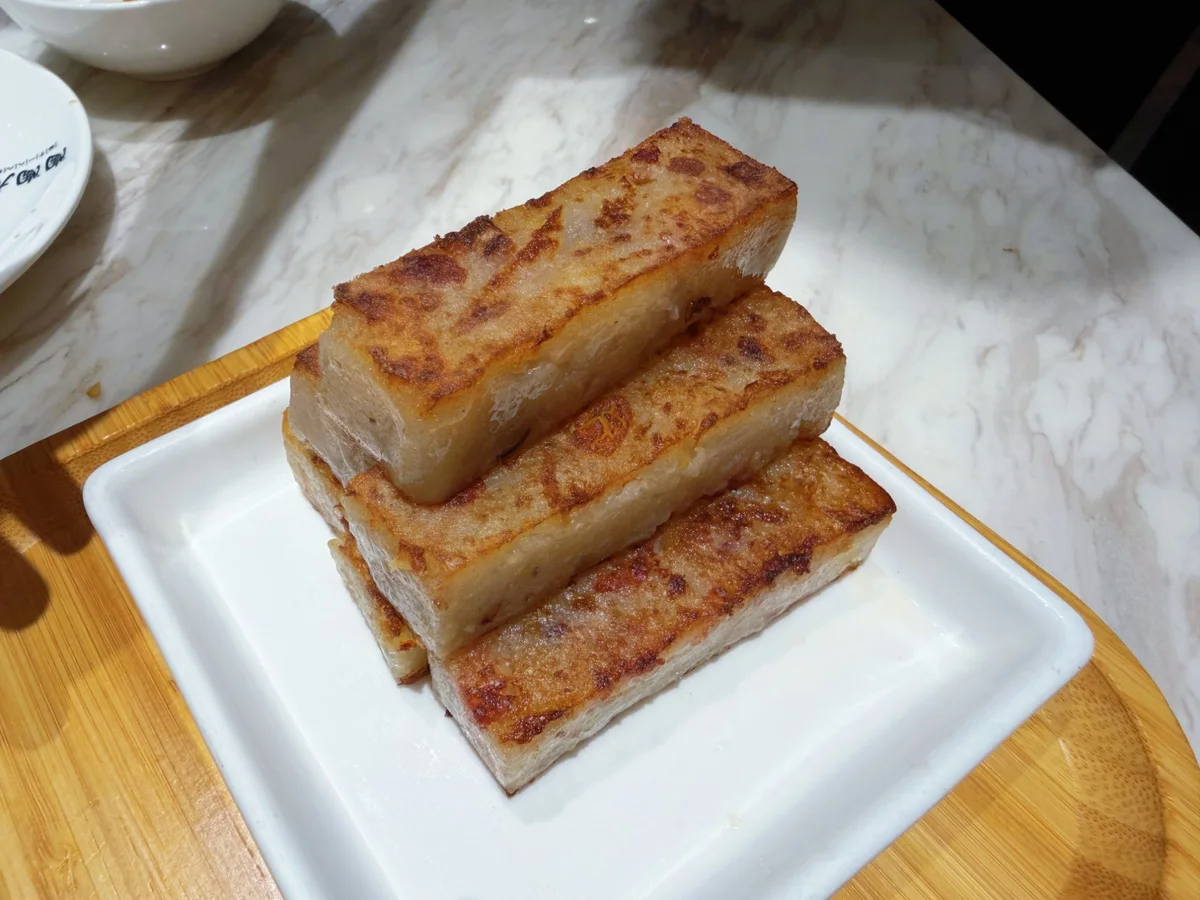
The vegetable in the name, 萝卜, lo bak in Cantonese, is the long white radish with a green top that Western supermarkets sell as daikon. “Turnip cake” is an old translation that stuck; turnips play no part. A good cake is white or pale ivory, flecked with pink cured meat and the brown of dried shrimp and mushroom.
It is made in three stages. The radish is grated or shredded and cooked first, by steaming or simmering in its own juice. It is then mixed into a batter of ordinary rice flour and water, not glutinous rice flour, which would turn it gluey, with fried cured meats and seasoning, and the batter is steamed in an oiled tray until set. Last, the cake is left to cool and firm up, cut into slices or fingers and fried in a little oil. A 1985 Guangdong cookbook of snacks describes the result: white and glossy in the tray, golden and slightly scorched after frying, soft, smooth and sweet-savory, “a seasonal snack for winter and spring,” when radishes are at their best.
Because the radish is so watery and mild, the cake tastes less of vegetable than its proportions suggest. The radish gives sweetness and a loose, moist texture; the cured pork and sausage give the salt and fat; the crust gives the crunch. Singapore calls the same cake carrot cake, though there is no carrot in it: white radish there is literally “white carrot.” Southern Fujian calls it 菜头粿, “radish kueh.”
02
Why it is a Chinese New Year food
糕, “cake,” sounds like 高, “high,” so a cake at New Year wishes for a year that rises step by step, 步步高升.
Cantonese New Year cooking runs to a timetable. A Guangzhou rhyme lays out the last week of the old year: thank the Kitchen God on the 23rd or 24th of the twelfth month, fry on the 25th, sweep on the 26th, wash on the 27th, steam cakes on the 28th, put up the couplets on the 29th and gather on the 30th. Turnip cake belongs to that batch of New Year cakes, beside sweet nian gao and taro cake.
The meaning is in the word. All of these are 糕, which sounds like 高, “high,” and a slice of cake is a wish for 步步高升, “rising step by step,” in work, school and fortune. In southern Fujian and Taiwan the pun is different but the cake is the same. There radish is called 菜头, which echoes 彩头, “a good omen,” so 菜头粿 goes on the New Year altar as 好彩头 and is carried to relatives as a present.
The season helps. Radish is a winter vegetable, which is why old cookbooks file turnip cake under winter and spring. In Hong Kong the cakes are also sold boxed: in the weeks before the 2015 New Year, Hong Kong’s Consumer Council surveyed 40 boxed festive foods from nine chain pastry shops, and fifteen of them were turnip or taro cakes. The habit travelled with Cantonese families. The writers of The Woks of Life, a Chinese American family, remember lo bak go on the table every Chinese New Year’s Day of their childhood.
03
Four old recipes, from a Shanghai home to a Guangzhou teahouse
Printed recipes show how the cake was made before rice flour came in bags.
A Shanghai household cookbook of 1935 already has it, as 蒸萝卜糕. Its cook shreds the radish, squeezes out the juice, mixes the shreds with japonica rice flour, a little salt and very little water, and packs them into a small rice steamer with a layer of chopped fat pork in the middle and dried shrimp, shiitake and ham on top. The cake is steamed through, sliced and fried, and the book’s verdict is short: fried and eaten at once, it is crisp and pleasant.
The Beijing Hotel, whose 1979 cookbook has a Cantonese chapter, printed its version that year. It uses wet long-grain rice flour and white radish in equal weights, a kilo and a quarter of each. The radish shreds are fried in lard with dried shrimp, Cantonese cured pork and sausage, simmered in two litres of water with sugar, salt and white pepper, and poured boiling into the raw rice slurry, so that the heat half-cooks the batter. After thirty minutes of steaming the top is scattered with shredded egg pancake, coriander leaves and toasted sesame. The same page notes that taro in place of radish, with five-spice and peanuts, makes taro cake.
A 1985 book of Guangdong snacks shows the teahouse scale. Ten jin of rice, five kilos, are soaked for an hour and a half and ground to a thin slurry; ten jin of radish are grated and steamed in a cloth-lined steamer sixty centimeters across. Boiling water goes into the slurry, the slurry goes onto the radish, and the cook stirs the mass with a homemade bamboo whisk, a length of bamboo split into four and wedged open, steaming it for ten minutes, stirring, steaming ten more and stirring again. Diced cured fat pork, sugar, salt and pepper go in when the cake is eight-tenths done. The finished batch, forty jin, about twenty kilograms, rests under a lid for twelve hours before it is cut into forty blocks and fried to order. The same book has a richer version with paste of dace, a Pearl River fish, and twice as much radish as rice.
In 1988 Guo Wenbin, the Beijing Hotel’s top-grade pastry chef, explained why the batter is half-cooked first. Stirred to about seven-tenths cooked, it is thick enough to hold the radish and meat evenly. If it is too raw, the heavy pieces sink and the light ones float, and the cake has an empty layer in the middle; if it is cooked too far, it is too stiff to mix. A batter that comes out thin can be thickened by setting its bowl in a pan of boiling water and stirring.
04
How much radish: the test of a good turnip cake
A good turnip cake tastes of radish, and it is soft enough to sag when you lift a slice.
The old recipes are generous. The 1985 teahouse batch uses radish and rice in equal weight, and its fish-paste version twice as much radish as rice. The Woks of Life, a widely used English-language family recipe, uses about 570 grams of radish to roughly 200 grams of rice flour. Restaurants, the same writers say, tend to skimp, and their cakes are mostly rice flour and starch: smoother, almost like a pudding, but with little radish taste.
In 2026 the question reached Taiwan’s Control Yuan, the government’s watchdog. One of its members opened an investigation into turnip cakes bulked out with modified starch and very little radish, noting that Taiwan requires some foods to state their main ingredient as a percentage but not turnip cake. A nutritionist quoted in the coverage put a traditional cake at more than half radish, and some factory products at under a tenth. Taiwan’s Food and Drug Administration answered that it had inspected 1,082 turnip cakes from markets and breakfast shops since 2021, had found none without radish, and always found radish among the first three ingredients, but admitted there is no laboratory test for radish content, and that no national standard anywhere sets a minimum.
So the test is by hand. A cake that is very springy, hard to break, or that jiggles like a pudding is mostly starch. A cake with plenty of radish is looser: lifted with chopsticks, a slice sags at the corners and may break. Singapore hawkers draw the same line. At Fu Ming Cooked Food, a Michelin Bib Gourmand stall, Goh Chye Oo still grates his radish by hand, beats the batter more than a hundred times and steams it in round tins for about four hours, because factory-made carrot cake, cut into uniform cubes, is harder.
05
Teahouse fingers, Taiwanese breakfasts, Chaoshan griddles and Singapore carrot cake
The same steamed cake ends up on very different plates.
In Guangzhou and Hong Kong teahouses it comes as 煎萝卜糕, pan-fried turnip cake: thick fingers or squares, crusted brown on the cut faces and soft inside, often with oyster sauce for dipping. At a Tao Tao Ju branch in Shenzhen, in October 2026, a plate of four fingers cost 19 yuan and stayed on the menu into the evening. Some people eat it steamed, without frying, and a 1985 recipe serves its fish-paste version reheated with a little lard and light soy sauce.
Taiwan eats it for breakfast. Neighborhood breakfast shops fry slices on the flat-top next to the egg crepes, and regulars order 萝卜糕加蛋, turnip cake with egg, either folded inside an egg crepe or fried with the egg poured over the pieces. A Taichung shop, in a news report from early 2022, listed “Hong Kong-style turnip cake” at NT$25 and charged NT$30 to fry it crisper. A specialist turnip cake seller in Taichung’s Sixth Market explained the surcharge: a cake made only from indica rice batter takes nine hours to make and six to eight minutes on the griddle over medium-low heat, or it burns.
In Chaoshan, in eastern Guangdong, 菜头粿 is street food. Hawkers fry slabs of radish cake hard on a griddle, then build a plate on top: pork, small oysters and egg for 15 yuan at a Chaozhou stall in 2024, or beef, egg and bean sprouts, 30 yuan for two, at a night stall in a Dongfeng town market in early 2025. Singapore’s carrot cake is fried in much the same way. Pieces of radish cake go onto a flat cast-iron pan with garlic, egg and chye poh, salty preserved radish, either plain, as “white,” to be eaten the moment it is fried, or with a sweet dark sauce as “black.”
06
Turnip cake and its relatives
Most Chinese communities in the south steam some version of it.
| Name | Where | What it is | How it is served |
|---|---|---|---|
| Turnip cake 萝卜糕 (lo bak go) | Guangzhou, Hong Kong, Cantonese communities abroad | White radish, rice flour, Chinese sausage, cured pork, dried shrimp, mushroom | Steamed, sliced and pan-fried; dim sum and New Year |
| Taro cake 芋头糕 (wu tau go) | Guangdong, Hong Kong | The same method with taro; the Beijing Hotel adds five-spice and peanuts | Pan-fried slices; New Year |
| 菜头粿, 菜粿 | Southern Fujian, Taiwan | Radish cake; 菜头 puns on 彩头, a good omen | New Year altar and gifts; Taiwanese breakfast with egg |
| Chaoshan 菜头粿 | Chaozhou, Shantou | Radish cake fried on a griddle | With pork, oysters, beef, egg or bean sprouts |
| Carrot cake, chai tow kway | Singapore, Malaysia | Cubes of radish cake | Fried with egg and preserved radish, white or black |
07
Turnip cake at home
This follows The Woks of Life’s family recipe, with the old teahouse rule for the batter added.
For a 23 × 13 cm (9 × 5 inch) loaf pan, about six servings: 570 g (20 oz) white radish (daikon), peeled and coarsely grated; 1¼ cups (about 200 g) regular rice flour, not glutinous; 1 to 3 tablespoons cornstarch; 1 Chinese sausage, diced; 3 to 5 dried shiitake and 1 tablespoon dried shrimp, soaked and chopped; 1 scallion, chopped; 2 tablespoons oil; ½ teaspoon salt, ½ teaspoon sugar, ¼ teaspoon white pepper; water.
- 1. Fry the fillings
Stir-fry the shrimp, mushrooms and sausage in the oil over medium heat for about 5 minutes, add the scallion and take them out.
- 2. Cook the radish
Put the grated radish in the wok with 1 cup (240 ml) water and simmer about 10 minutes, stirring so it does not brown, until about 1 cup of liquid is left.
- 3. Make the batter
Mix the rice flour and 1 tablespoon cornstarch with ½ cup (120 ml) water. For a softer cake add up to ½ cup more water, with 1 more tablespoon cornstarch for each ¼ cup. Stir it into the radish with the seasoning and the fillings.
- 4. Half-cook it
Over low heat, stir until the batter thickens to the consistency of thick pancake batter. This is the old teahouse step: a half-cooked batter keeps the sausage and shrimp spread through the cake instead of sinking.
- 5. Steam
Spread it in a well-oiled loaf pan and steam over medium-high heat for about 50 minutes, or 40 minutes in a 20 cm (8 inch) round pan, until a chopstick comes out clean.
- 6. Rest, slice and fry
Cool for at least 30 minutes; chilled overnight it slices more cleanly. Cut 1 cm slices with a wet knife and fry in a little oil over medium heat until golden and crisp on both sides.
08
How to order it
Use the local name, and know that the cake is salty.
In Guangzhou, Hong Kong and at dim sum abroad
Look for 萝卜糕 or 煎萝卜糕, pan-fried turnip cake, on the order sheet or the cart. A plate of four fingers cost 19 yuan at Tao Tao Ju in Shenzhen in October 2026.
In Taiwan
At a breakfast shop ask for 萝卜糕加蛋, turnip cake with egg. Some shops charge a few dollars more to fry it extra crisp.
In Chaoshan
Ask for 菜头粿 and choose the topping: pork, oysters, beef or egg, 15 to 20 yuan a plate at street stalls in 2024.
In Singapore and Malaysia
Order carrot cake, chai tow kway, and say white or black.
Mind the salt
Hong Kong’s Consumer Council checked the sodium in boxed turnip cakes in its 2015 survey of New Year foods, which it published as a caution against holiday binges.
09
More dim sum and New Year food
Other pages on the atlas.
Dim sum and yum cha
What to order at a Cantonese teahouse, and how morning tea works in Guangzhou.
Read the dim sum guide →Chinese New Year food
What China eats from Laba to the Lantern Festival, and what each dish means.
Read the New Year food guide →Rice noodle rolls
The other teahouse staple made from rice batter.
Read about rice noodle rolls →Tangyuan
Glutinous rice balls for the winter solstice and the Lantern Festival.
Read about tangyuan →Guangdong classics
- Egg Tart
Custard tart · Dim sum, afternoon tea or bakery snack
- Cantonese Yum Cha
Yum cha · Morning tea, weekends with family
- Char Siu
Roast pork · Lunch or dinner, with rice
- Egg Fried Rice
Fried rice · Lunch, dinner, end of a meal
- Beef Chow Fun
Fried rice noodles · Lunch, dinner or late-night supper
- Mooncake
Festival pastry · Mid-Autumn Festival
Dumplings and dim sum from other regions
FAQ
Questions about Turnip Cake
Is turnip cake made from turnips?
No. It is made from white radish, 萝卜, the long vegetable sold abroad as daikon. “Turnip” is an old translation that stuck; “radish cake” is more accurate.
What does turnip cake taste like?
Mild, slightly sweet and savory, with salty bits of Chinese sausage, cured pork and dried shrimp. Pan-fried, it is crisp outside and soft, almost creamy, inside.
Why is turnip cake eaten at Chinese New Year?
糕, “cake,” sounds like 高, “high,” so New Year cakes wish for rising step by step. Guangzhou families steam cakes on the 28th of the twelfth month, and in southern Fujian and Taiwan the radish, 菜头, puns on 彩头, a good omen.
What is the difference between turnip cake and taro cake?
Taro cake uses taro instead of radish; the Beijing Hotel’s 1979 version adds five-spice and peanuts. Both are steamed, sliced and pan-fried, and both are New Year cakes.
Is Singapore carrot cake the same as turnip cake?
It starts as the same radish cake. In Singapore it is cut up and fried with garlic, egg and preserved radish, plain (white) or with a sweet dark sauce (black). It contains no carrot.
Can I use glutinous rice flour?
No. Use regular rice flour; glutinous rice flour makes the cake gluey and it will not set properly.
How can I tell a good turnip cake?
It should taste of radish and be soft: a slice sags at the corners when lifted. A very springy cake that jiggles like pudding is mostly starch.
How much is turnip cake?
19 yuan for four pan-fried fingers at Tao Tao Ju in Shenzhen (October 2026); NT$25–30 at a Taichung breakfast shop (2022); 15–20 yuan for a fried plate at a Chaozhou street stall (2024).
Sources
Sources and further reading
- 1 On the 24th, Cantonese families thank the Kitchen God and heat the frying wok: the Guangzhou rhyme “steam cakes on the 28th” (2025) (in Chinese)Yangcheng Evening News, via Guangming Online ↗
- 2 Turnip cake the traditional way: cakes at New Year for “rising step by step,” with T’ang Court’s Kwong Wai-keung (2017) (in Chinese)MICHELIN Guide Macau (in Chinese) ↗
- 3 Behind the Bib: Fu Ming Cooked Food, Singapore carrot cake made from scratch (2019)MICHELIN Guide Singapore ↗
- 4 Unforgettable Carrot Cake at Bukit Merah View: “white carrot,” chye poh, and black versus white (2024)MICHELIN Guide Singapore ↗
- 5 Chinese Snacks: Guangdong (中国小吃·广东风味), p. 36: turnip cake for a 40-jin teahouse batch (in Chinese)China Financial and Economic Publishing House (1985), indexed by laocp.tech ↗
- 6 Chinese Snacks: Guangdong (中国小吃·广东风味), p. 37: turnip cake with dace paste (鱼茸萝卜糕) (in Chinese)China Financial and Economic Publishing House (1985), indexed by laocp.tech ↗
- 7 Famous Recipes of the Beijing Hotel (北京饭店名菜谱), p. 1006: turnip cake with cured meats, and the taro version (in Chinese)Beijing Hotel; Beijing Publishing House (1979), indexed by laocp.tech ↗
- 8 Guo Wenbin, Pastries of the Beijing Hotel (北京饭店的面点), p. 87: turnip cake with cured meats, and why the batter is half-cooked (in Chinese)Economic Daily Press (1988), indexed by laocp.tech ↗
- 9 New Household Recipes (家庭新食谱), p. 10: steamed turnip cake (in Chinese)Central Bookstore, Shanghai (1935), indexed by laocp.tech ↗
- 10 Chen Yanlan, “The joy of steaming New Year kueh in southern Fujian” (闽南的炊糕做粿之乐): 菜粿, radish cake, and the “good omen” of 菜头 (2024) (in Chinese)Shishi Daily (Fujian Daily Group) ↗
- 11 Caution on holiday binge on traditional CNY foods, CHOICE no. 460: 15 turnip and taro cakes from 9 chain pastry stores (2015)Consumer Council, Hong Kong ↗
- 12 Bill Leung, Turnip Cake (Chinese Lo Bak Go)The Woks of Life (updated January 2025) ↗
- 13 Turnip cake with no turnip? The Control Yuan investigates modified starch, and a nutritionist’s chopstick test (2026) (in Chinese)Taiwan News (in Chinese) ↗
- 14 Taiwan FDA: 1,082 turnip cakes inspected since 2021, none without radish, but no test for radish content (2026) (in Chinese)United Daily News (in Chinese) ↗
- 15 A Taichung breakfast shop charges NT$5 more to fry turnip cake crisper; a turnip cake specialist on rice batter and frying time (video, EBC News, in Chinese)Bilibili (January 2022) ↗
- 16 Turnip cake with egg, a favorite at Taiwanese breakfast shops (video, in Chinese)Taipei Pipi Zhu Ni Kankan (台北皮皮煮你看看), Bilibili (May 2022) ↗
- 17 Chaozhou street food: fried radish cake with pork, oysters and egg, 15 yuan (video, in Chinese)Chichi Chi Sha Ne (赤赤吃啥呢), Bilibili (April 2024) ↗
- 18 A night stall in a Dongfeng market, Chaozhou: radish cake fried with beef, egg and bean sprouts (video, in Chinese)Chanxu (馋叙), Bilibili (February 2025) ↗
Last updated November 2026