
01
One name, two very different cakes
The southern cake is sweet and sticky; the Yangtze delta cake has no sugar and is firm and chewy.
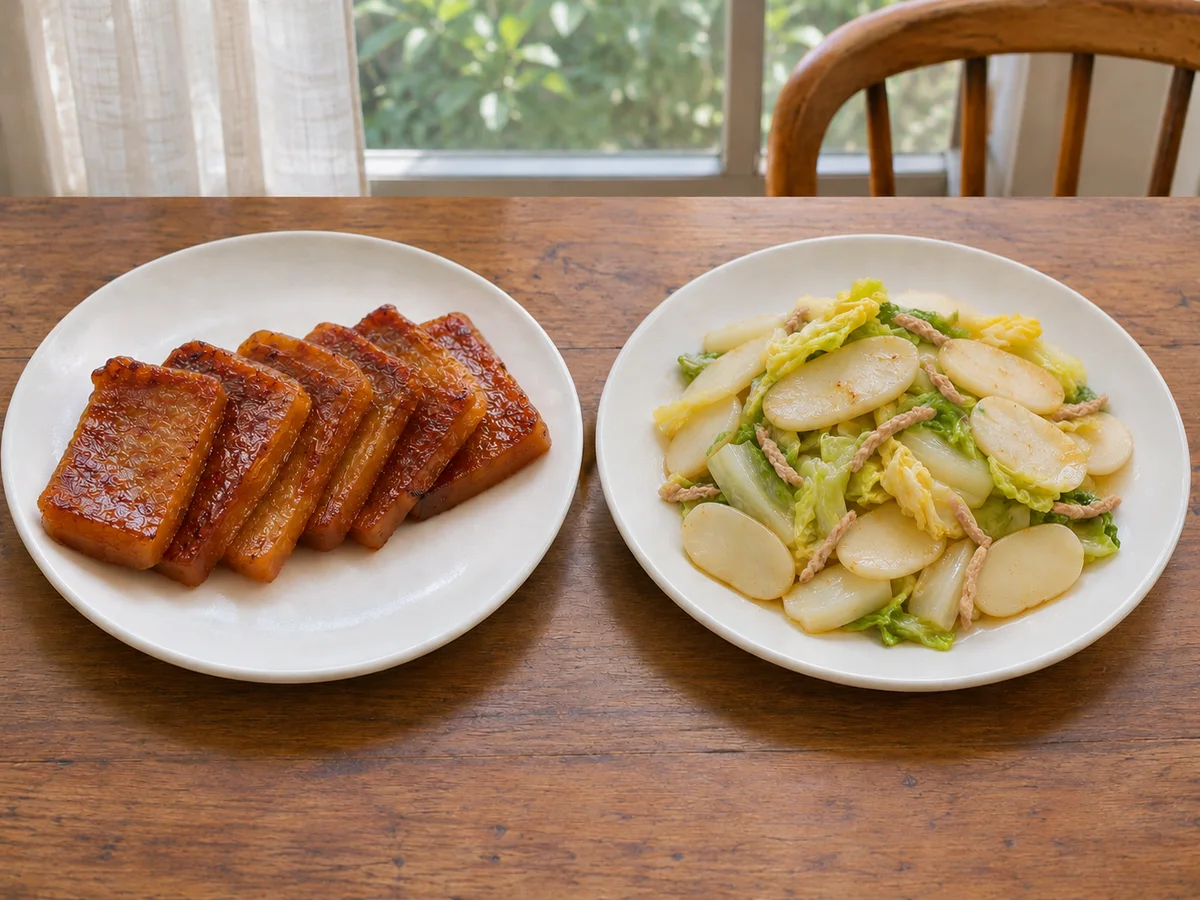
The word covers two families. The southern sweet cake is made from glutinous rice flour, sometimes with a little ordinary rice flour, stirred with a hot brown-sugar syrup and steamed for an hour or more in a shallow tray. It sets into a sticky, amber block that keeps for weeks, and it is eaten in slices, steamed again or fried until the edges crisp. The Yangtze delta cake is made from ordinary rice that is soaked, milled with water, steamed and pounded until smooth, then shaped into white bars. It has no sugar, is firm and chewy rather than sticky, and works like a pasta: sliced and stir-fried with pork and greens, cooked in soup, or sweetened with sugar and osmanthus.
The meaning is the same everywhere. Luo Shuwei, a researcher at the Tianjin Academy of Social Sciences, explaining New Year food to Xinhua in 2019, put it simply: 年糕 sounds like 年年高, “higher every year,” so southern families make a point of eating it on New Year’s Eve, as the north eats jiaozi; the square yellow and white cakes are said to stand for gold and silver. A 1985 Guangdong cookbook says the same of its brown-sugar cake: cakes are steamed for Spring Festival everywhere because 糕 sounds like 高, a wish that each year will be better than the last, and that is why the cake steamed only at the New Year is called the year cake.
Outside China the two often get confused. Asian grocery stores sell the white oval slices, fresh, frozen, vacuum-packed or dried, as “rice cakes” or “nian gao,” next to the fresh noodles, and the same shelves may hold Korean tteok, which are thicker cylinders.
02
The Cantonese brown-sugar cake
Guangdong’s nian gao is glutinous rice and brown sugar, steamed for an hour, then fried in slices.
The 1985 Guangdong snack book gives the classic proportions: three parts ordinary rice to seven parts glutinous rice, ground to a paste, and a full jin of brown sugar boiled into syrup for every jin of rice. The syrup goes into the paste a little at a time, stirred so it never forms lumps, with a spoonful of peanut oil, and the batter is steamed in a nine-inch square pan for about an hour over a steady, not fierce, fire, or the syrup bubbles over. Cooled, the cake is orange-brown, sweet, soft and chewy, and it keeps for a long time. Made with white sugar and candied lotus seeds, winter melon and water chestnut it becomes 果子年糕, fruit nian gao. Some boxed cakes contain coconut milk: of those tested in Hong Kong in 2015, three were high in saturated fat, probably from coconut milk.
Nobody eats it straight from the tray. It is sliced and pan-fried in a little oil over low heat until golden and slightly scorched, or dipped in beaten egg first, which gives each slice a soft yellow coat around the molten middle. Southern Fujian does the same with its sweet kueh, 甜粿, fried in egg and eaten beside a bowl of salty oyster vermicelli, which local people call “eating sweet, remembering salty.” Fujian’s red version, a 1984 snack book notes, is steamed for four hours, cut in triangles and fried.
It is very sweet. In 2015 Hong Kong’s Consumer Council checked the labels of fourteen boxed New Year puddings from chain pastry shops: half had at least 25 grams of sugar per 100 grams, and two pieces of one nian gao, about 116 grams, held 50 grams of sugar, the World Health Organization’s whole daily limit.
03
The white rice cakes of Ningbo, Shanghai and Suzhou
In the Yangtze delta, nian gao is a plain white cake of pounded rice, and it is eaten savory as often as sweet.
A 1960 Shanghai cookbook records the whole process for 水磨年糕, “water-milled nian gao,” at the scale of a city snack company. A hundred jin of fine rice is washed three times and soaked for a day, or better for five to seven days, then milled with water into a slurry, bagged and pressed under stones for four or five hours until the bag no longer gives under a finger. The cake flour is rubbed through a sieve into flakes, steamed in layers in a wooden barrel, then pounded in a stone mortar about 120 times while a second person, hands dipped in cold water, pushes the spilling dough back in. It is kneaded smooth, divided into pieces of two and a half liang, rolled into bars and pressed with a carved wooden board, which leaves the pattern on top. The book names Shanghai’s two great styles, Ningbo and Shaoxing, and their famous makers, Su Desheng and Ding Daxing, whose cakes “do not go mushy in the pan” and were shipped to Chinese communities in Southeast Asia.
The calendar is local. A 1935 Shanghai household cookbook says that in Suzhou the first meal of New Year’s Day had to be sweet boiled nian gao, “so this year will be higher than last,” that Hangzhou families stir-fried nian gao on the third morning of the year with shepherd’s purse, ham and chicken or chives and pork, singing a rhyme about earning silver ingots, and that the eighteenth, when the lanterns come down, was another nian gao day. Suzhou’s own cake, the book adds, was three parts japonica rice to seven glutinous; with that much glutinous rice it is softer and stickier than Ningbo’s. Suzhou also makes a rich sweet one, 猪油年糕, glutinous rice with sugar, cubes of sugared lard and rose jam, pressed in a frame and left a day to set; a 1985 Jiangsu book says it keeps more than a month and is sliced and steamed, pan-fried or fried in batter.
In Ningbo nian gao is not only New Year food. Restaurants send out brown-sugar nian gao and pomfret braised with nian gao, and breakfast stalls draw queues for 猪油年糕块, a block of lard-rich nian gao fried crisp outside and wrapped around a youtiao and egg; in 2024 one with egg and youtiao cost 7 yuan. The 1960 book describes the same idea in its 年糕团: freshly pounded cake, still hot, wrapped around youtiao, sesame sugar or pickles.
04
Stir-fried rice cakes and pork chop nian gao
Two Shanghai dishes made the white cake famous.
炒年糕, stir-fried rice cakes, is a Shanghai home lunch. A 1983 Shanghai snack book cuts the cake into thin diagonal slices, fries them briefly in lard, adds stock and salt and lets them braise for three minutes until soft, then tops them with chicken, winter bamboo shoot and peas, adding that napa cabbage and shredded pork will do instead of the chicken. That plainer version, pale or lightly browned with soy sauce, is the everyday one. The Woks of Life, whose Shanghainese mother and grandmother made it for quick lunches, lay the rice cakes on top of the vegetables so they steam rather than stick, and finish them with light and dark soy and a little oyster sauce until they are coated but still chewy.
排骨年糕, pork chop with nian gao, is Shanghai street food. The 1983 book names its two famous shops, each by then more than fifty years old. Xiao Changzhou, “the king of pork chop nian gao,” fried its chops without batter in oil seasoned with soy, sugar, scallion and ginger, then fried small, thin nian gao in the same oil so they tasted of the pork. Xiandelai battered its chops and cooked the nian gao in a sauce of soy and pork drippings, served with sweet bean sauce.
05
Millet, dates and sorghum: northern nian gao
The north has nian gao too, made from yellow millet rather than rice.
In the north the New Year cake is often made from 黄米, sticky yellow millet. A 1982 Shandong snack book shapes the millet dough into small hollow pyramids, studs each with three or four red dates and steams them on corn husks for half an hour; the cakes come out golden and are eaten dipped in sugar, a village Spring Festival food. In Beijing nian gao went on the New Year’s Eve altar: the 1900 Yanjing suishi ji lists a full offering of honey pastries, apples, dried fruit, mantou, vegetarian dishes and nian gao, one layer of each.
In the Northeast, farm families still steam big trays in the last days of the year. One family in 2024 layered yellow millet, rice and sorghum flour with beans over sauerkraut leaves in the steamer, steamed it for half an hour and cut it into blocks of several colors. Northeastern farm custom is to eat nian gao at the New Year.
06
Nian gao by region
The same name, cakes that hardly resemble each other.
| Kind | Where | Made from | How it is eaten |
|---|---|---|---|
| Brown-sugar nian gao 广式年糕 | Guangdong, Hong Kong | Glutinous and ordinary rice, brown sugar | Sliced and pan-fried, often dipped in egg |
| Sweet kueh 甜粿 | Southern Fujian, Taiwan | Glutinous rice, white or brown sugar | Fried in egg, with oyster vermicelli |
| Water-milled nian gao 水磨年糕 | Ningbo, Shaoxing, Shanghai | Pounded rice, no sugar | Stir-fried, in soup, with pork chop, or sweet |
| Lard nian gao 猪油年糕 | Suzhou | Glutinous rice, sugar, lard, rose or osmanthus | Sliced, steamed or fried |
| Millet nian gao 黄米年糕 | Shandong, the north, the Northeast | Yellow millet, red dates, sometimes sorghum and beans | Steamed, eaten hot with sugar |
07
Stir-fried rice cakes at home
This is the everyday Shanghai version with pork and napa cabbage, following The Woks of Life.
For two or three: 450 g (1 lb) fresh or frozen oval rice cakes; 225 g (8 oz) pork shoulder or loin, cut in thin strips; 225 g (8 oz) napa cabbage or baby bok choy; 2 cloves garlic; 3 scallions; 3 tablespoons oil; 1 tablespoon Shaoxing wine. Marinade: 1 tablespoon water, 2 teaspoons light soy sauce, ½ teaspoon sesame oil, ¼ teaspoon white pepper, 1 teaspoon oil, 1 teaspoon cornstarch. Sauce: 1 tablespoon light soy sauce, 1½ teaspoons dark soy sauce, 2 teaspoons oyster sauce, ½ teaspoon sugar, ¼ teaspoon white pepper, ½ teaspoon sesame oil.
- 1. Marinate
Mix the pork with the marinade and leave it 20 to 30 minutes. Rinse the rice cakes; soak them only if they are the dried kind.
- 2. Fry the pork
Heat the wok until it smokes, add the oil, then the pork and garlic, and stir-fry until the pork turns opaque.
- 3. Add the greens
Add the scallions, cabbage and Shaoxing wine and stir-fry 30 seconds. Pile everything in the middle and lay the rice cakes on top, so they do not touch the hot metal.
- 4. Steam
Pour in 120 to 180 ml (½ to ¾ cup) water, cover and cook 2 minutes.
- 5. Finish
Uncover, add the sauce ingredients and stir-fry over medium heat about a minute, until the rice cakes are coated and cooked through but still chewy. Taste for salt.
For the Cantonese sweet cake, buy a tray from a Chinese bakery, slice it about 1 cm thick, dip the slices in beaten egg and fry over low heat until golden on both sides.
08
How to find it
Know which nian gao you want before you ask.
In Guangdong and Hong Kong
Before the New Year, chain pastry shops sell boxed sweet nian gao; slice it and fry it at home, plain or dipped in egg.
In Ningbo
Look for 猪油年糕块 at breakfast stalls, wrapped round youtiao and egg; 7 yuan in 2024.
In Shanghai
Order 炒年糕 with pork and napa cabbage, or 排骨年糕, pork chop with nian gao, at a snack shop.
Abroad
For stir-fries, buy the white oval “rice cakes” in an Asian grocery, next to the fresh noodles; fresh and frozen ones need no soaking.
Go easy on the sweet one
In Hong Kong’s 2015 survey, two pieces of one boxed nian gao held 50 grams of sugar.
09
More New Year food
Other pages on the atlas.
Chinese New Year food
What China eats from Laba to the Lantern Festival.
Read the New Year food guide →Turnip cake
The savory Cantonese New Year cake, steamed from radish and rice batter.
Read about turnip cake →Sesame balls
Jian dui, fried in the Cantonese New Year frying.
Read about sesame balls →Tangyuan
Glutinous rice balls for New Year’s morning and the Lantern Festival.
Read about tangyuan →Across China classics
- Tea Eggs
Tea-marbled boiled eggs · Breakfast and snacks
- Jiaozi
Boiled, steamed or pan-fried dumplings · Everyday meals; New Year’s Eve in the north
- Chow Mein
Fried wheat noodles · Lunch, late-night meals, takeaway
- Hot and Sour Soup
Thickened soup · With dumplings, at banquets
- Stir-Fried Shredded Potatoes
Stir-fried vegetable side dish · Everyday meals with rice
- Youtiao and Soy Milk
Fried dough sticks and soy milk · Breakfast
FAQ
Questions about Nian Gao
What is nian gao?
China’s New Year cake, 年糕, named because it sounds like 年年高, “higher every year.” In Guangdong it is a sweet brown-sugar cake of glutinous rice; in Ningbo and Shanghai a firm white cake of pounded rice used in savory dishes.
Why is nian gao eaten at Chinese New Year?
For the pun on 高, “high”: a wish that each year will be better than the last. Southern families eat it on New Year’s Eve or New Year’s Day, and Suzhou once made sweet nian gao the first meal of the year.
Are Chinese rice cakes the same as Korean tteok?
They are close relatives, both pounded rice. Chinese stir-fry rice cakes are usually thin ovals; Korean tteokbokki rice cakes are thicker cylinders, and either can be used, with different cooking times.
How do you eat Cantonese nian gao?
Slice it about 1 cm thick and pan-fry it over low heat, often after dipping it in beaten egg, until golden outside and soft inside.
Do I need to soak rice cakes?
Only dried ones. Fresh, frozen and vacuum-packed rice cakes just need rinsing.
Is nian gao sweet or savory?
Both. The Cantonese, Fujianese and Suzhou cakes are sweet; Ningbo and Shanghai white rice cakes are mostly stir-fried or cooked in soup, though they can be sweetened too.
How much does nian gao cost?
A Ningbo breakfast of lard nian gao with egg and youtiao cost 7 yuan in 2024.
Sources
Sources and further reading
- 1 Fucha Dunchong, Yanjing suishi ji (1900): the New Year’s Eve altar, with a layer of nian gao (in Chinese)Chinese original on Wikisource ↗
- 2 Zhou Runjian, why the north eats jiaozi and the south nian gao on New Year’s Eve (2019) (in Chinese)Xinhua, via The Paper ↗
- 3 Chinese Snacks: Guangdong (中国小吃·广东风味), p. 39: Cantonese brown-sugar nian gao (in Chinese)China Financial and Economic Publishing House (1985), indexed by laocp.tech ↗
- 4 Famous Chinese Dishes: Shanghai (中国名菜谱·上海), p. 167: water-milled nian gao, from soaking the rice to the carved board (in Chinese)Light Industry Press (1960), indexed by laocp.tech ↗
- 5 Chinese Snacks: Shanghai (中国小吃·上海风味), p. 130: stir-fried nian gao with chicken, or with napa cabbage and pork (in Chinese)China Financial and Economic Publishing House (1983), indexed by laocp.tech ↗
- 6 Chinese Snacks: Shanghai (中国小吃·上海风味), p. 132: pork chop with nian gao (排骨年糕) (in Chinese)China Financial and Economic Publishing House (1983), indexed by laocp.tech ↗
- 7 Chinese Snacks: Jiangsu (中国小吃·江苏风味), p. 124: Suzhou lard nian gao with rose (in Chinese)China Financial and Economic Publishing House (1985), indexed by laocp.tech ↗
- 8 Chinese Snacks: Shandong (中国小吃·山东风味), p. 55: millet nian gao with red dates (in Chinese)China Financial and Economic Publishing House (1982), indexed by laocp.tech ↗
- 9 New Household Recipes (家庭新食谱), pp. 5–6: Suzhou and Ningbo nian gao, and the New Year days they are eaten (in Chinese)Central Bookstore, Shanghai (1935), indexed by laocp.tech ↗
- 10 New Household Recipes (家庭新食谱), p. 4: steamed white- and brown-sugar nian gao; Suzhou nian gao of three parts japonica to seven glutinous (in Chinese)Central Bookstore, Shanghai (1935), indexed by laocp.tech ↗
- 11 Chinese Snacks: Fujian (中国小吃·福建风味), p. 21: fried brown-sugar kueh, red nian gao (in Chinese)Fujian Catering Services Company (1984), indexed by laocp.tech ↗
- 12 Chen Yanlan, “The joy of steaming New Year kueh in southern Fujian” (闽南的炊糕做粿之乐): sweet kueh fried in egg and eaten with oyster vermicelli (2024) (in Chinese)Shishi Daily (Fujian Daily Group) ↗
- 13 Caution on holiday binge on traditional CNY foods, CHOICE no. 460: sugar in 14 sweet New Year puddings (2015)Consumer Council, Hong Kong ↗
- 14 Judy and Bill Leung, Stir-Fried Rice Cakes (Nian Gao)The Woks of Life (updated December 2021) ↗
- 15 A day of eating in Ningbo: brown-sugar nian gao, pomfret with nian gao, and the lard nian gao breakfast (video, in Chinese)Shenqi Hai Nuo (神奇海挪), Bilibili (November 2024) ↗
- 16 Five Ningbo breakfast stalls: a lard nian gao block with egg and youtiao, 7 yuan (video, in Chinese)Dage Zai Shanghai (达哥在上海), Bilibili (October 2024) ↗
- 17 A Northeastern farm family steams layered nian gao of millet, rice and sorghum flour before Spring Festival (video, in Chinese)Balingxu Laolao (八零徐姥姥), Bilibili (February 2024) ↗
Last updated November 2026