
01
A fried ball of glutinous rice, hollow inside
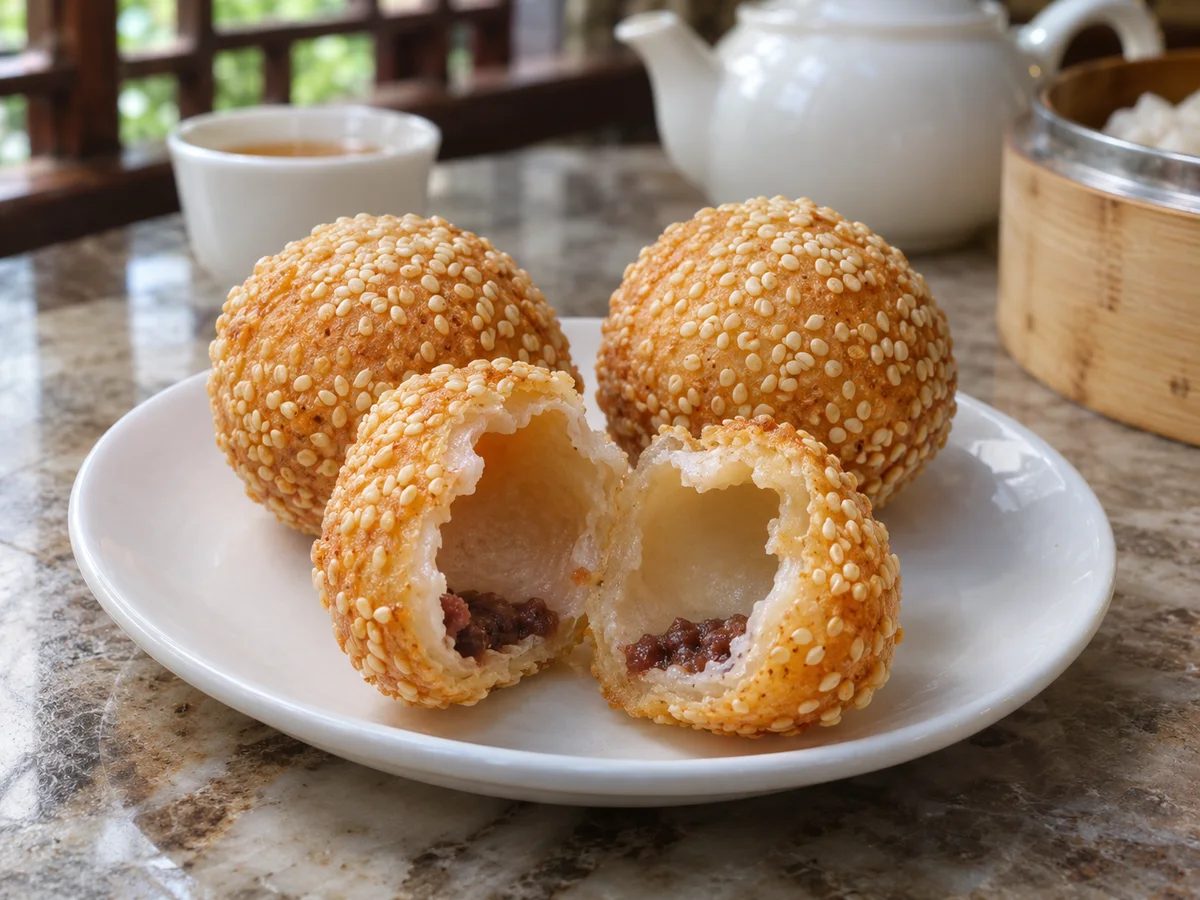
The ideal, in a 1983 Shanghai recipe, is round, full and golden, with a thin crisp skin and a sweet, chewy inside.
The dough is glutinous rice flour, the same sticky rice flour used for tangyuan, worked with sugar and hot water. It is wrapped around a ball of sweet paste, rolled in raw white sesame and fried slowly in a deep pan of oil. As it fries, the steam inside pushes the dough outward, and a ball the size of a walnut swells to twice its size or more. A good one crackles when you bite it and is chewy rather than greasy, with a little sweet filling sitting at the bottom of the hollow.
Nearly every region has its own name for it. Shanghai calls it 麻球, “sesame ball,” and Mandarin speakers often 芝麻球; in the north, in Sichuan and in Nanjing it is 麻团 or 麻圆; Hubei has the brown-sugar 欢喜坨, “joyful lump”; and Guangdong and Hong Kong call it 煎堆, jin1 deoi1 in Cantonese, “fried pile.” On English menus it is simply sesame balls. The Woks of Life family, writing in America, remembers them from Chinatown bakeries and the dim sum cart, where they came cut in half so a table could share.
The name is not a perfect guide. Two old regional snack books use 麻团 for things that are never fried: in Tianjin it was a cold ball of steamed, pounded glutinous rice with a sugar and nut filling, eaten in summer, and in Fujian a sweet glutinous ball rolled in oil and then in sesame. When a menu says 麻团, it is worth looking at what comes out.
02
Jian dui and the Cantonese New Year frying
Guangzhou families fry jian dui together with dan san and you gok in the last week of the old year.
The custom is old enough to have a seventeenth-century record. Qu Dajun, describing Guangzhou in his Guangdong xinyu, wrote that at the end of the year people popped glutinous rice over a fierce fire, calling it 炮谷, to fill their jian dui, which were balls of glutinous rice flour, large and small, fried in oil “to offer to the ancestors and give to relatives.”
Guangzhou families still heat the wok for the New Year frying, 开油镬, right after thanking the Kitchen God on the 23rd or 24th of the twelfth month. Out come 蛋散, crisp ribbons of egg dough, 油角, crescent pastries, and jian dui, with a rhyme for each: “煎堆碌碌,金银满屋;油角弯弯,家财百万.” As the jian dui roll, the house fills with gold and silver; as the you gok curve, the family’s fortune reaches a million.
The New Year jian dui of Guangdong are often not the small dim sum kind. A 1985 book of Guangdong snacks gives two famous town versions. Jiujiang jian dui, from Jiujiang in Nanhai, west of Guangzhou, is a flattened golden disc: popped rice, peanuts and candied orange are bound with a hot syrup of slab sugar, pressed between two thin sheets of cooked glutinous dough, brushed with water, coated in sesame and fried slowly. The book calls it famous in Guangdong, Hong Kong and Macau and “a fine gift for relatives and friends at the Spring Festival,” and its recipe is for a batch of 105 jin, more than fifty kilograms. Longjiang jian dui, from Longjiang in Shunde, is a ball of the same popped rice bound with brown sugar and maltose. The book adds that in the previous ten years jian dui had multiplied, with soft, hard or crisp skins and fillings of popped rice, bean paste or coconut, sold all year round.
03
Why a sesame ball puffs up hollow
Sesame balls go into oil cooler than most frying, and are pressed down once they float.
Most recipes start by cooking part of the dough. The Beijing Hotel boiled sugar and water into a syrup and stirred it into the flour; Shanghai cooks in 1983 mixed the flour with sugar and left it to rest, three hours in summer and twelve in winter, until the sugar was absorbed and the dough had softened; home cooks today pour boiling sugar water over part of the flour. Guo Wenbin, the Beijing Hotel’s top-grade pastry chef, explained why in 1988: scalding gives the glutinous rice starch stretch, so the shell can expand in the oil without tearing. Sugar matters for the same reason. Cut it too far and the balls split as they fry.
Then comes the oil, which starts cooler than most frying. Guo used oil at 120 to 150°C; The Woks of Life holds it at about 150°C for the first ten minutes. At first the balls sink. When they rise, the cook presses them down, one by one, with a spatula or against the side of the wok with a wire strainer, and keeps pressing. Each press pushes heat into the middle, the moisture inside turns to steam, and the ball inflates. The Shanghai recipe says it doubles in size; the Hubei snack book says the more you press, the more it puffs. Only when the shell has set hard does the heat go up to brown it, to about 175°C in The Woks of Life’s recipe, for a total of seventeen or eighteen minutes.
The failures are just as predictable. Oil that is too hot browns the outside before the ball can grow, and it sags as it cools. A ball pulled out too pale shrinks back. A thin patch in the skin bursts. Commercial kitchens can also buy a sesame-ball leavening agent, mixed into a dough with wheat starch, that makes the balls swell and turn over in the oil on their own.
04
Dim sum, Shunde giants, Hubei huanxi tuo and Nanjing breakfasts
The same ball turns up as a teahouse sweet, a banquet piece, a street snack and a breakfast filling.
In Cantonese teahouses jian dui are a small sweet filled with lotus seed or red bean paste. Shunde, south of Guangzhou, makes them big. At a Shunde farm restaurant in 2020, a jian dui counted as a local specialty: a large hollow ball, cut open at the table so the crisp shell could be broken off in pieces, for 32 yuan as a dessert. The Woks of Life family remembers being served giant hollow ones at a cousin’s wedding in China.
Restaurant kitchens dressed them up. The Beijing Hotel’s 1979 cookbook has bean paste sesame balls as one of its banquet pastries and a Cantonese jian dui filled with coconut and mung bean, with a pinch of baking soda in the skin. Central China kept it plain: Hubei’s huanxi tuo, “joyful lump,” is glutinous rice kneaded with brown sugar and fried with no filling at all, golden outside and soft within, and the 1984 Hubei snack book praises it as easy to carry.
Nanjing eats its sesame balls for breakfast, inside something else. Breakfast stalls, some open before dawn, spread a layer of black glutinous rice, 乌饭, dyed with the leaves of a shrub, and wrap it around a youtiao and a sesame ball, with pickled greens or sugar; in 2024 one with salted egg yolk and pork floss cost 12 yuan, sweet and salty at once and enough for a meal.
05
Sesame balls by region
One dough, several shapes and fillings.
| Name | Where | What it is | When it is eaten |
|---|---|---|---|
| Jian dui 煎堆 (sesame balls) | Guangzhou, Hong Kong, Chinatowns abroad | Small hollow ball, lotus or red bean paste, sesame crust | Dim sum; fried at home before Chinese New Year |
| Jiujiang jian dui 九江煎堆 | Jiujiang, Nanhai (Foshan) | Flat disc of popped rice and peanuts in syrup, glutinous skin, sesame | New Year gift |
| Shunde big jian dui | Shunde (Foshan) | Large hollow ball, cut open at the table | Restaurant dessert |
| Ma qiu 麻球, zhima qiu 芝麻球 | Shanghai, Jiangnan | Hollow ball with red bean paste | Snack, breakfast |
| Huanxi tuo 欢喜坨 | Hubei | Brown-sugar glutinous ball, no filling | Snack |
| Ma tuan 麻团 with black rice | Nanjing | A sesame ball wrapped in black glutinous rice with youtiao | Breakfast |
| Unfried ma tuan | Tianjin, Fujian | Glutinous rice ball with filling, rolled in sesame or flour | Snack; cold in summer in Tianjin |
06
Sesame balls at home
This follows The Woks of Life’s recipe, which uses part-scalded dough and a thermometer.
For 8 balls: 180 g (1½ cups) glutinous rice flour, divided into 60 g and 120 g; 65 g (⅓ cup) sugar; 60 ml (¼ cup) boiling water; 70 ml (¼ cup plus 1 tablespoon) room-temperature water; 200 g (7 oz) red bean or lotus seed paste; 35 g (¼ cup) white sesame seeds; about 1 litre of peanut or vegetable oil; a thermometer.
- 1. Scald part of the flour
Mix 60 g flour with the sugar, pour in the boiling water and stir until smooth. After 5 minutes add the remaining 120 g flour and the room-temperature water and mix to a soft dough. Cover and rest 30 minutes. Keep the full amount of sugar: it helps stop the balls cracking.
- 2. Portion
Roll the filling into 8 balls of about 24 g each. Divide the dough into 8 equal pieces, about 47 g each, so the filling is half the weight of the dough.
- 3. Wrap
Flatten each piece to about 7.5 cm (3 inches), a little thicker in the middle, wrap it round the filling and pinch it closed. Roll smooth so the shell is the same thickness all round; thin spots burst.
- 4. Coat
Rinse the sesame in a sieve so it is damp but not dripping, roll each ball in it, then roll again between your palms to press the seeds in.
- 5. Fry low and press
Heat the oil to 160°C and fry four at a time, stirring gently so they do not stick. Keep the oil near 150°C. When the balls float, after about 10 minutes, keep them rolling and press them under the oil for 2 to 3 minutes so they swell.
- 6. Brown
Raise the heat to about 175°C and fry 5 minutes more, until light golden and firm, 17 to 18 minutes in all. Drain and cool for 10 minutes before eating.
Eat them the same day, while the crust is crisp.
07
How to order them
Ask by the local name.
At dim sum
Look for 煎堆 or sesame balls on the order sheet or the cart. They are a sweet, filled with lotus seed or red bean paste.
In Shunde and Foshan
Ask whether the restaurant makes the big hollow jian dui; one was 32 yuan at a Shunde farm restaurant in 2020. Around the New Year, look for boxed Jiujiang jian dui as a gift.
In Shanghai and the north
Ask for 麻球 or 麻团 at a breakfast stall, and check whether it is the fried, hollow kind.
In Nanjing
Order 乌饭麻团 at breakfast and choose sweet or savory fillings; 12 yuan with salted egg yolk and pork floss in 2024.
In Hubei
Huanxi tuo is a snack with no filling, sweet with brown sugar.
08
More glutinous rice and New Year food
Other pages on the atlas.
Tangyuan
The same glutinous rice flour, boiled instead of fried.
Read about tangyuan →Turnip cake
The other Cantonese New Year snack, steamed from radish and rice batter.
Read about turnip cake →Chinese New Year food
What China eats from Laba to the Lantern Festival.
Read the New Year food guide →Dim sum and yum cha
What to order at a Cantonese teahouse.
Read the dim sum guide →Across China classics
- Jiaozi
Boiled, steamed or pan-fried dumplings · Everyday meals; New Year’s Eve in the north
- Wonton
Wontons in broth · Breakfast to late night
- Chow Mein
Fried wheat noodles · Lunch, late-night meals, takeaway
- Hot and Sour Soup
Thickened soup · With dumplings, at banquets
- Tea Eggs
Tea-marbled boiled eggs · Breakfast and snacks
- Stir-Fried Shredded Potatoes
Stir-fried vegetable side dish · Everyday meals with rice
Dumplings and dim sum from other regions
FAQ
Questions about Sesame Balls
What are Chinese sesame balls made of?
Glutinous rice flour, sugar and water, wrapped around a sweet filling, usually red bean or lotus seed paste, rolled in white sesame and deep-fried.
Why are sesame balls hollow?
The dough is soft and stretchy, and once the balls float the cook presses them under the oil so heat reaches the middle; the moisture inside turns to steam and inflates the shell, which then sets crisp.
What is jian dui?
The Cantonese name, 煎堆, for a fried glutinous rice ball. In Guangdong it is both a dim sum sweet and a Chinese New Year food, and some town versions, such as Jiujiang jian dui, are flat discs filled with popped rice and peanuts.
Why are sesame balls eaten at Chinese New Year?
Cantonese families fry them in the last week of the year for the saying “煎堆碌碌,金银满屋”: as the jian dui roll, the house fills with gold and silver. The custom was recorded in Guangzhou in the seventeenth century.
Are ma tuan and sesame balls the same?
Usually. 麻团 is the northern and Nanjing name for the fried, hollow ball. Old snack books from Tianjin and Fujian also use 麻团 for unfried glutinous rice balls, so check what is served.
Why did my sesame balls crack or shrink?
Too little sugar or uneven dough makes them crack; oil that is too hot browns them before they can expand; pulling them out too pale lets them shrink as they cool.
How much do sesame balls cost?
A big hollow jian dui was 32 yuan as a dessert at a Shunde farm restaurant in 2020; a Nanjing breakfast of black rice wrapped round a sesame ball with salted egg yolk and pork floss was 12 yuan in 2024.
Sources
Sources and further reading
- 1 Qu Dajun, Guangdong xinyu (廣東新語, 17th century), vol. 14 “Food”: popped rice for jian dui, fried glutinous balls for the ancestors and relatives (in Chinese)Chinese original on Wikisource ↗
- 2 On the 24th, Cantonese families thank the Kitchen God and heat the frying wok: dan san, you gok and jian dui (2025) (in Chinese)Yangcheng Evening News, via Guangming Online ↗
- 3 Chinese Snacks: Guangdong (中国小吃·广东风味), p. 26: Jiujiang jian dui (in Chinese)China Financial and Economic Publishing House (1985), indexed by laocp.tech ↗
- 4 Chinese Snacks: Guangdong (中国小吃·广东风味), p. 28: Longjiang jian dui (in Chinese)China Financial and Economic Publishing House (1985), indexed by laocp.tech ↗
- 5 Chinese Snacks: Shanghai (中国小吃·上海风味), p. 142: sesame balls (麻球) (in Chinese)China Financial and Economic Publishing House (1983), indexed by laocp.tech ↗
- 6 Famous Recipes of the Beijing Hotel (北京饭店名菜谱), p. 905: coconut and mung bean jian dui (in Chinese)Beijing Hotel; Beijing Publishing House (1979), indexed by laocp.tech ↗
- 7 Famous Recipes of the Beijing Hotel (北京饭店名菜谱), p. 965: bean paste sesame balls (豆沙麻团) (in Chinese)Beijing Hotel; Beijing Publishing House (1979), indexed by laocp.tech ↗
- 8 Guo Wenbin, Pastries of the Beijing Hotel (北京饭店的面点), p. 141: fried bean paste sesame balls, and why they swell (in Chinese)Economic Daily Press (1988), indexed by laocp.tech ↗
- 9 Chinese Snacks: Hubei (中国小吃·湖北风味), p. 163: huanxi tuo (欢喜坨) (in Chinese)China Financial and Economic Publishing House (1984), indexed by laocp.tech ↗
- 10 Chinese Snacks: Tianjin (中国小吃·天津风味), p. 96: Tianjin matuan and liangguo, unfried (in Chinese)China Financial and Economic Publishing House (1987), indexed by laocp.tech ↗
- 11 Chinese Snacks: Fujian (中国小吃·福建风味), p. 35: Fujian matuan, rolled in sesame and not fried (in Chinese)Fujian Catering Services Company (1984), indexed by laocp.tech ↗
- 12 Bill Leung, Sesame BallsThe Woks of Life (updated January 2022) ↗
- 13 Sesame balls that neither crack nor shrink: hot syrup, enough sugar and pressing them under the oil (video, in Chinese)Xiao Gao Jie’s Magic Seasoning (小高姐的魔法调料), Bilibili (June 2018) ↗
- 14 Why home sesame balls do not puff hollow: scalded dough, wheat starch and a commercial sesame-ball leavener (video, in Chinese)Pinnuo Meishi (品诺美食开课啦), Bilibili (August 2022) ↗
- 15 A Shunde farm restaurant: a big jian dui as a 32-yuan dessert (video, in Chinese)A Xing Tan Dian (阿星探店), Bilibili (November 2020) ↗
- 16 Nanjing breakfast: a sesame ball wrapped in black rice with salted egg yolk and pork floss, 12 yuan (video, in Chinese)Xiao Zhang He (小张鹤), Bilibili (January 2024) ↗
- 17 Nanjing before dawn: black rice wrapped round a youtiao and a sesame ball, with pickles or sugar (video, in Chinese)Nanjing Liu Haoran (南京刘好燃), Bilibili (December 2022) ↗
Last updated November 2026