
01
Dumplings with a rice wrapper
Fenjiao are steamed for about eight minutes over high heat and brushed with oil as they come out.
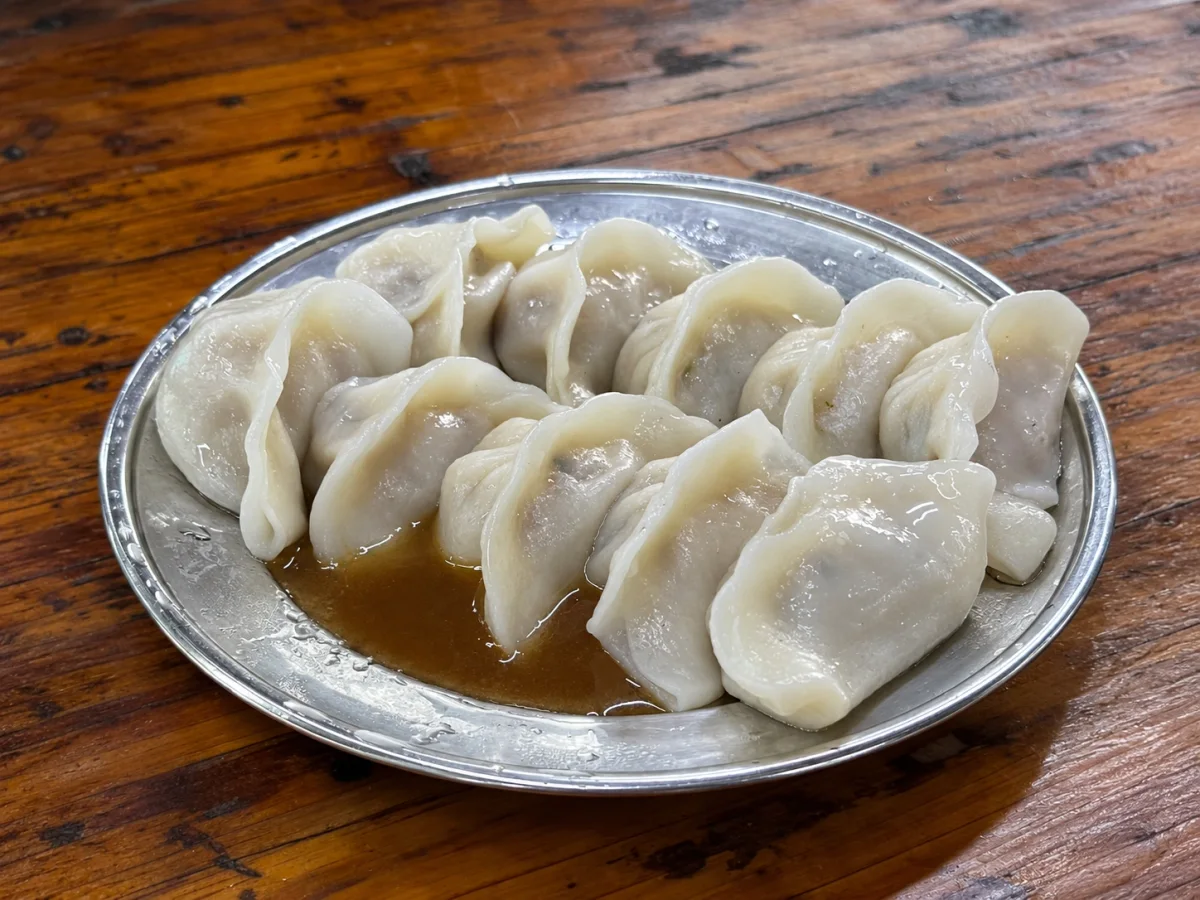
A dozen plump dumplings fanned across a steel plate, the one in our photograph, sit on an old wooden table, their wrappers white, faintly translucent and pinched into soft pleats along the top, in a pool of brown sauce.
The rice wrapper is fairly thick but soft and springy, and the water chestnut in a filling of pork and shiitake stays crunchy and fresh.
Wampee sauce, 黄皮酱, is the usual dip: sweet and sour against the mild rice and pork.
02
Rice batter, steamed and kneaded
The dough is made twice: once as a batter, once as a dough.
Making the wrapper from scratch takes hours. Rice is soaked for at least six hours, usually overnight; ordinary eating rice works, but a slightly stickier rice gives a better texture. It is ground with water into a smooth, heavy batter, then poured into a dish and steamed over high heat for about half an hour, until it sets into a solid, translucent cake.
While it is still warm the cake is turned out, dusted with starch and kneaded hard for five to ten minutes, until every grain has disappeared and the dough is smooth and silky. It is rolled into a log and cut into pieces of about 10 grams, each pressed out by hand into a thin round. No rolling pin is needed.
Shops and home cooks often take a shortcut: rice flour, a little wheat starch and cornflour, mixed with boiling water so that the starch cooks, then kneaded smooth. The more wheat starch goes in, the more translucent and chewy the wrapper; Nanning’s glassy, see-through fenjiao are made that way, while a wrapper of steamed batter is softer.
03
Pork, water chestnut and no soy sauce
The classic filling is pork and water chestnut.
The standard filling is minced pork from the front leg with chopped water chestnut, roughly seven parts pork to three of chestnut; cooks watching the cost use jicama instead, which gives the same crunch. Small amounts of ginger, soaked shiitake, wood ear and scallion go in for flavour, not bulk.
The seasoning is restrained and deliberately pale. The pork is stirred with salt until it turns sticky, then given oyster sauce, a little sugar, white pepper, a little starch and a pinch of five-spice so small that it should not be noticed. Soy sauce is left out altogether: a good fenjiao filling is not supposed to be brown.
The dumplings are pleated like jiaozi or simply folded and pressed shut, set in the steamer with space between them, steamed for about eight minutes over high heat and brushed with a little oil as they come out, so that they do not stick together or dry.
04
Wampee sauce, Nanning’s condiment
In Nanning one sauce goes on everything made of rice.
Wampee, 黄皮, is a small yellow fruit of the citrus family, grape-sized, tart and fragrant, that grows across southern China. Cooked with sugar, it becomes wampee sauce, brownish-yellow, sweet and sour. Most cooks buy it ready-made.
Nanning puts it on almost every rice snack. Rolled rice sheets, 卷筒粉, Nanning’s breakfast of thin steamed rice sheets rolled round pork, long beans or sour bamboo shoots, come doused in wampee sauce and tomato sauce with crushed peanuts on top, at 3.5 to 4 yuan a roll in 2024; in 2023 the cheapest roll at one shop was 2 yuan, with free soy milk. Fenchong, little steamed rice “worms”, and the basket noodles of Hengxian are dressed with it too. With fenjiao it goes on by the spoonful, as in our photograph.
The fruit turns up elsewhere as well, simmered in soups and in the wampee teas sold by many tea-drink chains.
05
Rice country’s dumpling
Fenjiao belong to a family of Guangxi rice foods.
Guangxi has grown rice for thousands of years, and its people turn it into dozens of foods: sticky rice, zongzi, ciba, mugwort cakes, rice cakes, rice noodles and fenjiao. In their history of Guangxi rice noodles, Lin Yexin and Gong Zheng list fenjiao among the festival foods of the Tanka, the boat people of the Yong River who came ashore at Nanning’s old Shuijie street: at every festival their families made cold zongzi, layer cakes, mugwort ciba, salty rice balls, sugar cakes, rolled rice sheets and fenjiao.
The same rice batter takes many shapes. Lin and Gong group Guangxi rice noodles by how the batter is formed: rubbed into little rolls, like Nanning’s fenchong; dripped through a perforated pot into boiling water; or spread flat in a tray and steamed, like rolled rice sheets. The idea is old: the sixth-century agricultural manual Qimin Yaoshu already describes steaming rice batter in a copper pan over boiling water. Fenjiao take the steamed batter one step further and knead it into a dough.
Today they are street food, sold at small shops and at the evening stalls of Nanning’s old streets; in 2020 one eighty-year-old Nanning woman was still selling fenjiao from a tricycle, as she had for forty years.
| Snack | How it is made | Dressed with |
|---|---|---|
| 粉饺 fenjiao | Steamed rice dough wrapped round pork | Wampee sauce |
| 卷筒粉 rolled rice sheets | Batter steamed flat, rolled round fillings | Wampee and tomato sauce, peanuts |
| 粉虫 fenchong | Dough rubbed into little rolls, steamed | Wampee or sour-plum sauce, or stir-fried |
| 簸箕粉 basket noodles | Batter steamed in a basket tray | Soy, wampee, tomato or lemon chilli sauce |
06
Fenjiao at home
The shortcut dough makes this an afternoon’s work.
For about 30 dumplings: 200 g rice flour, 50 g wheat starch, 25 g cornflour and about 250 ml boiling water; 300 g minced pork with some fat; 120 g water chestnuts, chopped; 1 soaked dried shiitake and 2 pieces wood ear, finely chopped; a little ginger and scallion, chopped; ½ teaspoon salt, 1 teaspoon oyster sauce, ½ teaspoon sugar, white pepper, 1 teaspoon cornflour and a tiny pinch of five-spice; oil; wampee sauce to serve (or a mix of plum sauce and lime juice).
- 1. Filling
Stir the pork with the salt in one direction until sticky, add the oyster sauce, sugar, pepper, cornflour and five-spice, then fold in the water chestnut, mushroom, wood ear, ginger and scallion without beating. No soy sauce.
- 2. Dough
Mix the three starches and pour in the boiling water, stirring. Cool slightly, then knead until smooth, dusting with cornflour if it sticks.
- 3. Shape
Roll into a log, cut into 10 g pieces, press each into a thin round in your palm, fill and pleat or fold shut.
- 4. Steam
Steam on an oiled plate, spaced apart, over high heat for 8 minutes. Brush with oil and serve with wampee sauce.
For the softer, whiter traditional wrapper, steam a rice batter into a cake and knead it with cornflour instead of using rice flour.
Sources [2]
07
How to eat them
Order a plate and ask for sauce.
Filling
Water chestnut and pork, 马蹄猪肉, is the classic; some shops add shiitake.
Sauce
Wampee sauce, 黄皮酱, is the usual dip; ask for more if it is not already on the plate.
With it
A rolled rice sheet or two, and soy milk.
Where
Small shops and evening stalls in Nanning’s old streets.
Eat hot
The rice wrapper dries out as it sits; eat them straight from the steamer.
08
More from Guangxi
Other pages on the atlas.
Nanning laoyou rice noodles
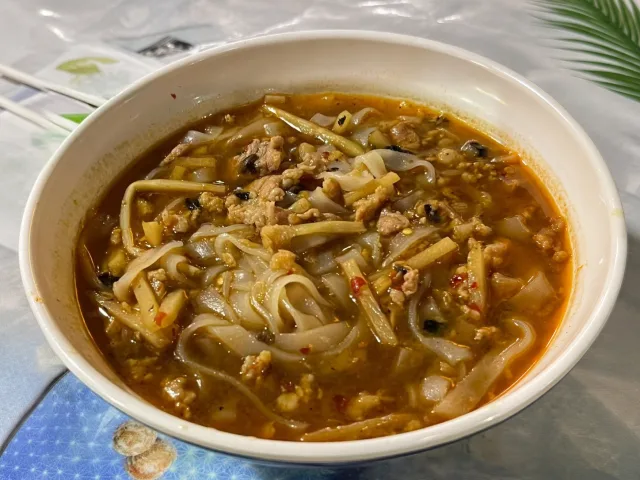
Sour bamboo shoot and chilli noodles, Nanning’s signature.
Read about laoyou noodles →Rice noodle rolls
Steamed rice sheets, Cantonese style.
Read about rice noodle rolls →Guilin rice noodles
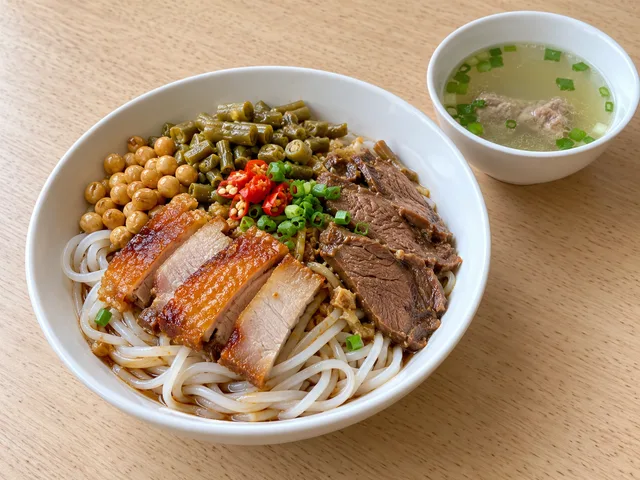
Round rice noodles with braised meat and brine.
Read about Guilin rice noodles →Guangxi food
Rice noodles, sour flavours and the cooking of many peoples.
Explore Guangxi →Guangxi classics
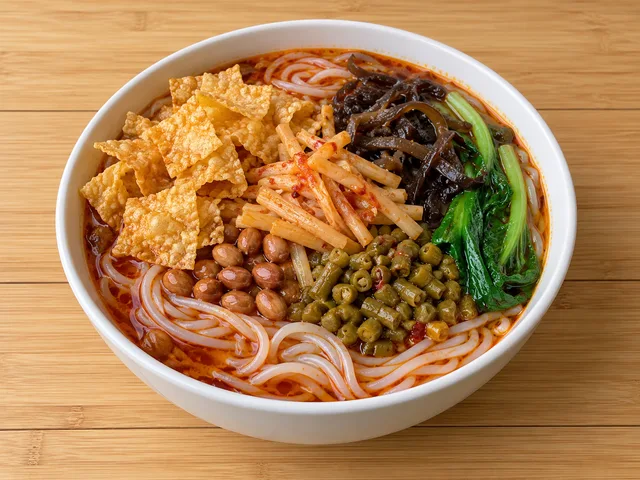
- Luosifen
Rice noodle soup · Any time, often late at night
- Guilin Rice Noodles
Tossed rice noodles · Breakfast or any meal
- Laoyou Rice Noodles
Wok-fried rice noodle soup · Breakfast, late night, when you have a cold
FAQ
Questions about Nanning Fenjiao
What are Nanning fenjiao?
Steamed dumplings with a wrapper of kneaded rice dough, filled with pork and water chestnut, eaten with wampee sauce.
Are they made of wheat?
The traditional wrapper is all rice; shop versions often add some wheat starch for translucency, so they are not reliably gluten-free.
What is wampee sauce?
A sweet-sour sauce made from wampee, a small citrus-family fruit of southern China; Nanning puts it on most rice snacks.
How are they different from crystal dumplings?
Both have see-through starch wrappers, but fenjiao are based on rice dough, softer and thicker, with a pork and water chestnut filling.
Why no soy sauce in the filling?
A fenjiao filling is meant to stay pale; the sweet-sour sauce brings the colour and tang.
When do people eat them?
As a snack at any time, including in the evening at Nanning’s food stalls.
Can I make them at home?
Yes, with rice flour, wheat starch and cornflour scalded with boiling water, which saves steaming a batter first.
Sources
Sources and further reading
- 1 Lin Yexin and Gong Zheng, Guangxi Mifen: Shejian shang de Chanmian (广西米粉:舌尖上的缠绵), chapters on Guangxi rice culture, the variety of Guangxi rice noodles and Nanning fenchong (in Chinese)Guangxi People’s Publishing House (2022), “Intangible Heritage of Guangxi” series; WeRead edition ↗
- 2 Dumplings made of rice: how to make Nanning fenjiao (video, in Chinese)Xiao Su Ya (小酥鸭), Bilibili (September 2020) ↗
- 3 A day of eating in Nanning: laoyou noodles, rolled rice sheets, fenjiao and suanye (video, in Chinese)Lizi zai Baozou (栗子在暴走), Bilibili (June 2023) ↗
- 4 Nanning’s rolled rice sheets drenched in wampee sauce, suanye and sticky rice (video, in Chinese)Ganggang Zhen Tanchi (刚刚真贪吃), Bilibili (April 2024) ↗
- 5 An 80-year-old Nanning grandmother who has sold fenjiao from a tricycle for 40 years (video, in Chinese)Xiao A Le Chibian Zhongguo (小阿乐吃遍中国), Bilibili (September 2020) ↗
Last updated November 2026