
01
A salted, pressed, lightly fermented fish
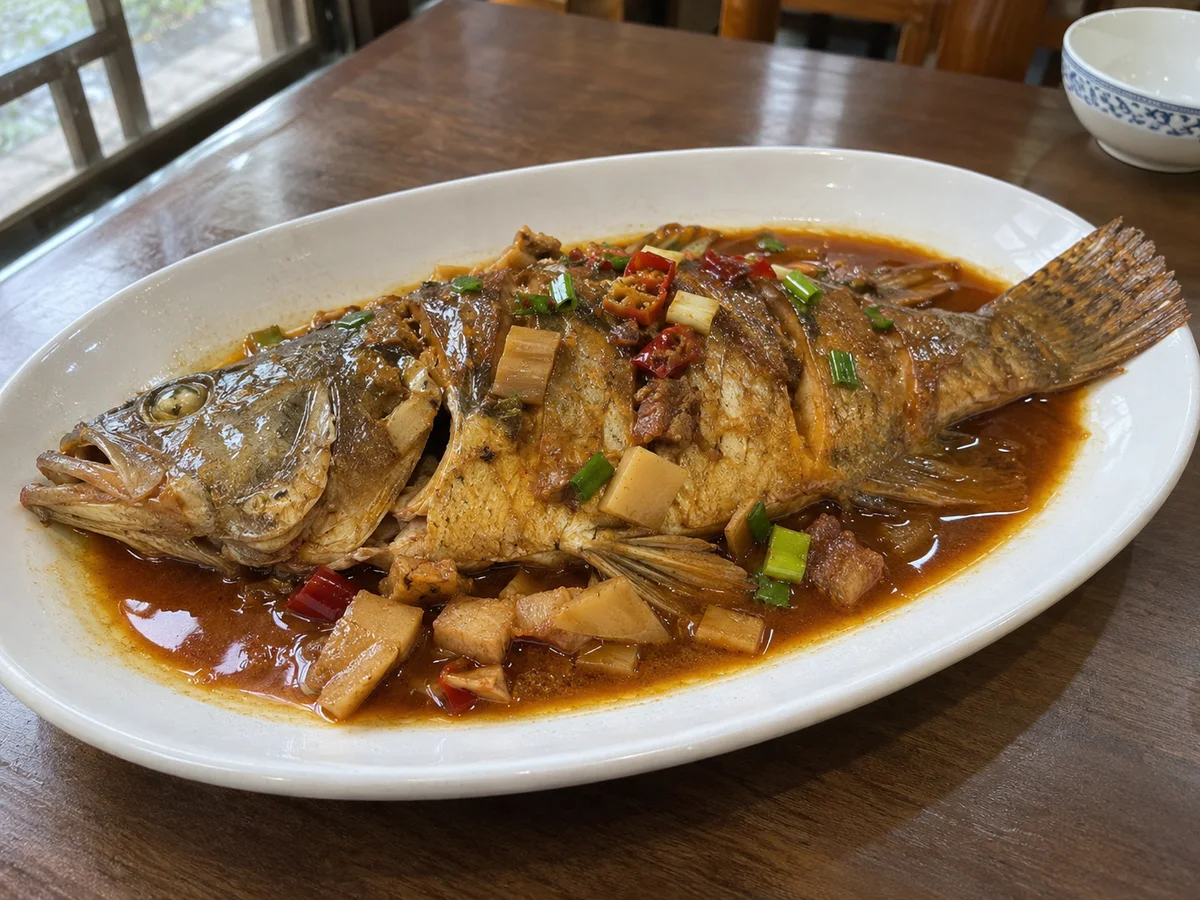
Stinky mandarin fish is a whole mandarin fish cured in light salt for several days until it ferments a little, then red-braised.
In Huizhou it goes by older names that say more about the method than the word “stinky” does: 腌鲜鳜鱼, “salted-fresh mandarin fish,” and 桶鲜鱼 or simply 桶鱼, “barrel fish.” Anhui’s official glossary of Hui cuisine, issued in 2018, lists it as red-braised stinky mandarin fish, a traditional Huizhou dish cooked with local green chilies, garlic, sliced ginger, small red chilies and cooking wine: glossy red, savory “to the bone,” its flesh firm and springy, with a special fragrance of its own. The Anhui writer Zhao Yan counts it among the Huizhou 鲜, the half-cured “fresh” foods the region is known for, and calls it the most famous of them.
The smell is real. Before cooking, a cured fish smells strongly of fermentation, closer to fermented tofu than to fish gone bad; Fuchsia Dunlop compares it to a pungent cheese. Most of that sharpness leaves in the pan, and what remains is a deep, savory fish with a faint funk and, by Zhao Yan’s account, a trace of the wooden barrel. The flesh is the other half of the appeal. Pressed and salted, it turns dense and separates into large, white, crescent-shaped flakes that cooks call 蒜瓣肉, “garlic-clove meat,” and it comes off the bone in whole pieces with a pair of chopsticks.
The dish belongs to the mountains of southern Anhui, to Huangshan city and the old Huizhou counties around it, Tunxi, She, Xiuning, Yi, Qimen and Jixi, and to Wuyuan across the border in Jiangxi, which belonged to Huizhou for most of its history. After it appeared on the documentary series A Bite of China it spread far beyond the region, and it is now the dish most Chinese diners name first when Anhui food comes up.
02
A river fish in mountain country
Huizhou is mountain country; the mandarin fish came from the Yangtze.
The mandarin fish (鳜鱼, Siniperca chuatsi), often written 桂鱼 on menus, is one of the prized river fish of the lower Yangtze. It is an ambush predator, and a life of sudden lunges gives it dense, muscular flesh with few fine bones. The Tang poet Zhang Zhihe fixed its season in a single line, “peach blossom on the flowing water, the mandarin fish are fat” (桃花流水鳜鱼肥): spring, around the Qingming festival, is when it is at its best. Elsewhere in the Yangtze delta that fish becomes something elegant, such as Suzhou’s sweet-and-sour squirrel fish. In Huizhou it became this.
The reason is geography. Old Huizhou is ringed by mountains and has no large rivers of its own, so big fish had to be bought on the Yangtze, around Anqing, Chizhou and Tongling, and carried in on foot over mountain roads, with no ice and no way to hurry. The region also had more people than its fields could feed, and the saying went that a Huizhou boy was sent out to learn a trade at thirteen or fourteen. Food that kept well on the road and in the storeroom, cured ham, dried bamboo shoots, salted vegetables and fermented tofu, runs all through Huizhou cooking, and the cured fish belongs with them.
03
Salt, a barrel and a stone
The cure is light salt, tight packing and time.
Zhao Yan records two traditional methods. In the wet cure, gutted fish are laid in layers in a wooden barrel and covered with a weak brine mixed at “a jin of water to a qian of salt,” about one percent, then weighted with stones and turned once a day: twenty days to a month in winter, five or six days in summer. In the dry cure, coarse salt is dry-fried with Sichuan pepper and rubbed over each fish and into the gills; the fish are stacked, weighted and turned daily, again for longer in winter than in summer. Either way, a fish is ready when the gills have turned red and the scales still hold fast.
Fir barrels are preferred. The stones press water out of the flesh, which is what makes it firm, and the daily turning keeps the cure even. The amount of salt is what separates this from ordinary salt fish: ten jin of salt fish take seven or eight liang of salt, a stinky mandarin fish only three or four, about half, and the excess is rinsed off. Most cooks speak of about a week, waiting for one particular smell, that of tofu turning into fermented tofu. Get the warmth or the timing wrong and the fish simply rots, which is why the old masters adjusted the cure to the weather.
Since 2018 the method has also been written down for factories. Anhui’s provincial standard for processing stinky mandarin fish, drafted by a producer in Xiuning county with the Anhui Academy of Agricultural Sciences, has live fish frozen first and thawed slowly, the fish never above 7°C, then gilled, gutted and preferably scaled. Salt at 3 to 6 percent of the fish’s weight is rubbed on evenly; the fish are stacked so tightly that no gaps remain and pressed evenly; when the brine has risen over the top layer, the top and bottom fish swap places. Fermentation runs at a steady temperature no higher than 20°C, checked and logged every day, until the fish gives off the characteristic 腌鲜 (“salted-fresh”) smell. The fish are then drained, vacuum-packed and frozen quickly, which stops the fermentation, and stored below −18°C. Today’s plants cure in rooms that hold temperature and humidity steady.
| Wet cure | Dry cure | Anhui standard (2018) | |
|---|---|---|---|
| Salt | Weak brine, “a jin of water to a qian of salt” | Coarse salt fried with Sichuan pepper, rubbed on the body and gills | 3–6% of the fish’s weight, rubbed on evenly |
| Packing | Layers in a wooden barrel, under stones | Stacked under stones | Stacked with no gaps, pressed evenly; top and bottom swapped once the brine covers the top |
| Time and temperature | 20–30 days in winter, 5–6 in summer | Longer in winter, shorter in summer | Steady temperature, no higher than 20°C, logged daily |
| Ready when | Gills red, scales intact | Gills red, scales intact | The characteristic salted-fresh smell; then vacuum-packed and frozen below −18°C |
04
Why it smells, and why it tastes good
The stink and the savor come from the same bacteria.
A light cure lets bacteria work on the fish without letting it spoil. A 2025 study in the journal Food Science followed stinky mandarin fish through a low-temperature fermentation and found three bacteria in charge: Lactobacillus sakei, a lactic acid bacterium familiar from cured sausages, and two others, Hafnia alvei and Serratia plymuthica. Of 81 volatile compounds in the fish, nine defined its character. One is trimethylamine, the sharp, ammonia-like smell of fish; others include linalool and D-limonene, which smell floral and citrusy, along with eucalyptol and several aldehydes. Hafnia and Serratia were linked both to the trimethylamine and to the pleasant aromas, which is the dish in a sentence: the bacteria that make it stink also make it fragrant.
The taste comes from protein. As the fish ferments, its protein breaks down into amino acids, among them glutamic and aspartic acid, which taste savory. Caught when the smell is only just appearing, the fish is at its most savory, which is why timing matters so much. Much of the smell is volatile and leaves in the pan, so the fish smells far stronger raw than cooked. The firm, flaking texture comes from water pressed out under the stones and from the bacteria’s work on the muscle.
05
Barrels on the mountain road: the origin stories
Every telling begins with fish carried in from the Yangtze that arrived smelling.
In the version China Daily gives, fishmongers from the Yangtze were selling mandarin fish into Huizhou about two hundred years ago, packing them in wooden buckets with salt for the long journey. When the fish arrived smelling, the sellers cleaned and cooked them rather than throw them away. Fuchsia Dunlop heard much the same story, of a fishmonger whose fish spent a week in the barrel with salt on the way home to southern Anhui. Zhao Yan’s telling names the customers: wealthy merchants who had retired to Huizhou and missed the fish of the Yangtze. Porters carried it in in wooden buckets, a layer of fish, a layer of salt, under the summer sun; three or four days later fresh fish had become stinky fish, just as those gourmets liked it, and from then on summer heat was no reason to stop the trade.
One popular story is best set aside. Many restaurants tell of a Huizhou prefect named Miao who loved fish, and of servants who salted a fish that died on the road. There was, however, no prefect of Huizhou named Miao in the Yongzheng and Qianlong reigns in which it is set. Whoever filled the first barrel, the dish grew out of a region that preserved what it could not get fresh, and treated the results as delicacies.
06
From a Huizhou dish to a 5.7-billion-yuan industry
Recognition came quickly once the dish left Huizhou.
In 2018 Anhui issued two provincial standards that both concern the dish: one for processing stinky mandarin fish and a glossary of Hui cuisine that defines the red-braised version. In 2022 the technique of making Huizhou stinky mandarin fish entered Anhui’s sixth list of provincial intangible cultural heritage, and it now has recognized bearers, among them Zhong Shaohua, a chef in Huangshan.
Huangshan has also turned the dish into an industry. The traditional process ran to more than thirty steps, from choosing the fish to curing and cooking; the city has since added local and industry standards, factory production lines and an e-commerce logistics platform. By 2023 more than 100 companies were processing nearly 55,000 tonnes a year, worth over 5 billion yuan and employing more than 30,000 people. In 2024 the figures reached nearly 60,000 tonnes and more than 5.7 billion yuan, with thirteen large firms, and Huangshan handled more than 80 percent of the province’s processing. The fish is now the city’s second farm specialty after tea, and on November 19, 2025 the first export shipment, from the Huangshan producer Huimu, landed in Singapore.
07
Red-braised, and other ways to cook it
The classic is red-braising: a hot pan, a little pork and plenty of sauce.
A cured fish of a jin (500 g) or a little more is cooked whole. It is soaked or rinsed briefly to take off the strongest salt and smell, patted dry, scored across both sides and fried in hot oil until the skin sets. Then come the aromatics: diced pork belly or salt pork, bamboo shoots, often shiitake, ginger, garlic and chilies, both the local green ones and small red ones; then soy sauce, yellow or rice wine and water. The pan is covered and the fish braised for ten minutes or so before the sauce is reduced around it. It comes to the table glossy and red-brown, scattered with green garlic or scallion and red chili, in the style that defines Hui cooking: heavy on oil, heavy on color, heavy on fire.
Restaurants now cook it many other ways: on a sizzling iron plate, in a dry pot, wrapped in lotus leaf, or in a stone pot as boneless pieces, and anywhere from sweet and mild to properly hot. Steamed stinky mandarin fish is said to exist, but it is rarely seen.
08
Hunan’s faster, stinkier version
Many diners outside Anhui first meet the dish in a Hunan restaurant.
Hunan cooks took the dish up relatively recently. Hunan recipe books of the 1980s and 1990s used mandarin fish in many dishes but had no stinky version, while Hui cookbooks always carried their salted-fresh mandarin fish. The Hunan method borrows its smell rather than growing it: the fish is cured quickly in the brine used for Hunan stinky tofu, or rubbed with jarred stinky fermented bean curd. In one quick version, a fish of about 750 g is seasoned with pepper and a little MSG, smeared with four cubes of stinky tofu, about 60 g, and braised over perilla leaves with pickled chilies and fermented black beans, a shortcut to a smell that a barrel takes four or five days to produce. The Hunan dish usually smells stronger than the Huizhou original.
It is served differently too. Hunan restaurants favor a smaller fish of about 400 g, fried golden on both sides, cut in half and sizzled in a dry pot over sliced onion with small hot chilies, while the Huizhou dish is a larger whole fish braised in plenty of sauce.
| Huizhou (Hui cuisine) | Hunan style | |
|---|---|---|
| Where the smell comes from | The fish’s own fermentation under salt, over days | A quick cure in stinky-tofu brine or stinky fermented bean curd |
| Size | A whole fish of a jin (500 g) or a little more | Often about 400 g, cut in half |
| Cooking | Red-braised with pork belly, bamboo shoots and chilies; thick sauce | Dry pot over onion with small chilies, or braised over perilla |
| At the table | A gentle funk | Usually a stronger smell |
09
Eating it in Huangshan, and what it costs
Order it whole, start with the belly and keep the sauce for rice.
In Huangshan nearly every restaurant serves it, from three-table village kitchens to the riverside dining rooms of the old streets, almost always as a red-braised whole fish. In 2026 a fish cost about 98 yuan at restaurants around Huangshan’s scenic areas, and 108 yuan, red-braised or as boneless pieces in a stone pot, at a riverside restaurant on Liyang Old Street in Tunxi. It is a shared dish, ordered with a few other Huizhou staples: hairy tofu fried golden, dried bamboo shoots braised with pork, cured pork served on a chopping board (刀板香) and Jixi stir-fried sweet-potato noodles. For cooking at home, cured fish sold for 48 yuan a jin at a Huizhou market in 2024.
Start with the belly and the thick back, where the flakes are largest, and spoon the sauce over rice. People wary of strong smells usually find the cooked fish milder than they feared; the smell is at its strongest when the dish first lands.
Share it
A whole fish is meant for the table, with two or three other dishes.
Order rice
The thick, savory sauce goes over rice.
Try the rest of Huizhou
Hairy tofu and bamboo shoots braised with pork are the usual companions.
Sources [14]
10
Cooking a cured fish at home
Outside Huizhou most stinky mandarin fish is sold cured, vacuum-packed and frozen; braising one takes about half an hour.
Under Anhui’s standard, packed fish are frozen to halt the fermentation and kept below −18°C, so keep them frozen and thaw them in the refrigerator. Curing your own is possible but unforgiving: it needs a very fresh fish, light salt, firm pressure and a cool place, no warmer than 20°C. A fish that smells putrid rather than of fermented tofu, or whose flesh has turned soft and pasty, has spoiled and should be thrown away. The amounts below are a typical home version for one fish.
For one cured fish of about 500–600 g: 50 g pork belly or salt pork, 50 g bamboo shoots, 2 dried shiitake (soaked), 4 slices ginger, 4 cloves garlic, 2–3 small red chilies, 1 green chili, 2 stalks green garlic or scallion, 2 tbsp oil (or lard), 1 tbsp light soy sauce, 1 tsp dark soy sauce, 2 tbsp Shaoxing or rice wine, about 300 ml water, a pinch of sugar. Add no salt until you have tasted the sauce.
- 1. Thaw and rinse
Thaw the fish in the refrigerator, rinse it briefly and pat it completely dry. Score the thick part of both sides.
- 2. Prepare the rest
Dice the pork, bamboo shoots and mushrooms; slice the ginger and garlic; cut the chilies.
- 3. Fry the fish
Heat the oil until it shimmers, lay in the fish and leave it until the underside is set and golden before turning. Fry the second side, then push the fish aside.
- 4. Build the sauce
Fry the pork until it gives up some fat, then add the ginger, garlic, chilies, bamboo shoots and mushrooms. Add the wine, both soy sauces, the sugar and the water.
- 5. Braise
Cover and braise over medium-high heat for 10 to 12 minutes, spooning the sauce over once or twice.
- 6. Reduce and finish
Uncover and reduce until the sauce is thick and glossy, taste for salt, scatter over the green garlic or scallion and serve with rice.
11
More fish and fermented foods
Other dishes on the atlas.
Squirrel fish
The same mandarin fish in Suzhou’s showpiece sweet-and-sour form.
Read about squirrel fish →Changsha stinky tofu
Hunan’s black stinky tofu, whose brine some Hunan cooks use for their version of this fish.
Read about stinky tofu →China’s acquired tastes
Stinky tofu, luosifen, century eggs and other foods worth a second try.
Read the guide →FAQ
Questions about Stinky Mandarin Fish
Is the fish actually rotten?
No. It is a light, controlled salt cure in which bacteria break the protein down into savory compounds, as in fermented tofu or fish sauce. A fish that smells putrid or has gone soft and pasty has spoiled and is not eaten.
Does it taste as strong as it smells?
Much milder. Most of the smell is volatile and leaves during cooking; the taste is deeply savory, with a faint funk and very firm, flaky flesh.
How long is it cured?
Traditionally about a week, five or six days in summer and up to a month in winter. Factories ferment at no more than 20°C until the characteristic smell appears, then vacuum-pack and freeze the fish.
Is it Anhui food or Hunan food?
It comes from Huizhou in southern Anhui. Hunan restaurants adopted it later and make a quicker version cured with stinky-tofu brine or stinky fermented bean curd.
How do you say it?
Chòu guìyú. The character 鳜 is read guì, which is why menus often write the fish as 桂鱼.
How much does it cost?
In 2026 a whole red-braised fish cost about 98 to 108 yuan in Huangshan restaurants.
Sources
Sources and further reading
- 1 Zhao Yan, Xingzou Xin’anjiang: Hui zhi Wei (行走新安江·徽之味), chapter “Dishes” (菜味) (in Chinese)Anhui Literature and Art Publishing House (2017)
- 2 Fuchsia Dunlop, Land of Fish and Rice, Chinese edition Yu Mi Zhi Xiang (鱼米之乡): “Ingredients of the Jiangnan region” (in Chinese)CITIC Press (2021)
- 3 “Stinky mandarin fish,” in “Chinese ‘smelly food’ adventure: Stinky or sweet-smelling?”China Daily (March 22, 2021) ↗
- 4 “Fermented mandarin fish fuel billion-yuan market”Xinhua (June 21, 2025) ↗
- 5 “Huangshan city’s fermented mandarin fish goes industrial”Amazing Huangshan, CPC Huangshan Municipal Publicity Department, presented by China Daily (January 24, 2024) ↗
- 6 “Huangshan’s rural industry development thrives”Amazing Huangshan, CPC Huangshan Municipal Publicity Department, presented by China Daily (March 19, 2025) ↗
- 7 “Huizhou stinky mandarin fish reaches global tables with Singapore export”Amazing Huangshan, CPC Huangshan Municipal Publicity Department, presented by China Daily (November 20, 2025) ↗
- 8 “Is Hui cuisine just one stinky mandarin fish?” (徽菜,就靠一条臭鳜鱼?) (in Chinese)Diqiu Zhishiju (地球知识局), via The Paper (January 29, 2023) ↗
- 9 DB34/T 3222—2018, “Technical specification for processing of stinky mandarin fish” (臭鳜鱼加工技术规程) (in Chinese)Anhui Administration for Market Regulation, provincial standard (October 20, 2018) ↗
- 10 DB34/T 3255—2018, “Terminology of Anhui cuisine” (徽菜菜品 术语): “Red-braised stinky mandarin fish” (in Chinese)Anhui Administration for Market Regulation, provincial standard (December 28, 2018) ↗
- 11 Wei Yiyi, “How did a stinky mandarin fish become the face of Hui cuisine?” (一条臭鳜鱼,为什么能成为徽菜代表?) (in Chinese)Sange Liaoliren (三个料理人), via Huxiu (June 14, 2022) ↗
- 12 Zhou Yingqin et al., “Correlation between microbial community composition and characteristic flavor substances in stinky mandarin fish during low-temperature fermentation” (in Chinese)Food Science (食品科学), vol. 46, no. 4 (2025) ↗
- 13 A stinky mandarin fish graded by its smell: a quick Hunan-style version (video, in Chinese)Lao Fan Gu (老饭骨), Bilibili (July 8, 2023) ↗
- 14 Four dishes and a soup, episode 48: red-braised stinky mandarin fish with local ingredients from Huizhou Ancient Town (video, in Chinese)A Cai Meishi Diaoke (阿蔡美食雕刻), Bilibili (July 28, 2024) ↗
Last updated November 2026